10 Apps That Scaled to Millions of Users With Organic UGC (Steal Their Exact Strategies)
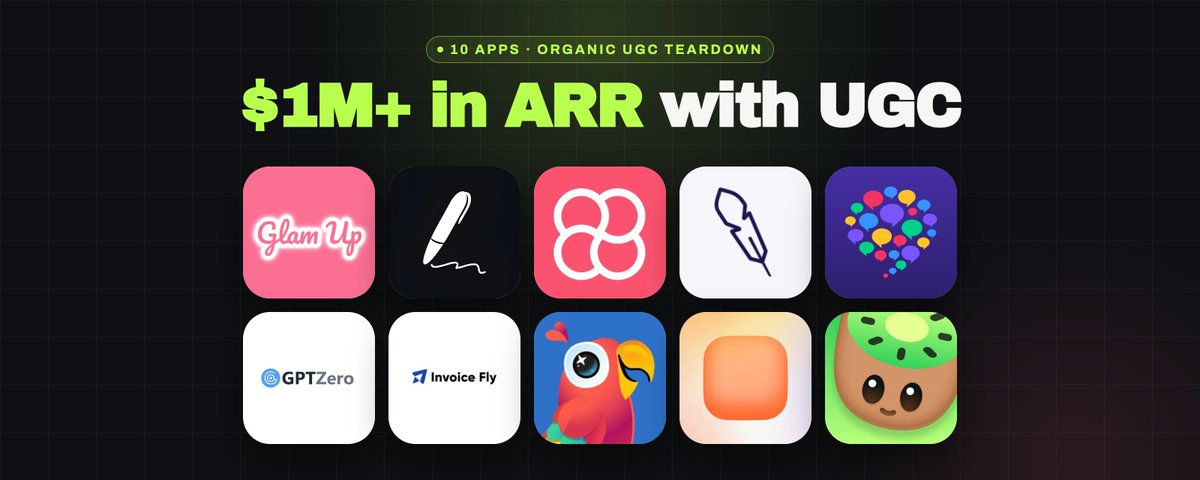
I researched founder interviews, official creator programs, and published campaign case studies to identify exactly how these apps used UGC to acquire millions users.
For each, I've broken down the results, the specific UGC strategy, why the approach worked, and how ANY app founder can replicate.
1. Glam Up: From $10 UGC videos to 1M+ users in six months

The results:
- 1M+ users in six months.
- $150K peak MRR.
- 40–50M monthly TikTok views during its peak.
- An eventual roster of 30–40 creators posting daily.
Founder Nicole Cheung initially experimented with traditional influencers and dozens of faceless beauty accounts.
Then a $10 beauty tutorial generated over 1M views in three days.
The team found its growth angle: visually satisfying beauty transformations.
After testing different approaches, Glam Up developed a repeatable format and trained creators to replicate it.
Their viral formats:
- Before-and-after transformations
Show the original appearance → reveal a dramatic transformation → connect the result to the app.
- Face-scan reveals
Upload a selfie → build anticipation → reveal the AI analysis.
- Faceless beauty tutorials
Use aesthetic beauty footage, relatable beauty problems, and screen recordings to demonstrate the app.
The team tested everything from hook placement and captions to audio and the timing of the reveal.
Once a format worked, creators reproduced variations of it.
Glam Up also implemented a referral mechanism: users could invite three friends to unlock an initial scan.
That gave organic traffic an additional sharing mechanism.
https://www.tiktok.com/t/ZP83cSxJG/
What to steal:
Find one visually satisfying transformation your app produces.
Build a format around it, test different openings, and let multiple creators reproduce the concept.
Then give viewers a reason to share or return to the product.
The lesson isn't to get 1M views once.
It's to find a format you can reproduce and connect to real user acquisition.
2. Turbo AI: 300K users before spending a dollar on ads
The results:
- 10M users by July 2026.
- $13M+ lifetime revenue.
- 300K users acquired before its first paid advertisement.
- Approximately 100M views from the founder's early content.
Turbo AI co-founder started by filming himself using the product around his college campus.
He posted three to four videos per day.
Most failed.
Then one video took off.
Instead of immediately changing the strategy, he repeated the successful approach.
Eventually, he recruited ten friends to help produce content, paying $5 per video plus bonuses for viral performance.
That small group developed into a full-time creator operation.
By July 2026, content creators were the company's largest expense.
Their core viral format: Real-life lecture demonstrations.
The creator films inside a lecture hall and demonstrates how Turbo AI turns recordings and other study materials into notes, flashcards, and quizzes.
The environment makes the problem immediately recognizable to students.
The product demonstration makes the value obvious.
https://www.tiktok.com/t/ZP83cdk52/
What to steal:
Your first creator should be someone who understands your product and its users.
That might be you.
Produce content in the exact environment where the customer experiences the problem.
For a study app, film in lecture halls.
For a fitness app, film at the gym.
For a finance app, show the financial decisions your audience actually makes.
Find what works with one creator before trying to scale it to fifty.
3. Nomadtable: Managing 60 creators and generating 44M views per month
The results:
- 1M+ downloads.
- Approximately $65K in monthly revenue.
- 44M monthly organic views.
- Approximately 60 creators, including the founder.
The founder spent months creating content himself before hiring anyone.
Once they learned which formats worked, they built a creator network that posted daily across TikTok and Instagram.
Ceators were mostly compensated using performance-based payments of approximately $1–$2 CPM.
Example viral format for Nomadtable:
The hook:
"imagine being scared of solo traveling when this literally exists."
The creator introduces the fear of traveling alone, then demonstrates how the app helps people meet other travelers.
A clickbait-heavy hostel format was also tested getting millions of views, but no installs.
The hook attracted attention, but the payoff wasn't compelling.
Nomadtable stopped relying on that approach, so they switched to target 75–80% of viewers making it past the first three seconds.
https://www.tiktok.com/t/ZP83c1XT7/
What to steal:
Don't optimize for views in isolation.
Test hooks that attract the right audience and actually deliver on the opening promise.
Track retention, engagement, installs, and conversion together.
A 300K-view video that attracts the wrong people isn't necessarily more valuable than a 30K-view video that acquires paying users.
4. Jenni AI: Over 100 creators repeating winning content formats

The reported campaign numbers:
- 100+ active creators.
- 4,164 cumulative videos.
- 236.7M lifetime views as observed in October 2025.
- 21.1M views in the preceding 30 days.
Jenni's growth strategy is built around relatable student problems.
One of its most successful content series revolves around an urgent essay deadline.
The viral format: Deadline POV
The creator realizes an essay is due at midnight that night.
They introduce Jenni AI as a way to tackle the writing process.
The situation is immediately recognizable to the target audience.
Instead of constantly inventing completely different concepts, Jenni reused the same underlying scenario with different openings, creators, and settings.
The founder has reported that its essay-deadline series accumulated hundreds of millions of views.
Jenni AI's compensation program has advertised $1 per 1,000 views, alongside affiliate commissions of up to 30%.
https://www.tiktok.com/t/ZP83cB2a4/
What to steal:
Turn a relatable customer problem into a repeatable series.
Don't abandon a winning format because you've already posted it.
Test new hooks, settings, creators, and storylines while preserving the underlying concept.
But continue developing additional formats so one exhausted idea doesn't kill your entire acquisition channel.
5. HelloTalk: A multilingual ambassador community with over 10,000 members
HelloTalk has taken a different approach.
Rather than distributing one identical content strategy to every creator, it builds content around specific languages and cultural audiences.
Its official ambassador program reports a community exceeding 10,000 members.
That is the community size, not the number of active paid creators.
Its creator program includes:
- At least one post per month.
- TikTok, Instagram, and YouTube distribution.
- Payment for approved content.
- Additional bonuses tied to views and engagement.
- Topic libraries, script frameworks, and creative feedback.
HelloTalk viral formats:
- Language tests
Challenge viewers to identify the correct word, translation, or expression.
- Pronunciation corrections
Show a common mistake and demonstrate the correct pronunciation.
- Real-world conversations
Creators share experiences talking with native speakers or learning expressions through the app.
The content teaches something before asking the viewer to consider the product.
https://www.tiktok.com/t/ZP83chN6b/
What to steal:
If your app serves multiple markets, don't simply translate an English script and expect identical performance.
Recruit creators who understand each audience's language, culture, and problems.
Give them proven format structures while allowing them to adapt the delivery.
One validated concept can produce different variations across multiple markets.
6. GPTZero: 22,300 creator posts generated 421.2M views

The reported results:
- 421.2M organic views.
- 22,300 creator posts.
- 1M+ new users.
- $53,740 campaign spending.
- Five-month campaign.
GPTZero had an interesting growth problem.
Teachers already knew about its AI detection software.
Students were a much less developed audience.
So the campaign recruited student creators and joined conversations students were already having about AI, schoolwork, and academic integrity.
The viral formats:
- Student skits
Relatable campus scenarios involving students and AI.
- AI challenges
Content built around the audience's existing interest in artificial intelligence.
- Product walkthroughs
Demonstrations showing how GPTZero checks text.
The campaign kept one consistent message while continually experimenting with how to present it.
And the sheer amount of content gave the team thousands of opportunities to test what resonated.
https://www.tiktok.com/t/ZP83c1wdS/
What to steal:
Find the conversations your ideal users are already having.
Recruit creators who naturally participate in those conversations.
Test multiple formats around one consistent product proposition.
Then use the results of each content batch to improve the next.
The goal is to turn experimentation into an operating process rather than waiting for a lucky viral post.
7. Invoice Fly: 90+ creators recruited in eight weeks
90+ creators recruited and onboarded.
200+ videos per month.
30M+ reported total views.
$1.5M company MRR.
What made the program interesting was its creator selection.
Invoice Fly didn't primarily recruit generic lifestyle creators.
It recruited contractors, electricians, landscapers, plumbers, and freelancers.
People who actually understood the product's target market.
Their winning formats:
- Day in the life
Contractor films a normal workday → completes a job → uses Invoice Fly to send an invoice.
- Money I made this week
Creator breaks down earnings → shows their invoices → naturally integrates the app.
- Small-business tips
Freelancer shares practical advice about running a business and demonstrates the invoicing process.
The product fits naturally into the storyline because these creators genuinely experience the problem.
https://www.tiktok.com/t/ZP83cYGp5/
What to steal:
Recruit creators who genuinely use or understand your product category.
Give them real situations to film instead of generic feature scripts.
And when you begin scaling creator volume, invest in the systems behind the content.
Recruitment, onboarding, strategy, QA, and reporting all need an owner.
8. Parrot: 627 founder videos became a 39-creator growth operation

The founder-reported results:
- $1.5M ARR after 11 months.
- 200K+ downloads.
- 110M+ views.
- Creator roster grew from eight to 39 people.
Parrot's founder personally created 627 videos while still working a full-time engineering job.
The first 600 videos didn't go anywhere, but the founder knew UGC would work.
Their viral content strategy:
Search TikTok for the core problem the app solves.
Filter for popular recent content.
Identify hooks that already resonate.
Adapt the underlying concept and integrate the product naturally.
One of Parrot's successful concepts positioned learning Spanish around the way a child learns a language.
It led with an interesting learning insight rather than a hard product pitch.
https://www.tiktok.com/t/ZP83cFRws/
The creator system:
Parrot developed a structured process that included creator sourcing, probation periods, performance bonuses, regular feedback, and a library of winning hooks.
Its reported creator base compensation was approximately $700–$900 per month, with performance bonuses at defined view milestones.
It also reused successful organic content through paid distribution when appropriate.
What to steal:
Create a repeatable process for finding hooks.
Give creators proven examples rather than vague instructions to make something viral.
Then coach them, measure their performance, and maintain an evolving library of concepts that actually work.
One format going viral is useful.
A team capable of repeatedly finding and reproducing successful formats is an acquisition system.
9. VibeCode: 40 creators producing 1,500+ videos per month
40 active creators.
1,500+ videos per month.
36M+ views in 2.5 months.
$20K monthly creator budget.
$0 to $1.3M company ARR over the reported period.
VibeCode initially experimented with influencer campaigns costing more than $50 CPM.
The team then tried a high-volume UGC operation with fresh creator accounts and formats to replace the unsustainable influencer campaigns.
Their winning formats:
- Build-along demonstrations
Creator starts with an app idea → enters a prompt → shows VibeCode building the application.
- Before-and-after reveals
Show the initial concept → demonstrate the process → reveal the completed app.
- Speed-building challenges
Challenge the creator to build an app quickly and document the result.
All three formats share one important characteristic:
The product's output is the content's payoff.
The viewer doesn't need a long feature explanation to understand the value.
https://www.tiktok.com/@kevinvibecode/video/7539972268164680967
What to steal:
Find the most visually impressive outcome your app produces.
Turn that outcome into entertainment.
For an AI application, the transformation might be especially compelling.
Show the starting point, the process, and the result.
Then test different use cases and hooks across multiple creators.
10. Kiwi AI: 60 active creators posting daily across three platforms
The company-reported results:
- 60 active creators across eight languages.
- 500M+ cumulative organic views.
- 1M+ app downloads attributed to creator content.
- A broader network of 100+ creators and coaches.
Kiwi AI has published its creator program publicly, giving us a look at how its operation is structured.
Each creator produced one unique short-form video per day.
That video is cross-posted to TikTok, Instagram, and YouTube.
Creators receive proven hooks, scripts, and pacing guidance.
€20 base pay per qualifying video.
Performance bonuses can increase compensation to €140 per video, depending on metrics including views, watch time, and app installs.
Their coaching system:
Creators receive weekly one-on-one calls, script feedback, and production guidance.
Kiwi also describes promoting a successful creator who accumulated more than 20M views into a coaching role.
Rather than hiring an entirely separate team of content experts, the company develops coaches from people who have already demonstrated the ability to create successful content.
https://www.tiktok.com/t/ZP83ckBxk/
What to steal:
Standardize production without stripping away creators' personalities.
Give them proven scripts, references, and weekly feedback.
Tie incentives to acquisition outcomes where possible.
And when someone consistently outperforms, consider making them responsible for helping other creators improve.
The common pattern behind these 10 campaigns
These apps have different products, budgets, creator teams, and audiences.
But several repeatable principles show up throughout their growth stories.
1. They tested before aggressively scaling
Turbo AI, Nomadtable, and Parrot all began with extensive founder-led experimentation.
They learned which hooks and formats worked before significantly expanding their creator operations.
2. They built around repeatable formats
Glam Up used beauty transformations.
Jenni AI used relatable student scenarios.
Invoice Fly used contractor stories.
VibeCode used visually satisfying app-building demonstrations.
Each connected an existing audience interest to the product's value.
3. They built production capacity
GPTZero produced 22,300 posts over five months.
VibeCode reportedly produced more than 1,500 videos monthly.
Kiwi AI operates a 60-creator team posting daily across multiple platforms.
But volume is useful only when it generates meaningful data and acquisition outcomes.
4. They developed systems around their creators
Parrot developed recruitment, training, probation, and coaching processes.
Kiwi provides weekly feedback and performance incentives.
Invoice Fly built an entire management team and documented its operations for an internal handoff.
The creators make the content.
The management system makes sustained production and experimentation possible.
5. They connected attention to acquisition
Glam Up paired content with referrals.
Turbo AI showed the product directly in the environment where students needed it.
Nomadtable rejected clickbait that generated views without meaningful engagement.
Jenni AI combined view-based creator incentives with affiliate commissions.
The business objective is acquiring customers, not collecting impressions.
Scale your app with organic UGC
If you’re trying to build this kind of creator-led growth engine for your app, that’s exactly what we do at Ki Marketing.
We’ve helped consumer apps generate 600M+ organic views, 430K+ app downloads, and managed 300+ creators across scaled UGC programs.
We handle the full stack:
→ creator sourcing
→ viral format + hook testing
→ briefing + QA
→ creator management
→ performance analysis
→ scaling winners
If you want to see what this could look like for your app, book a call with me
and we’ll break down the UGC growth system we’d build for you.
Related articles

10 UGC Hooks That Always Work (App Marketing)
your app doesn't need 100 new content ideas.

how to speedrun your consumer app to $1M+ with organic UGC
i've added $8,500,000+ ARR added to client topline revenue through end-to-end organic UGC marketing.

How to Make AI UGC Look Like Real iPhone Footage
*"realistic skin texture, visible pores around nose and cheeks, natural slight unevenness, no filter quality"*