9 mistakes that kill your AI startup before the first customer

Most AI micro-SaaS products die before anyone pays for them. Not because the idea was wrong. Not because the model was too slow or the UI too rough. They die because the builder made a sequence error early on, then spent three months compounding it. By the time they figure out what happened, the runway is gone and the motivation is thinner.
These are the exact moves that separate builders who close a customer inside sixty days from those still iterating on a product nobody asked for. Read them in order. The sequence matters. Mistakes 1-5 are the ones that actually kill the company. Six through nine accelerate a death that was already scheduled.
1. Building before validating
This is the founding error. Everything downstream of it is just consequence.
You spent three months building a tool because the idea felt tight. The use case was clear in your head. The demo looked good. Then you showed it to real people and the response was polite interest at best. You told yourself the market was not ready. The market did not reject you. You skipped the conversation that would have told you the truth before you wrote a single line of code.
Validation is not a survey. It is not a landing page with a waitlist form. It is a direct conversation with a specific person who has the problem you think you are solving, where you ask them to describe the problem in their own words, what they have already tried, and what they would pay to make it go away permanently. If you cannot find ten people willing to have that conversation, you do not have a validated problem. You have a hypothesis.
What this kills: your first three months and whatever budget you attached to them.
What to do instead: talk to twenty potential customers before you open a code editor. Not to pitch. To listen. Ask about the last time this problem cost them real time or money. If they cannot give you a specific answer, the problem is not painful enough to build around.
> The product is not the problem. The order of operations is.

2. Solving a problem people complain about but will not pay to fix
This one kills more people than the first because it feels like validation when it is not.
You find the problem. People confirm it is real. They nod along. They say things like "that would be incredibly useful" and "I would definitely try that." You felt like you validated. You did not. Pain and willingness to pay are not the same variable. They are not even on the same scale.
Pre-pay is the only honest validation. Everything else is permission you gave yourself to keep building. Ask for $49 or $99 before you have a product. If they hesitate, the conversation is over. You cannot negotiate someone into valuing a problem they have already made peace with. A credit card number is a pre-sale. Nothing else is.
That hesitation is data. It means the cost of the problem, in their own mental accounting, is lower than what you are charging. Or they have already made peace with the friction. Either way, you are not building a business. You are building a feature for someone else's roadmap.
What to do instead: run a pre-sell before you run a build. Describe the outcome, name the price, ask for money. Close manually via DM or email before you have a product. If nobody buys, you saved three months of your life.

3. Anchoring your margin to API costs before you have a single paying user
This mistake shows up early and compounds quietly until it is a structural problem.
You design the product. You run the numbers on paper. You pick a price point that looks reasonable for the market. $29 a month sounds right. Maybe $49. Then you wire the inference layer to GPT-4, route every call through the API, and realize at some point that your cost-per-active-user is eating the margin you designed the product around.
A user who runs twenty AI tasks a day through a GPT-4 pipeline can cost you $8 to $15 per month in API calls alone depending on context window size and call frequency. On a $29 plan, you have already spent somewhere between 28% and 52% of revenue before you pay for hosting, email, support, or your own time. That is before churn. That is before the users who try it for one week and cancel.
The API bill is for people who need speed. The local model is for people who need to keep the money.
You do not need GPT-4 for most of what micro-SaaS products actually do. Summarization, classification, extraction, first-draft generation, structured output: all of this runs competently on smaller models. A 7B or 13B parameter model running locally on a rented GPU that costs you $0.40 per hour changes the unit economics entirely. You stop paying per inference. You start paying for uptime, which you control.
Run this before you build anything: 1. Estimate daily active usage per user (be honest, not optimistic). 2. Price each inference call at current API rates for the model you plan to use. 3. Multiply by 30. 4. Subtract from your monthly plan price. If the remainder is below 60% of revenue, your model choice or your pricing is wrong. Fix it now. Fifty users locked into an unsustainable plan is not traction, it is a liability.

4. Treating the model choice as a competitive advantage
Claude versus GPT versus Gemini is not a moat.
Builders spend serious time on this. Forum threads, benchmark comparisons, qualitative tests across edge cases. The assumption underneath all of it is that the model is what customers are buying. It is not. Customers are buying the output. They are buying the workflow. They are buying the reduction in friction between their problem and a usable result. The model is infrastructure, not product.
Your competitor can switch models in an afternoon. If the only thing separating your product from theirs is which API endpoint you call, you do not have a product. You have a wrapper with a price tag.
The actual moat in this category comes from three places:
- The workflow wrapped around the model (how the problem is framed, structured, and delivered back to the user)
- The proprietary context that makes the output more relevant than a generic call (user history, domain-specific data, trained preferences)
- The distribution channel that your competitor has not plugged into yet
One model name changed everything for a lot of products, and that thing was never the name. It was the prompt architecture that extracted something useful from it. That is the variable worth optimizing. The API dropdown is not.
What to do instead: pick a model that is good enough for the use case and stop looking at it. Put every remaining hour into the workflow, the context layer, and the channel. Those compound. Model quality differences at the application layer are marginal past a certain threshold and every frontier model clears that threshold for most micro-SaaS use cases.

5. Starting at step five
This is the most common sequencing error and it is almost always invisible to the person making it. The sequence most people follow: build the product, add features until it feels ready, launch it somewhere, post about it, watch the numbers, wonder why the numbers are low, start talking about distribution. The product came first. Everything else is retrofitted around it.
The sequence that actually works:
- Validate the problem with real conversations
- Pre-sell before you have a product
- Close the first few customers manually, direct and personal
- Find a distribution partner or channel before you scale the build
- Productize last, once you know what the paying customer actually needs
Most people start at step five and wonder why nobody buys. validate, pre-sell, close manually, find a distribution partner, productize last. That is the order. The order is the thing.
Distribution shapes the product. Close your first three customers manually and you learn what they actually use, what they ignore, and what language they use to describe the value. You are either talking to customers before you build, or you are building a countdown.
6. Shipping a v1 with 14 features
Every feature you add before the first sale is debt you pay with every demo that goes sideways.
The instinct makes sense. You want the product to feel complete. You want the first impression to be strong. You do not want someone to try it and say "it would be useful if it also did X." So you build X before launch. And Y. And Z. Three months later you have a product with fourteen features, a demo that takes twelve minutes, and zero paying customers.
The product that closes the first sale is almost never the product you imagined. It is simpler. It does one thing well enough that the right person will pay for it immediately. One problem, one output, one price point. That is the minimum viable product in a form that can actually generate revenue.
Here is what happens when you launch with fourteen features:
- The demo becomes about feature coverage, not value
- The customer tries to evaluate all fourteen instead of feeling the impact of one
- You spend the call explaining things instead of letting the outcome speak
- The objections multiply because the surface area is larger
- The sale does not close
A tool that does one thing and does it in under thirty seconds gets bought faster than a platform that does twelve things and requires onboarding. The market is not rewarding completeness at launch. It is rewarding clarity.
The rule: if you cannot explain what the product does and who it is for in two sentences, ship less. Cut until those two sentences are obvious. Then launch.

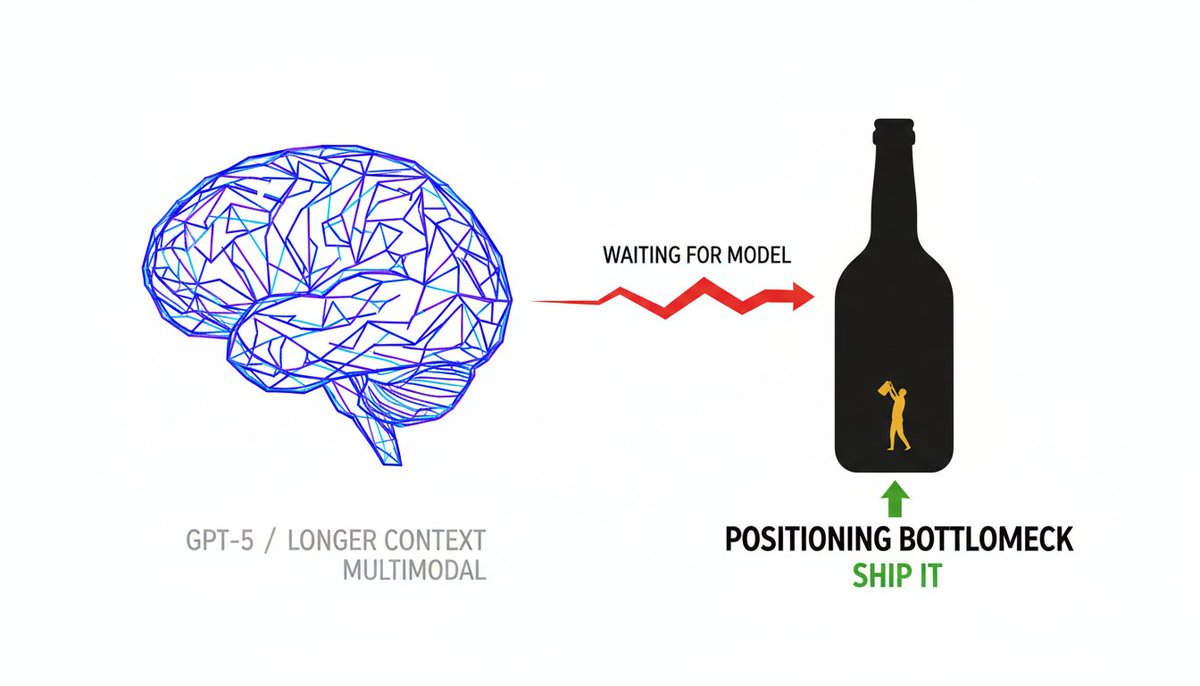
7. Waiting for the model to get better
The model is already good enough. Your positioning is the bottleneck.
"GPT-5 will handle this better." "The context window needs to be longer." "Multimodal isn't quite there yet." These sound rational. They are almost always irrelevant.
Here's what's actually happening: your product has no specific enough positioning for output quality to matter. If a prospect can't tell in sixty seconds who this is for and what they get, a better model won't save you. A well-positioned product on a two-year-old model beats a GPT-4o wrapper with vague positioning. Every time.
Waiting for the model is the tutorial loop wearing different clothes. It's research that feels like progress while the clock runs down.
The question that matters: what's the most constrained version of this problem where the current model already performs well enough for your target customer? Find that constraint. Build inside it. Ship it.
8. No specific customer
"Small businesses" is not a customer. It's a demographic category with millions of people who have nothing in common.
"Freelance designers who lose four hours a week writing client briefs" is a customer. You know where they hang out. You know what four hours costs them. You know the language they use to describe the pain. You can write a landing page that converts because every line hits something real.
The counter-argument: specificity limits your addressable market. True. Irrelevant. You're not optimizing for TAM right now. You're optimizing for your first ten customers. A specific customer gives you a channel, a message, a reason to buy. A broad one gives you nothing.
Once you have ten customers in that segment, expand intelligently. That expansion is earned, not guessed.
Test: can you name three places online where your exact customer talks about this exact problem? No? Your customer is still too broad.

9. Building a free tool to manufacture traction
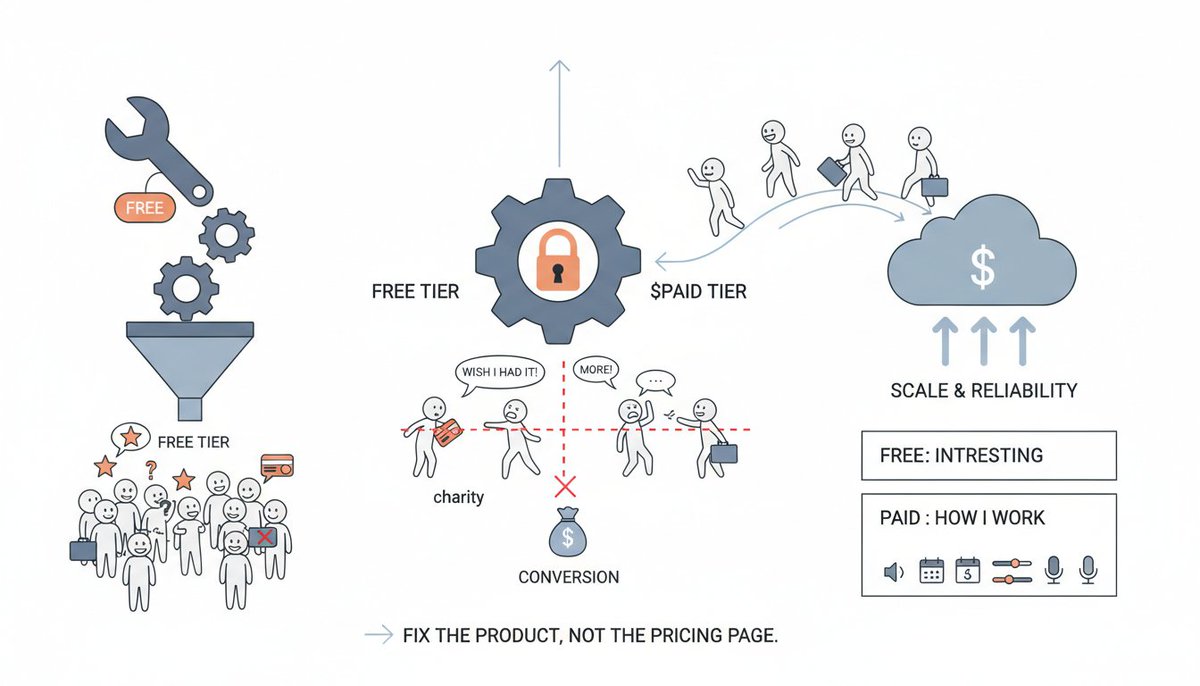
Free only works as distribution under one condition: the paid tier removes a constraint the free users are already hitting inside the free product. If that's not true, you're running a charity with a conversion funnel attached.
The logic sounds fine on paper. Ship free, get users, convert to paid. Problem: free attracts people optimizing for free. They use it to the edge of the limits, hit the paywall, leave. Not because they dislike the product. Because they came for free, and leaving is free too.
The version that works: the free tier makes the user feel the value. The paid tier removes the constraint that stops them from getting that value reliably, at scale. If your free users aren't constantly bumping into the paywall and wishing they had the paid feature, your free-to-paid architecture is broken. Fix the product. Not the pricing page.
The pattern underneath all nine
These aren't nine mistakes. They're one mistake wearing nine costumes: skipping the feedback loop that tells you whether what you're building connects to what the market will actually pay for.
Validate before you build. Pre-sell before you launch. Close manually. Find distribution before you scale. Productize last.
That's not a framework. It's the order the market rewards.
Which of these nine ended your last build? Not rhetorical. The answer tells you where to start the next one.
Related articles


34 Truths Nobody Tells You About Scaling a Consumer App
I ran marketing and day-to-day operations for Cal AI as we scaled from nothing to $50M ARR in roughly 18 months.

How to Build an AI-Native Company: Hiring, Standards, and Cadence
*We spent a year running hackathons, AI trainings, and office hours. But nothing changed until we made AI capability a requirement.*