f*cking genius youtube advice i stole from huge creators

I've been fortunate enough to get close with some of the icons of the YouTube space.
I led operations for Kwebbelkop, I've had several calls with MrBeast's own ideation team, I lead Chris Bumstead's channel, and somehow ended up talking YouTube strategy with the Dalai Lama.
The gap between creators who take off and creators who stall isn't talent. It's access to information. The top creators talk to each other. They compare notes and warn each other off what's not working.
So I wrote 10 pieces of genius advice on how the discovery algorithm and the platform behave, based on what I've picked up.
Having this information earlier would have changed my life:
1. The algorithm is working against you
The algorithm is not your friend. It doesn't work for creators. It works for viewers.
And in service of that, it displays its loyalty by guarding their time.
It's asking "how confident am I that recommending this won't waste someone's time?". It's allergic to risk.
And why shouldn't it be?
YouTube has enough content in its catalogue already to push amazing videos to viewers for years without needing any new content.
Giving a recommendation slot to a brand-new, untrusted video instead of a highly proven one is a huge cost if it's wrong, and only a tiny marginal gain if it's right. So it's built to favor the safe and familiar. Novelty only gets rewarded once it's already proven against a known audience.
And so you need to make your value proposition stunningly obvious. Why is your video better than what already exists?
Is it newer? Deeper? Or maybe entirely different?
2. You're teaching the algorithm to bury you
Every video gets shown to a small trial batch of people before the algorithm decides whether it deserves a bigger one. A flop is a data point, and it trains the system's confidence in your channel downward. That lower confidence follows the next upload out too.
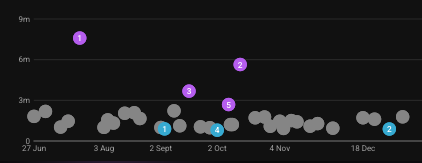
Publishing a bad idea costs more than not publishing at all. Validate it hard before it goes up.
3. Give the algorithm more data
YouTube ranks videos partly by something called "co-watch history", meaning who watched this and what else those same people watched. A common topic shot in a common format has years of that history built up already.
A rare combination of topic, format, and pacing has almost none. So its first guess about where you belong is close to a coin flip, and a coin flip looks random from the outside.
Uploading more videos with the same topic and format, consistently, is what sharpens the pattern until it stops looking random. Your content determines where you live on the platform. Your consistency determines how fast the roads leading to your house get built.
You can see this for yourself. Take a look at the "suggested panel" under each of your videos. Huge creators rarely take their eyes off this.
4. Stop limiting your reachable audience
YouTube tags the entities you mention in speech and metadata (people, brands, tools) and routes distribution partly based on how widely recognized those entities are.
Drop a niche insider's name in the first thirty seconds, even if you explain the whole concept in plain language two sentences later, and the video can get quietly flagged as "prerequisite-heavy."
The algorithm doesn't wait to see if your explanation was good. It reads the name and makes a call about who the video is for before your explanation even lands.
So sequence it. Anchor your first thirty seconds, title, and thumbnail around names people already recognize.
5. Copy the tiny channel, not the one with millions
An embedded creator with millions of subscribers gets clicks out of loyalty. Their audience shows up for almost anything they post, so their packaging looks stronger than it is.
Copy that exact format onto a brand-new channel with no built-in audience and you'll end up with a polished video that pulls a few hundred views, because the thing doing the real work, years of accumulated trust, didn't come along with the format.
The channel worth studying is the one solving your exact stage of problem, right now, in front of you. The one that went from a few thousand subscribers to a few hundred thousand in under a year. Find that channel, figure out the principle behind what they're doing rather than the surface style, and apply it to your own situation.
6. Try to make the wrong people scroll past your video
You'd think a broader thumbnail and title, one that could appeal to almost anyone scrolling by, is always the safer bet.
It isn't. A click that leads nowhere is worse than no click at all, because a click followed by an early exit tells the algorithm this video failed someone, in real time. That's a negative signal, and it costs more than a lower click-through rate ever will.
Using language and visual cues that only your actual audience recognizes filters out the wrong crowd before they click. Your click-through rate might look worse on paper. That's the filter doing exactly what it's supposed to do: a smaller audience that sticks around beats a bigger one that bounces.
7. If you're pivoting to a new audience, feed your old audience more, not less
When you're pivoting, the easy move is easing off your existing audience and letting the algorithm sort out who the new video is for.
That backfires. YouTube tests new uploads against your existing subscriber base by default, since that's the fastest, cheapest trial batch it has. If the new video wasn't built for that old audience, their lukewarm response reads as a bad signal, and it can suppress the video before your intended new audience ever gets a chance to see it. Call it the wrong-audience tax: the cost of pivoting gets charged to you by the exact people you're moving away from.
The fix is to keep feeding content your old audience already trusts, while separately going out and finding the new audience yourself, through collabs, paid reach, whatever gets cold new viewers into the pool. Don't wait for your existing base to discover the shift on its own. Seed it on purpose.
8. Waste effort on purpose
Every efficient bone in your body says trim the video down to its cheapest version: stock B-roll instead of your own footage, the first thumbnail instead of the fifth revision.
Don't. Visible effort is expensive, and because it's expensive, it's hard to fake. A viewer can't audit your research hours or count your thumbnail drafts, but they can feel the difference between something made cheaply and something made with care, before they've watched a single second. That visible effort becomes a signal of quality that arrives ahead of the content itself.
Strip out every inefficiency in the name of speed and the video gets faster to make and cheaper to watch. Everything you spend beyond food and shelter is your profit, including the flight you booked for eleven seconds of usable footage nobody will ever ask about.
9. "How I did it" beats "how to do it," almost every time
A "how-to" is a claim anyone can make. It's unanchored, a theory offered with confidence, no proof it was ever tested on a real channel.
A "how I did it" is a claim backed by evidence. It happened, to a specific person, and the result still exists and can be checked. In a market flooded with generic advice, lived experience is the one version of the claim nobody else can copy and paste.
I was splitting a bedroom for a few hundred dollars a month when I made the video that changed my channel's trajectory. That detail isn't there for color. It's the reason the advice is worth anything to someone hearing it for the first time.
10. Run one platform hard at a time
It's tempting to grow YouTube, TikTok, and X all at once, splitting your effort evenly across all three.
Don't. A flywheel needs a disproportionate push at the start to overcome its own weight. Split that push across three platforms and none of them get enough force to start spinning on their own. You end up with three slow-moving projects instead of one fast one.
Keep the other two running on autopilot (reposted, scheduled, mostly delegated) while every ounce of deliberate strategy goes toward the one platform you're actively trying to spin up. Once that one is moving on its own, point the same disproportionate push at the next.
The creators who compound aren't smarter or more talented than everyone else. They just know how the platform behaves, and most people never bother to find out.
Now you know too.
(Follow for more, and comment "AUDIT" for a free channel audit)
Related articles

How to Build a Faceless YouTube Affiliate Business From $0 - $40k in 2026
How to make money on your faceless youtube channel with affiliate before ever getting monetized

distribution 101: how to sell your products
the consensus on AI twitter right now is that BUILDING is the skill worth learning...

you called it AI slop > they called it $47,000/month
doodle style triggers "educational" signals in the algorithm = YouTube promotes it harder