GLM-5.2: The Open-Weight Model That Quietly Caught Up to GPT-5.5

Most AI releases in 2026 follow the same script: a closed model from a US lab, a big price tag, and a benchmark table you can't reproduce yourself. You read the announcement, you nod, and you go back to paying the same API bill.
GLM-5.2 breaks that script.
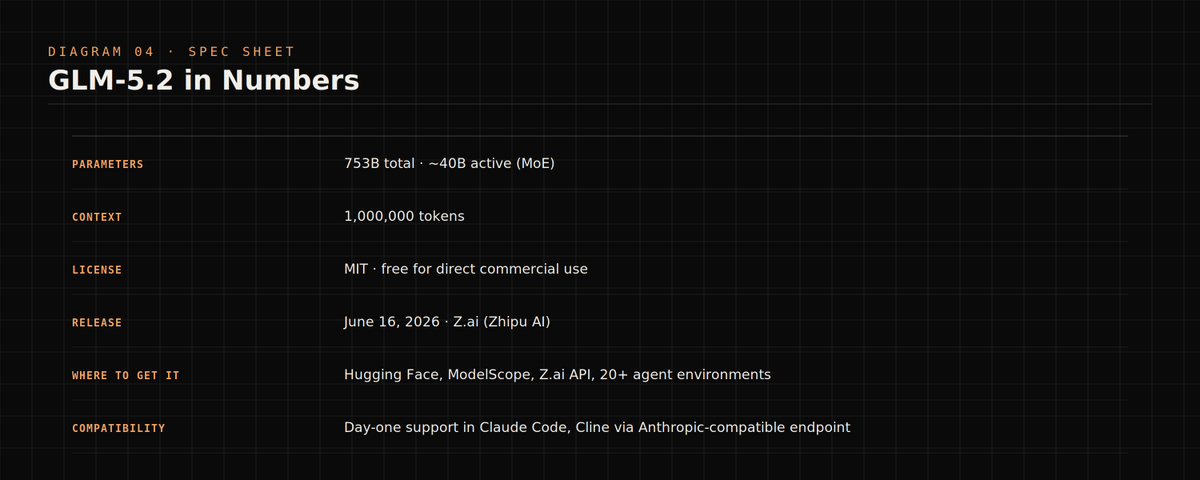
On June 16, 2026, Beijing-based Z.ai (formerly Zhipu AI, a 2019 spinoff from Tsinghua University) released a 753-billion-parameter model under the pure MIT license, with a 1-million-token context window — five times larger than its predecessor's 200K limit. Coding performance closes in tight on GPT-5.5 and Claude Opus 4.8, at a fraction of the cost. And because the weights are actually public, nobody has to take Z.ai's word for any of it.
The developer reaction was immediate. Within hours of release, the team behind Kilo Code posted on X that GLM-5.2 was already running in their tool — day one, no waiting period. That's become the real signal for whether an open-weight release matters: not the announcement, but how fast the existing agent ecosystem adopts it without being asked.

NUMBERS YOU CAN VERIFY YOURSELF
This isn't a marketing table — the weights are on Hugging Face and ModelScope, so you can run the benchmarks on your own hardware and check whether the claims hold up.
On Terminal-Bench 2.1, GLM-5.2 scores 81.0 — a major jump from GLM-5.1's 62.0, landing just a few points behind Claude Opus 4.8's 85.0 while beating Gemini 3.1 Pro outright. On SWE-bench Pro, which measures real bug fixes pulled from actual repositories rather than synthetic problems, it's 62.1 versus GPT-5.5's 58.6. On FrontierSWE it scores 74.4, again ahead of GPT-5.5's 70.0.
It's not just a coding story, either. On June 19, 2026, Design Arena put GLM-5.2 in first place on its single-round HTML web design leaderboard, with an Elo score around 1360 — beating Claude Fable 5 along with the Opus 4.6 and 4.7 generations, and a five-place jump over its own predecessor. It also placed second on Code Arena Frontend and topped the open-weight category of the Artificial Analysis Intelligence Index v4.1.
The honest caveat: on SWE-Marathon — an extreme-difficulty benchmark covering things like building compilers, optimizing kernels, and shipping production-grade services from scratch — GLM-5.2 still trails Opus 4.8 by about 13%. Across all three long-horizon benchmarks it's the best open-weight model by a clear margin, but it's the strongest open-weight model of 2026, not an outright new
WHY THIS CHANGES THE COST MATH
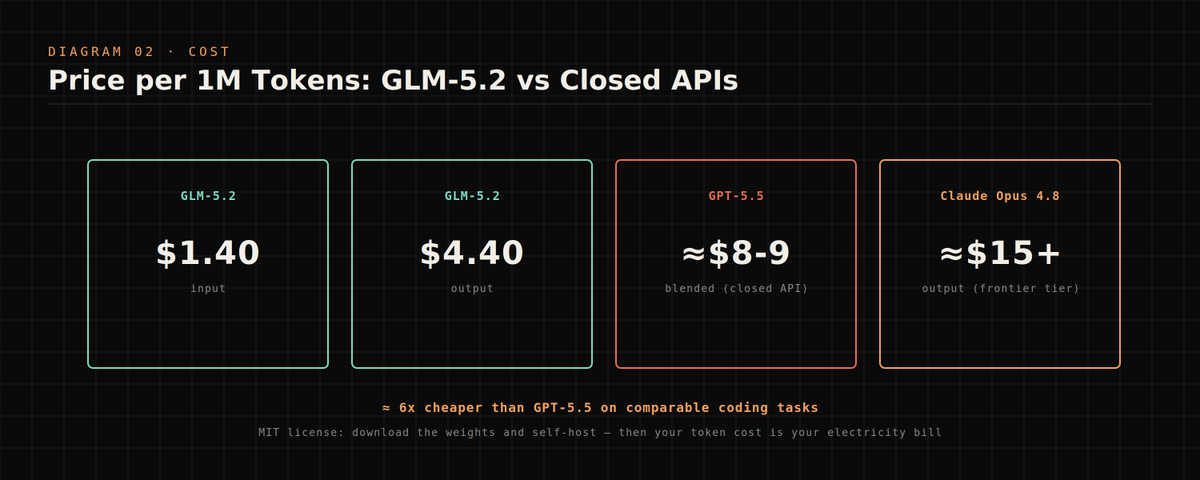
Z.ai prices GLM-5.2 at $1.40 per million input tokens and $4.40 per million output tokens through its own API — roughly one-sixth the blended cost of GPT-5.5 on comparable coding work. For teams running high-volume agentic workflows, that difference compounds fast: a workload that costs $900 a month on a closed frontier API can land closer to $150 on GLM-5.2, before any self-hosting discount.
And that's before counting the bigger advantage: the MIT license means you can download the weights and self-host on your own hardware, fine-tune them, or inspect them line by line. At that point, your cost per token is your electricity bill, not an API invoice. Z.ai says it outright in their own documentation: "no regional limits," "technical access without borders" — no usage permissions to request, no geo-restrictions, no vendor lock-in, no "acceptable use" policy standing between you and production.
For context on how seriously the market is taking this: Z.ai went public on the Hong Kong Stock Exchange on January 8, 2026 (ticker 2513.HK), raising roughly HK$4.3 billion — about $558 million — in what it billed as the world's first IPO by a large language model company. This isn't a side project; it's a company betting its public listing on open weights being the winning strategy.

WHAT'S UNDER THE HOOD
Architecturally, it's a Mixture-of-Experts model: 753 billion parameters total, but only about 40 billion activate per token — which is why inference stays reasonably fast even at this scale, and why self-hosting it doesn't require the kind of hardware you'd assume from the headline parameter count.
The key engineering piece is IndexShare: one lightweight indexer gets reused across every four sparse-attention (DSA) layers, cutting per-token compute by 2.9x at the full 1M-token context. There's also an improved MTP (multi-token prediction) layer for speculative decoding, which raises accepted-token length by up to 20% — a meaningful speed gain on long agentic runs where the model is generating thousands of tokens per task.
GLM-5.2 also ships with two selectable reasoning modes, High and Max, letting you trade latency for capability depending on whether you're doing quick edits or a genuinely hard multi-step task. Z.ai recommends Max specifically for complex coding work.
Day-one support shipped straight into Claude Code, Cline, and more than 20 other agent environments through an Anthropic-compatible endpoint, with the model also available via six third-party inference providers including DeepInfra, Fireworks, and FriendliAI. No waiting on separate integrations — it plugs into tools you're already using, the same day it launched.
WHEN TO REACH FOR GLM-5.2, AND WHEN TO KEEP CLAUDE
The practical takeaway from independent testing is that this isn't a replacement story — it's a routing story. Security firm Semgrep ran GLM-5.2 against Claude Code on IDOR vulnerability detection and found it scored 39% F1 versus Claude's 32%, at roughly $0.17 per vulnerability found — though both still trailed Semgrep's own purpose-built multimodal pipeline at 53-61% F1. That's a useful data point precisely because it's mixed: GLM-5.2 wins on this specific task, loses to a specialized tool on the same task, and the "best" answer depends entirely on what you're optimizing for.
Send to GLM-5.2: routine bug fixes, template-based refactors, frontend and HTML work (it's genuinely a leaderboard-topping choice here), tests and linting, and long agentic runs where the 1M context window matters more than squeezing out the last few points of accuracy.
Keep on Claude Opus 4.8: the hardest repo-level fixes, security-sensitive code where a missed vulnerability is expensive, SWE-Marathon-tier problems that require sustained correctness across a long build, and anything where the cost of a mistake is high enough that the token savings don't matter.
THE HONEST TAKEAWAY
GLM-5.2 is the first open-weight model in 2026 that genuinely closes the gap to frontier-level performance instead of just approaching it on a marketing slide. For everyday coding, it's already an economically sound replacement for an expensive closed API — and the fact that you can verify every claim yourself, on your own hardware, is a different kind of trust than any benchmark table can offer. For the hardest problems, frontier models still hold the edge, and escalating to them when the stakes are genuinely high remains a smart strategy, not an admission of defeat.
If this was useful, follow@BLAZT_AI I post something like this every day — no fluff, just things worth actually using.
Related articles

OpenClaw: The Personal AI Agent That Went Viral in January and Nobody Explained How to Set It Up
OpenClaw: The Personal AI Agent That Went Viral in January and Nobody Explained How to Set It Up

The $3,999 box that runs 200B parameter models locally and kills your cloud rental in 9 months
The $3,999 box that runs 200B parameter models locally and kills your cloud rental in 9 months

THE 5-STAGE PIPELINE BEHIND EVERY LLM YOU HAVE EVER USED - Full Guide
Every time you type a message to Claude, GPT, or any other large language model, you are talking to the output of a five stage pipeline that took months, sometimes years, and tens to hundreds of mill…