how memecoin insiders really make money (and how you can spot them)

a token appears, the chart starts moving almost immediately, big accounts begin posting about it, people in telegram say the community is taking over, the market cap pumps from almost nothing to millions of dollars in a few hours.
then someone checks the wallets.
wow the first buyers somehow entered before the contract was public. dozens of supposedly independent wallets were funded from the same source.
a small group controls much more of the supply than the holder page initially suggests. while everyone on social media is talking about the next 100x, those wallets are already selling.
after the collapse, the explanations are usually the same.
surprise, the team says it never sold, KOLs say they were only paid to promote it.
the community blames snipers, sometimes all of those things are technically true.
they can still be part of the same extraction.
i work inside crypto, so i’ve watched enough launches from the beginning to know how different they look before and after the narrative takes over. from the outside, a memecoin pump often looks organic. thousands of people discover the same joke, buy the same token and somehow create a market worth hundreds of millions of dollars.
on-chain, it often looks much more organized.
this article is a breakdown of what memecoin insiders actually look like, how they prepare launches, how they hide concentration across hundreds of wallets, why most people only notice after the money is gone, and what the blockchain can tell you before you become their exit liquidity.

stage one: the wrong image
when people hear the word insider, they usually imagine someone sitting inside a public company with access to confidential earnings numbers.
he finds out that revenue is about to collapse, buys or sells before the market knows, the information becomes public, everyone else reacts too late.
memecoins don’t usually work like that, the information advantage is much more primitive.
someone knows the contract address before you do.
someone knows exactly when liquidity will be added.
someone has already received tokens that were never publicly disclosed.
someone controls the wallets that look like separate early buyers.
that is what an insider usually looks like in memecoins.
a network of wallets with structural advantages before the public even sees the chart.
stage two: before the chart exists
before the ticker appears on x, someone has already chosen the name, supply, chain, contract settings, liquidity structure and launch window.
the narrative is rarely random.
it might be built around a politician, celebrity, animal, viral video, artificial intelligence trend or online joke that is already gaining attention. the goal is to choose something that requires almost no explanation. the faster people understand the meme, the faster they can buy it.
the supply is usually large enough to make the token look cheap.
people feel more comfortable buying millions of units at a fraction of a cent than buying a small fraction of an expensive asset, even though the market capitalization can be exactly the same.
then comes the part most buyers never see.
the wallets.
insiders rarely wait until launch day to start organizing them. new addresses are created in advance, often in the same time window. they receive just enough SOL, ETH or BNB to execute the planned buys. sometimes the money comes directly from the deployer. sometimes it comes through intermediary wallets. sometimes every address is funded from the same exchange or bridge so the relationship is less obvious.
individually, each wallet looks unremarkable.
a new address receives three SOL.
it buys one token, it sells later, then it becomes inactive.
but when thirty or fifty wallets behave the same way, at the same time, using similar amounts and eventually sending profits toward the same destination, the pattern changes.
It looks sus right?
on ethereum, base or bnb chain, insiders can use high gas, private relays, prebuilt transactions and MEV systems to buy as soon as the pool becomes active.
on solana, they use prefunded wallets, priority fees, bots and bundled transactions to enter immediately after liquidity is added.
sometimes they buy in the same block as the pool creation, sometimes they buy before the first public announcement.
by the time the contract address reaches your favorite public telegram group, the token may already be up several multiples.
retail thinks it found the launch early, the real early buyers are already sitting on unrealized profit.
how did these wallets know what to buy, and how did they know exactly when to buy it?

stage three: making it look organic
buying early is only useful if someone arrives later to buy at a higher price.
once insiders have accumulated enough supply, the token needs to stop looking like a contract created a few minutes ago and start looking like something the internet discovered naturally.
the first posts usually come from smaller accounts.
someone notices the ticker, someone says the community is forming, someone shares a screenshot of the chart, someone points out that the market cap is still low.
then larger accounts begin appearing.
the language is often strangely similar.
the posts don’t always need to be directly paid. some influencers receive tokens, some receive stablecoins, some are given early access, and others simply join because they can see attention forming. the result looks the same from the outside: multiple accounts begin talking about the same token within a very short period, creating the impression that everyone independently discovered it at once.
this works because people use social consensus as a shortcut.
most buyers don’t inspect the deployer.
memecoins don’t need revenue, customers or a working product. their value comes almost entirely from attention
marketing is the asset and coordinated posts create buyers.
volume plays an important role in making that transition feel legitimate.
people assume volume means demand.
sometimes it does.
sometimes the same wallets are buying and selling repeatedly to create the appearance of activity without meaningful economic change.
Chainalysis describes this as wash trading. in one of its 2025 heuristics, it looked for addresses buying and selling the same asset within twenty-five blocks, with less than a 1% difference between the amounts, and repeating the pattern at least three times.
the exact method can vary, but the objective is simple.
make the market look busier than it really is.
a token with $50,000 in visible volume looks easier to ignore than one showing several million dollars. the second one appears liquid, competitive and already validated by thousands of other traders, even when much of the activity is circular.
this is one of the reasons volume without holder growth can be so revealing.
if millions of dollars are supposedly changing hands but very few new people are entering, something may be moving repeatedly rather than spreading naturally.
the same is true when volume explodes while the price barely moves, or when the same addresses appear on both sides of the market again and again.
stage four: the distribution
once retail demand arrives, insiders don’t need to sell everything at once. doing that would destroy the price and make the operation obvious. they can distribute gradually across dozens of wallets, allowing new buyers to absorb the supply without seeing one enormous red transaction.
one wallet sells $20,000, another waits several minutes and sells $15,000, a third transfers tokens to a fresh address before selling.
others swap into SOL, ETH or USDC in smaller amounts over several hours.
the chart continues moving upward because incoming demand is still larger than the visible selling pressure.
fifty connected addresses doing the same thing can represent a major part of the token.
the strongest analyses stop treating wallets as separate people and start asking whether they behave like one economic actor.
were they funded from the same place?
did they receive similar amounts?
did they buy within the same few blocks?
did they interact with the same deployer?
did they begin selling after the same influencer post?
did the proceeds eventually consolidate?
someone buying in the first minute and later selling for profit isn’t automatically suspicious. public sniping bots exist, launch traders specialize in speed, and every market needs early risk-takers.
the pattern becomes much harder to dismiss when the buyer entered before the contract was public, received funding shortly before launch, controlled supply through several related wallets and sold while the public narrative claimed there were no insiders.
with HAWK, Bubblemaps reported that 285 wallets controlled 96% of the supply and that connected insiders or advisors sold approximately $3.3 million as the token collapsed from a reported peak $490 million in market capitalization.
with WOLF, on-chain analysts alleged that insiders controlled 82% of the supply. the token reached $42 million before losing 99% of its value within two days.
with WAP, wallets described as insiders reportedly acquired 60% of the supply at launch and sold $500,000 within twelve hours.
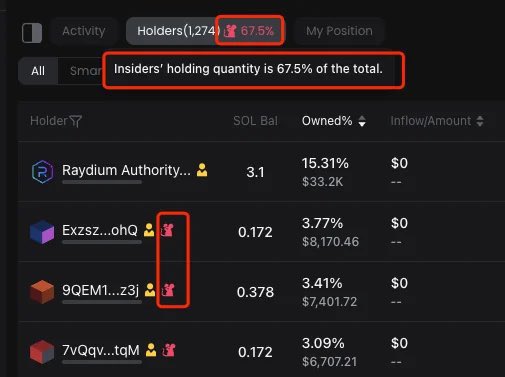
stage five: when selling isn’t enough
a liquidity pool contains two sides of a market. the memecoin sits on one side, while SOL, ETH, BNB or a stablecoin sits on the other. buyers add valuable base assets to the pool as they purchase the token.
if the person who created the pool still controls the liquidity position, they may be able to remove those assets later.
the token doesn’t need to be sold into the market.
the market can simply be taken away.
the creator adds enough initial liquidity for trading to begin, promotes the token until buyers fill the pool with valuable assets, then withdraws a large portion of that liquidity. holders are left with tokens they may technically still own but can no longer sell without catastrophic slippage.
Chainalysis tried to measure how common versions of this behavior had become in its 2025 market manipulation report.
it identified 2,063,519 tokens launched during 2024.
873,957 of them reached a decentralized exchange.
74,037 showed characteristics consistent with suspected pump-and-dump activity.
according to the report, 94% of the suspicious pools were rugged by the same actor that created the pool.
stage six: the wallets
one of the biggest mistakes people make when investigating a memecoin is starting with social media.
you should ask whether the wallets behave independently.
those are two very different questions, a healthy launch should look messy, people discover it at different times, they buy different amounts, some panic sell, others hold, some fund their wallets days before, others withdraw from exchanges minutes before buying.
the activity is chaotic because real markets are chaotic.
a wallet was created the same day as the launch, it was funded from the same source as twenty other wallets, it bought before the public announcement, it received almost exactly the same amount of capital. it sold during the first wave of influencer promotion.
imagine one hundred wallets each holding 0.4% of the supply.
individually, they don’t look alarming, together, they control 40% of the token.
stage seven: the control group
one reason i find memecoins so interesting is because they expose something that’s much bigger than crypto.
every launch gives thousands of people access to exactly the same market.
and most markets don’t reward the people who consume the most information.
they reward the people who receive the right information first, or the people who know how to recognize structural advantages before everyone else notices them.
memecoins simply make that process visible because everything happens so quickly.
a full cycle that might take years in traditional finance can happen in a single afternoon.
conclusion
i don’t think every memecoin is manipulated, i also don’t think every early buyer is an insider.
sometimes people are simply faster.
what changed my perspective was realizing how often the same patterns appear once you stop looking at the chart and start looking at the wallets.
you may not know who controls a wallet, but you can usually see when it was funded, how it behaved, who it interacted with and where the money eventually went.
that’s why i don’t think the most valuable skill in memecoins is finding the next 100x.
it’s learning how to identify who already owns it before you do.
If you liked this read, remember to follow!
StarPlatinum.
Related articles

Five Grok Agents on Pump.fun: The Memecoin Pipeline That Never Sleeps
Launch monitor. A WebSocket connection to the pump.fun API, filtering the stream of new tokens by basic metrics: age, volume on the curve, number of unique buyers, presence of metadata. Token analyze…

What Watching Fomo’s Rise Taught Me About Vector
*Reflections on product-market fit, finding a bigger market, and the future of social trading.*

Grok Bot: a real way to make a profit
Memecoins are back in style. The hype cycle came around again and everyone's chat is full of "who made money on what." So I wanted to test something: what happens if you meet that cycle not by tradin…