How to Build a $50K/Month AI Info-Business From Your Laptop in 30 Days [FULL GUIDE]
Most people think the money in AI is in building the next big model. It is not. The money is in the oldest business on the internet, wrapped in a technology that just removed the only thing that ever capped it.
Info-businesses were always the highest-margin thing a single person could run. A creator with a private community, a coach with a waitlist, a niche expert with a paid newsletter. No inventory, no shipping, no storefront. Just knowledge, packaged, sold on repeat. The catch was always the same. One human can only coach so many people, answer so many messages, write so many plans before the day runs out. The ceiling was never demand. It was the founder's own hours.
AI just deleted that ceiling. And almost nobody in your feed has connected the two facts yet.
This is the full playbook. Four weeks, laid out day by day, from zero to your first paying clients. Read to the bottom. The single filter that decides whether your niche prints money or wastes three months is at the end, and it only makes sense once you have seen the rest.
Why this is the window, and why it closes
Three things converged in the last eighteen months, and together they unlocked something that was not possible before.
One. AI got good enough to hold an expert persona. Not "chatbot good." Good enough that a person messaging it for advice on their sleep, their guitar practice, or their dog's leash training gets a genuinely useful, personalized answer, every time, at 3am.
Two. The tools to run a persona end to end went to near-zero cost. Voice, image, a landing page, payments, an automated delivery pipeline. What needed a small team and a five-figure budget in 2023 is now a weekend and under a hundred dollars a month.
Three. The buyers arrived. People now expect to pay a subscription for anything that improves their life on a schedule. Language apps, meditation apps, fitness apps. The behavior is trained. You are not teaching the market to pay. You are stepping in front of a market that already pays.
Here is the part that should be making more noise than it is. The audience for self-improvement is the most willing-to-pay audience on the internet. People who will argue over a $2 coffee will drop $40 a month, every month, on something they believe makes them better, calmer, or more skilled. That is the customer you are building for.
The math that breaks the industry

A traditional coach in almost any niche runs into the same wall. Look at the economics side by side.
Human coach, one-on-one:
  Clients they can serve at once:      ~20-40
  Hours per client per week:           2-4
  Price they must charge to survive:   $150-300/hr
  Ceiling:                             their own calendar

AI-run practice, same niche:
  Clients served at once:              unlimited
  Founder hours per client per week:   ~0
  Price to the customer:               $30-50/month
  Ceiling:                             how many people you reach
The human coach charges more per client because they have to. Their time is the product, and time is scarce. You charge less per client and still win, because your marginal cost per client is close to zero. You are not competing on being cheaper. You are competing on being infinite.
Run the numbers on a single niche.
Subscription price:                    $39/month
Clients at month 6:                    1,300
Monthly revenue:                       $50,700
Founder cost (tools + compute):        ~$400/month
Founder hours per week:                a handful, mostly marketing
That is one niche. AI removes the reason to stop at one. The same system, retooled, runs a second and a third. The founder is not the coach in any of them. The founder is the person who built the machine that coaches.
The opportunity is not "become a guru"
This is where most people misread it. They think this business means putting their own face on camera and becoming an influencer. It does not.
The play is not to be the expert. The play is to build a system that delivers expertise on a schedule, to a specific person, for a specific outcome. You are not selling your personality. You are selling a personalized result that arrives reliably, forever, without you in the room.
That reframe changes everything about what you build. You are not chasing a following. You are building a product that happens to teach.
Pick the niche: the four-part filter
Not every niche works. The ones that print money share four traits. Run every idea through all four before you touch a single tool.
1. Unregulated       -> no license required to give this information
2. High pay-intent   -> people already spend real money to get better at it
3. Recurring pain    -> the problem comes back weekly, not once
4. Objective-ish win -> the customer can feel it working
Niches that pass all four and are wide open right now:
- Instrument teaching (piano, guitar) — sensory, visual, premium tier is easy to justify
- Chess coaching — endlessly scalable, clear progress, obsessive audience
- Language practice and correction — enormous existing demand, no regulation
- Dog and pet training — viral content, works for a monthly plan, real customers
- Productivity and focus systems for solopreneurs — templates plus weekly check-ins
- Gardening and seasonal home skills — calm aesthetic, seasonal renewal built in
Niches to stay away from, because they are regulated and one wrong answer becomes a real problem:
- Medical, nutrition-with-diagnosis, or therapy
- Legal advice
- Specific financial or investment picks
- Anything where being wrong hurts someone's body or bank account
Pick from the first list. The virality is identical and the downside is not.
The four-week build
You do not need to know how to run a business to run this. You need to do four things in order. One week each.
Week 1 — Read the market
You are not guessing. You are copying what already sells.
Day 1 to 2. Go where your niche already pays. Search the exact phrases people use: "learn [thing] with me," "day in my life as a [profession]," "how I got good at [thing]." Save the 20 most-engaged examples. These are your proof the demand exists.
Day 3 to 4. Find the three most common questions in that niche. Read the comments, the Reddit threads, the reviews of existing apps and courses. Write down the pain people repeat. That repeated pain is your product.
Day 5 to 7. Study three paid competitors. Note their price, what they promise, and the one thing everyone complains they get wrong. Your opening is that complaint.
By the end of the week you have a niche, a proven pain, a price anchor, and the exact weakness you will beat.
Week 2 — Build the AI practice

This is the part that used to take a team. Now it is a weekend.
The persona. Give it a name, a voice, a way of speaking. Warm, specific, never robotic. This is the front of the business.
The engine. This is the actual product. An intake that captures the client's situation, an AI that turns it into a personalized plan, and a loop that checks in and adjusts. The plan has to feel written for that one person, because it is.
The core loop of any AI info-product:

  intake    -> capture the client's real situation
               (schedule, level, goal, constraints)

  generate  -> AI writes a plan tuned to that exact input,
               in the persona's voice, in seconds

  deliver   -> the plan lands where the client already is
               (email, Telegram, a private dashboard)

  adjust    -> every week it reads their check-in and
               rewrites the plan sharper than before
The last step is the whole business. A one-time plan is a PDF. A plan that gets better every week is a subscription people do not cancel.
Here is a starter prompt for the generate step. Swap the brackets for your niche.
You are [persona name], a [niche] coach known for [specific strength].
A client just sent this intake:
[level] / [goal] / [weekly time available] / [main obstacle] / [constraints].

Write them a one-week plan that:
- fits their exact time and level, never generic
- names the single most important thing to focus on this week
- gives 3 concrete daily actions, each under 15 minutes
- ends with one line of encouragement in your voice

Keep it warm, specific, and short. No filler. No medical or safety claims.
Week 3 — Turn on distribution
A perfect product nobody sees earns zero. Week 3 is all reach.
Day 1 to 3. Build the front door. A one-page site with the promise, three bullets on how it works, and a payment button. Framer or Carrd plus Stripe. An afternoon, not a project.
Day 4 to 7. Start posting as the persona. Short vertical clips in the format your Week 1 research showed works: the day-in-the-life, the quick win, the before-and-after. Every post ends with the same soft line pointing to the free version. You are not selling in the post. You are proving the persona is worth following, and letting the funnel do the selling.
Give people a reason to start for free. A free intake plus the first week's plan. Once the plan is genuinely good and it lands in their inbox, the upgrade to keep it going is an easy yes.
Week 4 — Take your first clients
Day 1 to 2. Open the free tier to everyone who engaged. Deliver the first plan flawlessly. This is the moment the whole thing is judged.
Day 3 to 5. Watch who comes back and asks for more. Those are your buyers. When someone asks "can it do next week too," that is the upgrade prompt, and the answer is the paid tier.
Day 6 to 7. Count. If even a handful converted to the paid plan, the machine works. Everything from here is the same motion, repeated and widened.
By the end of month one you are not rich. You have something better. Proof, a working system, and revenue that covers its own costs. That is the hard part done. Scale is just the same four weeks pointed at more people, and eventually at a second niche.
The numbers at scale
One niche, run patiently, on realistic conversion.
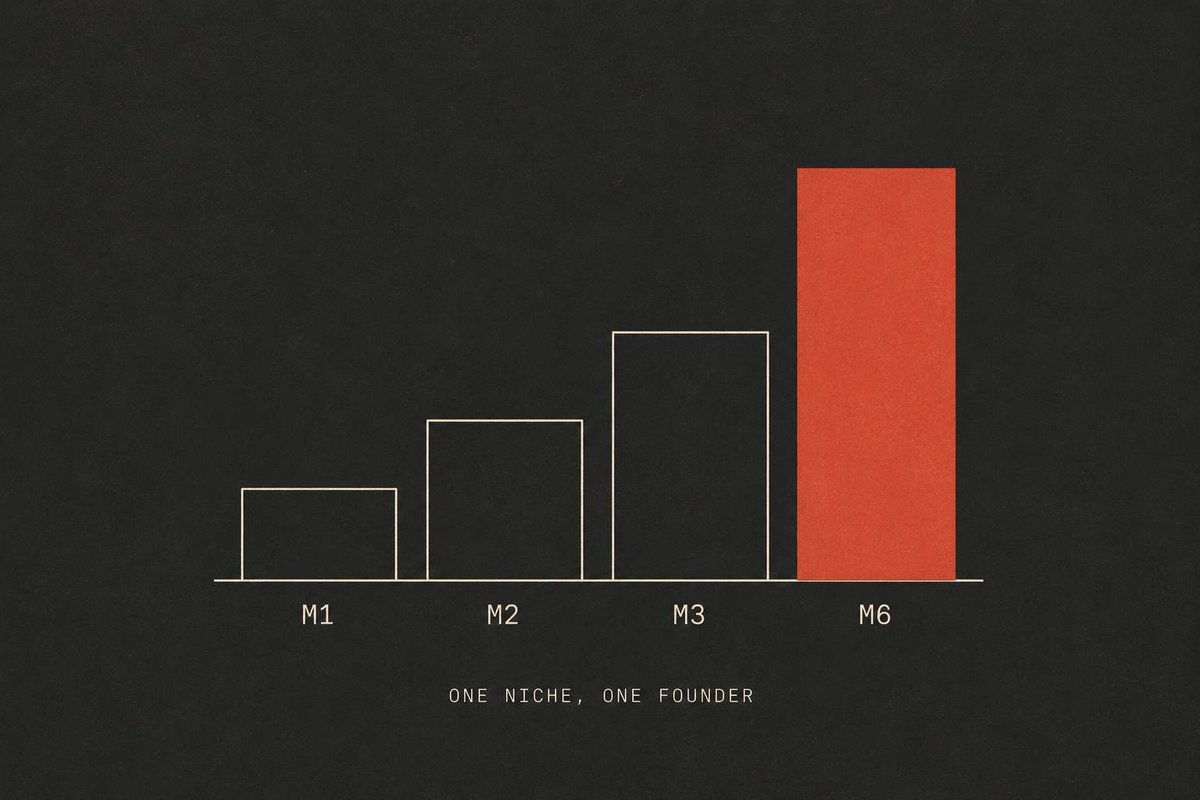
Month 1:   first paying clients, covers its costs
Month 2:   $2,000 - $5,000/month
Month 3:   $8,000 - $15,000/month
Month 6:   $30,000 - $60,000/month, one niche
Month 12:  add a second niche, same system, double the base
The founder's hours do not scale with the revenue. That is the entire point. Client number ten thousand costs you the same as client number ten.
What kills 90% of attempts
Being honest about the failure modes is what makes the rest of this credible. Here is where people blow it.
Selling the technology instead of the outcome. Nobody buys "an AI-powered coaching system." They buy "sleep through the night in two weeks" or "play your first song by Sunday." Pitch the result, never the machine behind it.
Picking a regulated niche because it looks lucrative. Health, money, and legal pay well and end careers. Stay in the safe lane. The unregulated niches are just as profitable and nobody comes after you.
Making a one-time product. If there is no reason to pay again next month, you built a course, not a business. The weekly adjustment loop is what turns a sale into a subscription.
Faking credentials or impersonating a real person. Do not attach a real doctor, athlete, or expert's name to your product to borrow trust. It is the fastest way to get exposed and it turns a business into a liability. Build the persona's authority honestly, on results.
Skipping the disclaimer. Whatever the niche, you provide information and education, not professional advice, and you say so plainly. "Results vary. This is not a substitute for a licensed professional." One line protects the whole thing.
The real insight
A technology existing and a technology being packaged for one specific buyer are two completely different things, and the entire business lives in the gap between them.
The AI is available to everyone reading this. That is not the edge. The edge is being the one person who took a proven, willing-to-pay audience, understood exactly what result they want, and built the machine that delivers it on a schedule while you sleep. The tool is commoditized. The packaging is not.
Most people will read this, nod, and keep waiting for permission that never comes. The ones who open a blank doc tonight and write down three niches from the filter will have a working product before the people who "thought about it" have finished thinking.
Here is the filter I held back, the one that only makes sense now. Before you build anything, ask one question about your niche: would someone pay to fix this problem again next month, even after you solved it this month? If yes, you have a subscription. If no, you have a one-time sale dressed up as a business, and you should pick again. Every niche on the safe list above passes this test. That is why they are on it.
Reply with the niche you are eyeing and I will tell you which monetization model fits it best and the one competitor weakness to build your whole pitch around.
Related articles

faceless pages in boring niches making ridiculous money.
the niches nobody wants to talk about because they sound too dull to be real.

How to achieve financial independence with AI
I once asked how to get rich and received a meticulous plan for saving money: max out tax-advantaged accounts, automate the transfers, buy low-fee funds, and wait. Every line was sound. Together they…

Steal My Simple Writing Exercise To Write Better Fiction Stories
Last year, I started a newsletter to document the entire process of stepping into a brand new writing vertical and growing it from $0 to $1,000,000/year.