How to Build a Claude System That Turns Missed Calls Into $4,000 Checks
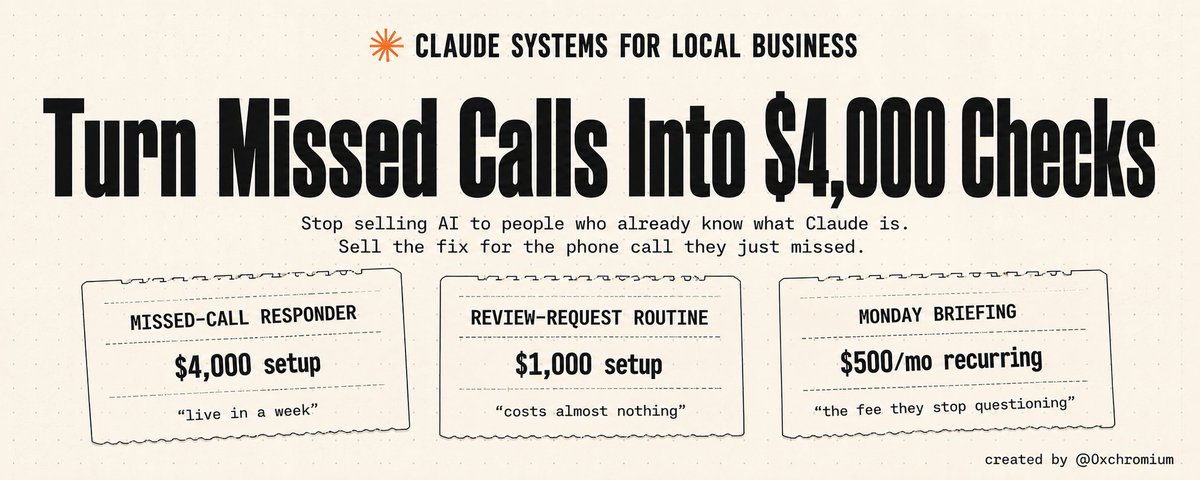
Almost everyone in AI is selling to people already in AI, prompts for founders, tools for other builders, the whole market is talking to itself
The real money is sitting offline, in the dentist down the street, the plumber, the med spa, businesses no one in AI has ever knocked on
Picture a busy dental office, the front desk is slammed, the phone rings a fourth time and goes to voicemail
That caller wanted an appointment, they hang up and dial the next office on Google, that's $600 gone in ten seconds, fifteen times a week
You're not selling that office Claude, they don't care what Claude is, you're selling their missed calls and their evenings back, with a setup they say yes to without thinking, $5,000 to build and it pays for itself the first week
This article shows you which systems to sell, how to price them, and how to build them step by step
Part 1: Why local businesses are the open lane
The founder market is picked clean, everyone selling to startups is fighting fifty other people selling the same thing
Local businesses are the opposite, they have real budgets, real cash flow, and not one vendor has ever shown up offering this, the lane is wide open because nobody in AI wants to talk to a guy who fixes HVAC
Three things make them the easiest sale you'll ever make:
- You can name their pain in one sentence, "you're losing calls you never see," and they feel it instantly because they already know it's true
- They trust a person who shows up, walk into the shop, shake a hand, and you're ahead of every faceless SaaS they ignored
- They will never build this themselves and they don't care which model runs it, they want the result, not the tool, that's the whole reason a middleman like you gets paid
You're not competing on tech, you're competing on being the only one who bothered to walk in
Part 2: The systems that sell every time
You don't need twenty products, you need a short menu of systems that solve a pain the owner already loses sleep over
Missed-call and inquiry responder
- The pain: missed calls and ignored texts are customers calling your competitor instead
- What it does: drafts an instant reply to every missed call, text, or web form, owner taps send
- Fits: dentists, salons, contractors, med spas, anyone whose phone is their lifeline
Review-request routine
- The pain: happy customers leave and never post the review that brings the next five
- What it does: after each job, drafts a personal review text with the customer's name and a link
- Fits: home services, restaurants, clinics, anyone who lives on their star rating
Monday briefing
- The pain: the owner is buried in the day-to-day and never sees the week coming
- What it does: every Monday, sends the week's jobs, follow-ups owed, and leads gone quiet
- Fits: any business with a booking calendar and repeat customers
Quote and intake drafter
- The pain: writing quotes at 9pm is why the owner never gets an evening
- What it does: turns raw job details into a ready-to-send quote in the owner's voice
- Fits: contractors, cleaners, event vendors, anyone who quotes custom work
Reactivation campaign
- The pain: a list of past customers sits dead in a phone that could be booking today
- What it does: drafts personal win-back texts to old customers with a reason to return now
- Fits: salons, dentists, gyms, any business with customers they haven't seen in months
Part 3: The three systems to lead with, and why
You can build all five, but you open with these three, they close fastest and prove your worth quickest
Missed-call responder, lead with this one
> The pain is countable in real dollars, you can stand in their office and add it up out loud, and the result is visible in two days > > The owner watches a missed call turn into a booked appointment and you're hired for life
Review-request routine, the fastest visible win
> Nothing proves value faster than the owner watching new 5-star reviews roll in the same week, reviews bring referrals, referrals bring revenue > > And it costs you almost nothing to set up, this is your easiest yes
Monday briefing, the recurring revenue anchor
> This is the one you sell as a digital manager, it shows up every week, so the owner never questions the monthly fee > > It's the piece that turns a one-time setup into income that keeps coming
Lead with the first for the dollar math, add the second for the quick win, anchor with the third for the monthly check
Part 4: The pricing that closes
Never open with your price, open with their loss
Do the math in front of them: 20 missed calls a week, each booking worth around $350, that's $7,000 a month walking straight out the door, month after month, and they've never once counted it
Then the offer lands soft: $4,000 to set the whole thing up, then $500 a month to keep it running and maintained
Now it's not an expense, it's a rounding error against what they're already losing, the setup pays for itself in the first week and the monthly fee is a tenth of what one recovered week is worth
When the price is smaller than the pain, the yes is easy, that's the whole game, you're never selling software, you're selling back money they're already losing
Part 5: The exact build, step by step
Here's the part nobody explains, so nobody has to google anything
Every system you'll ever build is the same three pieces, only the instructions change:
- The brain, Claude, it holds the instructions and writes the actual responses
- The hub, one Google Sheet, every lead, job, and customer lives here in one place
- The connector, a no-code tool like Zapier or Make, it links the phone, texts, and email to the sheet and to Claude
Learn these three once and every build below is just wiring the same parts a little differently
System A: the missed-call and inquiry responder
- Make a Google Sheet with these columns, name, number, message, time, status, reply
- Get the business a text-capable number, either their existing line through their phone provider or a fresh Twilio number
- In Zapier, set the trigger to fire on a missed call, a new inbound text, or a new website form
- That trigger adds a row to the sheet and sends the customer's message to Claude
- Paste the responder prompt into Claude, with brackets filled in for the business type, hours, and services
- Claude writes the reply, it drops into the sheet, the owner taps approve, and the connector sends it
- Test it, send a fake inquiry, watch the row appear and the draft come back
- Go live, keep the approve step on until it's proven, then let it auto-send
Here's the responder prompt:
You are the front desk for [business type] called [business name]

Our hours are [hours] and we offer [main services]

A potential customer just reached out and we missed it, here is their message: [message]

Write a short friendly text back that:
- answers their question if you can from our services and hours
- if you can't answer, tells them we'll call back within [time] and asks for the best number
- sounds like a real person at a local business, not a bot
- stays under 300 characters and adds no links unless I include one
System B: the review-request routine
- Add a tab to the same sheet with these columns, customer name, service, job done yes or no, review sent
- In Zapier, set the trigger to fire when a row is marked job done, or when a payment is marked paid
- That sends the customer name and service to Claude
- Paste the review prompt, Claude drafts a short text with the customer's name and your review link
- The owner approves, and the connector sends the text
- Test it on one real job you finished this week, check the text arrives and reads naturally
- Go live, keep the approve step on until it's proven, then let it send on its own
Here's the review prompt:
You are writing a review request text for [business name], a [business type]

We just finished [service] for a customer named [customer name]

Write a short warm text that:
- thanks them by name for their business
- asks for a quick review using this link: [review link]
- sounds personal, not automated
- stays under 300 characters
System C: the Monday briefing
This one is built differently, there's no Twilio and no messages going out to customers at all, it only reads the data and sends a summary to the owner
- Claude reads the whole Google Sheet, new leads, jobs with no follow-up, customers who haven't left a review yet, and the week's upcoming appointments
- Set a scheduled task in Claude to run every Monday at 7am
- Saste the briefing prompt, the output is who to call, what's overdue, and who to chase
- The summary goes straight to the owner by email or text
- Test it, run it once by hand and fix whatever it flags wrong
- No approve step here, it only reports and never writes to anyone outside, so there's nothing to gate
Here's the briefing prompt:
You are the Monday manager for [business name], a [business type]

Read the connected sheet for this week's data, the new leads, finished jobs, past customers, and upcoming appointments

Give me one short briefing with:
- leads from last week that never got a reply, with name and number
- finished jobs that never got a review request, with name
- past customers we haven't seen in [time] worth reaching out to
- appointments this week that still need confirming
Put the most urgent items first and keep it short enough to read in one minute
The two systems left on the menu, the quote drafter and the reactivation campaign, are built just like A and B, the same sheet, the same connector, the same brain, you just change the trigger and the instructions you hand Claude
Part 6: What runs itself, and what waits for one tap
Not every part of a system should run on its own, here's the line that keeps you and the owner safe
Runs on its own, read-only and internal:
> The Monday briefing, the lead log, sorting inbound messages, and reminders that go out only after the owner approved them once > > These just read data or act inside the business, nothing here can embarrass the owner in front of a customer
Auto-draft plus one approval, anything that leaves the building:
> The missed-call reply, the review request, the quote, the reactivation message these all reach a real customer > > So Claude drafts and the owner taps send, at least until the workflow has proven itself over real use
The reason is simple: an agent with free rein to send can misread one message and blast nonsense to the whole customer list, one bad auto-send to 500 people undoes every good thing the system did, so the approve step stays on until it has earned the right to come off
Part 7: How to land your first three clients
You don't need ads or a website, you need five doors you already walk through
- Walk into five places you're already a customer at, the barber, the dentist, the gym, the coffee shop, you're not a cold stranger, you're a regular with something useful
- Offer them a free week of the missed-call responder, no risk and no invoice, just let it run
- At the end of the week show them a screenshot of the leads the system caught that they would have lost
- Turn that proof into the paid offer, $4,000 to set it up properly and $500 a month to keep it running
- Your first three clients become your case studies, and a happy local owner tells every other owner they know, that's your referral engine
Part 8: How to turn one client into a business
One install is a favor, ten installs is a business, and the jump is smaller than it looks
- Systematize the build so every new client is the same assembly with the name swapped, same sheet, same connector, same prompts, you're not rebuilding, you're duplicating
- That's how $4,000 one-time quietly becomes $500 a month recurring, ten locations on the monthly plan is $5,000 a month that shows up whether you work that week or not
- Once a workflow has proven itself reliable, you take off the approve step and sell the autonomy as an upgrade, hands-off is a premium the owner happily pays for once they trust it
Conclusion
The AI money everyone is chasing is in the most crowded room in the world, selling to people who already know what Claude is
The open money is three blocks away, in a business that's losing $7,000 a month it can't see, run by an owner who would happily pay to make it stop and has never had anyone offer
You don't need to be technical, you need three pieces wired together and the nerve to walk in and name the pain out loud
Pick one local business you already know, add up their missed calls, and offer them the first system this week, the setup is one afternoon and the yes is easier than you think
Related articles

from $0 to $38K in 30 days with a product I could not code
a few people asked me to write the whole story. not the tweet version. the real one, with the boring parts.

How to conquer everyone with AI (FULL Course)
founders and employees using agents instead of chat are running 5 to 10 times more productive. take the middle number, 7x, and a single working day starts doing a full week's worth of output. this is…

(Free Prompt) How To Write Mind-Grabbing Story Hooks With AI
Today, I’m going to help you generate irresistible mind-grabbing hooks for those same stories by hijacking the genius of one of the most ripped-off copywriters on the internet—John Carlton.