How to Build Apps with Claude Code and Make $26,436

The exact agent setup and build sequence one person uses to ship a real product in 2 weeks, then turn it into about $4,000 in monthly recurring revenue.
Claude Code is not autocomplete. It is an agent loop that lives in your terminal. It reads your files, runs shell commands, edits code, manages git, and calls outside tools, then repeats until the task is done. By February 2026, about 4% of all public GitHub commits came from it, around 135,000 a day, and 90% of Anthropic's own code was written by AI. The skill that matters now is not typing code. It is driving the agent.
The gap between a builder who ships and one who fights the tool comes down to setup. Five layers do the heavy lifting: a CLAUDE.md file, MCP servers, skills, hooks, and subagents. Wire them once and one person ships what used to need a small team.

0. Install and pick a boring stack
Install in one line: npm install -g @anthropic-ai/claude-code, then run claude inside your project folder.
The 2026 solo stack is boring for a reason. Next.js with the App Router. Supabase for Postgres, auth, and storage, with row-level security on every table. Vercel for deploys. Stripe for billing. Resend for email. Tailwind and TypeScript in strict mode. Claude Code has seen mountains of this exact combination in training, so it guesses right far more often than on an exotic stack.
1. CLAUDE.md: the agent's memory
Run /init in the project. It scans your files and writes a first CLAUDE.md at the root. The agent loads this file on every session, so a good one means it behaves like it already knows your codebase.
Keep it lean. Put only rules that hold for every task: the stack, code style (TS strict, no any), the shape of your API responses, "run tests before you say done," "never touch src/legacy." A rule that only applies sometimes belongs in a skill, not here. Every extra line in CLAUDE.md costs you context on every single turn.
Write a short prd.md with what you are building, then tell the agent to update CLAUDE.md from it.
2. MCP: give the agent hands and eyes

Add a server with claude mcp add --transport http <name> <url>. Four matter for shipping an app:
- GitHub. Commits, branches, pull requests from inside the session.
- Postgres or Supabase. The agent reads your real schema and live data while it codes, so it stops inventing column names.
- Stripe. Billing wired without you copy-pasting docs.
- Playwright. The agent drives a real browser and checks the UI itself. You stop clicking through flows by hand after every change.
Keep the list short enough that you can explain why each server is there.
3. Plan mode: think before it writes
For anything that spans more than one file, switch to plan mode. The agent fires an Explore subagent, fast and read-only, to map the repo, returns a written plan, and waits for your approval. Then it builds. This one habit stops the agent from charging into the wrong file and rewriting half your project.
4. The build sequence, in order

This is the sequence that holds up, not the demo version:
- Scaffold. "Initialize a Next.js 15 and TypeScript project with the App Router, Supabase auth, and a database connection. Put env vars in .env.local."
- Schema and security first. "Design the PostgreSQL DDL for [feature]. Add indexes for these query patterns: [list]. Add RLS policies so a user reads only their own rows. Give me a migration file ready to run." Row-level security puts the rules in the database, where the front-end cannot bypass them.
- Auth before protected routes. Wire Supabase Auth, add the middleware, check the user's role on login, then redirect.
- One core feature, end to end. Build the single thing your product exists for. Do not start a second feature until the first one works.
- Payments last. Stripe checkout, the webhook, and plan gating once the product earns the right to charge.
- Commit after every green change. Granular history makes git bisect usable the day something breaks.
5. Skills, commands, and hooks: stop repeating yourself
- Slash commands are saved prompts as .md files. Build /lint-fix, /ship, and /pr for the steps you run daily. They take arguments and can pipeline work: scan the repo, write the change, run the tests.
- Skills are folders with a SKILL.md the agent loads when a task matches. Drop one in .claude/skills/ for your deploy checklist or a framework convention the agent keeps getting wrong. The metadata sits in context. The body loads only when needed.
- Hooks are scripts that fire on an event every time, regardless of what the model decides. Two earn their keep at once: block destructive commands on PreToolUse, and run the formatter on PostToolUse.
6. Subagents: protect the context
Context degrades as it fills. Sessions past 90 minutes drift and forget early decisions. Two defenses cover most of it: run /clear between unrelated tasks, and push noisy work into subagents.
A subagent gets a clean context window, does one job, and returns only the conclusion. Reading 40 files, comparing two libraries, reviewing a diff. The exploration never bloats your main thread. Route that exploration to a fast, cheap model like Haiku and keep your strongest model for architecture.
7. Guardrails that save your weekend
Review every line that touches auth, payments, and access rules before it ships. The agent is fast, and fast plus a leaked database ends a project.
Skip the bypass-permissions mode. It runs rm -rf-class commands without asking, and one bad call costs you a full day of recovery.
8. Deploy
Connect the GitHub repo to Vercel. Add the Supabase env vars in project settings. Every push to main deploys in under 2 minutes, with a preview build for each pull request so you test before production. Custom domain, SSL, and a global CDN configure themselves.
Proof the stack carries real weight: one solo builder shipped a marketplace with auth, payments, search, and 8 languages in 7 days on this same setup.
The money part (the easy half now)
The code stopped being the bottleneck. Price the tool at $29 to $49 a month, pick one distribution channel, and post on it for 90 days before you add a second. One focused app that ramps to roughly $4,000 MRR clears about $26,436 in its first year. The build above is the part that makes that number repeatable across your next app, and the one after that.
Spend your first hour on CLAUDE.md and MCP. The agent repays it all week.
Thanks for reading. If this saved you a weekend of fighting your own setup, follow along for the next build breakdown.
Related articles

how to scale past $100k+/mo with AI outbound funnels
the funnel behind $100k+/month in agency revenue is not complicated in concept.
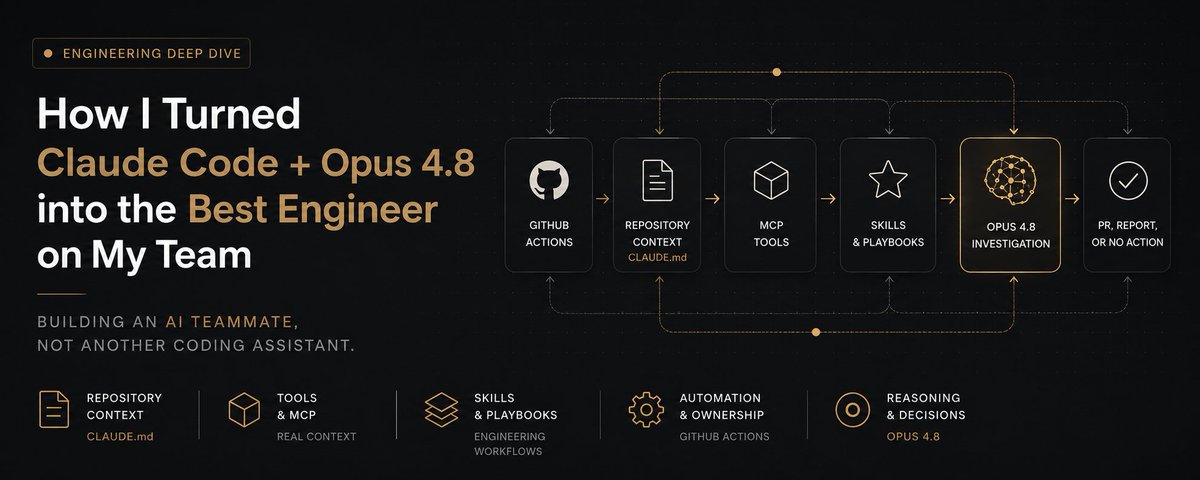
How I Turned Claude Code + Opus 4.8 into the Best Engineer on My Team
An engineering deep dive into building an AI teammate, not another coding assistant.

A 70-LINE TEXT FILE BECAME ONE OF THE TOP 50 REPOSITORIES IN GITHUB HISTORY. NO CODE. NO FRAMEWORK.
Sit with that for a second. GitHub has hosted fifteen years of frameworks, languages, and operating systems. And in 2026, a plain markdown file with four behavioral rules climbed past almost all of t…