HOW TO BUILD YOUR OWN JARVIS: A PERSONAL AI OPERATING SISTEM
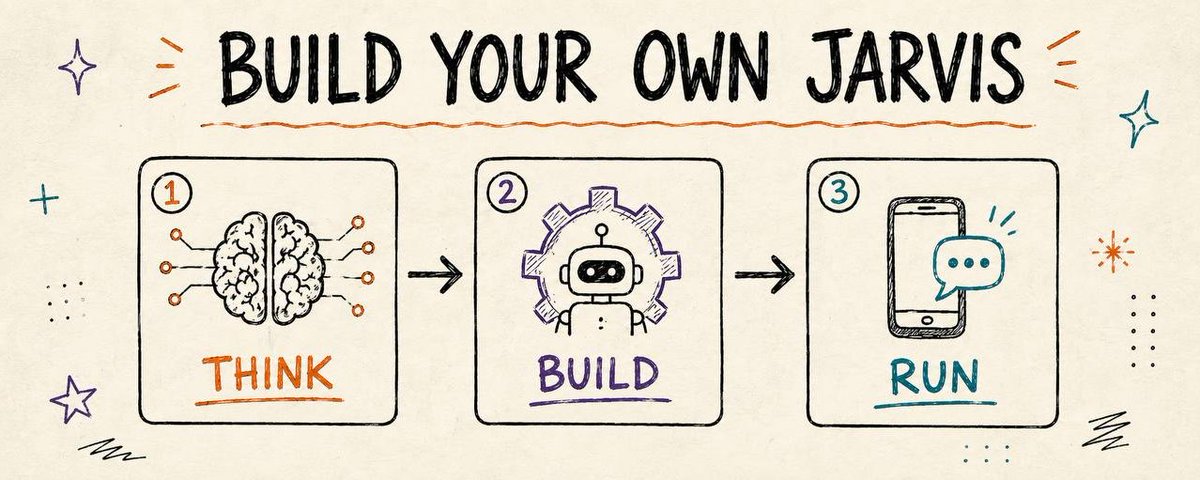
If you are still treating AI as a chatbot you go to for answers, you are leaving most of the leverage on the table. There is a different way to set this up: an AI system that does not just answer questions, but takes action across the tools you already run your business on.
The Problem: You Are the Bottleneck
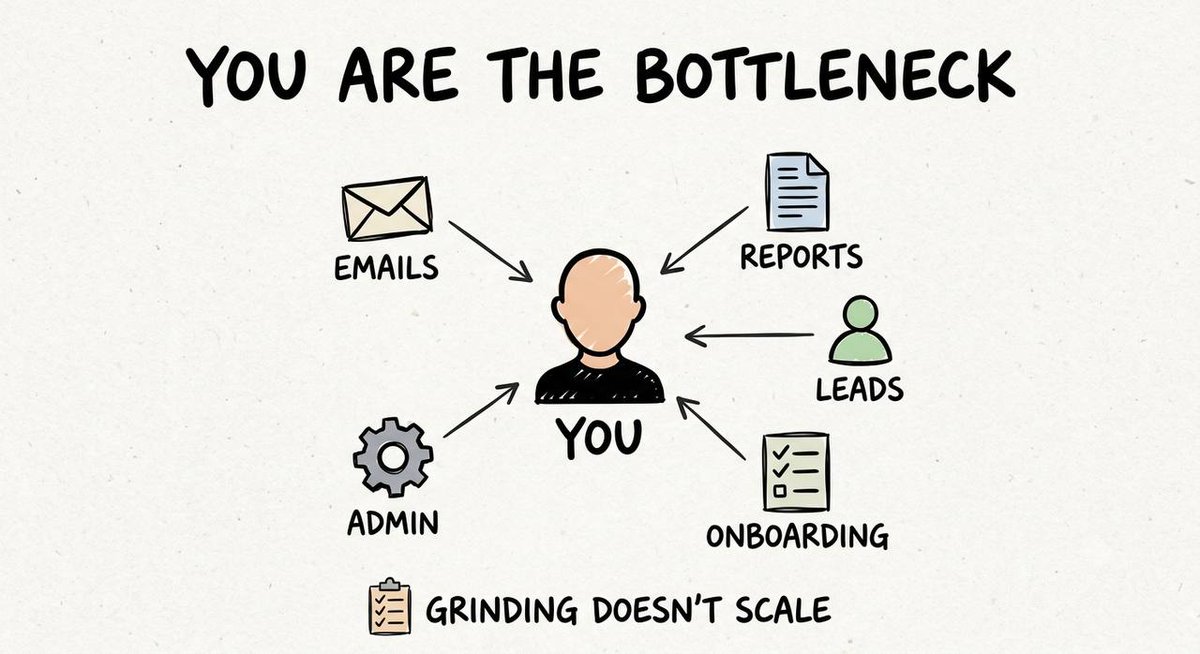
In most small businesses and solo operations, every task and every decision routes through one person. Emails, leads, content, onboarding, reports — all of it funnels back to you.
That setup breaks down fast:
-
A virtual assistant still needs managing.
-
Software still needs operating.
-
Grinding harder does not scale.
The fix is not another tool. It is removing yourself as the router.
The Principle: Not a Chatbot. An Operating System.

A chatbot answers questions. You still do the work.
An operating system takes action across your tools. It executes — you just direct it.
This is the core shift: instead of asking AI "what should I do," you set it up to actually do the task, inside the tools you already use — your CRM, your notes, your payment processor.
That only works if the system has three things:
-
It can act across your tools, not just talk about them.
-
It learns your business — real context, not a one-off prompt.
-
It is genuinely executing tasks, not producing a plausible-sounding answer.
The First Build: Start With One Workflow

Do not try to automate your entire business on day one. Pick a single high-friction workflow and start there.
The example that works well: content. Feed the system your content board and your existing data. Point it at Claude Code. Fifteen to thirty-plus hours a week that used to go into drafting content gets handed off, and first drafts are ready to post.
Once that one workflow is live — and it can be live in a single weekend — expand outward: CRM next, then reporting.
The pattern:
-
Content first.
-
Live in a weekend.
-
Then CRM and reporting.
The Stack: How It Actually Runs

Strip away the hype and the architecture is simple:
-
Claude Code runs on a cheap VPS that stays on at all times. This is the brain.
-
MCP connectors link it to the tools you already use — a CRM like GoHighLevel, Notion, Stripe, automation platforms like n8n.
-
Telegram gives you phone control. You can direct or check in on the system while on the move.
Claude Code is the brain. MCP connectors are the hands. Telegram is the remote control.
Build Yours This Weekend — No Code Required
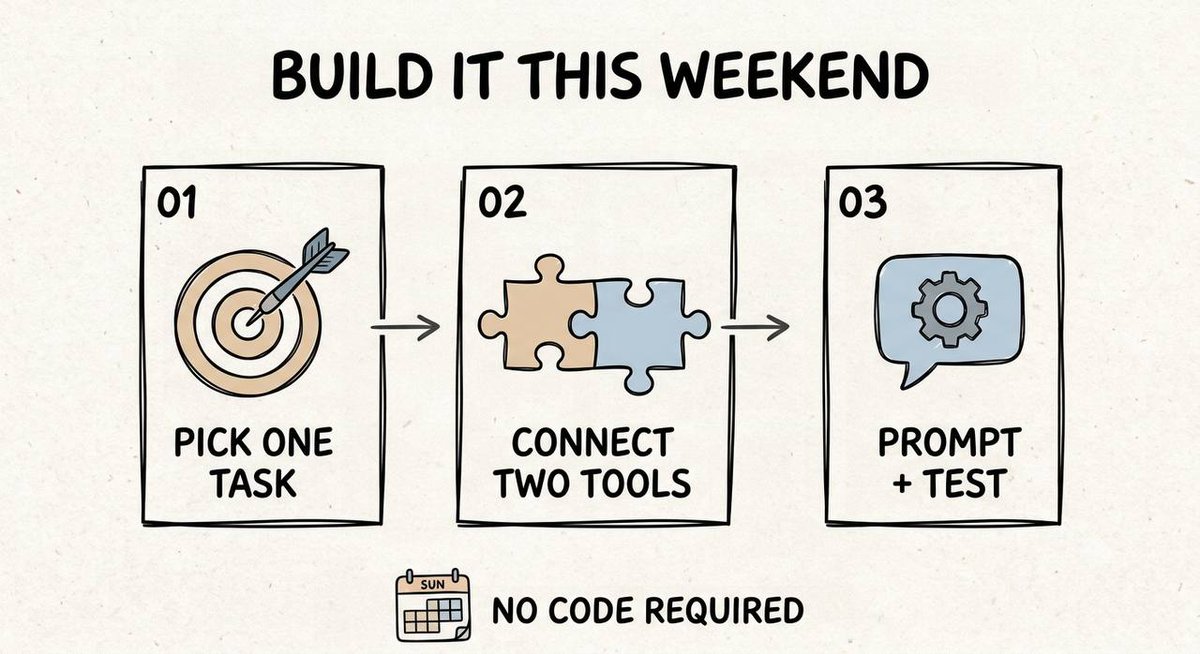
The build process compresses into three steps:
-
Pick one task. High impact, low effort. Do not start with the hardest problem in your business.
-
Connect two tools. Only the two the task actually needs — resist the urge to wire up everything at once.
-
Prompt, test, expand. Start in plain English. Test the workflow end to end. Then widen the scope.
The Real Unlock
The point is not that AI can answer your questions faster. The point is that a system built this way stops being something you consult and starts being something that runs parts of your business for you — while you're the one deciding where it points next.
Related articles

Graph Engineering replaced RAG at Microsoft, Stanford and Anthropic. Here's how it works.
Bookmark This and follow - I'm Sprytix, a developer who builds AI systems and automation pipelines that turn technology into real income. DMs open.

Stanford and Anthropic discovered a system more powerful than any AI model.
Bookmark this and follow - I'm Noryxx, an Oxford student building AI systems and automation pipelines. I share projects, experiments, and practical ways to turn technology into real value. DMs open.

MOST PEOPLE USE CLAUDE CODE LIKE A CHATBOT. IT'S ACTUALLY A FULL OPERATING SYSTEM FOR AI AGENTS.
I watched a developer build an entire project in Claude Code on stream. No slides, no theory. Just the terminal. And at some point I realized: I've been using maybe 15% of this tool for six months.