How to Earn Money with Claude AI in 2026 (Full Guide)

One regular guy quietly banked close to $10,000 from this in a matter of months, without spending a cent on ads. The whole trick: one unglamorous niche, three overlooked ways to earn with Claude AI, and the move that merges them into a single system. What follows is that exact playbook, laid out step by step. No hype, no rehashed ideas everyone's already tried, just three low-key methods that click together into one real business
Everything that follows is built around one example niche: travel. Stick with this niche or swap it out at the end. The point is the system itself, not the topic
Here's the system, broken down piece by piece:
Custom AI-built travel plans sold as a digital product on Etsy
A Pinterest traffic engine earning through display ads and affiliate income
A free PDF funnel that grows an email list you can sell offers to
An agency system that bundles all three under one brand
A handful of numbers explain why this model works:
Close to 87 million active buyers shop on Etsy (86.6M as of Q1 2026), meaning the audience already exists - no building it from scratch
631 million people use Pinterest monthly, and most show up already in planning mode, not just scrolling
Email delivers roughly $36 to $42 back for every $1 spent, the best ROI of any channel, and the list is an asset you own, not one you're renting
The 2026 World Cup final is set for MetLife Stadium in New Jersey on July 19, 2026: 82,500 seats and roughly 1.5 billion estimated viewers. That's a single event, in a single city
Method 1: Custom AI-generated travel plans
The demand is already validated. Search Etsy for a state or city travel itinerary and you'll find shops with thousands of sales on plain planners. That's the signal: people are already paying for this
The angle here is customization, not a generic file. Rather than one static planner, the product is a plan tailored to the buyer's exact city, dates, group size, and budget. Example: a 5-day New Jersey trip for a family of four on a $2,000 budget

Why New Jersey specifically? Because demand spikes around events. The 2026 World Cup final is landing in the New Jersey area, meaning hundreds of thousands of travelers will be searching for plans. And that's just one city. There are hundreds of events happening monthly and thousands of cities worldwide this same approach could apply to
Building the plan with Claude
This prompt gets Claude to reason like a consultant, stick to the budget, and deliver a finished file:
Two ways to deliver it
Since the output is a digital file, you've got options:
HTML turned into a shareable link. Download the HTML, drop it into Canva, and use "view public link" to get a link you can send out
PDF. Have Claude convert the same plan into a PDF, wait a few seconds, and download it
Best practice: hand the buyer both versions
Listing it and ranking it
Set up a brand-new Etsy store, fill in every field properly, and don't rush the setup. Then generate a full launch kit for each city:
Numbers and smart moves
The fee structure is forgiving. Etsy charges $0.20 to list an item (active for 4 months) plus roughly 6.5% + 3% + $0.25 per sale, landing around 10 to 11% total. A digital plan needs no printing and no shipping, so most of the price is pure margin
Lean on charm pricing. $17 or $27 tends to convert better than $20 or $30. Sell a cheap basic plan first, then upsell a premium version with extra days, a packing list, and a restaurant map
Ride events, not just cities. The 2026 World Cup final (MetLife Stadium, July 19) draws a global wave of planners, and concerts, marathons, and festivals spike demand in the same way
Illustrative math only (not a promise): 100 published cities, each selling just 2 plans a month at $17, comes out to roughly $3,400 in mostly-margin revenue. The lever here is listing count, not luck
Let Claude batch out your catalog. Don't build one city at a time:
The one rule for Method 1: stay consistent. Most shops that genuinely sell carry 100+ listings. Don't publish one city and sit back. Volume is the strategy itself


Method 2: The Pinterest traffic engine
If only one of these methods survives the year, let it be this one. It has the most direct path to a six-figure content business
The math behind the money. Travel blogs bring in steady monthly views from a high-value audience. Display ads pay roughly $6 to $20 per 1,000 views, stacked on top of affiliate income. Build up enough traffic and it compounds month after month. (These figures are illustrative and shift by niche and season.)
Level-up tip: AdSense is just the starting point. As traffic grows, work your way up the ad-network ladder for bigger payouts: Ezoic (no minimum traffic required), then Raptive (now only 25,000 monthly pageviews, down from 100,000), then Mediavine. Same traffic, larger checks
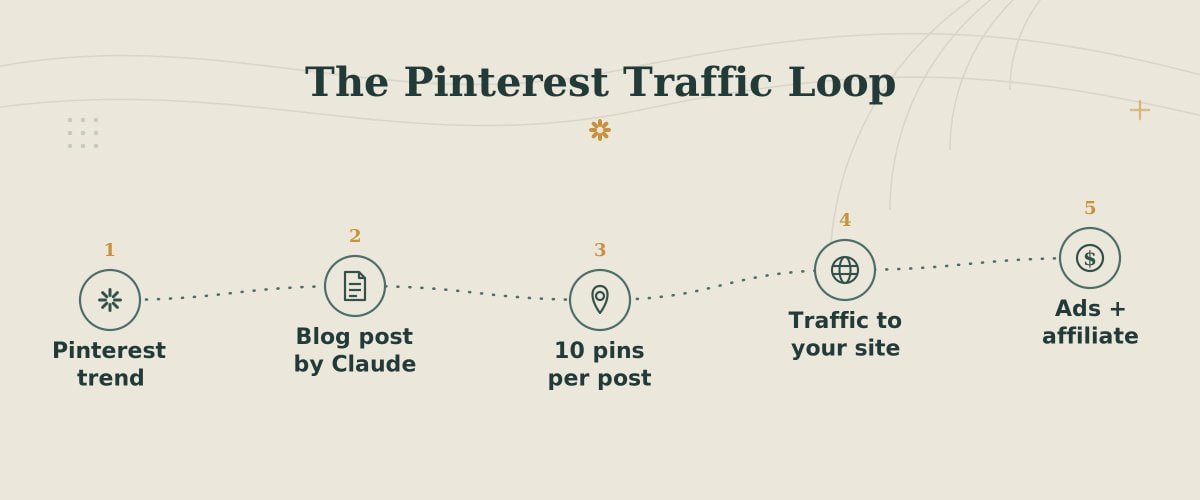
The real traffic secret is Pinterest Trends. Open Pinterest Trends, filter to your niche, and see what's trending right now. Write a blog post on that exact topic, then drive traffic to it with a batch of pins. Since the topic is already trending, your pins stand a much better shot at ranking and funneling readers to your site
A four-prompt content engine
-
Title, SEO, and outline. Paste in the trend and get back the structure. Save the SEO elements for later use.
-
The actual blog post. Turn the outline into real writing, one section at a time
-
The pin image and details. Repeat this for every pin. The image matters more than anything else.
Generate the image using any free image tool (create a few variations) or connect an image generator to Claude. Put genuine effort here: the image accounts for roughly half of why someone clicks
Pro move: Pinterest favors fresh images. Create 3 to 5 different pin designs for the same post and stagger them out over several days. One blog post can supply pins for weeks
Publishing the website
Two routes, pick one:
Free route: start on Blogger. Build up traffic first, then apply for AdSense or move over to WordPress later
Professional route: host with a provider like Hostinger (paid plans start around $3 to $5 a month on longer terms and usually throw in a free domain for the first year, while month-to-month costs more) and use a fast theme like Astra. You can have a site running within a few hours
Paste in your post, add a header image (ask Claude for the image prompt), and plug in the three SEO elements you saved earlier: focus keyword, meta description, and URL slug
Want a complete site-build guide? The domain, theme, plugins, and on-page SEO genuinely deserve their own walkthrough. If you'd like a full step-by-step "build your site from zero" guide, comment website and I'll put it together


Pinterest by itself isn't enough. Google should be ranking it too, so scatter several helpful images throughout the post. For travel content, free stock photos and AI-generated images are easy to source
Setting up Pinterest
Brand your account, then ask Claude which boards to set up (travel tips, travel planners, city guides, and so on). Upload each pin with its image and details, placing it on the matching board. Not sure which board it belongs on? Ask Claude
Rules for Method 2: never give up, because a single viral pin can change everything. Followers barely matter here, since sites pull in millions of visitors with only a handful of subscribers. Space pins roughly 10 to 20 minutes apart so it doesn't look spammy, and aim for one blog post daily
Method 3: A free PDF funnel
This is the method that most often generates those first real dollars. It's straightforward: give away something valuable for free, collect emails in return, then sell to that list again and again
Creating the lead magnet
Let Claude identify the pain point, name it, and write around it. First, the problem:
Next, the title:
A deliberately broad title like "Read This Before You Start Traveling the World" attracts many kinds of travelers at once. Now generate the actual guide, with guardrails so it never cuts off or shortchanges chapters:
Building the capture funnel
Create a Google Form with two required fields: name and email. Add a "country" field if you want to segment for targeted offers down the line
Link the form's responses to a Google Sheet so your list builds itself automatically
After sign-up, send the PDF by email. That single step confirms the address is real and active
Add a brief disclaimer in the form description noting you may send future offers. This keeps things transparent and professional
Getting traffic without ads
Most people pay for ads to run funnels like this one. It's not necessary. Active Reddit and Facebook communities within the niche (10+ posts daily) get the job done, as long as the free guide is shared the way a real person would:
Show a couple of images from the PDF to build desire. Free is free, and people rarely turn it down
Turning the list into money
Now for the payoff. The list is packed with targeted buyers. This is where the Method 1 custom travel plans come in, along with travel offers from CPA and affiliate networks, where payouts can run strong. Then let Claude handle the email copy:
Numbers and smart moves
Email remains the highest-ROI channel around, roughly $36 to $42 back per $1 spent, and unlike social followers, the list is something you own outright
Send a welcome email right away. Deliver the PDF, then use that same email to set expectations: what you'll send, how often, and one quick win. First impressions decide who bothers opening email number two
Segment by country. That optional country field lets you match the right offer to the right person down the road, which boosts conversions
Value first, pitch second. Aim for three helpful emails for every one that sells. A list that trusts the sender keeps buying for years
Rules for Method 3: never mass-spam DMs, and don't bury people under offers. One offer a week is plenty. Scale later by running ads to grow the list faster
The best part: fusing all three into one agency
Notice all three methods sit inside the same niche. That's intentional. Rather than three scattered side hustles, they package together into three services under one brand. That brand is the agency
Set it up in stages:
Name the brand using Claude, then generate a logo with any image tool
Set up short-form accounts (TikTok, Reels, Shorts) under that same brand
Add a Linktree to the bio holding three links: your website (fed by Pinterest), your Etsy listing (custom plans), and your Google Form (free PDF)
Post short travel clips in your own style to feed the whole system. One hook that works: "Three places that look unreal, and many travelers can visit without an embassy visa..." closing with "Comment your dream destination and I'll send you a custom travel plan"
Now every viewer can walk in through any of the three doors, and each door feeds traffic into the others
The last trick: swap the niche
None of this is tied to travel specifically. Take the entire model and rebuild it for any niche using one prompt:
Fitness, personal finance, parenting, pets, home decor - the structure holds up. The niche is just a variable you swap out
Common mistakes that wreck results
Publishing once and waiting around. One listing or one post isn't a real test, it's a rounding error. Volume is what creates luck
Weak pin images. The image accounts for half the click, so a poor image sinks even great writing
Skipping SEO. No focus keyword, no meta description, no alt text, and Google ignores the post entirely, leaving all your traffic dependent on Pinterest alone
Buying a domain on day one for a niche you haven't validated yet. Start free, prove the demand exists, then invest
Over-pitching your list. Ten offers in a single week torches an audience that took months to build
Setting realistic expectations
This is a genuine business model, not a lottery ticket. Results hinge on your niche, effort, traffic, offer, and market demand, and none of this is guaranteed. Volume and consistency are what actually make it work: many listings, regular posts, and steady list-building beat one perfect attempt. Always stick to the terms of service on every platform you use
Alright, time to move
This isn't three random side hustles, it's a system. The only thing left is to stop reading and start shipping: one listing, one pin, one email. Not perfect, just today. A month from now you'll look back and can't believe this ever just sat untouched in your notes
Here's the thing: AI shifts every single week, and what's printing money today can either take off or go stale by next month. I track it so you don't have to. AI news, the newest tools worth trying and tactics that actually work (money plays like these included)
Now close this tab and go build something. Your move starts with @insomnia_vip
Prompts
Using that chosen problem, write 7 lead-magnet titles that feel worth paying for but are free.
Use these angles: "read this before", number-outcome ("7 X that Y"), mistake-avoider, shortcut,
insider secret, checklist, and ultimate guide. Each under 60 characters, each promising one clear
outcome. Mark the most broadly appealing.
Act as a professional travel writer with a warm, first-hand voice (a well-traveled friend,
not a brochure or generic AI). Write the section "[SECTION NAME]" from this outline: [PASTE OUTLINE].
Constraints:
- 250 to 400 words, paragraphs of max 3 sentences, one scannable list only if it helps.
- Use the focus keyword "[FOCUS KEYWORD]" once, naturally, in the first 100 words.
- One concrete detail per paragraph: a price, a place name, a time, or a number.
- Include one honest "watch out" mistake to avoid.
- No filler openers, no repeating the heading.
End with a one-line transition into the next section.
Save the finished post to Google Docs for later.
Ten pins. Every post needs a batch of pins behind it to promote it.
You are a Pinterest copywriter who studies why travel pins go viral.
For the blog "[BLOG TITLE]" targeting [TREND KEYWORD], write 10 pin-title concepts.
- Use a different hook each time: number list, mistake-to-avoid, "nobody tells you",
seasonal urgency, budget angle, hidden gem, and save-for-later.
- Each under 100 characters, no two alike.
- For each, add the emotion it targets and one line on why it earns the click.
Rank them 1 to 10 by predicted click-through, strongest first.
Give me 30 cities with strong 2026 travel demand (events, sports, festivals).
For each: the event or reason, the best months to visit, 5 keyword ideas, and a
one-line listing hook I can use on Etsy. Return it as a numbered list I can work through.
You are an email copywriter. Write a 3-email sequence to my [NICHE] list promoting this offer:
[OFFER + LINK].
- Email 1: pure value tied to the offer's problem, mention the offer once at the end.
- Email 2: a short story or case, then the offer as the natural fix, one clear call to action.
- Email 3: a gentle deadline or bonus, one call to action, and a soft PS.
Keep each under 180 words, friendly, skimmable, and never pushy.
You are a direct-response marketer who builds lead magnets that convert cold traffic.
For the [NICHE] niche, list 7 painful, specific problems people hit right before they act.
For each: the problem in the reader's own words, the emotion under it, and why current free
advice fails them. Then pick the ONE with the widest audience and highest urgency, and defend
the choice in 2 lines.
You are a Pinterest creative director. For the pin title "[PIN TITLE]", output a publish pack:
1. Image prompt: vertical 2:3. Describe the scene, lighting, mood, color palette, and the exact
bold text overlay and where it sits. Make it stop the thumb in a busy feed.
2. Two alternate image concepts for A/B testing.
3. Pin description: 2 keyword-rich but natural sentences ending in a soft call to action.
4. 5 hashtags, broad to niche.
5. The exact board to pin it to, and why.
You are a content designer building a premium free guide.
Write a complete lead magnet titled "[TITLE]" for the [NICHE] niche with exactly 8 chapters.
Each chapter: a benefit-driven heading, exactly 200 to 250 words of genuinely useful content
(no thinner tail chapters), one actionable tip box, and one common mistake with the fix.
Also add: a cover page (title and subtitle), a one-page intro that promises the outcome, a
table of contents, and a final page with a soft call to action.
Build it as one self-contained HTML file: a clean color theme, readable typography, styled
callout boxes, and page-break-friendly sections. Close every tag and do not stop until
</html> is written. If you approach a length limit, keep every chapter at 200 words rather
than dropping any. Return only the HTML.
You are a brand strategist. Build a brand for a [NICHE] content-and-services business.
1. 10 names, each with a 4-word tagline, the vibe it signals, and a quick .com-likely or unlikely guess.
2. Shortlist the top 3 and score each on memorability, spelling on first hearing, and room to grow
beyond one product.
3. For the winner: a logo concept (icon idea, 2-color palette with hex codes, font style) and how
the handle looks across TikTok, Pinterest, and Etsy.
You are a community marketer who never sounds spammy.
Write 10 posts that give away the free guide "[PDF TITLE]" in [NICHE] groups on Reddit and Facebook.
- Each leads with value or a short story, mentions the guide naturally, and ends with: [GOOGLE FORM LINK].
- Vary the format: a personal lesson, a question to the group, a quick tip list, a "I made this,
is it useful?" ask, and a myth-buster.
- Tag each with its platform (Reddit is skeptical and detail-loving, Facebook is casual) and the
type of subreddit or group it fits.
Skip the hype words and the fake urgency. Sound like an actual community member giving something back.
You are a senior travel-planning consultant who has designed 500+ custom trips.
Build a complete [N]-day itinerary for [CITY] for [TRAVELER PROFILE, e.g. 2 adults
and 2 kids aged 6 and 9] with a hard total budget of [BUDGET] covering lodging, food,
transport, and activities. State at the top whether airfare is included.
Work in this order and show your work:
1. List 5 assumptions a pro would make (travel style, pace, dietary needs, mobility, season).
2. Shortlist 3 lodging options across budget tiers with nightly price and why each fits.
3. A day-by-day plan with morning, afternoon, and evening blocks. Each block: time, place,
realistic cost, a one-line insider tip, and a rain or sold-out backup.
4. A transport plan (airport plus getting around) with costs.
5. A budget as an HTML table that keeps the grand total at or under [BUDGET], plus a 10%
contingency line. Target 90 to 100% of the budget: a big unspent surplus is a fail, so
spend it on upgrades and show them. If you go over, cut the lowest-value items and say what you cut.
6. A book-ahead checklist: what to reserve and how far in advance.
Rules: use realistic current-season prices, flag any estimate, and keep every tip specific
(name neighborhoods, dishes, transit lines). Output one clean, styled, self-contained HTML
document: cover header with trip title and budget, clear section headings, colored tip boxes,
and the budget table. Return only the HTML.
You are a business systems designer. Here is a 3-part model built for travel: (1) custom AI plans
sold on Etsy, (2) a Pinterest-fed blog earning from ads and affiliates, (3) a free PDF lead-magnet
funnel that builds an email list and sells offers.
Rebuild the whole system for the [YOUR NICHE] niche. Return:
1. Three digital-product ideas, each with who buys, a price, and one line justifying that price.
2. Five trending content angles and the single best platform (Pinterest, YouTube, TikTok, or SEO) with why.
3. The exact free lead magnet, the pain it solves, and 3 offers that follow. Name specific affiliate
programs and their rough commission where you can.
4. One brand name and a one-line positioning.
5. A 30-day launch plan, week by week, where each week has one measurable target (like "20 videos published").
Finish with the single biggest risk in this niche and a concrete way to de-risk it.
You are a travel SEO strategist and Pinterest growth expert.
Trending topic: [TREND KEYWORD]. Target reader: [WHO]. Target length: [e.g. 1,500 words].
Deliver:
1. Search intent in one sentence.
2. 3 titles: one how-to, one numbered listicle, one curiosity-gap. Mark your pick and why.
If a title promises a number (like "9 spots"), the outline must contain exactly that many.
3. On-page SEO: focus keyword, 3 secondary keywords each with a rough difficulty (low/medium/high),
a meta description under 155 characters that contains the keyword, and a short URL slug.
4. A full outline: H2s and H3s, the intro angle, an FAQ with 4 questions real searchers ask,
and 2 internal-link ideas.
5. A skimmability note: exactly where to add images, lists, or callout boxes.
Give specific numbers or date ranges where useful and flag any forecast. Stay specific to
[TREND KEYWORD], never generic travel advice.
The actual blog post. Turn the outline into real writing, one section at a time.
Act as a professional travel writer with a warm, first-hand voice (a well-traveled friend,
not a brochure or generic AI). Write the section "[SECTION NAME]" from this outline: [PASTE OUTLINE].
Constraints:
- 250 to 400 words, paragraphs of max 3 sentences, one scannable list only if it helps.
- Use the focus keyword "[FOCUS KEYWORD]" once, naturally, in the first 100 words.
- One concrete detail per paragraph: a price, a place name, a time, or a number.
- Include one honest "watch out" mistake to avoid.
- No filler openers, no repeating the heading.
End with a one-line transition into the next section.
Save the finished post to Google Docs for later.
Ten pins. Every post needs a batch of pins behind it to promote it.
You are a Pinterest copywriter who studies why travel pins go viral.
For the blog "[BLOG TITLE]" targeting [TREND KEYWORD], write 10 pin-title concepts.
- Use a different hook each time: number list, mistake-to-avoid, "nobody tells you",
seasonal urgency, budget angle, hidden gem, and save-for-later.
- Each under 100 characters, no two alike.
- For each, add the emotion it targets and one line on why it earns the click.
Rank them 1 to 10 by predicted click-through, strongest first.
The pin image and details. Repeat this for every pin. The image matters more than anything else.
You are an Etsy SEO strategist who has ranked digital products on page 1.
Build a full launch kit for a digital "[CITY] custom travel plan" listing:
1. Buyer-intent map: 5 phrases a real buyer types, split into ready-to-buy and researching.
2. 5 listing titles, each under 140 characters, strongest keyword first, written for humans, no stuffing.
3. 13 tags, each 20 characters max, mixing long-tail and broad, none duplicating another.
4. A description: a hook first line, 3 benefit bullets, what is included, delivery info, and
a 3-question FAQ that kills the top objections.
5. Pricing: 3 tiers, each with a name, a charm price (like 17 or 27), and one line on why that buyer picks it.
6. 3 thumbnail-text ideas to A/B test.
Label each block so I can paste it straight into Etsy.
Related articles


How to Build an AI-Native Company: Hiring, Standards, and Cadence
*We spent a year running hackathons, AI trainings, and office hours. But nothing changed until we made AI capability a requirement.*

38 Ways to Find $1M Startup Ideas:
1. Scrape 1 and 2-star G2/Capterra reviews of popular SaaS tools to find broken features or unmet needs.