How to Get Paid $500,000 to Do Math

There is a small industry that pays more for mathematical ability than almost anything else on earth pays for anything. It is not a secret, it is not a scam, and the reason the money is that large is more interesting than the number itself.
Somewhere in Manhattan, Chicago, London and Amsterdam, a few thousand people are being paid like professional athletes to do things that look, from the outside, like homework. They estimate probabilities. They stare at data. They argue about whether a pattern is real. Many of them are twenty three years old and have never taken a finance class.
A first year among them will make more than a surgeon. A good one at year five will make more than almost any CEO of a mid-sized company. And the strange part, the part worth understanding, is that their employers consider this cheap.
I want to walk you through this world properly. Not the meme version, the actual mechanics: who pays, what the numbers really are, what the job is, what the math actually consists of, how people get in, and the honest costs nobody puts in the recruiting brochure. Whether or not you ever apply, understanding why this money exists will teach you more about how markets work than a year of reading charts.
Layer 1 — Why the Money Is There at All
Start with the only question that matters. Why would anyone pay a twenty three year old half a million dollars?
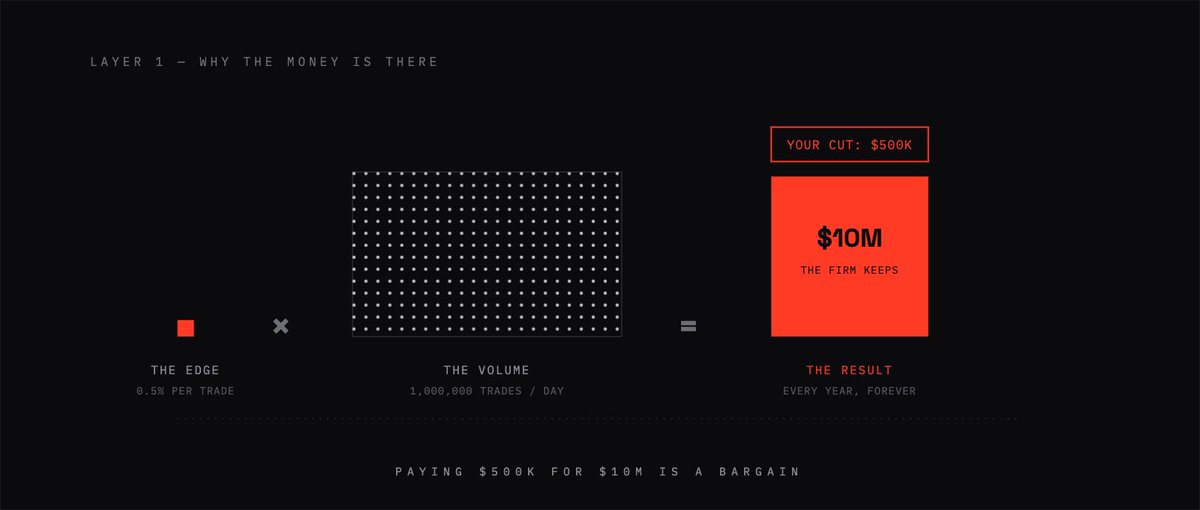
Because in this specific business, the gap between a good decision and an average one is measured in millions of dollars per year, and it compounds daily.
Think about what a firm like Citadel Securities or Jane Street actually does. It stands between buyers and sellers, and on each trade it captures a tiny spread. Fractions of a cent. But it does this millions of times a day, across thousands of instruments. Now imagine a researcher improves one model by a barely-visible amount, so the firm's prices are slightly less wrong than before. That improvement runs across every trade, every day, forever.
A tiny edge, times enormous volume, is an enormous amount of money. So a person who can produce a tiny edge is worth an enormous amount. In that arithmetic, paying someone $500,000 to find something that earns the firm $10 million is not generosity. It is a bargain, and the firms know it. That is the entire reason this pay scale exists, and it is why it survives every market cycle. You are not being paid for effort or credentials. You are being paid a slice of measurable, attributable money you helped create.
Hold onto that, because it explains everything that follows, including the parts that are unpleasant.
Layer 2 — The Three Jobs (They Are Not the Same)
"Quant" is not one job. It is three, and they pay and feel differently. People waste years applying to the wrong one.

The Quant Researcher looks for signals. This is the closest thing to being a scientist. You take enormous amounts of data, form a hypothesis about something that predicts price, and then spend most of your time trying to prove yourself wrong. The skill is statistics, machine learning, and above all research discipline. Most of your ideas will fail. The job is to kill them cheaply and honestly. Backgrounds here skew heavily to PhDs in math, statistics, physics and computer science.
The Quant Trader manages live risk. Where the researcher thinks in months, the trader thinks in seconds. You are pricing, hedging, deciding how much to take on, and staying calm when the number on the screen is moving against you. The skill is probability intuition, fast mental arithmetic, and temperament. This role hires plenty of sharp undergraduates, no PhD required.
The Quant Developer builds the machine. The models are worthless if the system cannot execute in microseconds, ingest terabytes cleanly, and never break. This is serious software engineering, usually C++ and Python, sometimes exotic stacks. Jane Street famously runs on OCaml, a functional language almost nobody uses elsewhere, and teaches it to new hires.
If you love proving things and hate pressure, you are a researcher. If you love pressure and quick decisions, you are a trader. If you love building things that cannot fail, you are a developer. All three are paid extremely well. Picking honestly is the first real decision.
Layer 3 — The Actual Numbers
Here is the part everyone wants, with the caveat that these are ranges reported publicly, and that compensation here is heavily bonus-driven. Base salary is typically only about 30 to 50 percent of the total. The rest depends on you and the firm's year.
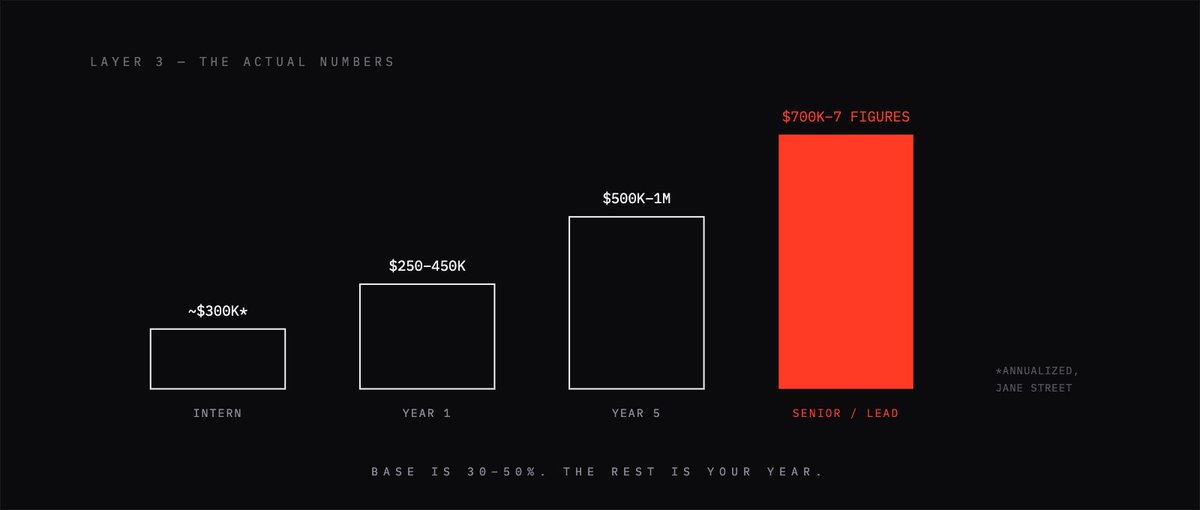
Starting out. A new graduate quant trader at a top firm is generally in the range of $250,000 to $450,000 in total compensation. New grad researchers land roughly $225,000 to $400,000. At the very top of the market, entry level traders at Jane Street are reported around $350,000 to $450,000 and above.
Citadel Securities publicly lists base salaries around $250,000 to $350,000 for quantitative researchers, with first-year totals reported anywhere from $400,000 to over $700,000 once the discretionary bonus is paid.
The internships are the tell. Jane Street pays the bulk of its interns the annualized equivalent of about $300,000. Citadel's quant interns earn roughly $4,300 to $5,800 per week for the 2026 program, around $47,000 to $64,000 over an eleven week placement, plus a signing bonus of $15,000 to $25,000 and corporate housing worth close to $5,000 a month. Hudson River Trading pays about $54,383 for a ten week program with a separate $25,000 signing bonus. XTX Markets, the London firm founded by the mathematician Alex Gerko, has advertised an AI research internship at $35,000 per month in base salary, which over a full placement can exceed $120,000 before anything else.
Read that again. These are students. Firms pay this because an internship is the cheapest possible way to test whether someone can actually do the work, and finding one person who can is worth vastly more than the entire intern budget.
Later on. The gap widens brutally. A first year is at $250,000 to $350,000. A senior researcher or a lead quant is commonly at $500,000 to $1.5 million and up. At Citadel, Two Sigma, D.E. Shaw, Jane Street and Renaissance, senior researchers routinely clear $700,000 and frequently reach seven figures. Renaissance Technologies is widely regarded as the highest-paying employer in the industry, which makes sense: its Medallion fund has compounded at roughly 66 percent a year before fees since 1988, and the people inside share in that. Renaissance also almost never hires the inexperienced, and its fund is closed to outside money entirely.
The tiers, roughly. Elite market makers, Jane Street, Citadel Securities, Hudson River Trading, Optiver, IMC, SIG, Jump, tend to pay the most at the graduate level. The great quant hedge funds, Two Sigma, D.E. Shaw, AQR, PDT, and Renaissance above them all, pay at the top for experienced researchers. Bank quant roles pay meaningfully less but are far easier to enter and a completely legitimate way in.
Layer 4 — What the "Math" Actually Is
This is where most people are surprised, and it is genuinely good news. You do not need exotic mathematics. You need a small number of things understood far more deeply than most graduates understand them.

Probability, to the bone. Not the formulas, the instincts. Conditional probability, expected value, distributions, and the ability to answer "what is this bet worth?" without a calculator and without fooling yourself. This is the single most tested subject in the entire industry.
Statistics and inference. How to tell signal from noise. Sample size, significance, overfitting, out-of-sample testing. A researcher's whole professional life is the question "is this real, or did I torture the data until it confessed?"
Linear algebra and optimization. Portfolios, covariance, regression, risk. Everything becomes matrices eventually.
Programming, seriously. Python universally. C++ where speed matters. Even research roles now test coding directly, often with algorithmic problems on top of the mathematics.
Mental arithmetic. For trading roles specifically. You will be asked to do arithmetic fast, out loud, while someone watches. It sounds like a party trick. It is really a test of whether your thinking degrades under pressure.
Notice what is not on this list. No corporate finance. No accounting. No knowledge of markets at all, at entry level. Firms assume they will teach you the domain. What they cannot teach you, in their view, is how to think under uncertainty.
Layer 5 — How the Door Actually Opens
The process is famously brutal and surprisingly consistent.

It usually starts with an online assessment, mathematics and often code. Then technical interviews of forty five to sixty minutes, sometimes with a pen and paper or a whiteboard, where you are watched while you reason. Expect probability questions above all, brain teasers, estimation problems, and for researchers, statistics, machine learning and research design.
Then comes the Superday, several interviews back to back, sometimes an entire day, mixing harder technical rounds with case studies, trading simulations and conversations with senior people. Some firms add unusual tests: IMC uses a gamified cognitive battery called NeurOlympics, roughly forty five minutes of brain games measuring memory, reaction and strategy.
Two things matter more than candidates expect. First, they are watching your process, not only your answer. Saying "I think it is about 30 percent, here is my reasoning, and here is what would change my mind" beats a confident wrong number every time. Second, they are hiring a colleague. These are small teams in high-stress rooms. Being unpleasant is disqualifying no matter how good your math is.
Layer 6 — Who Actually Gets In
The mythology says International Mathematical Olympiad medalists and MIT PhDs only. The reality is more open than that, and worth stating plainly.
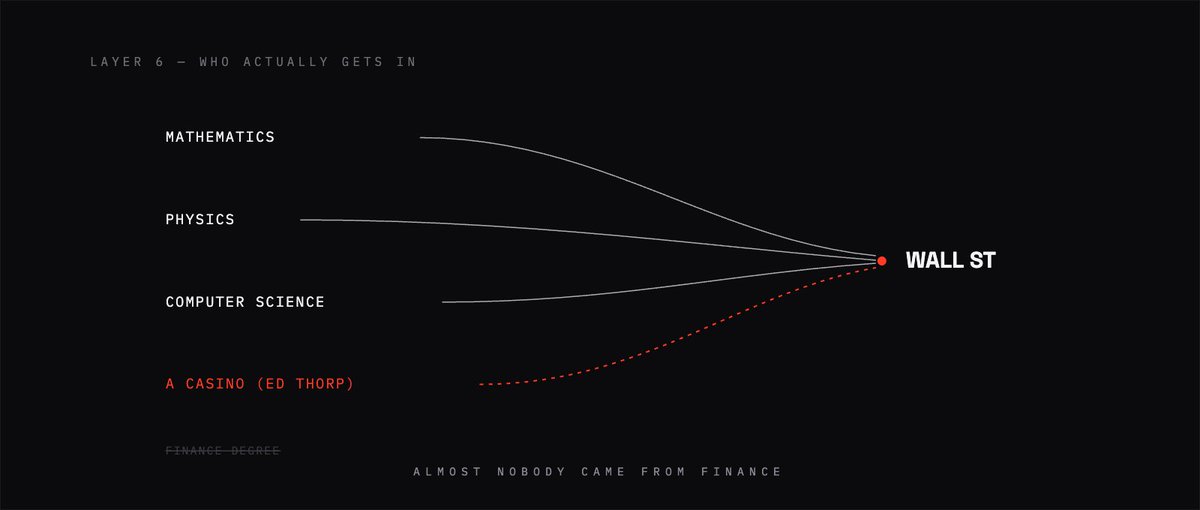
Yes, firms actively recruit Putnam competitors and Olympiad medalists. The pedigree is real at the very top. John Overdeck, co-founder of Two Sigma, won a silver medal at the IMO as a teenager. But there are only so many Olympiad medalists in the world, and the industry is far larger than that pool.
Look at how the founders actually arrived. Ed Thorp, the first modern quant, was a mathematics professor who learned to beat blackjack and then applied the same thinking to markets. Jim Simons was a decorated geometer who had never traded and hired code breakers and physicists instead of financiers. David E. Shaw was a Columbia computer science professor, and a young employee of his named Jeff Bezos left to start a bookstore. Ken Griffin was an undergraduate trading convertible bonds out of his Harvard dorm room with a satellite dish on the roof. Cliff Asness did a PhD under Eugene Fama in Chicago before founding AQR. Emanuel Derman was a particle physicist who wandered into Goldman Sachs and wrote a book about it.
Almost none of them came from finance. They came from mathematics, physics, computer science, and in Thorp's case, a casino. The industry has always hired for raw analytical ability plus evidence you can finish hard things. A strong quantitative degree, real programming, demonstrable projects and serious interview preparation get people in every year from schools nobody would call elite. The genuine gatekeeping is at a handful of firms, not at the profession.
Layer 7 — The Honest Part
Now the section the recruiting page will not write for you, because you should walk in with your eyes open.

The money is a bet on your output, not a salary. Since so much of it is bonus, a bad year is not just a smaller number, it can be an exit. Research seats especially are judged on whether your signals made money. Some firms are famously willing to part with people quickly.
Your edge decays, permanently and by design. Every strategy that works attracts imitators and stops working. Researchers spend their careers replacing their own past discoveries. The work is never finished, and last year's brilliance is worth nothing this year.
The hours and the pressure are real. Not banking-style all-nighters at most firms, but sustained intensity, and for traders, the specific stress of losing real money in real time.
The work is narrower than it sounds. You will not roam free across mathematics. You may spend eighteen months on one corner of one problem. People who need variety often burn out even while being paid extremely well.
And it is genuinely hard to enter. Acceptance rates at the top firms are brutal. Many strong candidates apply for years. The right expectation is that you are trying to enter one of the most competitive labor markets that exists, and preparing accordingly.
The Part That Actually Matters
Put it together and the picture is clear, and much less mysterious than the number suggests.

This industry pays extraordinarily for one reason: a small analytical advantage, applied at enormous scale, produces enormous money, and that money can be traced back to specific people. Not credentials. Not effort. Output. The half million is a share of value you can point at.
Which means the real question is not "how do I get paid $500,000 to do math." It is "can I produce a small, real, provable edge, and can I prove it honestly?" That is the same skill whether you are interviewing at Jane Street, running your own strategy, or doing something else entirely with your life. The firms are simply the most efficient market in the world for buying it.
And here is the part I find genuinely hopeful. Every single thing on that skill list is public. Probability, statistics, linear algebra, programming. The textbooks are free or nearly free, the university lectures are on YouTube, the interview material is documented in detail by people who went through it. Nobody is hiding the curriculum. What is scarce is not access. It is the number of people willing to learn it to the depth where it becomes instinct.
Here is what I would sit with. The firms are not paying for knowledge, because knowledge is free and they know it. They are paying for calibrated judgment under uncertainty, the ability to say how sure you are and be right about how sure you are. That skill pays half a million dollars in one building in Manhattan. It also happens to be the single most useful thing you can own in any career, any business, and any bet you will ever make. So what would change if you trained it deliberately, starting this week, regardless of whether you ever send a single application?
Related articles

7 faceless YouTube hooks i used to generate 200M+ views (steal these)
i've written hooks for 8,000+ youtube scripts across 50+ niches.

How Quants Use AI to Build Regime-Adaptive Trading Strategies (Complete Guide)
A practical framework for detecting market regimes and dynamically adjusting your strategy-before the regime changes destroy your P&L.

the EASIEST faceless youtube niche to print in 2026
i get asked this question more than any other. six months straight.