I Built An AI Trailer Factory for $124/Month. It Made Me $14,000 Last Month.

$124 in tools. $14,000 in trailers for films nobody greenlit. Same month.
A trailer sells an audience on two minutes of a movie that took two years to make. Mine sells the same feeling for a movie that was never made at all.
Key art, a voice, a score, a cut. Two minutes, sometimes ninety seconds. Nobody checks whether the film behind it exists before they hit play.
Most people think a trailer needs a production company, a marketing budget, and six months in post. It needs six tools and a weekend.
The ones who figured this out are quietly selling teaser trailers to indie authors pitching adaptations, game studios pitching cinematics, and posting fake blockbuster trailers that outperform the real ones in the same week.
Here is the whole build.

What It Actually Is
A trailer is six pieces: a premise, key art, motion, a voice, a score, and a cut that hits every beat on time.
A studio builds all six with a marketing department. I build all six with a prompt.
The business doesn't pay for the film. It pays for the two minutes that make you want the film to exist.
That's the system.
The Pipeline
concept → key art → motion → voice → score → cut Claude → Midjourney → Runway → ElevenLabs → Suno → Make
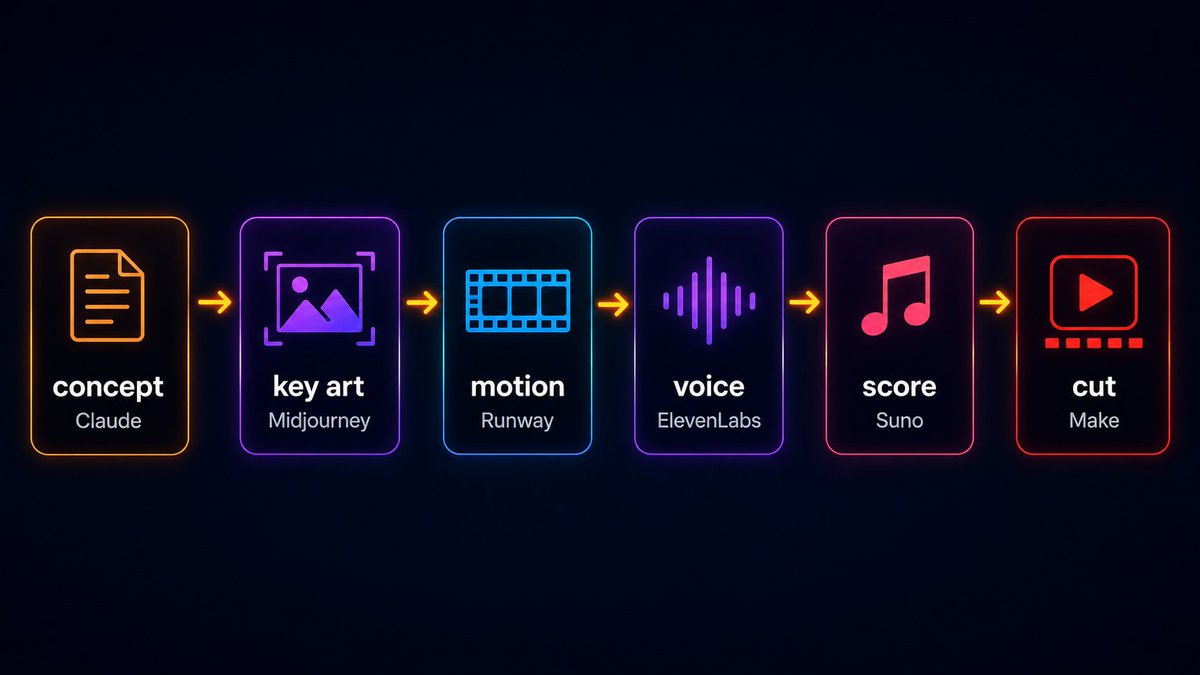
> Claude writes the concept and scene breakdown: 20 minutes > > Midjourney generates the key art: 30 minutes > > Runway animates the shots: 45 minutes > > ElevenLabs records the narrator: 15 minutes > > Suno scores the trailer: 10 minutes > > Make cuts, titles, and publishes: automatic
Total build time: one weekend per concept. Total run cost: $124/month. Concepts you can run in parallel: as many loglines as you can write.
Step 1: Claude Writes the Concept
Everything starts with a premise nobody greenlit. Claude writes the logline, the scene breakdown for Midjourney, the narrator lines for ElevenLabs, and the title card copy.
Prompt for the trailer concept:
You are a trailer editor pitching a concept to a studio.

Write a 90-second trailer concept for a film that does not exist:
"Meridian" - a sci-fi thriller about a lighthouse keeper on an
abandoned orbital station who discovers the distress signal she's
been relaying for 3 years is her own, sent from the past.

Format the output as:
- Logline (1 sentence)
- 8 scene beats, each described for image generation
- Narrator lines (trailer-voice, sparse, one line per beat)
- Title card copy (3 cards: setup, twist, release date)

Tone: slow-burn dread building to one loud reveal.
Total runtime: 90 seconds. End on the title card, not a scene.
Not a coder? This prompt is the only thing you write from scratch. Every step after it just reuses the scene list Claude hands back.
Step 2: Midjourney Generates the Key Art
Prompt for key art:
lone woman in a worn orange EVA suit, helmet under one arm,
standing in a flickering control room aboard an abandoned
orbital station, red emergency lighting, condensation on
every surface, staring at a blinking console,
cinematic sci-fi thriller still, anamorphic lens flare,
teal and orange grade, volumetric light, 4k, ultra detailed
Generate 4 variations per beat. Upscale the strongest one. An 8-beat trailer needs 8 to 12 stills total.

Change one line: swap the character and setting description for your own premise. The lighting and grade notes carry over untouched.
Step 3: Runway Animates the Shots
Prompt for motion:
Camera pushes in slow on her face.
Her eyes shift to the blinking console.
The lighting flickers once, holds red.
She reaches for the comm switch, hesitates.
6 seconds. Dread building, no cuts.
My first cut of this trailer died in the first three seconds. I animated all 8 beats with the same slow push-in and it read as one long shot with no pulse. The fix: alternate push-ins with one static wide every third beat, the way a real trailer breathes. The reworked cut got forwarded 40 times in a Discord before I posted it anywhere.
Change one line: the camera direction is the only thing that changes per beat. Reuse the pacing rule (push-in, push-in, static wide) on every concept.
Step 4: ElevenLabs Voices the Narrator
Best voices by role:
> Narrator - deep, measured. Dread stays flat until the last line, never rises early. > > Mara (lead) - breathless, restrained. Speaks like she already knows the ending.
Directing the performance:
Read this flat. She's not scared yet, she's counting seconds.
"The signal isn't coming from out there."
Hold half a second before "out there."
Drop the volume on the last two words instead of raising it.
ElevenLabs responds to direction written into the prompt. Most people paste the line. Write the performance.
Step 5: Suno Generates the Score
Prompt for the trailer score:
Epic trailer score, slow-burn horror-thriller build,
opens with a single low drone and a heartbeat pulse,
sparse piano notes enter at 0:20, string tension rises
at 0:45, one deep braam hit at 0:70 timed to the reveal,
resolves into a single cold piano note, runtime 90 seconds,
Hans Zimmer meets Ludwig Goransson energy,
cinematic, dread-building, ends unresolved
All tracks are yours. Commercial license on the paid plan.
Step 6: Make Cuts and Publishes
The scenario runs whenever a new concept folder lands in Drive:
- Pull the scene list and narrator lines from the Claude doc
- Send each beat's Midjourney still into Runway, download the animated clip
- Send the narrator lines to ElevenLabs, download the audio
- Drop the Suno score under the dialogue, duck it automatically under the VO
- Assemble clips in cut order, insert the 3 title cards at their marked timestamps
- Render at 1080p, export a 9:16 crop for Shorts alongside the 16:9 master
- Upload the master to YouTube with an auto-generated title and description
- Post the 9:16 cut to X and TikTok with a link to the article
- Send a Telegram ping when the render finishes
Setup time: 4 hours once. Every concept after that runs the same scenario.
The Cost
> Claude Pro $20/month > > Midjourney Pro $30/month > > Runway Standard $35/month > > ElevenLabs Creator $22/month > > Suno Pro $8/month > > Make Core $9/month. > > Total: $124/month in. $14,000/month out.
How You Make Money
> YouTube AdSense - the fake-trailer genre runs a higher RPM than most content because it's entertainment-adjacent and pulls long watch time. At 900k monthly views, $4,500 to $9,000/month. > > Client commissions - indie authors pitching a book-to-screen adaptation, game studios needing a cinematic for a pitch deck, screenwriters wanting a sizzle reel for a manager. $400 to $1,200 per trailer > > Studio sizzle reels - small production companies commission a proof-of-concept trailer to shop an option around before financing exists. $1,500 to $4,000 per reel. > > Key art and prompt licensing - sell the character and environment prompt packs from finished concepts on Gumroad. "Cinematic Trailer Prompt Pack, 12 concepts" at $29. Sells indefinitely. > > Sponsorships - AI tool companies and streaming platforms pay for integrations once a channel clears 30k subscribers. $500 to $1,200 per placement.
The Numbers

> Month 1 - built on a laptop, first client a self-published author wanting a book trailer. $700/month. > > Month 3 - 4 concepts a month, 2 client commissions plus early AdSense. $3,200/month. > > Month 6 - a sizzle reel client signs for an option pitch, AdSense clears six figures in views. $8,000/month. > > Month 12 - prompt packs selling on autopilot, 3 studio clients on retainer. Past $14,000/month with cost still under $130.
The work is done once per concept. The trailer keeps earning after the upload.
How You Land the First Client
Skip the pitch deck. Find a self-published author or an indie game dev with a finished manuscript or build and no marketing budget.
Ask for the premise, or write one yourself from their existing pitch. Build the 60-second version over a weekend and send it unsolicited.
Watching their own book or game get a trailer treatment closes the deal faster than any rate card. My first 3 clients signed off that exact move.
The Bottom Line
Most people wait for the movie before they build the trailer.
This runs the other way. The trailer is the product. The movie is optional.
Six tools. One weekend per concept. The tease sells itself.
comment "TRAILER" and I'll send the concept prompt pack and the Make scenario.
Related articles

Two Developers Used AI to Build a Game in Two Months. It Made Them $100M and Outsold Half of Steam's
A few weeks ago, two developers used AI to help them build a game in just two months. It sold over 15 million copies.

Agencies charge $8,000 for a mini-game. I built one for $20 with Fable 5
Gamification agencies sell custom browser mini-games to brands for thousands of dollars per project. Marketing teams buy them because an interactive thing holds attention far longer than a banner. Un…
