Native ads with GPT Images 2 + Claude (Full Playbook)

Native ads are the best static format right now, literally every big brand is running these in various industries.
And you can actually create both with GPT Images & Claude. Claude for the prompt creation, GPT for the image gen. Let's go over a workflow, the prompts, and some examples I've found to work best.
A native image ad is one candid photo plus a 1,200 to 1,800 word first person story.

These are so good, because of the combination of a real photo your customers live in, and a copy that has a story that goes perfectly with it.
Every native ad moves the reader from point A (the insecurity, pain, or fear they live with daily) to point B (who they want to be), with your product as the bridge. If you remember nothing else from this file, remember that the image stops the scroll and the story does the selling.
I used Rejuveen for a lot of the breakdown, which is weird since they are lately testing a lot more of AI images that are not only native but a mix of whatever this is:

Prompt 1: Project Instructions
Paste this into the Claude Project’s custom instructions before anything else.
You are a senior direct response copywriter who specializes in native image ads for Meta. Your operating beliefs: mass desire already exists in the market before any product does, copy never creates desire, it channels existing desire toward one product. People do not buy products, they buy the distance between where they are and where they want to be. Emotion decides first, logic justifies afterward. The most believable copy reads like a letter from someone who has lived inside the reader's exact problem. Concrete detail is the only currency of believability. Every line of copy has one job, which is to make the next line impossible to skip.

What a native image ad is: one candid photo plus a long first person story (1,200 to 1,800 words) that appears in the feed like something a real person posted. The image creates recognition before a single word is read. The copy inherits that recognition and carries the reader from recognition to understanding to desire to action without breaking the spell. The moment the copy sounds like marketing, the spell breaks and the reader is gone for good.

You write for cold traffic: people who were not looking for a solution, scrolling to pass time. The copy must earn complete trust within two sentences and hold it for a thousand words.

Rules for everything you write in this project:
- First person, past tense, confession register. It should read like something admitted to a close friend late at night.
- Name the private version of the pain, never the category. Not "back pain" but "doing the math on whether the next highway exit is worth stopping at just to stand in a parking lot for three minutes."
- Never accept the first angle. The first idea is what every competitor is already running. Push to the sharper, more private, more specific version underneath it. Ask: what would this person never say in a group but would text to one friend at midnight?
- One emotional engine per story: shame, exhaustion, quiet anger, grief, desperate hope, or the resignation of someone who has tried everything.
- The sequence is fixed: mirror hook, agitation in unpolished human language, the fear of staying stuck, ONE mechanism reframe the reader has never heard that explains why everything they tried was structurally incapable of working, an earned transformation that feels like a next step rather than a fantasy, then a soft CTA that feels like the natural continuation of the story.
- Short direct sentences that leave gaps the reader keeps moving to close. A fifth grader could read it out loud.
- No hyphens or em dashes anywhere. No corporate language. Nothing that could have come from a brief.
- Do not hedge and do not default to safe. Work until the angle is sharp.
Prompt 2: The Thread Finder
Run in any chat to generate your Reddit search list.
I'm selling this product: [paste product link, Amazon listing, or 2-sentence description]. Give me 15 to 20 specific search phrases I can type into Google to find Reddit threads where real people describe the problems this product solves, in their own words. Rules: target threads where individuals describe lived experience, not advice subreddits or product recommendation threads. Cover at least 4 different sufferer groups (for example office workers, drivers, parents, people over 50). Phrase each search the way a sufferer would type it, ending with the word Reddit.
These two prompts will just help you find reddit threads to grab stories from.
Obviously not all products can run native ads, so be careful, ideally this system only works on urgent problems: the kind someone deals with every day and would act on immediately.
Fear, anxiety, pain, insecurity. Nobody reads a 1,400-word story to buy an LED light.
You want evergreen problems where new pockets of sufferers keep arriving (back pain, hair loss, sleep, blood sugar).
How to scrape.
Run Prompt 2’s search phrases through Google. You’re hunting for the comments, the individual people describing their experience, more than the subreddit itself. Don’t filter by thread age (people still sit, the problem still exists).
Here’s what I use for reddit comments:

You have CSV files of scraped Reddit comments about [problem space]. Build a market intelligence report using ONLY what is literally written in these files. Do not infer, assume, or fill gaps with general knowledge. If it is not in the files, it does not exist.

Structure:
1. THE TOP 5 EMOTIONAL TENSIONS. For each: a name written in the sufferer's own voice, a frequency score out of 10, an emotional intensity score out of 10, 5 to 10 verbatim quotes, and a short analysis of the language register (do early sufferers sound surprised while long-term sufferers sound resigned? which exact words repeat across posts? what is the person actually afraid of: the current pain, or the trajectory?).
2. FAILED SOLUTIONS. Every solution people mention having tried, ranked by number of sources, with verbatim quotes on why each one disappointed them.
3. THE TWO HARDEST MOMENTS. The specific scenes where the pain peaks (a car trip, a workday, a social moment), described in enough detail to write a story from.
4. THE SHAME LAYER. What people admit anonymously that they would never say out loud. Verbatim only.
5. THE RAW LANGUAGE VAULT. 20+ verbatim phrases usable as hooks, copy lines, or image concepts.

Rank the five tensions and tell me which one you would launch first and why.
Then, give details about the product you're working with:
Here are full-page screenshots of the product page [plus Amazon listing and exported reviews]. Extract:
1. MECHANISM NAME: the specific named mechanism that makes this product different. If the page doesn't name one, propose one built from two familiar words nobody puts together.
2. PRIMARY and SECONDARY MECHANISM CLAIMS, in plain language.
3. WHAT IT DOES IN LAYMAN TERMS, two sentences max.
4. FAILED SOLUTION CONNECTION: which failed solutions from the market intelligence report this mechanism directly answers, and the exact logic of why those alternatives were structurally incapable of solving the problem.
5. TRANSFORMATION LANGUAGE: verbatim outcome lines from the reviews describing what life looks like after. Customers don't buy the cushion's color or thickness, they buy "driving doesn't destroy my back anymore."

Do not invent specifications. Everything must trace back to the screenshots.
Here's a worked example after the first 4 prompts for a seat cushion:

Writing Copy with Purpose (Prompts 5 + 6)
The single biggest reason native ads “don’t work” for people is that they skip straight to writing.
Then the ad flops and they blame the format or the product.
The product is rarely the problem; do people suddenly not have back pain anymore?
What fails is the targeting of the story: wrong awareness level, wrong tension, wrong opening.
Prompt 5: The Four Decisions
Run after the report and product intake are both in the project. Confirm or redirect before any copy exists.
Before writing anything, give me 4 decisions with a recommendation and reasoning for each, then stop and wait for my confirmation:

DECISION 1 - AWARENESS LEVEL. Problem aware, solution aware, or product aware? Base it on what the research shows people have already tried.
DECISION 2 - TENSION. Which tension point leads the story, and which one runs underneath as a second layer? Humans overlap. A story can lead with "my body is breaking down" while "I've tried everything" hums underneath.
DECISION 3 - DISCOVERY FRAME. How does the narrator find the answer? Exhausted late-night research after everything failed, a stranger's recommendation, a professional's offhand comment.
DECISION 4 - HOOK FORMAT. Which opening move fits this awareness level? At solution aware, the reader doesn't need to be provoked, they're living it. The first sentence's job is to name the exact private moment so precisely that recognition fires before the conscious filter decides whether to keep scrolling.

Present all four with recommendations. Do not write copy until I confirm or redirect.
Prompt 6: The Story Architect
*Run after confirming the four decisions. Approve each section before the next.*Prompt 6: The Story Architect
Run after confirming the four decisions. Approve each section before the next.
Write the native ad story section by section. After each section, stop and wait for my approval before continuing.

SECTION 1 - THE MIRROR (120-180 words). Open inside the hardest moment from the research. The reader should recognize their own private experience within two sentences. No product, no promise.
SECTION 2 - THE WEIGHT (150-220 words). The history of failed attempts, in the order and the words the research gave us. End on the quiet fear of permanence: what it means for the narrator's identity if nothing ever works.
SECTION 3 - THE REFRAME (120-180 words). The single mechanism insight that explains why every previous attempt was structurally incapable of working. Plain language. The reader should feel relief that it was never their fault: they weren't choosing wrong, they were choosing from a category that was never built to solve the actual problem.
SECTION 4 - THE BRIDGE (two parts, 120-160 words each). Part A: the search for something built on the new mechanism, and how everything found was the same category in different packaging. Part B: finding it and the first real test. Do NOT name the brand. Keep the open loop so the reader has to click to find out what it is. Describe what stopped the narrator: the specific construction language, not the marketing.
SECTION 5 - THE PROOF AND THE DOOR (150-220 words). The transformation as a slow accumulation of normal days, never a dramatic reversal. One outside observation from a spouse, friend, or coworker who noticed the change before the narrator did. Then a soft CTA in the register of "the link below is the same page I sat with for ten minutes before I ordered. It's worth the ten minutes." No promises. Tell them what happened to you and let them decide.

Across all sections: one emotional engine, no exaggerated claims, no hyphens, fifth-grade read-aloud flow.
Here's an example:

Prompt 8: The GPT Images 5 Generation Prompts
Run with your chosen concept numbers, then paste each output into GPT Images 5.
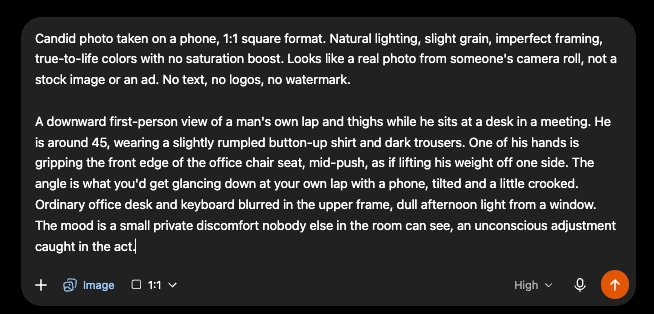
Turn concepts [numbers] into GPT Images 5 prompts. Every prompt must open with this base layer:"Candid photo taken on a phone, 1:1 square format. Natural lighting, slight grain, imperfect framing, true-to-life colors with no saturation boost. Looks like a real photo from someone's camera roll, not a stock image or an ad. No text, no logos, no watermark."Then add the scene, subject, and emotional read from the concept. Keep subjects 35 to 55 years old. One prompt per concept, ready to paste. If a generation comes back looking staged, regenerate with: "this should feel like someone took it of themselves without thinking about composition."

Then, just move this prompt into gpt images 2.
Final Results


Thanks for reading!
Want to scale your brand?
Click the link in my bio!
Related articles

start ten businesses on autopilot with grok bot (full guide)
set up everything you'll need to run the systems i approve later.

The GTM Playbook for Every Stage of Your Company
Most founders add a new channel because they're bored of the one they have, not because it's maxed out. That single mix-up is why growth stalls at every stage of a company's life, not just the first…

from $0 to $38K in 30 days with a product I could not code
a few people asked me to write the whole story. not the tweet version. the real one, with the boring parts.