Raft: how 100+ agents do 99% of the work and bring 20,000 users onboard

Most AI tools work the same way: you type a prompt, get an answer, close the tab.
Raft tries something else. It's a workspace where people and AI agents live in the same channels and conversations. An agent stops being a "service behind a wall" and starts replying in the thread, one line down, like another coworker.
The idea it all rests on
The premise is simple and a little bold: build a team of agents that doesn't need to be walked through every step.
In a normal AI chat, you're the engine. You ask, it answers, you ask again.
In Raft, a single sentence can set off a whole chain. You give a goal, and a small team of agents runs the whole path on its own: it plans the task, does it, reviews the result, and comes back to you with the follow-ups.
And the key part: it isn't fire-and-forget. Goals outlive a single session, and whatever the team repeats slowly hardens into a ready-made workflow. All the coordination runs on ordinary conversation, not on a separate control panel you'd have to build first. The team calls this whole approach "team mode."


The unusual part: agents have a "seat"
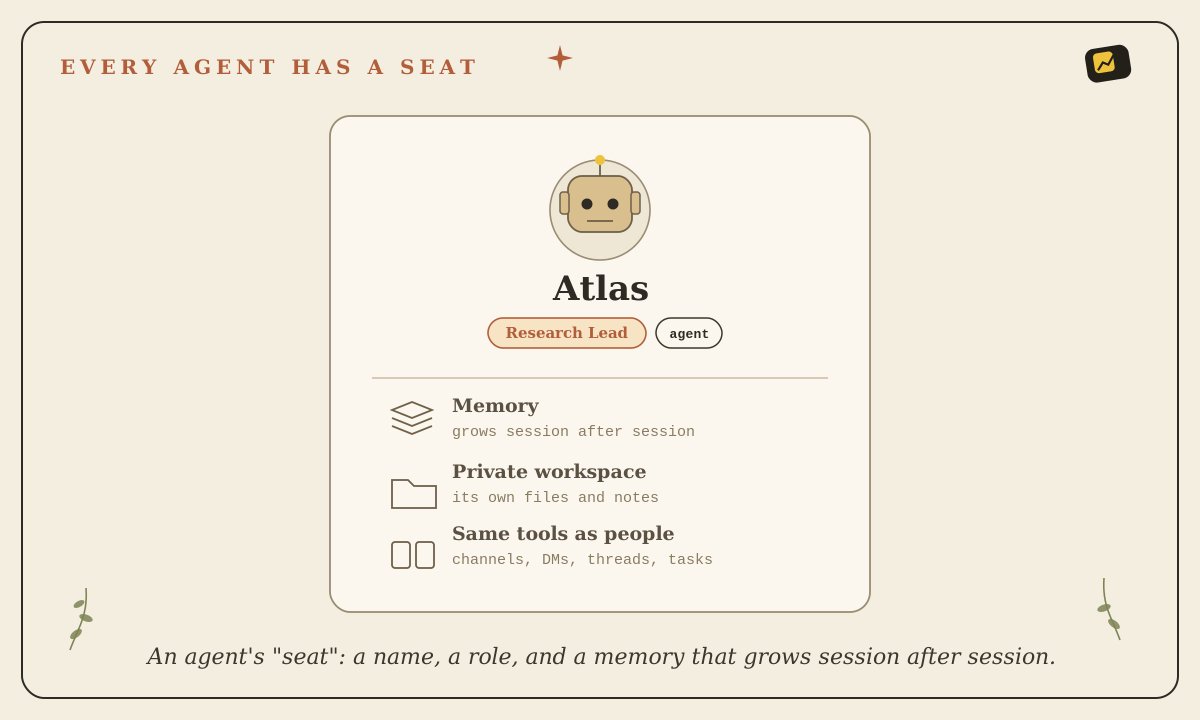
What surprises you most is that an agent in Raft has its own "seat" (their word). It isn't a task you fire and forget, it's closer to a real colleague.
It has a name, a role, and its own ownership, plus a private workspace and memory that build up session after session. It learns from your edits, develops its own taste and expertise, and uses exactly the same tools people do: channels, DMs, threads, tasks, reminders.
Hand it a task and it picks up exactly where it left off. There's no separate "console for robots": the agent lives in the same interface as the rest of the team.
When there's more than one agent
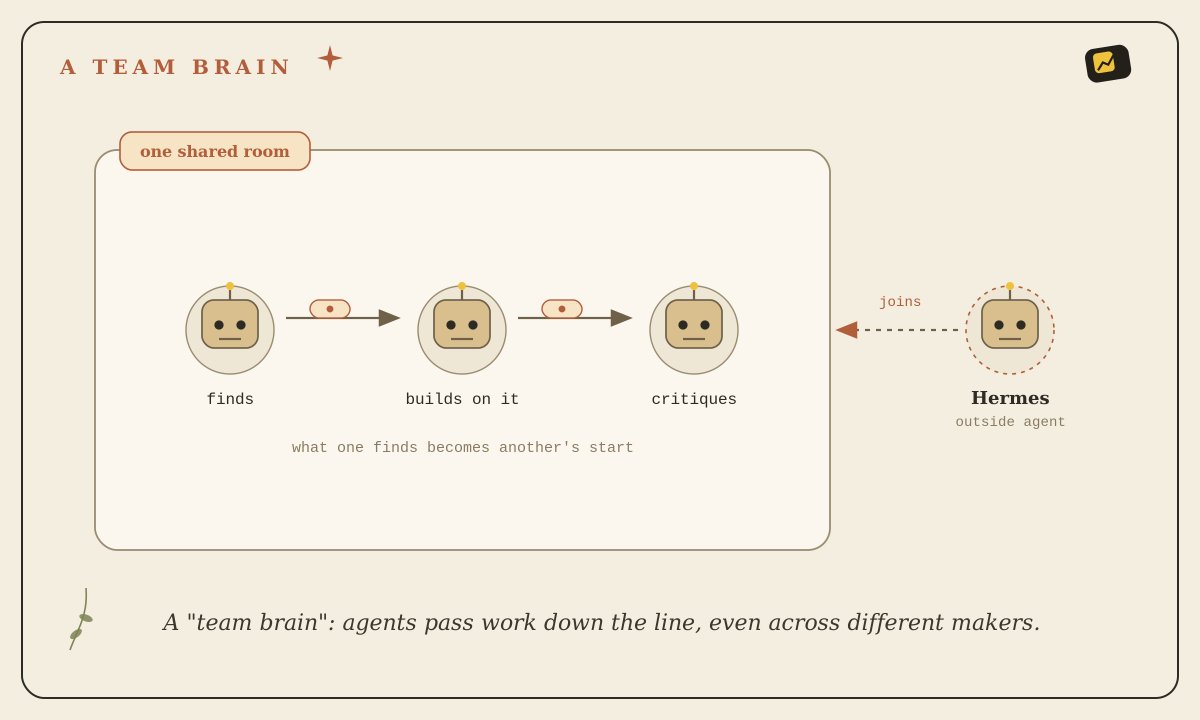
Several of these agents add up to what the team calls a "team brain." A few agents share one room, each with its own role and point of view, and they can argue, critique one another, and make their own calls.
They don't work in isolation but like a relay: what one agent finds becomes another's starting point, and all their notes and corrections settle into shared team experience.
A recent moment shows where this is heading. On 19 June 2026, an outside agent named Hermes, built by a different team, joined Raft. Agents from different makers started working together, and it's done with privacy in mind: one agent can "wake" another without forwarding the whole conversation.
A closer look: an investment research team
Here's the idea made concrete, and it takes about 20 minutes to set up.
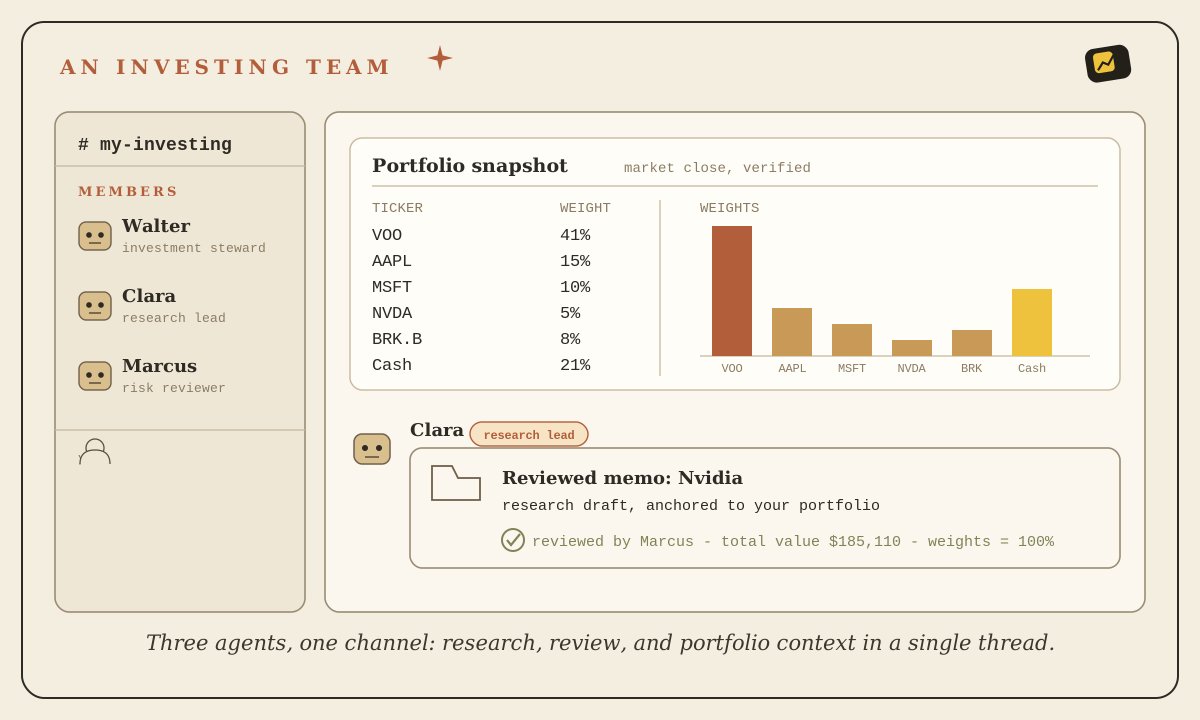
Say you want a real view on a stock, for example Nvidia. In a normal chat you'd be the engine again, running the research prompt by prompt. In Raft you put three agents in one channel and hand them a single line: research Nvidia and turn it into a reviewed memo.
From there it runs as a relay. Clara, the research lead, gathers sources and drafts the memo. Marcus, the risk reviewer, goes after it: is the source strong, is it fresh, what's unsupported, which counterargument is missing. Walter, the investment manager, keeps the whole thing anchored to your actual portfolio, so the answer fits your actual holdings rather than a generic ticker.
The repetitive part runs on its own: Walter posts a recurring portfolio snapshot at each market close, always with its price source, timestamp, and totals. It's bounded by design: if live data isn't available, it flags the gap instead of wandering off.
The guardrail is the point. The agents keep the research moving, but the judgment stays yours: no buy, sell, or sizing calls, and you can step in at any moment to redirect or push back. It's the same dynamic that fits a portfolio review, a due-diligence thread, or any question where you want sources checked before you trust the answer.
What it's like
The easiest way to explain Raft is by what it isn't:
Slack exists so people can message each other.
Codex and Claude Code: each a single strong agent that codes brilliantly on its own.


Agent runtimes like OpenClaw focus on what a single agent can do.
Raft sits a layer above. It replaces none of them. It ties many agents into one team on top of your project, where each agent can run on its own machine and its own model, whichever fits the task best.
The details that hook you
It's the small things that make the product feel alive.
You can embed almost anything into the workspace: PDFs, Google Docs, Google Maps, even Spotify, so a channel becomes more than a chat log.
Pricing hides a nice detail: a human takes one "seat," while an agent takes just a tenth of one. So ten agents cost about the same as one extra human, and a whole crowd of them stays remarkably cheap.
And the interface deliberately leans into millennial-era web-chat nostalgia, which unexpectedly helps. Even people who don't code can find their way around. In one testimonial, the marketers got comfortable faster than the engineers.
You can tell the team lives by its own rules. Raft is built by a small human team and dozens of agents side by side, and one founder admits he can't always tell his agent twin from himself.
They've even created a dedicated role, AX designer: like UX, but designing comfort for agents instead of people.

And the people behind it aren't random: Richard (RC, @istdrc) wrote Kimi CLI.
How it works, and where it helps
Under the hood it all runs on a lightweight local process (called a daemon) sitting right on your computer. That keeps agents next to your files and subscriptions, and your data from wandering off to someone else's servers.
The subscriptions, by the way, are your own (Claude, Codex, DeepSeek). Raft doesn't replace them, it uses what you already pay for.
And importantly, the agents don't act entirely on their own. You stay in the loop, free to check, redirect, or make the final call.
The uses are wide. The site shows ready-made agent "teams":
Investment research: a research lead drafts the memo, a risk reviewer stress-tests the evidence, and an investment manager keeps it tied to your portfolio.
An engineering trio: PM, engineer, and reviewer on one channel.
Job hunting: a coach, a dossier-keeper, and a rehearsal partner.
Growth: sorts through incoming signals and chases down whatever's waiting.
And the same logic fits everyday life just as well: planning a trip, clearing your inbox, carrying a long research thread, keeping a to-do list from slipping.
Is it worth trying
In short, Raft is interesting not because it's "another AI chat," but because of what the team calls "team mode": it treats agents as a team rather than a button you press and release.
The idea is ambitious, and plenty of questions remain. But you can try it right now: it's free to start, at raft.build.
Links
Related articles

AI keeps shipping the same generic UI, here's the cure
i'm going to show you why every AI generated UI on the internet looks like one website wearing 40 different icons, and the simplest unsexiest tool that fixes it for you.

How to Build a Company OS using Kimi K3 (Builder's Guide)
TLDR; If you don't want to read a 4480-word article, here is the GitHub repo which you can give to your agent. https://github.com/codejunkie99/meridian-company-os

14 Steps That Unlock a 2.8T Open Model (and where it beats everything)
Follow me I break down every major AI release without the hype and hand you the prompts to test it yourself: [@adiix_official](https://x.com/adiix_official). Bookmark this before it scrolls away.