Sol 5.6 vs Fable 5 (what's better for marketing?)

I ran the same marketing jobs through Sol 5.6 and Fable 5 this week. Same prompts, side by side, pulled straight from my work week.
And the results were surprising.
I was watching for two things the whole way. Whether the output was good enough to put in front of people, and whether it shipped without me babysitting every step.
Let me take you through it, job by job:
The website
I gave both models the same simple prompt, pulled straight from a tweet: install the skill and build my website singlebrain.com into a world.
For context, the old singlebrain.com is fine. It says what we sell, managed revenue agents that know the client, and it gets to the point. I wanted to see what each model would do if I asked it to turn that into something you move through.
Sol 5.6 went first. The setup took about five minutes. It installed the Higgsfield CLI, I approved once, and it started building.
Fifteen minutes in, it had a rough concept. It kept working, showed me the direction it was heading, and I let it run.
Around the hour mark it had the shape of the thing. Thirty-odd minutes after that, it handed me a world I could scroll through.
Here's what got me. I gave it almost no direction, and it built the whole world around the idea behind the product.

A single brain at the center, then team brains around it, then individual brains under those, going down level by level. I never described that. It inferred it from the site and ran with it.
The whole run was thirty-four minutes, 766,000 tokens, and 467 credits, off one prompt. What came back is a first pass I still need to massage, but it's a starting point instead of a blank page.
Then I ran Fable 5 on the same prompt.
Three hours later it was still building. It kept struggling, backing up, and hitting the same wall on the same piece, over and over.
When it finally produced something, the brain it designed was better than 5.6's. More care in it, more taste, and it went a level deeper on the concept.
The catch was the three hours, and that I had to sit with it and keep nudging the whole way. 5.6 gave me something I could open and start shaping in about half that time, on the first try.
The thumbnails
Next, thumbnails. I handed both a video transcript and asked for the same thing: study my Leveling Up thumbnails, work out a thumbnail identity, and give me three options.
Sol 5.6 came back in six minutes with directions I could react to. I told it to design the thumbnails, ran it on 5.6 Ultra, and refined from there.
Reimagine number two. Tighten this one. A few passes later I had a handful I'd put on the channel that day, including the exact one I want for this comparison.
Partway through, I noticed we weren't using the Fable butterfly mark, so I had it work that in. That opened a good rabbit hole about whether to keep the mark on its own or put the Claude logo behind it for recognition.
That's the kind of small branding call I'd normally chew up an hour on. It handed me the versions to choose from in minutes.

Then Fable 5, same transcript, same prompt.
It reached for Higgsfield, then failed to download my channel page. Without the channel pulled, it had no base thumbnails to learn from, so it was working from nothing. And it kept eating my Higgsfield credits while it tried.
I didn't want to spend my afternoon debugging a download or wiring up a connection by hand. Skipping that is the whole reason I handed the job off.
5.6 finished in six minutes and never touched my Higgsfield credits. Fable never got a base to build on. Thumbnails decide whether a video gets clicked, so I care a lot about this one, and I can move much faster on them now.
The clips
Then the job I care about most for volume. I pointed both at a webinar I'd recorded with Neil on Marketing School and gave them the same brief.
Cut social clips, midform two to five minutes, shortform sixty to ninety seconds, plus ten-minute YouTube cuts with a montage and a few cliffhangers.
Sol 5.6 started by laying out the plan. It gave me the deliverables first: a set of shortform ideas, a couple of midform ones, a longer cut, plus the visual system and camera treatment it would use.
Then it went and rendered them into files, cut from moments in the episode.
I watched a couple cold, seeing them for the first time myself.
One opened on a sharp point about why most AI transformations fail. Companies bolt AI onto small tasks and never touch the core of the business. Good hook. A little choppy in the middle, and it needs some audio cleanup, but the bones are there.
Another was Neil telling a story about buying home-building tech that was supposed to save time and ended up costing more of it. Good B-roll potential, broad enough topic to pull views on its own. Worth posting close to as is.
Then Fable 5 on the same brief. It got stuck in a loop. Done, try again, done, try again, still running while I sat there wondering why it kept failing.
By the time I came back, 5.6 had rendered ten of twenty-one clips and kept going. Fable was still spinning.
Getting most of twenty-one usable clips out of one webinar changes how much I can post that week. When a model stalls out like that, I get none of it, and the webinar just sits there.
The recruiting loop
Not every job is a one-shot. Some of what I run are long loops that build for days.
I have a recruiting operating system loop that had been going for about two days and stalled out. Held back, stuck on the same spot for a day.
I switched it over to 5.6 and it started moving again. It specced the plan out deeper than it had been, filled in the parts that were jammed, and gave me a version I could keep building on.
This test is about staying power. Can the model keep a big, messy build moving when it bogs down? When I want a loop to plan harder and go a level deeper, 5.6 has been the one doing it lately.
The Amazon analysis
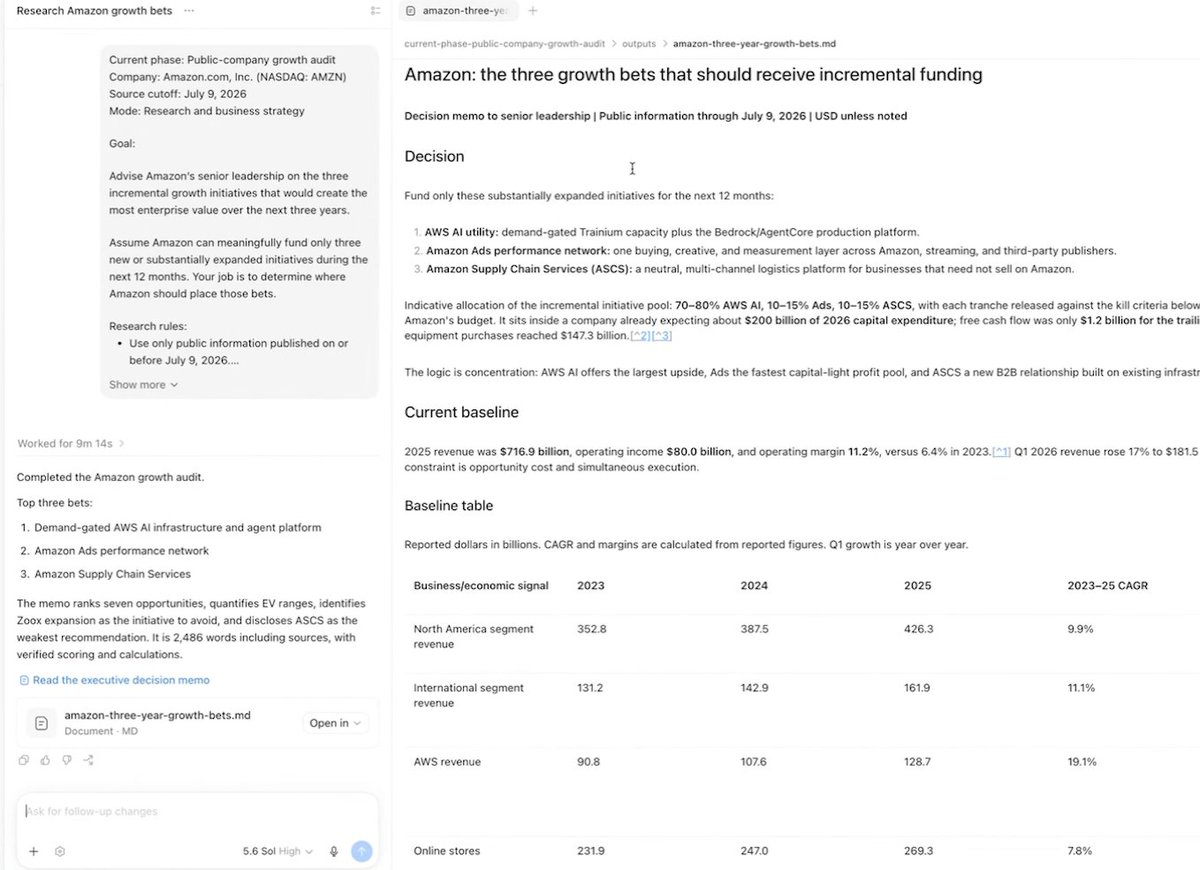
To see whether this holds up past design work, I gave both a heavier job. Advise Amazon's senior leadership on the three growth moves that would create the most enterprise value over the next three years.
Sol 5.6 came back in about nine minutes. It put roughly 70 to 80 percent of the weight behind AWS AI, 10 to 15 percent into ads, and 10 to 15 percent into Amazon's supply chain services.
It ranked the opportunities and laid out the revenue segments behind each bet.
It even flagged Amazon's supply chain services, a newer part of their business, as a growth lane worth going after. That's not the obvious pick, and it's the kind of call I'd want a good analyst to make.
That's the sort of memo I'd use to decide whether to pitch a company or put money into one.
Fable 5's analysis was just as strong. It only took longer to get there.
This was the closest job of the whole test. Both landed on a good answer, and both surfaced bets I'd consider.
What the stalls cost me
There's a cost these comparisons skip, and I felt it all week.
Every time a model stalled, it burned something. The site run tied up three hours. The thumbnail job failed its download and still drained Higgsfield credits on the way to nothing. The clip job looped while I waited.
A benchmark won't tell you about any of that. I felt it in my week and on my bill.
A model that finishes on the first pass saves me the second pass, the debugging, and the credits I'd burn getting there. Over a full week of marketing work, that adds up to a lot of hours and dollars.
Where I land
Fable made the better-looking work more than once. Better brain design, more taste, cleaner output. On looks alone, it wins a few of these.
But looks were never the job. I needed thumbnails on the channel, clips on the feed, a site that works, a memo I could act on that day.
And every time a job had to get across the line, 5.6 got it there: six-minute thumbnails while Fable choked on the download, a finished world while Fable sat three hours deep, ten of twenty-one clips rendered while Fable was still looping.
So for early marketing work, I'm reaching for Sol 5.6 right now. I still love Fable 5, and it genuinely out-designed 5.6 more than once here. These models leapfrog each other every few weeks, so treat this as a this-month read.
The reason I care goes beyond which model is ahead today. When a model can finish a job on its own, I turn that job into a skill and run it forever.
The thumbnail process, the clip-finding, the site build, they all become repeatable instead of something I sit and steer every time. I'm already turning the thumbnail and clip workflows into skills off the back of this test.
That's the whole reason I pick the model that finishes. It hands me work I can systematize, and that work keeps paying long after I close my laptop.
What would you choose?
If you're a business that wants AI systems built for you, check out https://www.singlebrain.com
For marketing help, go to https://www.singlegrain.com
For more like this, level up your marketing with 14,000+ marketers and founders in my Leveling Up newsletter, free: https://levelingup.beehiiv.com/subscribe
If you want to join our team, beat AI first ;) https://github.com/ericosiu/beat-claude Embedded post:
Author: ericosiu (@ericosiu) Post ID: 2075763942895538641 Source: https://x.com/ericosiu/status/2075763942895538641 Reply to: none
Text:
> Yeah. Sol 5.6 completely crushes for YouTube thumbnails.
>
> Everyone can be a world class thumbnail designer now.
>
> @MrBeast pays up to 5 figures for the best of the best.
>
> You can get great quality thumbs with a strong skill.
>
> 
Media:
- image: https://pbs.twimg.com/media/HM6YL_baUAAg87E.jpg
- image: https://pbs.twimg.com/media/HM6YL_abgAA7Umf.jpg
- image: https://pbs.twimg.com/media/HM6YL_bb0AAE1ZY.jpg
Prompts
same prompt, one job
        |
        v
run it through both:
  Sol 5.6  vs  Fable 5
        |
        v
graded on two things:
  does it look good?
  does it ship on its own?
Links
Related articles

how to FORCE sonnet 5 to give you viral AI short-form vid ideas
every content team solves the same problem every monday morning: what content do we make this week?


How to Build an AI-Native Company: Hiring, Standards, and Cadence
*We spent a year running hackathons, AI trainings, and office hours. But nothing changed until we made AI capability a requirement.*