Start a 1-Person Business with Claude (FULL COURSE)

I run a $40k MRR agency with zero employees
No developers. No sales team. No ops manager. No agency partners taking 30%
Just Claude Code, a folder of skills organised like a real company, and a client pipeline that fills itself while I sleep
This is NOT another "AI will make you rich" article. I'm going to show you every system, every prompt, every price and every mistake, in order, from zero
If you need money next week, close this tab. If you're ready to build something real over the next 3-6 months, this is the only article you need
After reading and implementing this, you'll have:
A complete AI operating system for your business (Claude Code + a skills folder backed up in the cloud)
Two client machines running in parallel (freelance platforms + cold email on autopilot)
A sales process that closes without being salesy (including the trick where Claude listens to your sales calls)
Three service tiers you can deliver completely solo: websites, automations, full AI systems
A build framework that lets you ship things you've never built before
A pricing model that keeps clients paying for years (the 5x rule)
[ Let's build it ] ↓↓↓
Why a 1-Person Business? (And Why 2026 Is the Cheat Code Year)
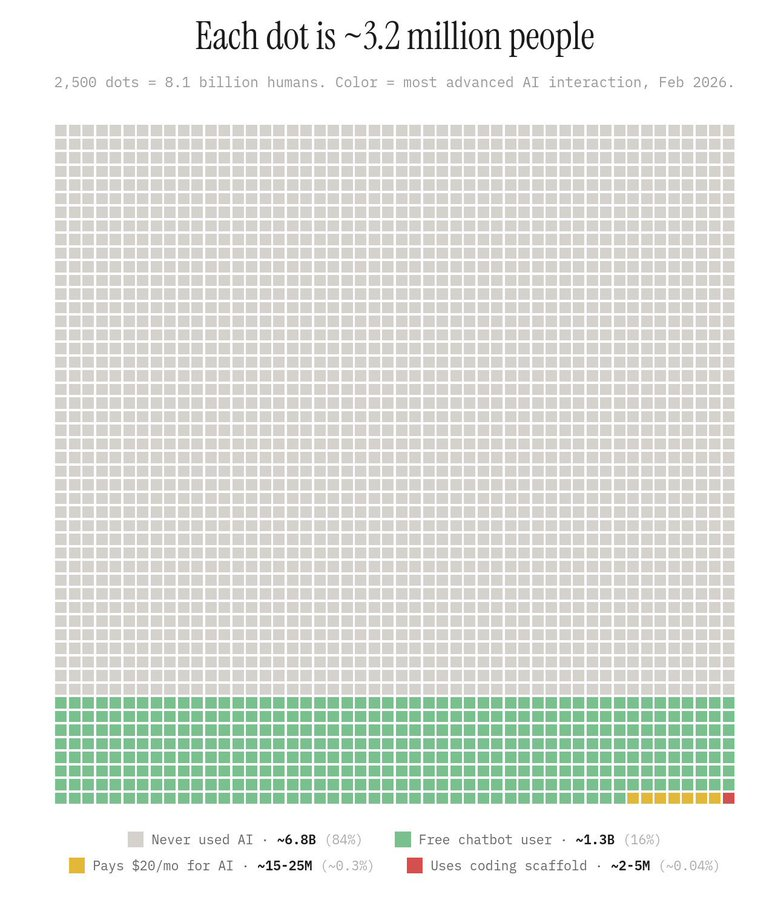
Quick math on where the world actually is with AI:
Roughly 84% of the planet has never used AI once. Not one prompt
Around 16% touched a free chatbot and stopped there
About 0.3% pay $20/mo for a real model
And a rounding error of humanity knows tools like Claude Code exist
You're reading an article about running a company on Claude skills
You're not late. You're early by default
Here's why that matters for money:
Billions of people and tens of millions of businesses will NEVER learn these tools
They're focused on their craft: roofing, dentistry, law, e-commerce
To them, what you'll build by the end of this article looks like magic
And magic is billable
One more unlock most people miss:
3 years ago only the US, UK, Canada and Australia were realistic markets for AI services
Right now Europe, LATAM and Asia are waking up at the same time
If you speak Swedish, Portuguese, Greek, Polish, anything non-English: that market is basically EMPTY
Same service, near-zero competition, way higher reply rates
The Honest Part (Because I Promised No Guru Energy)
Every new business follows the same curve:
Day 1: you're hyped. "I can automate everything, clients everywhere, I'm rich"
Week 3: reality. The first client is hard. Skills take time. Nobody answers your messages
That's the bottom of the curve, and 95% of people quit exactly there
They call it a scam and move on to the next shiny thing
The 5% who push through the flat months win everything
My first client took months of daily outreach and paid a few hundred dollars
If that sentence just killed your motivation, this business is not for you
If it didn't, remember one rule for the rest of this article:
GET GOOD BEFORE YOU GET RICH
People pay you for the time you invested into skills they don't have. No skills = no invoice
The Business Model (3 Levels, You Start at Level 1)
Before any tools, here's the full map of what you're actually selling
Level 1: AI-Built Websites
Roughly 30% of US small businesses have no website at all. Most guides tell you to chase them
Don't. A business that survived 15 years without a website doesn't want one. That's the hardest sell, not the easiest
The real buyers are the other 70%: businesses with BAD websites
They already paid for one once, so they're proven buyers. The pain is visible: slow, broken on mobile, invisible on Google, looks like 2011
Plus two bonus segments almost nobody targets:
-
brand-new businesses (fresh LLC registrations are public data, they need a site NOW and have no vendor yet)
-
businesses running ads into a bad site (easiest pitch alive: "you're paying for clicks that bounce")
Easiest to deliver, fastest first dollar, and every rebuild starts with proof: their current site IS the before picture
Example on how you can get build easily one (with no specific design skills):
Typical ticket: ~$500 first sale, $3-10k once you have proof
Level 2: Automations and Agents
Invoicing, lead follow-up, onboarding, review collection, support
This is where recurring revenue starts: things that run monthly get billed monthly
The niches where this is genuinely bleeding money:
- home services (roofers, plumbers, HVAC): one job is worth $2-15k
and the owner is on a roof when the lead calls. missed-call textback + follow-up is a printing press here
-
dentists and clinics: every no-show costs $200-500. reminders, recalls and reactivation sell themselves
-
real estate: a lead answered in 5 minutes converts many times better than one answered in an hour. speed-to-lead automation is the product
-
law firms: intake chaos + clients ghosting paperwork. document chasing alone is worth the retainer
-
solar and contractors: graveyards of old quotes. one reactivation campaign = five figures from zero ad spend
-
e-commerce, gyms, salons: support inboxes, win-backs, abandoned carts
and here's the cheat code:
it's the same 4 automations in every niche. instant follow-up, review collection, reminders, dead-lead reactivation
build them once, skill-ify them, deploy per niche forever
Typical ticket: $1-5k setup + $200-500/mo
Level 3: Full AI Systems
5-25 automations bundled behind one dashboard the client logs into
The client sees executions, hours saved, money saved. It's a product, not a gig
Typical ticket: $10-20k projects or $2-5k/mo retainers
The Rules of This Model
Everyone starts at level 1, no exceptions. Websites build skill, trust and testimonials at once
Levels compound: the client who bought a $500 website buys a $2k/mo system 8 months later
And you're not selling AI. Nobody pays for "an agent"
BAD: "we implement AI agent solutions"
GOOD: "you'll never miss a lead again, and your invoices send themselves"
[ PLAYBOOK BEGINS ] ↓↓↓
Your AI Operating System (The 20 Minute Setup)
Your entire company will live in ONE folder
Claude Code is the operating system, skills are the employees, the folder is the office
Setup, step by step:
- Install VS Code
You won't write code. Claude will. VS Code is just the garage
- Install Claude Code from the terminal
Log in with a subscription (Pro or Max), not an API key. Pro is enough to start
- Create your company folder and name it like your agency
This folder is your business. Everything you ever build lives here
Here's the exact structure you're gonna build:
Go create this structure RIGHT NOW. Seriously, pause reading and do it
Empty folders are fine today. They fill up over this article
- Install your first skills
Skills are portable instruction sets that turn Claude into a specialist. I shared my full org chart of them before (42+ skills organised like departments), grab what fits
Install flow, copy-paste this into Claude Code:
Restart the session after installing, skills load on start
- Back it up
Create a PRIVATE GitHub repo named after your agency, then tell Claude:
If your laptop dies tomorrow, your company shouldn't die with it
The Core Principle (Remember This One)
The IP of a one-person business is not code
It's your SOPs, your processes and your skills
Every time you build something twice, turn it into a skill
By month 6 your skills folder is worth more than your client list
OS is running. Now we need the thing every beginner skips: customers
[ Client Machine #1 ] ↓↓↓
Personal Brand + Lead Magnets (Clients Come to You)
Most guides send beginners to freelance platforms
I won't. A fresh profile with zero reviews competes against 6-year-old accounts, and you pay for every application. Brutal place to get offer #1
Here's the smarter machine: build proof in public and let clients DM you
The Proof-First Principle
Nobody hires a stranger with no track record
But here's the cheat: you don't need clients to build a track record
You need BUILDS. And with Claude you can produce a portfolio in one weekend that most freelancers take a year to collect
Step 1: Build Before Anyone Asks
Pick ONE niche (say, roofers or dentists)
Then build 3-5 real demos for businesses in that niche:
-
a premium website for a real local business (yes, without asking)
-
a missed-call textback automation with a 60 second demo video
-
a review-collection flow showing the before/after math
fake clients, real builds. the work is identical to paid work, only the invoice is missing
Step 2: Post Every Build (The Content Engine)
every build becomes 3-5 posts:
-
the 60 second screen recording: "built this website for a local roofing company in 10 minutes with Claude"
-
the before/after shot of their current site vs your rebuild
-
the numbers post: "this automation answers calls the owner misses. roofers lose $2-15k per missed call"
-
the how-I-did-it breakdown for the builder audience
post on X and LinkedIn, daily. one platform for reach, one for buyers
you're not posting content. you're posting EVIDENCE
Step 3: The Lead Magnet (Turn Views into DMs)
a lead magnet is something so useful people hand over contact
info to get it. yours are free because Claude built them:
-
the niche template pack: "5 website templates for [niche], free, DM me TEMPLATE"
-
the audit: "comment AUDIT and I'll record a 2 minute video on what your website is losing you"
-
the calculator: "this tool shows how much revenue a slow site costs you. link below"
the mechanic that matters: make them COMMENT or DM to get it
every comment = the algorithm pushes your post harder
every DM = a warm conversation you didn't cold-start
Example on how you can sell your product with this mechanics:
His tweet got 765 interested people in this system
For example 300 of 765 will read the docs he sent in DMs
In this doc, he literally leaves a lot of sales magnets to "BOOK A CALL" or if you want to get ready such as system with no efforts, "BUY IT HERE"
His system costs $247 (and let's just imagine the most minimum conversion 1%). That's 3 buyers at $247 = $741 from only one tweet and it scales...
In total, from such as conversion loops, he has already attracted 683 members who got interested to buy this system for $247 (IN TOTAL: $168,701)
Proof from Whop:
Step 4: The Smart Sell (The Demo-First Close)
here's the move that closes the loop, and it's the whole philosophy of this article in one play:
- find a business in your niche with a bad website
-
rebuild their homepage with Claude (10 minutes, you have the skill)
-
deploy it on a free subdomain
-
send the owner a short loom: "I rebuilt your homepage, here's yours vs this. if you want it, it's yours, and I'll connect your domain today"
-
post the before/after publicly (blur the name if they haven't answered)
you're not asking for work. you're handing them the finished product with the price tag as the only step left
rejection rate is irrelevant: every "no" still produced
a portfolio piece and 3 posts
Step 5: First 3 Clients = Testimonial Price
your first 3 clients don't pay full price, they pay in proof:
"I'll build it for [cheap/free]. in exchange: a testimonial, a case study with real numbers, and 2 referrals if you're happy"
after 3 case studies with numbers, the personal brand machine
runs itself: post proof, collect DMs, close on calls
and unlike a freelance profile, this asset is YOURS. every post compounds, nobody charges you per application, and the audience you build becomes distribution for everything you ever sell after
Personal brand is your daily grind. now the machine that works while you sleep
[ Client Machine #2 ] ↓↓↓
Cold Email (The Background Engine)
Personal Brand = active daily work, an hour or two every day
Cold email = passive pipeline, set up once, feeds you leads in the background
Run BOTH from day one. This pair is the highest-leverage combo that exists for a beginner
The Stack:
Deliverability Crash Course
Skip this and you burn your domains:
NEVER send cold email from your main domain. One bad campaign kills it
Buy pre-warmed domains inside the sending tool (~$10-15 per domain, 5 inboxes each)
Each inbox sends ~20 emails/day safely, so one domain = ~100 sends/day
Warming your own domain takes ~30 days, pre-warmed skips the wait
Set domain forwarding to your real website so curious prospects land somewhere real
Wait for 100% health score before sending anything
Building the List
The formula:
[niche] x [country] x [1-50 headcount] x [owner/founder titles] x [verified emails only]
Filter in Apollo: location, industry keywords, titles (CEO, Founder, Owner), verified emails
Headcount is the most underrated filter: 1-50 employees means the owner reads their own inbox
Export through a scraper: 1,500 leads for ~$25 instead of Apollo pricing
Clean the list through a verifier: expect ~60-65% "good", send ONLY to good
Sending to dead emails = bounces = blacklisted domain = start over
And remember the language arbitrage: Swedish, Portuguese, Greek, Polish inboxes are EMPTY while US inboxes are a warzone. Same offer, translated, multiples of the reply rate (check local cold-email laws first, seriously)
The MCP Moment
Now the part that makes this a Claude article
Connect your sending tool's MCP to Claude (Claude settings → Connectors → add custom connector → paste the API URL)
Suddenly Claude can create campaigns, write sequences, pull replies and manage follow-ups on its own, ~38 tools worth of control
Then encode your campaign structure into a skill. The skill interviews YOU before writing:
Answer, and Claude drafts the full sequence with follow-ups and creates it in the tool through the MCP. You review, save, launch
Here's the first-email framing that works:
The Numbers
So you know what "working" looks like:
A good campaign: ~10,000 sends, 5%+ reply rate. The industry norm is ~0.5%
Follow-ups produce most of the replies. Never send one-and-done
Rule of thumb: 100 sends/day = one interested lead every other day
One interested lead every other day = a full calendar within a month
And the offer rule that drives all of it: never email "we do AI solutions". Email a tangible artifact. "I built your company a demo site, here it is" flips the whole dynamic, they've seen the product before the call even starts
Leads are replying. Now the part everyone fumbles: the call
[ The Sales System ] ↓↓↓
How to Close Clients (The Doctor Approach)
Beginners lose deals in three places: before the call, during the call, after the call
Here's all three, fixed
Before the Call
Rule 1: NEVER give price before the call
Price in DMs = judged on price alone, they can't see value yet
Price after a demo = compared against the value they just saw
Show $10k of value, then say $2k, and their brain does the math for you
If they push for price over text: "depends on scope, that's exactly what the 15 minutes is for"
Rule 2: confirmations + reminders on every channel
People forget they booked, feel embarrassed, and ghost. Kill it with cadence:
The demo mention is deliberate. Skipping a meeting where someone built something FOR YOU feels rude. Guilt is a show-up strategy
Rule 3: never sell in DMs
Limited info in text, full value live
During the Call
A doctor doesn't open with "buy this prescription"
They ask where it hurts, diagnose, THEN prescribe
You talk 20%, they talk 80%, and your 20% is mostly questions
Why it works: when the CLIENT says the pain out loud, they convince themselves. You can't out-argue a conclusion they reached on their own
The question ladder:
Question 3 is the pattern: make them state the loss themselves
Question 4 makes them price the solution before they've heard your price
The call skeleton:

Pain questions (the ladder above)
"I might have something for this, let's see if it even makes sense"
Show the demo, screen share, under 10 minutes
State the price. ONE number, clean
Then SHUT UP. The silence after price is where deals close. Don't fill it
Handle objections (they're usually questions in disguise: "what if it doesn't work?"), answer, close
And the ethics line: if they don't need it, tell them. A business with 500 reviews doesn't need your review system. One honest "you don't need this" generates more referrals than any close
Closing Mechanics
Always book the next call ON the current call. Calendar = commitment. "Let me send the invite right now while we're here"
Always take a commitment on the call
The $1 Stripe trick: create a $1/year recurring payment link. "Let's put a card on file, it's $1 and I'm refunding it". Later you charge the real amount with zero friction
And the conversion weapon, the Proof of Concept close:
Payment upfront + satisfaction guarantee
"You pay to start, I build the entire thing, you see the finished product, and if you're not happy: full refund, no questions"
Removes 100% of their risk, signals total confidence
If your work is good you will basically never refund, and your close rate jumps
After the Call
Overdeliver on the first project. Your reputation IS the business at this stage
Set recurring bi-weekly review calls with every client. Agencies average 20-30% monthly churn, review calls take you to ~5%. 30% churn means clients stay 3 months, 5% means years
Upsell ON those calls, never cold: website client → review automation → AI phone agent → ads
Referrals, 2 rules: be SPECIFIC ("do you know any plumbers or electricians?" beats "know anyone?", the brain can't search "anyone") and give 20% commission on referred revenue
The Claude Trick I Promised
Connect an AI notetaker MCP to Claude (Fathom or similar). It records and transcribes every call
After the call, one prompt:
Claude reads the meeting, writes the spec, and can START BUILDING before you've had lunch
Zero context loss between what the client said and what gets built
Client closed, money committed. Now we deliver, and this is where Claude turns you into a team
[ Delivery Level 1 ] ↓↓↓
Websites (Your First Product)
~10 million US small businesses have no website. They will never learn Claude Code, they're busy roofing and filling teeth. That gap is the job
What the market charges:
The $500 first website is not underselling. It's buying a testimonial, a portfolio piece and a future upsell path in one transaction
The Build
Use a premium-website skill (build one or grab one from the skill repos)
/build-premium-website, then answer the interview: industry, brand vibe, colors, services
Production React + Tailwind site on localhost in under 10 minutes
Then iterate with screenshots: paste what looks wrong, describe it in plain words, Claude fixes it
What Makes It Sellable (Not Just Pretty)
Bold CTA above the fold with a click-to-call number
Social proof section: reviews, before/after photos
Contact form wired to their CRM or email
Fast load, animations in code
Mobile checked (inspect → toggle device view)
Most designers build pretty sites that don't convert. You build converting sites. That's the pitch
Ship It, Free
Push the code to a GitHub repo
Vercel: add new project, paste the repo, deploy
Live in ~30 seconds on a free subdomain
Custom domain later through any registrar
Hosting cost at this stage: $0
The Portfolio Play
Build 5 template sites for 5 different industries THIS WEEK. Fake businesses are fine
One portfolio site that showcases all 5
Prospects pick instead of imagine, and picking closes faster than imagining
These templates are also your Upwork portfolio and your first proof posts
Then, after your second real website: encode the process into a skill
Delivery collapses from days to an afternoon
You just created your first employee
Websites open doors. Automations keep the money coming every month
[ Delivery Level 2 ] ↓↓↓
Automations (Where Recurring Money Starts)
The default advice is drag-and-drop builders. Skip them
Use a code-based open source automation runner instead, here's why:
Claude writes code better than it clicks UI
Code is versionable, testable, and lives in your GitHub
Open source = host anywhere, even on the client's own servers
"Runs on your servers" is a phrase enterprise buyers pay extra for
For third-party access use an OAuth broker (Composio style) so Claude never touches raw Google credentials. You run one script, click two links, connections go active
One Complete Build: The Invoicing Automation
Form in → PDF invoice out → auto-sent via Gmail → archived to Drive
The prompt pattern:
Memorize that pattern, it repeats for everything: outcome + skills to use + constraints + plan mode
Claude asks clarifying questions (fields, trigger, email style), you answer, approve the plan, it builds
Then wire it up:
The Debug Loop
Something always breaks on the first test. The loop:
"check the logs, did my test work?"
Claude reads the run logs, finds the issue, fixes it, you rerun
Repeat until green. You never open a stack trace yourself
This loop is 80% of what "being technical" means now
Deploy the task to production, deploy the form to Vercel, done
One SECURITY WARNING: an exposed endpoint wired to your API key = a stranger burning your credits at 3am. Auth on anything public is not optional (the full pattern is in the next section)
The Biggest Idea in This Article
BUILD ONCE. SKILL-IFY IT. DELIVER FOREVER
After any successful build:
Then double check: "is this skill standalone? does it reference the invoice app anywhere?"
Your skills folder = your product catalog = the actual IP of the business
Every skill is an employee that works free, forever
Single automations sell for hundreds. Bundled systems sell for thousands
[ Delivery Level 3 ] ↓↓↓
Full AI Systems (The $10k+ Tier)
A full AI system = 5-25 automations behind ONE dashboard the client logs into
Most agencies hand over spaghetti flows the client never opens
You hand over a product: executions this month, hours saved, tickets answered
The dashboard is what makes a retainer feel like software instead of an invoice
The stack:
The Build Order That Works
- Scaffold the structure FIRST with zero design
Dashboard page, sidebar of automations, settings, login
The rule: it's much harder to fix bad to good than to build good from the start, but structure comes before beauty
- Design makeover pass with a frontend skill
"Give this app a makeover, [style] vibe, light and dark mode", then iterate with screenshots
- Install automation #1
The invoicing build you already have, rebranded inside the dashboard
- Onboarding automation, built in minutes
Contract PDF generated with the client's details + calendar link email + onboarding survey
One trigger, three emails, new client onboarded while you sleep
- The flagship: the AI support inbox
What it does:
Watches a shared support inbox every 10 minutes
RAG over the client's knowledge base (they paste docs, PDFs, URLs)
Auto-answers the ~60% of tickets that are repetitive
Every answer ships with a confidence score + citations
Low-confidence tickets escalate to a human queue WITH a pre-drafted reply waiting
Analytics tab: tickets answered, escalation rate, hours saved
The Economics That Sell It
And the same system resells to your next client with just a new knowledge base. Second sale = almost pure margin
Ship It + Skill-ify It
Private GitHub repo, Vercel deploy, set every env variable in the hosting dashboard, and update the auth URL from localhost to the live domain (everyone forgets this exactly once)
Then the final skill-ification: encode the whole scaffold as a "new-client-system" skill that asks for client name, email domain and brand colors
Every future client gets a live dashboard on DAY ONE, in minutes
This is the moment it stops being freelancing and becomes a company
And if you're thinking "I could never build this", the next section deletes that excuse
[ The Meta-Skill ] ↓↓↓
How to Build ANYTHING With Zero Experience (The 4-Step Framework)
- BUILD PLAN (the design spec)
What you're building + the tech stack + the design and UX
The stack determines cost, speed, scalability and how hard it is to extend later
Go back and forth with Claude for literally HOURS on a complex build
This document is where the project is won or lost
- IMPLEMENTATION PLAN
The how: the build plan broken into steps with checkboxes
A complex build is ~40 steps: file structure, database, auth, features, in order
Forcing sequence forces good decisions
- BUILD
Feed steps one at a time: "start with step 1"
Approve between steps, don't dump the whole plan at once
Use sub-agent execution for speed on big builds
- TEST AND REFINE
You WILL hit bugs. Paste every error to Claude verbatim
Then the design makeover pass at the end
The Ratio Rule
80% of your time goes into steps 1 and 2
20% into step 3
Everyone does the opposite, then wonders why the AI "built the wrong thing"
Give me six hours to chop down a tree and I'll spend four sharpening the axe
The Zero-Experience Cheat: Two-Model Verification
One AI proposes the stack and the plan
A second session audits it: "here's a proposed architecture, is this actually the right choice? what breaks at scale?"
Consultant + auditor. They catch each other's blind spots
This is how you make senior-engineer decisions with zero background
And when you don't know the answer to a clarifying question, "what would you recommend?" is always allowed
Your kickoff prompt for anything:
The framework is the skill. The stack is a detail
You can build anything. Now let's make sure you charge like it
[ Pricing ] ↓↓↓
How to Price AI Services (The 5x Rule)
The golden rule of everything:
GIVE EVERY CLIENT A 5X RETURN ON WHAT THEY PAY YOU
Save them $10k/mo, charge $2k/mo
Why it works:
The client re-does the math every month and re-decides to stay. Make the math undeniable
Low churn compounds into referrals
Enough referrals = negative churn: the agency grows without outreach
Calculating the Value
Path 1, payroll saved:
Path 2, new revenue:
Price on GROSS PROFIT of NEW revenue only, never existing
System generates $100k/mo new revenue at ~$40k gross profit → your price ~$8k/mo
The Three Pricing Structures
- Result-based (% of gross profit, ~20%)
Highest ceiling, scales infinitely with the client
Requires trackability: a real CRM, clean attribution
One result-based client can produce six figures of LTV where a retainer would have made $12k
Rule: retainer if you're average, result-based if you're great
When value is untrackable (a support widget), fall back to per-unit pricing (~$1 per conversation)
- Upfront + recurring (the default)
Example: $2k upfront + $500/mo service fee
The upfront creates commitment. Clients who pay nothing ghost
The recurring is justified as support, monitoring, fixes, improvements
ALWAYS pair with the satisfaction guarantee
Ten clients on this = $5k/mo baseline before any new sales
- Usage tiers (whale insurance)
Like software: 100 calls / 1,000 calls / 5,000 calls / custom above
Protects you from the $500/mo client who turns out to do 10,000 calls
Simplicity Rules
A confused person doesn't buy
ONE price, not a menu of line items
Bundle software costs into your price 99% of the time ($600 flat beats "$500 + $100 in tools")
Exception: enterprise that wants to own and host everything, they pay their own tooling and a much higher fee
And the rule above all pricing rules:
BAD: "an AI agent with RAG over your knowledge base and confidence-scored escalation"
GOOD: "your support inbox answers itself and you save $10k a month"
Nobody buys AI. Nobody even buys automation. They buy more money, more time, and fewer employees doing boring work
One more engine and the whole loop closes
[ The Flywheel ] ↓↓↓
Show Your Work (The Compounding Loop)
Every client build is a content asset you already paid for
The loom you recorded for the proposal: content
The dashboard screenshot: content
The before/after of their website: content
The support inbox hitting 63% auto-answered this month: content
The loop:
build for a client → post the proof → proof pulls inbound leads → inbound = no connects, no sending costs, no cold anything → better clients → better builds → better proof → repeat
What to post: "built this in 10 minutes with Claude" screen recordings, before/after shots, real numbers, and the org chart of your skills folder (meta, but it works, ask me how I know)
I run this exact posting system across 10 platforms without writing anything manually. The full breakdown is in my Content Engine article, it's the perfect companion to this one
Your agency and your audience feed each other. Most people build only one. Build both
CONCLUSION (what to do)
-
Set up the OS today: folder + Claude Code + skills + GitHub backup. 20 minutes, do it right now
-
Build your first template website tomorrow for a fake business, deploy it free
-
This weekend: create your freelance profile AND launch one small cold campaign
-
Spend 4 HOURS A DAY on outreach. Marketing and selling are the real skills of this business, not AI. This is the part everyone underestimates and the reason most people fail
-
Take your first clients free or cheap. You're buying testimonials, trust and reps, not income
-
Get to $2-3k/mo that covers your life. The success criteria of business is staying in business. 9 out of 10 die here, not at scaling
-
Then raise prices. Fire broke and annoying clients. Fewer clients, higher pay
-
Find the bottleneck, fix it, find the next one. Leads, then calls, then delivery, then leads again. You'll be on this step forever. That's the job
And the honest footnotes:
You don't have to quit your job. Build 5-9am when your brain is fresh, work 9-5, two hours in the evening, weekends
Growth is exponential AND volatile: months of flat, then it clicks, then a dip, then a bigger click
One person is how you START, not a cap. Claude carries 10-15 clients mostly on its own
And don't over-automate. Sometimes hiring one human for calls beats three weeks of building a mediocre automation. Even coming from me
A business used to be an office full of people
Now it's a folder, a subscription, and someone who refuses to quit
If you loved this article and found it valuable, please put the LIKE + RT ❤️
If this article collects 2,000+ Likes, I drop the full skill pack from it (proposal writer, campaign builder, website builder, new-client-system) in a follow-up
Now, it's time to go build it buddies 😎 Embedded post:
Author: Miko (@Mho_23) Post ID: 2071293386724982947 Source: https://x.com/Mho_23/status/2071293386724982947 Reply to: none
Text:
> I just cracked the code on AI animation ads 🤯 > > every one of these cost me 12 cents and under 20 seconds to make > > Gemini Omni + Claude Code is f*cking wild. > > i built a system that turns any product into an end-to-end AI animated ad in ANY style you want.. claymation, pixar-style 3D, anime, paper cutout, lego, you name it > > you drop in your product photo and a one line pitch and it handles everything end to end. images, video, voiceover, music, captions, all generated with AI inside Claude.. > > AI animation ads are crushing on Meta right now and everyone still assumes you need an expensive editor with a 3-week turnaround time to make one. you don't. you just need the right workflow. > > Im making full end to end high quality AI animation ads in under 3 minutes with this system > > and they work just as hard organically on TikTok, reels and shorts > > so i packaged the whole thing up… > > here's what you're getting: > > > every prompt i used across all 8 steps > > > the exact tool stack + the order to run it in > > > style recipes for claymation, pixar, anime, wes anderson, retro cartoon + CGI > > > one system that works for paid Meta AND organic > > built across Claude Code and Gemini Omni > > RT + reply 'STYLES' and i'll send it over (must be following so i can dm)
Media:
- video:
Prompts
Instantly        sending + inbox management      ~$10-15 per domain
Apollo           lead database + filtering       free to browse
lead scraper     exporting Apollo lists          ~$0.005 per lead
MillionVerifier  cleaning the list               cheap per batch
Claude + MCP     writing and managing campaigns  your subscription
runner API key      (from the automation platform)
auth broker key     (from the OAuth service)
Anthropic API key   (for AI-generated email text)
Drive folder ID     (from the folder URL)
business details    (logo URL, bank details, currency, net terms)
I want to automate my invoicing process

Flow: I fill a simple web form, it builds the invoice,
exports a PDF, emails it to the client via Gmail,
and archives a copy to Google Drive

Use two skills:
1. the composio skill for all third-party authentication
2. the trigger.dev skill to build and host the task

Auto-generate invoice numbers by date. Keep all secrets
in a .env file, nothing hardcoded

Plan mode first: ask me your clarifying questions before building
front end    Next.js + Tailwind + shadcn components
auth         magic links via email, no passwords,
             restricted to the client's email domain
back end     code-based automation runner (open source)
database     MongoDB (built-in vector search for RAG)
hosting      Vercel (front) + runner cloud (back),
             or the client's own servers for enterprise
1. What are you selling and to whom? (one paragraph)
2. What's the #1 pain this niche feels daily?
3. What tangible asset does the email offer?
   (a demo site, a lost-revenue calculator, an audit,
   this becomes the subject line)
4. What should the campaign be called?
Create a skill from what we built this session

Make it GENERIC: any mini automation with a form front end,
a background task back end, and OAuth-brokered integrations,
not invoicing-specific

The skill must interview the user about their use case first,
and must research before building

Make it fully standalone: no references to this project's paths

Verify it's standalone before finishing
instantly:     "confirmed, [day] at [time]. calendar invite sent"
every 3 days:  "still on for [day]! preparing something for you"
1 day before:  "quick reminder about tomorrow. I built a demo
                based on your actual business, excited to show it"
1 hour before: "see you at [time]"
5 min before:  "just wrapping another call, see you in 5"
/your-agency
├── CLAUDE.md              (who you are, what the business does, how to behave)
├── skills/
│   ├── engineering/       (superpowers, context7, mcp-builder, webapp-testing)
│   ├── design/            (frontend-design, taste, brand-guidelines)
│   ├── sales/             (proposal-writer, campaign-builder, call-prep)
│   ├── delivery/          (build-premium-website, mini-automation, new-client-system)
│   └── operations/        (invoicing, onboarding, reporting)
├── clients/
│   └── [one folder per client: context, transcripts, builds]
├── templates/
│   └── [website templates, contract template, proposal skeleton]
└── content/
    └── [proof posts, looms, screenshots for marketing]
I downloaded a folder of Claude skills to my Downloads folder

Research the official documentation for installing Claude skills
in a project, then install them into this folder

After installing, list every skill you now have access to
1. "how do new customers usually find you right now?"
2. "what happens to a lead that calls after hours?"
3. "what do you think a customer does when they compare
   your 5 reviews to your competitor's 150?"
4. "how much is one new [job/patient/client] worth to you?"
5. "what have you already tried to fix this?"
subject: [tangible asset for their business]

I was going to call, but figured I'd write first

I think [company] is losing [jobs/patients/orders] because
[specific observable problem: site doesn't rank, no reviews,
slow follow-up]

I made you [the asset] so you can see what I mean: [link]

Worth a 15 minute call?
support team: 10 reps at $3k/mo
your system cuts it to 5
value created: $15k/mo
your price at 5x: $3k/mo
client keeps: $12k/mo, forever
template freelancer         $1-3k
boutique studio             $3-10k
proper agency               $10-30k
mid-tier agency             $30-80k
top agency                  $80-250k+

your realistic FIRST sale   ~$500
your target in year one     $3-10k
a support rep costs        $2-4k/mo
a 10-person team cut to 5  saves $15k/mo
you charge                 $2-5k/mo
client still saves         $10k+/mo

nobody churns from that math
Check the transcript from my [time] call with [client]

Extract: their business context, every pain point mentioned,
what we agreed to build, timeline and budget signals

Write a full project spec into clients/[client-name]/
and propose the build plan
push this folder to [repo url], don't push any secrets
I want to build [thing]

First: a build plan. Ask me questions about how it should
work, then write the design spec as a .md file

Recommend the tech stack and justify it: cost to run,
speed, scalability

Don't write any code until I approve the spec
Related articles

How to design an AI agent
Who the fuck wants to pay for your platform when $200 already buys Claude Max or Codex?

How I Use Claude Fable 5 to Build $10k/Mo Faceless AI Story Channels
Six months ago, every AI-generated YouTube script I produced needed 2+ hours of manual rewriting before it was usable. Characters changed names between chapters. Documentary scripts cited events from…

The Production AI Stack for Solo Builders
*One-person companies now ship like ten-person teams. The ones that survive run a system: a build loop the model cannot lie to, a defense layer attackers cannot walk through, and operations that run…