The 12 People Who Actually Built Quantitative Finance. Steal Their Fundamental Knowledge for $0
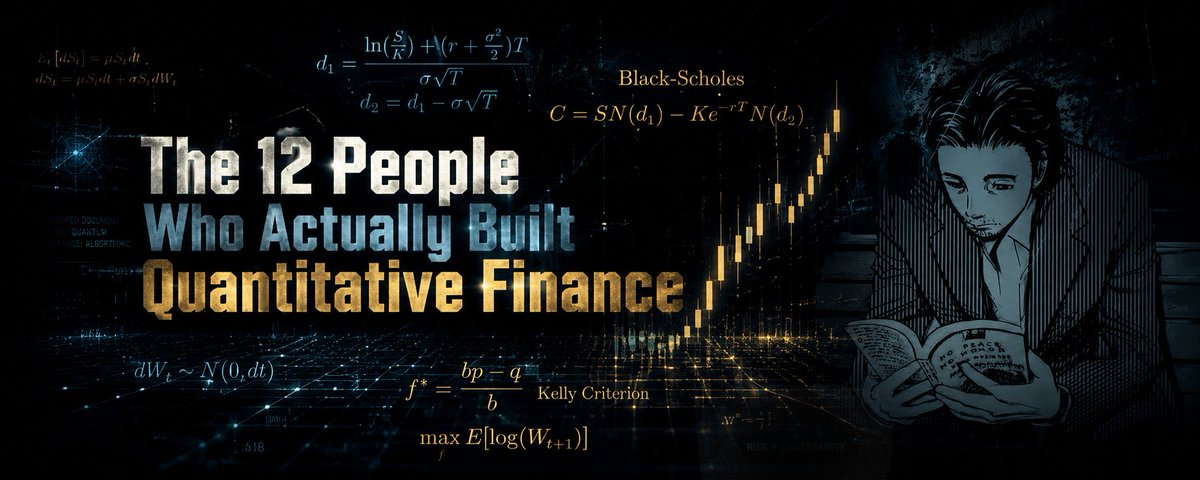
You look at charts and think you feel the market
These guys didn't feel anything. They wrote equations. And they extracted trillions
Through pure math and obsession
Here's what I learned from studying all of them
1. Jim Simons (1938-2024)
Firm: Renaissance Technologies (founded 1982)

PhD math from Berkeley. Cryptanalyst. Then chair of Stony Brook math department. Chern-Simons theory in physics. Thats his legacy in academia
But the market? That's where he became immortal
**The Medallion Fund, launched in 1988, is what RenTec is best known for: ~40% annually. NET. Closed to outsiders since 1993**
Simons proved that real scientific talent dominates traditional finance backgrounds. He hired physicists, mathematicians, coders. Not bankers. Not MBAs
> Lesson: The quality of brains in the room matters more than any diploma. The Medallion team is probably the smartest collection of people in any financial firm on earth. No joke
2. Ed Thorp (born 1932)
**Firm: Princeton-Newport Partners** (founded 1969)

First he cracked blackjack. Wrote Beat the Dealer in 1962. Then he looked at markets and said "this is just a bigger casino with good odds"

Pioneer of convertible arbitrage and stat arb. He was using optimal bet sizing (Kelly criterion) and continuous-time mathematics in the 60s. Decades before it became standard
Princeton-Newport: 20%+ annual returns. 19 years straight
And get this. He discovered the Black-Scholes formula years before Black, Scholes and Merton. Just didn't publish. Too busy printing money
> Lesson: First principles math + actual capital management. That's the original quant playbook. He was doing this when most people still used paper and gut feeling
3. David Shaw (born 1951)
Firm: D.E. Shaw & Co. (founded 1988)

PhD Computer Science from Stanford. Columbia faculty. Morgan Stanley APT
Built one of the first major quant hedge funds. Brought real statistical methodology and CS discipline to equity trading. The culture (high math standards, programmer-friendly, research output) became the template for the entire industry
Spawned Two Sigma and a dozen other giants
> Lesson: The intersection of computer science, applied math, and capital. That's where modern quant lives. Period
4. Cliff Asness (born 1966)
Firm: AQR Capital Management (founded 1998)

PhD Finance from Chicago. Under Eugene Fama. Goldman Sachs before
Built AQR into a $100B + systematic asset manager. Pioneer of factor investing. Value, momentum, quality, size. All the factors institutions use now? He productized them. Turned academic papers into real strategies at scale
His research output (AQR Insights, academic journals) shaped how allocators think about markets
> Lesson: Translating academic research into real investable products is a skill. Not every PhD can do it. Asness could. That's rare
5. Robert Mercer (born 1946)
Firm: Renaissance Technologies (joined 1993; co-CEO 2009-2017)
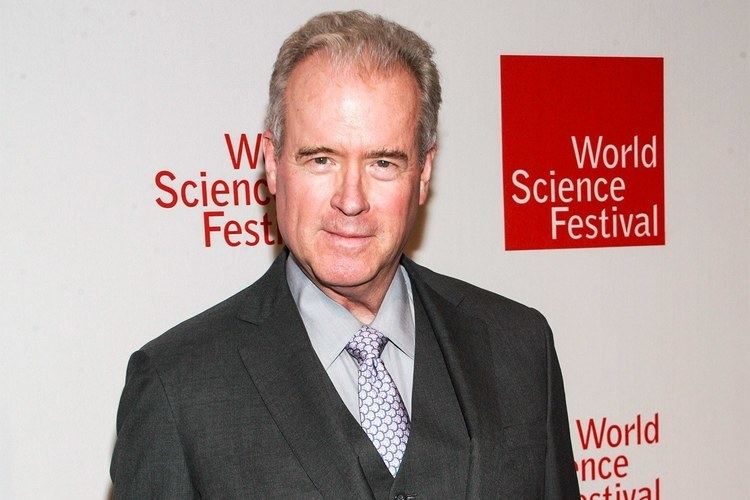
PhD Computer Science from UIUC. IBM Research. Speech recognition. Statistical machine translation
He brought industrial-strength ML to Renaissance. His IBM work is foundational to modern NLP. And he applied the same statistical firepower to markets. Decades before "AI trading" became a buzzword
> Lesson: Deep expertise in adjacent fields transfers in non-obvious ways. NLP to billions. Who would have guessed
6. John Meriwether (born 1947)
Firm: Salomon Brothers bond arbitrage; Long-Term Capital Management; JWM Associates
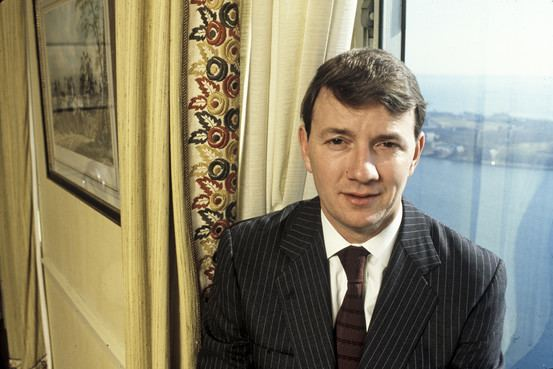
Northwestern MBA. Built Salomon's legendary bond arbitrage desk in the 80s. Then founded LTCM in 1994
Yes, LTCM collapsed. That's a billion-dollar lesson in tail risk. But his track record at Salomon was extraordinary. He saw relative-value opportunities that nobody else saw. Built the team and infrastructure to capture them at massive scale
> Lesson: Even legendary track records don't protect you from tail risk. The market doesn't care how smart you are. It will find you. Always
7. Myron Scholes & Robert Merton
Firm: Long-Term Capital Management; Platinum Grove Asset Management; academic appointments at Stanford and MIT
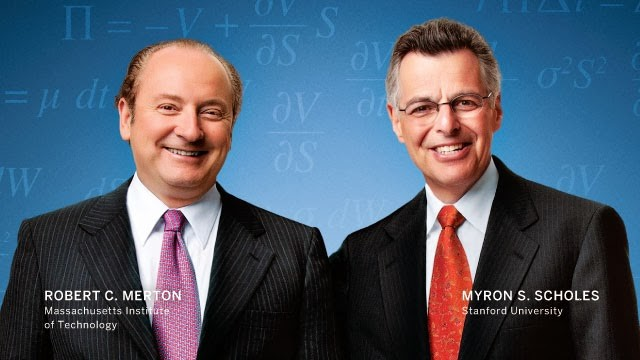
Nobel 1997. The Black-Scholes-Merton options pricing framework
This equation is the foundation of the entire derivatives industry. Every options market. Every risk management system. Every derivatives desk. It all traces back to their work
LTCM was a chapter. Not the whole book
> Lesson: Theoretical breakthroughs that solve real problems create industries worth trillions. Just math on paper. Which is insane
8. George Soros (born 1930)
Firm: Soros Fund Management (Quantum Fund founded 1969)
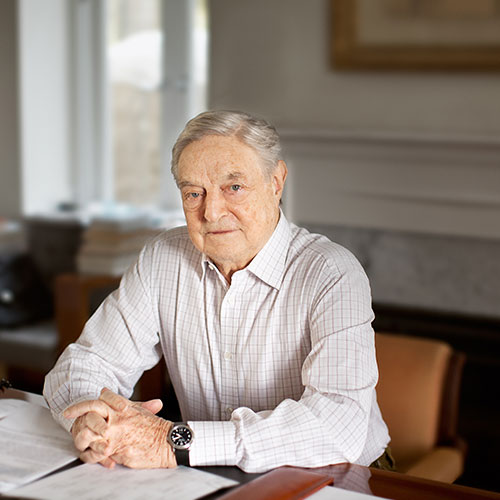
LSE. Refugee from Nazi-occupied Hungary. Student of Karl Popper
Global macro. "Broke the Bank of England" in 1992. $1B + in days shorting GBP
He's not systematic. He's discretionary. His reflexivity theory (markets influence the fundamentals they predict) is serious intellectual work. Worth studying even if you're a pure quant
> Lesson: Not all great investors are quants. Some have an intuitive feel for macro that math can't capture. And that's fine. Both paths work
9. Stanley Druckenmiller (born 1953)
Firm: Duquesne Capital Management (closed 2010); previously co-managed Soros's Quantum Fund

Bowdoin College. 30 years. 30%+ average returns. Not a single down year
Co-led that 1992 GBP trade with Soros
> Lesson: Risk management. Knowing when NOT to bet. That compounds just as hard as alpha. Sitting on your hands is a skill. Most people don't have it
10. Ray Dalio (born 1949)
Firm: Bridgewater Associates (founded 1975)

Harvard MBA. Commodities trader
Built Bridgewater into the largest hedge fund in the world ($170B + AUM at peak). Pioneered "risk parity" investing and the concept of systematically diversifying across uncorrelated return streams
His "Principles" document everything. Decision-making process. Systematized thinking. Pain + reflection = progress
> Lesson: Write down your decisions. Your logic. Your mistakes. That compounds over decades. Unfair advantage. Seriously
11. Igor Tulchinsky (born 1965)
**Firm: WorldQuant** (founded 2007); previously Millennium

PhD Computer Science, UPenn
Built WorldQuant into one of the largest systematic alpha research operations. The "alpha factory" model. Crowdsourcing signals from researchers globally. www.worldquant.com trains the next generation of quants
> Lesson: Scaling research itself (not just capital) is a real edge. More brains working on alpha means more alpha. Simple math
12. David Siegel & John Overdeck
Firm: Two Sigma Investments (founded 2001)

Both PhD Computer Science. Both ex-DE Shaw
Built Two Sigma to $60B + AUM. The "tech company that happens to trade." Engineering-first. ML-first. Data infrastructure
> Lesson: The future of quant is engineering-led. Not finance-led. If you think this is about economics, you're 20 years behind. Wake up
Honorable Mentions
- Fischer Black (1938-1995) - co-creator of Black-Scholes; would have shared the 1997 Nobel
- Eugene Fama (born 1939) - efficient markets, factor research; 2013 Nobel
- Andrew Lo (born 1960) - MIT; adaptive markets hypothesis; AlphaSimplex
- Manoj Narang - Tradeworx; HFT pioneer
- Vincent Mathieu, Yves Lemperiere - Capital Fund Management; CFM stat arb pioneers
- Brevan Howard's Alan Howard - macro discretionary that uses systematic infrastructure heavily
- Pete Muller - PDT Partners; Morgan Stanley's Process Driven Trading group, later spun out as an independent firm
- Boaz Weinstein - Saba Capital; CDS strategies and tail risk
What do all 12 have in common?
Real expertise in technical fields. Most have PhDs in math, CS, physics. Their edge came from genuine depth
Long horizons. Decades of work. Compounding works for returns AND skill
> Lesson: Surface-level knowledge isn't enough. Never was. Never will be
> Disciplined risk management
Every spectacular success pairs with rigorous risk frameworks. The exceptions (LTCM, Soros in 87) prove the rule.
> Organizational ability
Building a top firm means assembling and keeping great teams. Not just solo genius. Simons didn't do it alone
> Adaptation
The strategies from 1990 don't work in 2026. The ones who lasted adapted continuously. They evolved or they died
What this means for you:
- Read their books. Follow their firms. Don't copy their strategies. You can't. Those edges are gone. Dead
- Copy their mindset. Their methodology. Their obsession with technical depth
- Develop real skills. Math. CS. Statistics. Domain knowledge. Surface finance knowledge is useless in 2026
> And document everything. Your trades. Your logic. Your mistakes. That's how you compound learning
Look, the people who built this field weren't lucky. They were obsessed. They were technical. And they played long games
You can do the same. But you have to actually do the work. No shortcuts
If you read this far, you're in the top 5% of people in this space
Save this aticle
Follow @tsukiema_ for more
And share it with someone who needs to stop guessing and start thinking
be stoic.

Related articles

The Quant Research Pipeline Nobody Explains.
Most people think quant research starts with a strategy idea.

100 Tips & Tricks for Building Your Personal AI Agent
Fifteen of these took me four of the six weeks to learn. They're separated at the end, in build order. If you read nothing else in this issue, you must read those fifteen and apply them before you wr…

faceless pages in boring niches making ridiculous money.
the niches nobody wants to talk about because they sound too dull to be real.