The 2 Claude Prompts That Write Your Hooks In Your Customers' Exact Words (Steal Them Below)
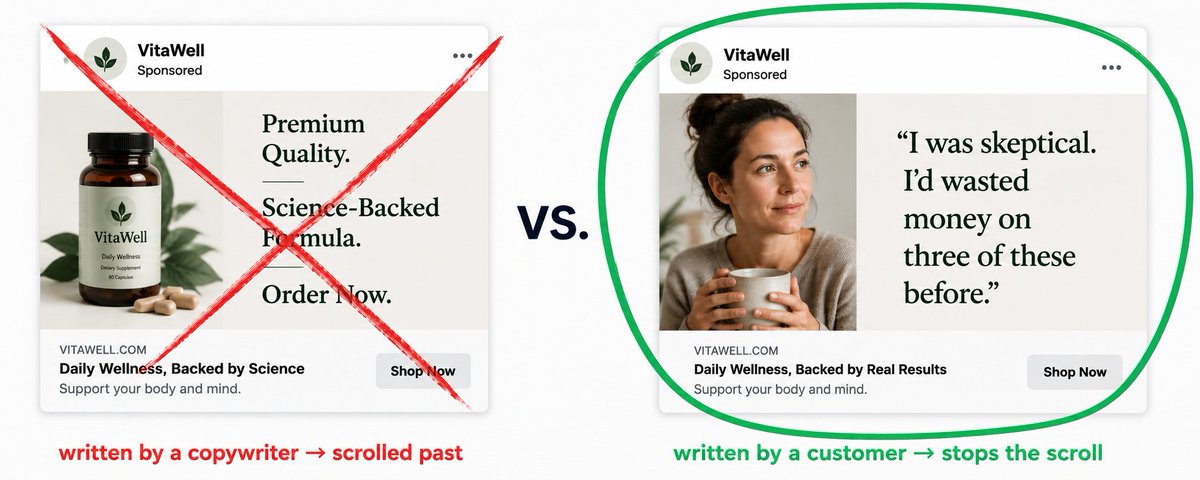
Your best hooks have already been written by your customers. These 2 prompts find them, extract them, and organize them into a copy bank you'll use for years.
The highest-converting line in your next ad will not be written by you, your agency, or your copywriter.
It already exists. A customer wrote it, in a review or a Reddit post, with no idea it was a hook.
Your job isn't to write better copy. It's to find the copy your market already wrote and put paid spend behind it.
This article gives you the exact 2-prompt system we use at Loud Lion to do that. Prompt 1 builds research-backed profiles of the people behind each customer desire. Prompt 2 extracts the exact phrases they use, organized into 13 copywriting categories, ready to paste into briefs.
Both prompts are below in full.
One note before you start: this stack works from your top customer desires. If you already know them, you can run it right now by listing them manually. If you want them extracted from data instead of guessed, I published the 2-prompt desire research stack that does exactly that. Run that first for the strongest version of this.
Why "Oh Shit, That's Me" Beats Every Copywriting Formula
Think about the last ad that actually stopped you.
It almost certainly wasn't the one with the cleverest wordplay. It was the one that described your situation so precisely it felt like surveillance.
That reaction has a mechanism. When someone reads their own thoughts in an ad, in the same words they'd use, the brain files it as recognition, not persuasion. Recognition doesn't trigger sales resistance. Persuasion does.
Copywriters can't manufacture that from imagination, because the phrases that trigger recognition are weirdly specific. A tired mom doesn't say "I struggle with low energy." She says "by 3pm I have nothing left for my kids." No brief produces that sentence. Only she does.
Which means the job is extraction, not invention. Here's the two-step system.
Prompt 1: Build the Macro Avatars
Knowing what people want isn't enough to write copy. You need to know the person behind the desire: what event triggered them to start looking, what they've already tried, what false belief keeps them stuck, and how much they already know about solutions like yours.
Those four things determine everything about how a hook should open.
This prompt builds a fully-researched avatar for each of your top desires, sourced across 7 mandatory platform types so it doesn't just become a summary of Reddit.
Where the prompt says to list your desires: write the top 3 to 5 outcomes customers actually get from your product, in plain language. "Stops bloating after meals." "Falls asleep faster without melatonin grogginess." Specific beats polished.
The two output sections that matter most for ads:
Trigger experiences. A hook that names the trigger event ("if you've started waking up at 3am for no reason...") earns the stop, because it meets the customer at the exact moment their search began.
Limiting beliefs. A hook that names the false belief ("you've been told it's just your age. It isn't.") earns the watch-through, because it promises to resolve the thing keeping them stuck.
Prompt 2: Extract the Exact Language
Now the payoff. This prompt takes your avatars and sends Claude into Reddit, long-form Amazon reviews, YouTube comments, Facebook ad comments, and forum threads to pull the exact phrases each avatar uses. Verbatim. Typos kept. No paraphrasing.
The output is a copy bank organized into 13 categories, from problem language to transformation language to the marketing words your customers never actually say.
Two categories will do most of the work for you.
Category 12, high-frequency words. The words appearing 10+ times per 1,000 are the load-bearing vocabulary of your market. They go in hooks, headlines, and the first line of every ad. This is exactly how we found that "finally" appeared in 1 of every 4 five-star reviews for a 9-figure client. That single word went into hook after hook, and ROAS climbed. The insight wasn't clever. It was counted.
Category 13, taboo words. The mirror image, and almost nobody does this. These are the marketing words your customers never say: "revolutionary," "game-changing," "premium." Every one of them in your copy is a signal that a brand is talking, and sales resistance switches on. Strip them. Your copy instantly sounds less like an ad.
The Test For Every Hook You Write From This
Take a phrase from Category 12. Build the hook around it. Then apply one filter: would a real customer say this sentence out loud to a friend?
"I finally found a protein that doesn't wreck my stomach" passes.
"Discover the revolutionary protein trusted by thousands" fails.
If it sounds like a brand wrote it, kill it and pull another phrase. The bank has hundreds.
One Warning Before You Run This
The output quality is entirely downstream of the desires you feed Prompt 1. Vague desires in, generic avatars out, useless language bank at the end.
If your top desires are guesses, run the desire research stack first (the 2-prompt article I published before this one) and feed its output into this. If you know them cold from years in the market, list them and run.
Your customers already wrote your ads. Go collect them.
We run this full extraction for DTC brands as part of every audit at Loud Lion. 8 years, 250+ clients, $100M+ in tracked Meta spend, $500M+ in revenue generated. If you want us to build your copy bank and hand you the three hooks most likely to win, DM me "AUDIT."
Prompts
I want your help building customer avatars for my product: [YOUR PRODUCT + ONE-LINE DESCRIPTION].
My customers' top desires (the outcomes they get by using the product) are:
1. [DESIRE 1]
2. [DESIRE 2]
3. [DESIRE 3]
4. [DESIRE 4 — optional]
5. [DESIRE 5 — optional]
Create one Macro-Avatar for each desire listed above. You MUST conduct NEW research across ALL source types to find the experiences, behaviors, beliefs, and awareness patterns for each desire.
MANDATORY SOURCE REQUIREMENTS (track usage per avatar):
[ ] Amazon Reviews: 50-100+ reviews mentioning this desire
[ ] Reddit: 30-50+ posts/comments mentioning this desire
[ ] Forums (non-Reddit): 20-30+ posts from specialized forums
[ ] Quora: 10-20+ questions/answers about this desire
[ ] YouTube Comments: 20-30+ comments on relevant videos
[ ] Review Blogs/Sites: 10-20+ articles or their comments
[ ] Social Media: 20+ posts from Facebook, TikTok, Instagram, Twitter
If you only cite Reddit, you have failed this task.
FOR EACH DESIRE, RESEARCH THESE 5 COMPONENTS:
STEP 1: TRIGGER EXPERIENCES
What happened that made them want this?
- Direct personal experiences: "My vet warned me about..." / "I noticed that..."
- Vicarious experiences: "My friend's cat..." / "I saw a post about..."
- Product experiences: "I tried X but..." / "I bought X and it..."
- Situational experiences: "Since we moved to..." / "After switching to..."
- Discovery experiences: "I just learned that..." / "I didn't know until..."
STEP 2: CURRENT BEHAVIORS
What are they doing now? What have they tried?
- Workarounds and hacks (without the product)
- Products tried (what worked/didn't work)
- Routines and habits (daily/weekly activities)
- Research behaviors (where they look, who they trust)
STEP 3: LIMITING BELIEFS
What belief allows them to remain comfortable without taking action right now?
Look for: "I've tried everything..." / "Nothing works for..." / "All [products] are basically the same..." / "It's probably my fault that..."
Categories:
- False beliefs about the problem
- False beliefs about solutions
- False beliefs about why past attempts failed
- False beliefs about themselves
- False beliefs about timing
Only track beliefs that: allow inaction, can be invalidated with new information, are actually FALSE, and appear frequently in research.
STEP 4: DOMINANT EMOTIONS
From the research, identify the 2-3 dominant raw emotions in this avatar's LIFE SITUATION (not product frustration). Categories: FEAR, GUILT/SHAME, FRUSTRATION/HELPLESSNESS, SADNESS/GRIEF, LOVE/PROTECTION, PRIDE/CONFIDENCE, SOCIAL ANXIETY. Support each with verbatim quotes.
STEP 5: AWARENESS LEVEL
What do they know? What stage are they at?
Stages: Problem-Aware / Solution-Aware / Product-Aware / Most Aware
Track: dominant stage + %, what they know, what they don't know, brands they're aware of, trusted sources.
FINAL OUTPUT — TWO SECTIONS:
SECTION 1: DETAILED RESEARCH FINDINGS
Full Step 1-5 findings per avatar with source breakdowns and quotes.
SECTION 2: MACRO-AVATAR QUICK REFERENCE
For each avatar:
- Avatar name + core desire
- Dominant emotions (from Step 4)
- Most common trigger experience + verbatim quote
- Key current behaviors (top 3-5)
- Core limiting beliefs (top 3-5 in exact customer language)
- Awareness level + what they know / don't know
- Ad angle: hook, lead emotion, angle, proof needed, CTA, example copy, landing page focus
COMPARISON TABLE: All avatars, desire, emotion, trigger, behavior, belief, awareness, hook
SOURCE TRACKING: Per avatar + grand total across all platforms
QUALITY CHECKLIST:
[ ] Used ALL 7 source types for EACH avatar (not just Reddit)
[ ] Section 1 contains full evidence, quotes, and source data
[ ] Section 2 present with complete profiles for every avatar
[ ] Comparison table at end of Section 2
[ ] Each avatar has 1 trigger, 3-5 behaviors, 3-5 limiting beliefs, 2-3 dominant emotions
[ ] Ad angles are specific and actionable
From the Macro Avatar output you just generated, do the following:
For EACH macro-avatar, go to Reddit, Amazon reviews (500+ words with backstory), YouTube comments, Facebook ad comments, and forum threads. Find 50-100 real posts per avatar — posts that are 200+ words written by real people describing their lived experience.
Extract their EXACT language. No paraphrasing. No fixing grammar. No cleaning up typos. Copy their natural voice.
OUTPUT FORMAT (repeat for all avatars):
AVATAR #1: [NAME]
1. PROBLEM LANGUAGE — How they describe the problem (5-10 exact phrases)
2. DAILY EXPERIENCE LANGUAGE — Daily life with this problem (5-10 phrases)
3. BELIEF LANGUAGE — What they believed was true (5-10 phrases)
4. PSYCHOLOGICAL/MENTAL STATE LANGUAGE — Mental/emotional state (10-15 phrases)
5. EMOTIONAL EXPRESSION — FEAR / GUILT / HOPE / RELIEF / DETERMINATION phrases
6. FAILED SOLUTIONS LANGUAGE — What they tried, why it didn't work (5 phrases each)
7. IDENTITY & RELATIONSHIP LANGUAGE — Who they are vs. who they want to be
8. DISCOVERY/LEARNING LANGUAGE — Realization moments, 'I wish I'd known' phrases
9. TRANSFORMATION LANGUAGE — Before/after, 'I'm myself again' type phrases
10. AUTHORITY REFERENCE LANGUAGE — How they cite experts
11. TIMELINE/REGRET LANGUAGE — How they describe time passing
12. HIGH-FREQUENCY WORDS — 15-20 words/phrases that appear most often
13. TABOO WORDS — 10 marketing/hype words they never actually say
RULES: Exact quotes only. No paraphrasing. 5-10 phrases per category. Target: 3-4 pages per avatar. Ready to copy-paste into copy briefs immediately.
BEGIN EXTRACTION NOW.
Related articles

After 1,000 Hours In Claude Code, I Only Use These 10 Things
*Every one of these survived a thousand hours of real builds. Number ten is the one almost nobody sets up, and it's the one that matters most.*

You're using 10% of what Claude skills can do
one iphone photo. I turned it into a full product photoshoot, editorial angle, close ups, technical drawing, catalog piece. then I did it for hundreds of products.
