The $35K Motion-Website Playbook with Higgsfield + Claude Code 👇

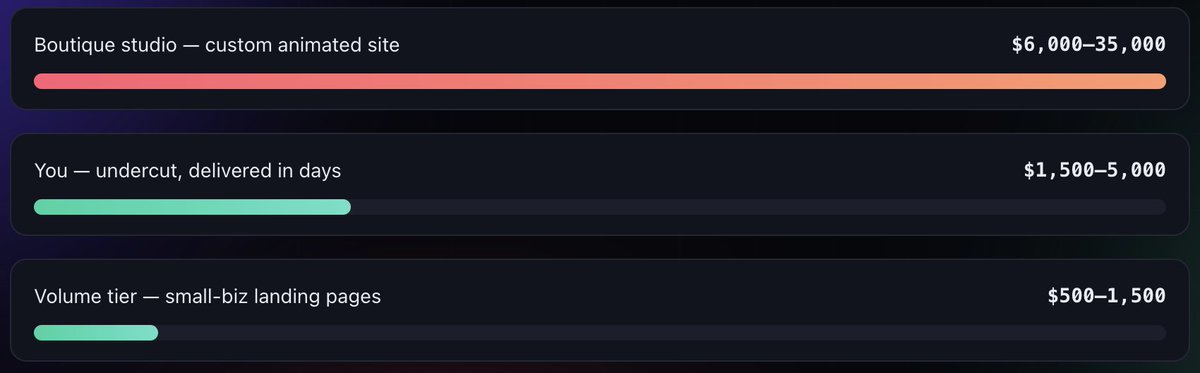
Boutique web agencies quote $6,000–$35,000+ for a custom animated site and bill $100-149/hr. With Claude Code + Higgsfield MCP, one agentic session generates the assets, writes the scroll animations, and assembles a finished site - for the price of a subscription and a few dollars of credits. This is the full build, the math, and the technical setup.

01 - The collapse
The studio's moat was the production pipeline.
For years a custom animated site meant a designer, a motion artist, a developer, and weeks of handoffs. That pipeline was the moat - and what justified the invoice. In June 2026 Higgsfield shipped a downloadable Motion Website Generator skill for Claude. You drop in a brand kit and some business details; Claude generates the motion clips through the Higgsfield MCP, extracts every frame, writes the HTML/CSS, and assembles a working scroll-driven site - without you touching a frame extractor or writing a CSS keyframe.
It runs on two pieces of plumbing Higgsfield has been building for months: the MCP, which exposes 30+ generative models behind one connector, and Vibe Motion, a code-generating motion-graphics engine. The skill is just the recipe that tells Claude how to chain them - so the output is consistent every run.


02 - The math that makes it worth doing
Their floor is your ceiling.
Independent pricing data for 2026 puts agency websites at $2,500–$10,000+ for a standard build, $6,000-$35,000+ at boutique studios, with an average project around $5,280. Your marginal cost per site is a Claude subscription plus a few dollars of Higgsfield credits.
Price to win, still keep the margin
Higgsfield's own monetization piece frames this skill stack at up to $38,400/month for motion work. Treat that as a ceiling story, not a promise - but the structural point holds: when your delivery cost approaches zero, every price above it is margin. Build once, reskin and resell many times.


03 - How the build actually runs
One agentic session, six systems.
A scroll-driven site normally means coordinating 4–6 separate technical systems - GSAP ScrollTrigger, Lenis smooth-scroll, frame extraction, asset optimization, layout, and copy. Fable 5 executes all of them inside one session with no manual handoff between phases. Once triggered, Claude extracts every frame automatically, builds a complete HTML/CSS site with scroll animations, and applies six cinematic effects with zero extra config: film grain, particles, vignette, glass cards, color tints, and scroll pacing.


04 - The full setup
Wiring it up, end to end.
Connect Higgsfield MCP - Claude desktop / web
Or connect via Claude Code (terminal)
Load the skill & build


05 - Turning it into income
The product isn't the site. It's the speed.
A live animated demo closes deals that a deck can't. Clients pay for proof that you can go from brand kit to a deployed, motion-rich site in a day - something studios bill weeks for.
Lead with a portfolio, not a pitch. Build 3 niche demos first (SaaS, e-commerce, local service). "Here's a live site for a business like yours" beats any proposal.
Sell the video angle. ~63% of people prefer watching a short product video before buying - a motion site is that, as the whole page.
Reskin to scale. One codebase becomes a branded site for the next client. Studios quote $6k-35k for this; you deliver in days and still undercut them.
Find clients where static sites are leaving money on the table. Shopify/Amazon sellers, Kickstarter campaigns, and local SMBs with basic sites are the clearest fits.
Most people will bookmark this. A few will connect the MCP tonight, build three demos by tomorrow, and send their first ten pitches by the weekend. The pipeline is right here.
Related articles

How to Run a Design Studio Solo with Claude Code + Higgsfield MCP
For years the hard part of running a web-design studio was never finding clients. It was delivery. Someone had to design every layout, build every page, and produce every piece of media. In the old m…

How to Turn Nexlev MCP + Opus 5 into a 24/7 YouTube Video Analyst
a good youtube video analyst charges $5K-$10K per month.

How to Use Fable 5 + NexLev MCP to Find $10k/Mo Faceless YouTube Niches
I used to spend 8-12 hours per week scrolling competitor channels in incognito, pulling view counts by hand, cross-referencing RPM estimates on SocialBlade, checking 48-hour view data to separate sta…