the art of appmaxxing...

i love how everyone blames ai ugc for not converting

but the ones who crack that are the ones running $100k/mo apps.
this didn’t happen because of a/b testing paywalls or onboarding, it happened because of distribution.
i’m going to show you the neural farm that turns ai ugc into installs instead of videos that die in 48 hours…
grok bot as look, gpt-6 astra on the computer and a lot more...

and i’ll say it right now.. my favorite part is where the bot stops writing prompts and starts running the factory, because that’s what astra’s computer use unlocks, so that’s the piece we’re building with the most detail.
the current chatbot + video model is not a system, it’s a habit. one chat writes a prompt, one model renders a clip, you post it without improving, and that's not scalable.
the mistake i keep seeing when people “do ai ugc” for a live app is that they stack scripting, rendering and editing into one giant chat session, then can’t tell which step failed and go back to $20–$30 cpm ads
what’s inside this guide:
- why use neural farms
- how to run in a way, they keep improving
- how one real day looks end to end
- how to scale it without turning your brand account into a hobby
1. why the neural farm
paid ads still hit you for $20–$30 cpm if your category is even allowed to run and brand accounts dropping $5,000–$6,000 a shoot is not scalable.
ugc became the natural way creators talk to their audience about a product or an app, as it feels more personal and a friendly tip rather than an ad stuck on their feed

the old way to get that was slow and expensive. you’d brief creators, wait on revisions, and if you were lucky you got one usable video a week, by which the trend already died
then ai ugc popped up.
most people just opened a chat window, pasted a prompt, and hit a video model. that’s why every feed looks the same now..
ai ugc got popular when the bar for “ai slop” was low.
users would watch content with weird hands, dead eyes, plastic skin. nowadays the bar is at an all time high. content that looks too perfect gets skipped the same way ads do.
so you don’t win with one magic prompt. you need a repeatable system.
basic ai ugc answers a prompt and renders a clip it can’t tell you what hooks are other founders using, it can’t sit in capcut and move the hook earlier, and it can’t predict the psychology of a human brain
split the jobs and that changes.
- grok bot finds the viral format (formats used by founders on X)
- dump the data to gpt-6 astra for new scripts
- use gpt-6 for prompts and image 2.5 + seedance 2.5 for images and videos
- use tribe v2 to test the hook and the script before rendering the video
2. how to actually perform it
high converting ai ugc doesn’t come from chat window. you need specialized tools for each job.
1> grok bot for finding viral formats
this is not a one-off chat. a bot here is one persistent, agent which acts as an employee.

every few hours, grok bot looks at the given set of accounts on x with live search and video understanding. to keep the hassle away, i already created a master prompt with accounts posting viral formats:
Role: X format scout for AI UGC.
I write hooks in GPT-6 Astra. You only research.

Job
Every run, scrape ONLY these X accounts:
[accounts ex - @viraltiktoktracker]

Do not scrape the open timeline. Do not invent posts. If an account has nothing useful, say so.

Lookback
Last 14 days unless I say otherwise.

What counts as a hit
Only keep posts that:
- include video or a clear video format
- already cleared 100k+ views OR are an obvious velocity outlier vs that account’s normal
- are easy to remake for an app/product ugc clip
- show a repeatable skeleton, not a one-off meme only that account could pull

If fewer than 2 accounts in the list are hitting the same skeleton, mark it “weak / one-off.” Prefer formats hitting on more than one listed account.

For each keeper, output this dump sheet exactly so I can paste it into Astra:

---
FORMAT ID: [short slug]
ACCOUNTS USING IT: [@..]
POST LINKS: [urls]
VIEWS / ENGAGEMENT: [numbers if visible]
FIRST 3 SECONDS / HOOK: [what happens or what is said]
SKELETON: [talking head + app demo / pov rant / reaction / side-by-side / etc.]
WHY IT TRAVELED: [velocity vs that account’s baseline, not vibes]
WHAT TO STEAL: [structure only — no copied wording]
WHAT NOT TO COPY: [words, jokes, identity-specific bits]
APP ANGLE MAP: [how this could sell / demo an app]
REMIX DIFFICULTY: [easy / medium / hard]
STATUS: [validated multi-account / weak one-off]
---

Overnight / learning pass
Also read yesterday’s posted ugc from our side (or the batch log I give you) and mark each piece:

HELD: [what held attention]
FLATLINED: [where it died]
CLONE: [deserves to be cloned — why]
KILL: [should get killed — why]

Humans still approve the final calls. You do not post, delete, or spend. You only mark recommendations so tomorrow’s scout is biased toward what actually printed instead of what sounded clever in a prompt.

If I have not given you yesterday’s posts yet, ask for the batch log / links once, then continue. Do not invent performance.

End the run with:
1. Top 3 formats to send to Astra today
2. Formats to ignore
3. Clone list / kill list from overnight
4. One line: “quiet window” if nothing cleared the bar

First-lane setup
If we’re starting from zero, this is the first lane to open: read-only, zero risk, immediate value, and it feeds every render after it.

On the first run only:
- do the job once while I watch
- then save this workflow as a skill
- confirm what “done” means in one short checklist before you invent your own definition

Default “done” means:
- only [accounts] were scraped
- dump sheets use the exact template above
- top 3 / ignore / clone / kill are filled
- no invented metrics
- no actions taken on X

Rules
- Read only. Never like, reply, repost, follow, or DM.
- No fake metrics.
- No strategy essays.
- No “here’s the thing.”
- Plain operator English.
- If video understanding is available, watch the clip before judging the hook.

Output only the dump sheets + overnight marks + the end summary.
overnight it also reads yesterday’s posts and marks outliers, what flatlined, what deserves should be cloned.
if you’re starting from zero, open with this. read-only, zero risk, immediate value, and start creating a table. do the job once while you watch, save it as a skill.
2> gpt-6 astra writes the prompts
before you touch anything, paste this prompt in gpt-6 astra
you are the prompts lane for an ai ugc farm. i will paste a grok format-
scout dump sheet under this message. your only job is prompts, not
 research and not rendering. lock to one offer and one format from that
 sheet with no ten-idea roam. if the sheet says talking-head app demo
with a complaint hook, that is the only lane for this batch. write 15 to
20 ranked hooks with a fast first 3 seconds, a one-line why each lived,
 and a plain-english scene note. scrap anything that smells like a brand
 ad. then write gpt image 2.5 prompts for stills that keep the same
face, show the app ui clearly on the phone, use a messy-real room,
keep the brand inside the moment instead of a logo sticker at the end,
and skip any still you would not send a friend. then write seedance 2.5
 prompts for the keepers that describe person, app on screen, setting,
 and what they say, around 30 seconds, one-shot friendly, no novel-
length spam, ready to push through hexpm into seedance 2.5. output
only paste-ready blocks in this order: ranked hooks, image 2.5
prompts, seedance 2.5 prompts, and a short shortlist of which
variants should get rendered first. no strategy essays, no fake metrics,
no “here’s the thing,” plain operator english.
now here's my favorite workflow, which generates batches of viral videos in 1 go:
step 1 - the lock: astra picks the strongest format from the grok dump and checks if it fits your brand. once done it locks the pick.
step 2 - the hooks: astra ranks 15–20 fast paced hooks, a line about why each lived. output should be boring and paste-ready, not a strategy essay.
step 3 - the image prompts: astra writes gpt image 2.5 prompts for the stills. same face, and realistic environment
step 4 - the seedance prompts: astra turns the keepers into short seedance 2.5 prompts, with audio and around 30 seconds.
i’d run the generation through higgsfield. connect the mcp straight to gpt, then push those astra prompts into seedance 2.5 without opening five tabs.
3> tribe v2
tribe v2 is trained from 700+ people and 1000+ hours of brain scans of people watching video, audio, and text. you give it a clip and it shows where engagement spikes and where it flatlines across the timeline.

before anything goes to distribution, run 2–4 variants through it. move the highest spike earlier, cut the dead seconds, and scrap anything which flatlines before 3s.
what you’re looking for is simple. does the curve rise in the first seconds and whether does it hold through the app demo or die when the ui appears. lastly if the ending still have signal.

> if tribe says the winner is variant b with the hook swapped forward, that is the cut that gets the footage pack, not the one you personally liked in silence.
5. the expansion rule
don't wait for 50 videos, start with 2-3 accounts with daily uploads first.
what i'd do if you are at zero: first get your hands dirty and get familiar with the tools, then paste those prompts in and start with 2-3 quality videos per batch and then scale up
that's it, after that get a phone farm setup so you can create hundreds of accounts to post on.
4. alternative method to scaling
for most people, handling a phone farm is too much work, that's why the quit or stay small.
a $100k/mo app doesn’t win on 20 clips. it wins because of volume. replicating a trend 50x asap is not possible without scaling it correctly, which is the reason most apps fail.
people don’t download the first time they see you. they download around the 7th time, when it already feels familiar. so once the farm is printing scored winners, you need a distribution layer under it.
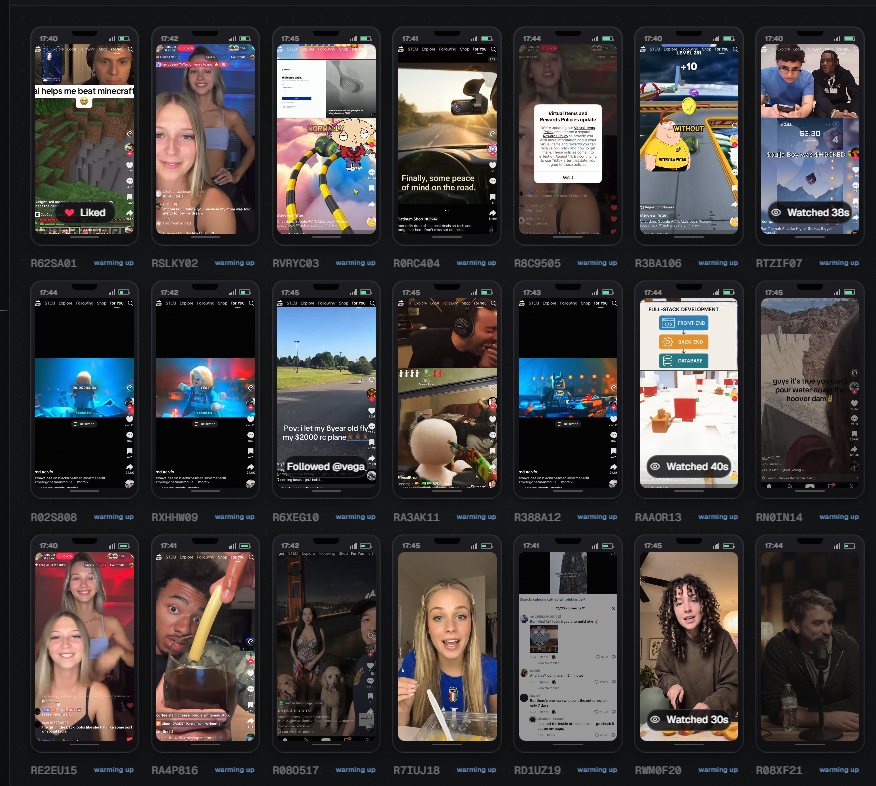
here are some simple rules for scaling with an agency:
- footage pack so creators don’t have to ask you for assets.
- a brief so the creators know what counts as a valid post, which platforms, what the hook and caption need to do.
- kill formats that don’t drive installs in about 48 hours.
- clone the ones that do, including language variants once a skeleton is proven.
- pay on verified views so you’re not guessing and you’re not buying charts.
i plug that layer through affiliatenetwork.com.

creators pick up the cuts, post at network volume, get paid per 1,000 real views, and bot checks happen before payouts and your apps get the attention it deserves
the farm makes the winners, but this scale, makes winning a habit
tools used:
Related articles

how to run an ai native agency with jev (FULL GUIDE)
jev is open to everyone now. it's a super fast decision model, so one person can now do work that businesses usually pay an agency a big cut for. here's how you can set up a whole ai native agency wi…
We got 75M+ views in 6 months. This is how we run social with Muse, GrokBot now (Step by step tips)
Part of that is luck. Most of it is a content marketing system we built with [Helena](https://www.hirehelena.com), our favorite AI marketer.
how to automate lead generation (FULL GUIDE)
by the end of this guide you'll know how to generate leads on autopilot for anything. a digital product you sell online, a business generating leads for itself. or someone with no business at all, ge…