the new way to blitzscale google ads (at 21x ROAS)

i'm watching brands spend $10k, $20k, $50k/month on google ads and send every single click to a product page.
cold traffic from youtube shorts. to a PDP.
non-branded search traffic from someone who typed "best supplements for sleep." to a PDP.
competitor conquesting traffic from someone comparing your brand against three others. to a PDP.
all the same page. all the same experience. regardless of where the buyer is in their decision process.
and then they wonder why ROAS plateaus at 3x.
here's the uncomfortable reality: sending cold traffic to a product page is like proposing marriage on the first date. the maths doesn't work because the psychology doesn't work. the buyer isn't ready. they haven't been educated. they haven't been sold on the mechanism. they don't trust you yet.
the brands printing 4x, 13x, 21x ROAS from google ads right now aren't running better campaigns. they're running better funnels.
and this is the part of google ads that nobody in the meta-obsessed ecom world is talking about.
the PDP era is over for cold traffic
let me be direct.
product pages are a conversion tool for warm and hot traffic. someone who already knows your brand, already understands the product, already trusts you. for that person, a PDP is perfect. add to cart. buy. done.
but that person represents a fraction of the total traffic available to you on google.
the vast majority of google traffic is problem-aware and solution-aware. they know they have a problem (back pain, bad sleep, thinning hair). they know solutions exist (supplements, devices, treatments). they don't know your solution. they don't trust you. and they're not ready to buy from a brand they discovered 3 seconds ago.
sending that traffic to a PDP is asking them to make a purchasing decision before you've done the work of educating, agitating, and positioning.

this is the same mistake i see in 90% of accounts i audit. the campaigns are fine. the keywords are relevant. the bidding is reasonable. the landing experience is wrong for the traffic temperature.
the fix isn't better ads. the fix is funnels.
what "funnels on google" means (and why it changes everything)
when i say funnels, i don't mean some clickfunnels 42-step webinar sequence.
i mean purpose-built landing experiences matched to the awareness level of the traffic hitting them.
cold TOF traffic from youtube shorts and top-of-funnel search queries?
these people don't know your brand. they're problem-aware at best. send them to an advertorial that:
validates their struggle (makes them feel seen)
agitates the unknown problems they haven't considered
introduces the mechanism behind your product (not the product itself)
positions your brand as the expert who solved this
ends with a soft, education-first CTA that moves them to the next step
the advertorial doesn't sell the product. it sells the explanation. it educates the buyer so deeply on the problem and the mechanism that by the time they reach the PDP, they're already 80% sold.
we're generating 4x, 13x ROAS from non-branded search campaigns running to advertorials. the same keywords running to PDPs were getting 1.5-2x.
the difference isn't the keyword. it's the landing page.
mid-funnel search traffic from people comparing solutions?
these people know the solution category. they're evaluating options. send them to a comparison page or a listicle that:

positions your product against the alternatives they're already considering
addresses specific objections (price, ingredients, results, shipping)
uses social proof, clinical data, and UGC to build trust
makes the comparison feel editorial, not advertorial
competitor conquesting traffic from people searching rival brand names?
this traffic has the highest intent but also the highest scepticism. send them to a dedicated comparison landing page that respects their intelligence. don't trash the competitor. show them, side by side, why your mechanism works differently and the results it produces.
brand search traffic from people who already know you?
send them to the PDP. this is the only traffic that belongs on a product page. these people are ready.
if you want us to audit your ecom brand's google ads and show you how we'd implement this funnel system to multiply your ROAS in 60 days, DM me "BLITZ" and we'll make it happen.
the funnel system that generated 21x ROAS
let me show you how this comes together with a real account.
high-ticket brand. australian market. previous agency was sending all traffic to PDPs. one pmax campaign. one target ROAS. $500/month VA managing 12 accounts simultaneously.
we took over and rebuilt the entire architecture.
step 1: google merchant center overhaul.
non-branded titles structured by keyword intent. descriptions rewritten around outcomes, not features. supplemental feed with margin data so we bid differently on high-margin vs low-margin SKUs.
result from the GMC overhaul alone: 30% more clicks, higher ad rank.
step 2: campaign segmentation.
separated brand from non-brand. segmented shopping by product margin tier. launched non-branded search campaigns by keyword theme and ICP angle. each campaign had its own bidding strategy matched to its role in the funnel.
step 3: funnel builds.
TOF search queries ran to advertorials. problem-agitation-mechanism structure. education-first CTA to the PDP
MOF search queries ran to comparison pages and listicles. editorial-style content with social proof embedded
competitor conquesting ran to dedicated comparison landing pages
brand search ran to PDPs
step 4: youtube shorts as demand gen.
cold traffic youtube shorts filling the TOF remarketing pool. these viewers didn't convert immediately. they showed up in our shopping and search campaigns 3-7 days later with higher conversion rates because they'd already been exposed to the brand.
step 5: geographic and margin-based bid optimisation.
increased bids in high-converting regions (perth and adelaide were outperforming sydney at nearly double the conversion rate). allocated more budget to high-margin products. decreased exposure on low-margin SKUs.
the result: $57k in spend. $1.21M in revenue. 21x ROAS.
this is the same account the previous agency said "australia is too small to scale."
the platform wasn't the problem. the structure was the problem. the lack of funnels was the problem.
why funnels eliminate the biggest google ads objection
the objection i hear most: "google ads can't scale cold traffic."
this is true if you're sending cold traffic to PDPs.
it's false if you're sending cold traffic to advertorials.
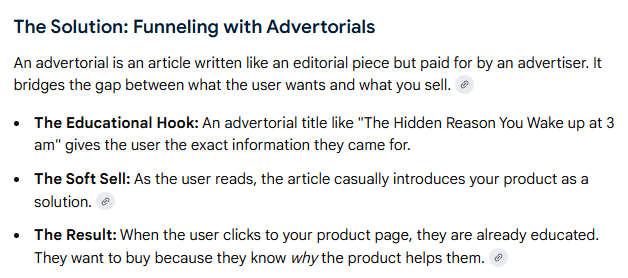
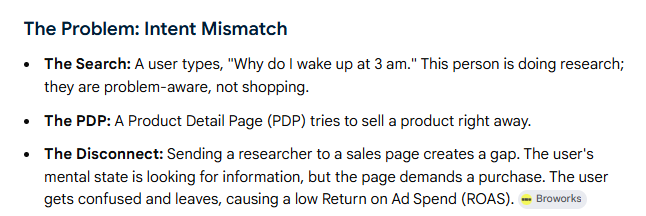
here's the psychology behind it. someone searching "why do i wake up at 3am" is problem-aware. they're not shopping. they're researching. if your google ad takes them to a product page for a magnesium supplement, they bounce. the disconnect between their mental state and the landing experience is too large.
but if your ad takes them to an advertorial titled "the hidden reason you're waking up at 3am (and the one mineral most people are deficient in)", they read. they learn. they absorb. and when the advertorial introduces your product as the mechanism behind the solution, they click through to the PDP already educated.
the traffic temperature matches the landing experience. that's the entire game.
cold traffic to an advertorial is a 4-13x ROAS play.
cold traffic to a PDP is a 1-2x play on a good day.
same keyword. same ad. same person. different landing page. completely different result.
the no-fatigue advantage
here's the part that makes funnels on google structurally better than the meta creative treadmill.
on meta, your creative dies every 14-21 days. you're constantly replacing, testing, refreshing. the audience gets saturated. you need new hooks, new angles, new visuals on an endless cycle.
on google, if the problem your brand solves is real, demand regenerates infinitely.
there are always new people searching "best magnesium for sleep" for the first time. there are always new people who've never seen your brand. the demand is intent-driven, not creative-driven.
your advertorial doesn't fatigue the same way a meta creative does. the person searching hasn't seen it before. they're finding it through a search query, not having it pushed into their feed repeatedly.
this means your funnels compound without the constant rebuild cycle. write one great advertorial that matches the keyword intent, and it prints for months. sometimes years.
the work is front-loaded. build the funnel once, optimise it over time, and let the intent-based traffic do the rest.
the full funnel architecture
here's the system laid out:
layer 1: youtube shorts demand gen (cold TOF) - fills the remarketing pool. builds brand awareness. 15-60 second UGC-style content. no direct conversion expected. this is the investment layer.
layer 2: non-branded search to advertorials (warm MOF) - captures problem-aware and solution-aware search queries. educates the buyer. positions the mechanism. 4-13x ROAS.
layer 3: non-branded shopping to PDPs (warm-hot MOF/BOF) - captures product-aware buyers. clean GMC feed with non-branded titles. margin-based bidding through supplemental feeds.
layer 4: competitor conquesting to comparison pages (hot BOF) - captures competitor traffic. positions your brand as the better alternative with editorial-style content.
layer 5: brand search to PDPs (hot BOF) - captures bottom-of-funnel buyers who know your name. 95%+ impression share. lowest CPCs. highest conversion rates.
layer 6: remarketing across all layers - youtube viewers who didn't convert see shopping ads. advertorial readers who didn't buy see remarketing display. comparison page visitors see brand ads. every touchpoint feeds the next.
this is the ecosystem that generates 21x ROAS. not one campaign. not one landing page. a system where every dollar of spend has a clear role and a clear next step for the buyer.
why this works and what breaks when you skip it
the brands running one pmax campaign to one PDP are leaving 60-70% of their potential revenue on the table.
they're capturing the bottom 20-30% of buyers who were already ready to purchase and ignoring the massive pool of problem-aware and solution-aware traffic that needs education before conversion.
funnels don't make google ads harder to manage. they make google ads make sense. because you're finally matching the landing experience to the traffic temperature instead of treating every click like it came from a buyer with their credit card out.
the era of "send everything to a PDP and let google figure it out" is done.
the brands printing 4x, 13x, 21x ROAS have already moved on.
the ones still running one pmax campaign to one product page? they'll keep wondering why their ROAS never breaks 3x.
and their agency will keep telling them "the market is saturated" instead of building the system that fixes it.
if you want us to audit your ecom brand's google ads and show you how we'd implement this exact funnel system to turn your campaigns into a 5x-20x+ ROAS machine, DM me "BLITZ" and we'll make it happen
($10M+ in ad revenue generated through google ads ecosystems, fully done-for-you)
amin
Related articles

How to Start a 6 Figure Faceless YouTube Channel (Full Breakdown)
I've helped over 400 people start profitable faceless youtube channels. i've ran over 50 channels myself. Generated over $4 MILLION by age 25. Worked with youtubers that have 10 million+ subscribers,…

How to Build a Faceless YouTube Affiliate Business From $0 - $40k in 2026
How to make money on your faceless youtube channel with affiliate before ever getting monetized