What It Actually Takes to Build a $45K/Month YouTube Channel

How Claude, Python, and a real production pipeline turn a code-focused YouTube channel into six revenue streams
Most guides to building a YouTube channel around code content follow the same formula. A big revenue number in the title, a screenshot of a dashboard, and five simple steps that somehow take you from “record a video” to “quit your job.” The tools are usually real. The problem is that the math behind the big number is rarely explained.
This guide takes a different approach. We start with what the number actually requires, work backward to the kind of production system that could realistically support it, and only then look at the tools. Claude handles the planning and scripts. Python takes care of the repetitive work. An editor turns the raw footage into something people actually want to watch. Together, they can make production faster and more consistent.
But none of them can replace the part that takes the most time: building an audience large enough for the numbers to work.
1. The Problem: Why the Headline Version Doesn't Hold Up
Every content-factory guide has a version of the same pitch: pick a niche, automate the boring parts, and the revenue follows. The pitch isn't wrong. It's just incomplete in a specific, predictable way. It quotes the RPM range that makes the math work instead of the conservative end of it. It shows one sponsor deal instead of the deal size an actual mid-tier channel gets. It treats a course launch like a light switch instead of something that depends on an email list that takes months to build.
None of that is a tooling problem. Claude, Python, and a competent editor can genuinely remove the busywork from this process. They cannot remove the part where a YouTube channel needs on the order of a million views a month before any of the revenue streams below start behaving the way the guide promised.
> The honest version of this guide exists because the dishonest version is easy to write and expensive to believe.
2. The System: Three Layers, Five Stages
The production system has three layers, and each one does a job the others can't.
Claude plans. It turns a niche and a format list into a full content plan and a scene-by-scene script, which removes the blank-page cost that stalls most solo creators by month two or three.
Python automates. It takes Claude's output and turns it into upload metadata, batched Shorts, and funnel emails, without a human re-typing the same five fields fifty times a month.
An editor produces. It takes a raw recording and, using text-based editing, automatic speech enhancement, and auto-reframe, turns it into a finished long-form video and a set of Shorts without requiring professional editing skill.

> A channel doesn't reach $45K by uploading more. It reaches $45K by turning views into five other things besides views.
Those three layers run across five repeatable stages: content architecture, production automation, recording and editing, funnel automation, and monetization. The rest of this guide walks through each one, then shows the math that ties the whole system to the number in the title.
3. The Content Engine: Niche, Scripts, and Eight Formats
Pick one sub-niche inside "code-focused content," not the whole category. Backend, frontend, AI tooling, DevOps, and interview prep each carry different search volume and different competition, and Claude can pull that apart before a single video gets recorded.
Act as an expert YouTube content strategist for a code-focused channel.
Pick one sub-niche in [backend/frontend/AI tooling/etc]. Build a YouTube
content plan of 10 videos using these formats: build-in-N-minutes
tutorial, framework comparison, AI build-log, interview walkthrough,
best-practice takedown, career commentary, live debugging, and a
Shorts series. For video 1, write a full script with timestamps,
on-screen text cues in [brackets], and 3 thumbnail concepts. Output
as JSON keyed by scene.
Plan a full week of scripts in one sitting, not one video at a time. Claude holds the whole plan in context, so video four's script can reference video one without re-explaining the series.
The eight formats aren't interchangeable. Each one carries a different funnel role:
- Build-in-N-minutes. Top-of-funnel volume. View-to-subscriber runs around 2%.
- Framework comparison. Slightly better conversion, around 2.5%, from viewers actively deciding on a tool.
- AI build-log. Lower subscribe rate, higher buyer intent, around 1.2% subscriber-to-buyer.
- Interview walkthrough. Best for list growth. Point the CTA at a free practice-set download.
- Best-practice takedown. Reliable mid-funnel format with strong watch time.
- Career commentary. The strongest format for membership signups.
- Live debugging. Highest-trust format, and the one that actually produces consulting leads.
- Shorts. Pure reach. Not a direct revenue format, a feeder for the others.

4. The Production Pipeline: Automation, Recording, and the Funnel
This is the stage most guides gesture at and few actually show. Three parts, run every week.
Production automation removes the templating work that eats an hour a video if it's done by hand:
import json
with open("script_output.json") as f:
    scenes = json.load(f)

title = f"{topic} in {year}: {hook} [{series_tag}]"
tags = ["coding", language, topic.lower(), f"{topic.lower()} tutorial"][:15]
summary = " ".join(s.get("narrator", "") for s in scenes.values())[:280]
desc = f"{hook}\n\nIn this video: {summary}\n\n{{cta_placeholder}}"
This reads Claude's scene-by-scene script directly and drafts the title, tags, and the first line of the description from the actual content, not a placeholder filled in later.
Recording and editing is where an editor's AI tools do the most real work: text-based editing turns a voiceover into an editable transcript, so dead air and false starts get cut by deleting words, not scrubbing a timeline. Speech enhancement closes most of the gap between a desk mic and a studio one in one pass. Auto-reframe converts a finished long-form cut to vertical instead of re-cutting Shorts by hand. Pulling multiple Shorts from one video happens in a single batch instead of five manual exports:
for pair in "00:07:40 00:08:25" "00:12:10 00:12:55" "00:15:00 00:15:40"; do
  set -- $pair
  ffmpeg -i full_video.mp4 -ss "$1" -to "$2" -c:v libx264 -c:a aac "short_${1//:/}.mp4"
done
Funnel automation makes sure every video adds names to a list, not just views to a counter, since views decay and a list compounds. Route the description CTA to a real opt-in page matched to the video's format, then put a three-step sequence behind it: a delivery email sent immediately, a trust-building email two to three days later, and a deadline email that actually converts the list into buyers. Wire the product to a real checkout rather than a "message me for the link":
const session = await stripe.checkout.sessions.create({
  mode: 'payment',
  line_items: [{price_data: {currency: 'usd', unit_amount: 19900,
    product_data: {name: '{PRODUCT_NAME}'}}, quantity: 1}],
  success_url: '{SUCCESS_URL}', cancel_url: '{CANCEL_URL}'
});

5. The Money: What $45K Actually Requires
Six streams, each sized against the conservative end of a real, sourced range, not the number that makes a title work.
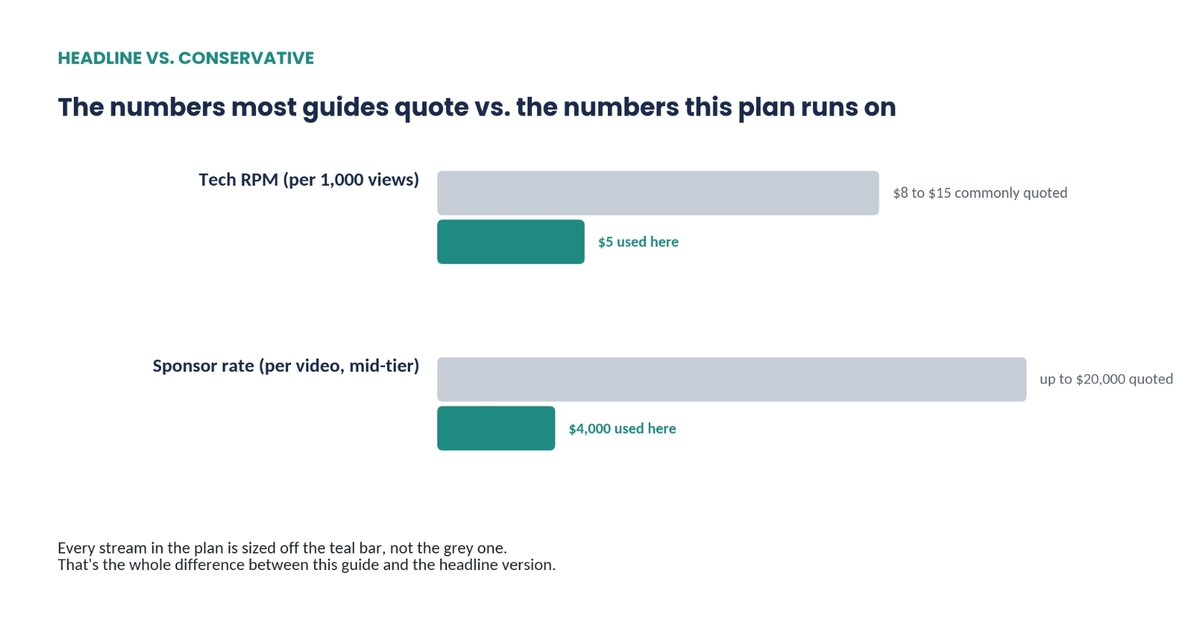
YouTube ads need 1,200,000 monthly views at a conservative $5 tech RPM to produce $6,000, against headline figures that often run $8 to $15. Affiliate revenue turns the same view base into $4,000 at a 0.5% link click rate, 2% conversion, and a $33 average commission. A $199 course needs an email list past 10,000 converting at a conservative 0.6% a month to produce $12,000, which is 60 sales, not a launch-week spike. Productized consulting produces $8,000 from four engagements a month at $2,000 each, capped by hours rather than views, which makes it the most stable stream on the list.
A membership at a $7 blended tier converting 0.5% of subscribers produces $3,000. Sponsors produce $12,000 from three deals a month at a conservative $4,000 each, against a real mid-tier tech rate of $5,000 to $20,000 per video.
 — "Revenue "
That totals $45,000. The binding constraint underneath all six numbers is the 1,200,000 monthly views, which implies roughly 250,000 to 400,000 subscribers depending on view-per-subscriber ratio.
> Ads and sponsors can start paying this month. A course and a membership are paying off a list you haven't finished building yet.
That's also why this system runs on an 18 to 36 month timeline, not a viral video. Ad, affiliate, and sponsor revenue can start early, since they only need views. Course and membership revenue lag until the list and the subscriber base actually compound.
6. Where This Breaks
- Trusting the headline RPM. Tech RPM is commonly quoted at $8 to $15. The conservative $5 used here is what the math should actually run on.
- Treating the list as instant. A launch-week spike is not the same as a list converting at a steady 0.6% a month. Plan for the second one.
- Letting one sponsor dominate. No single sponsor should exceed roughly 30% of monthly sponsor revenue, and only trailing 30-day view averages should go in a pitch, never a peak.
- Skipping the KPIs until something's already wrong. RPM under $4 for four straight weeks means the thumbnails and titles need an audit before the content strategy does. List growth under 500 a month means the opt-in offer is the problem, not the traffic. Course conversion under 0.4% across two launches means the offer or the price is wrong, not the list size.
- Assuming automation replaces audience-building. Claude removes the blank-page cost. Python removes repetitive templating. An editor removes the technical skill floor. None of the three shortens the time it takes to actually build the audience the math depends on.
7. Where to Start
- Week 1: Run the content-plan prompt, get a full week of scripts, record two videos, and get the metadata script running on real output.
- Week 2: Publish two videos, cut Shorts in one batch pass, and get the opt-in page and email sequence live before the next upload, not after.
- Week 3: Publish two videos, send sponsor outreach using a real 30-day view average, and open membership tiers.
- Week 4: Publish two videos, get the checkout live for the first product, and check RPM, CTR, and retention against the thresholds above before planning month two.
The system compounds from here. What it doesn't do is skip the part where the audience has to be built for real, at the pace the math above actually requires.
Checkout the quotes on this article, for extra detailed resources on this topic
I'm putting together video resources for the parts of this system that are easier to show than to explain
So follow @mikenevermiss and stick around.
Related articles

$20,000/mo YouTube Automation System I'd Use If I Had Only 5 Hours A Week
Five hours a week is enough to build a $20,000 a month YouTube channel


We are in the middle of the digital renaissance, please take advantage of it
We’re in the middle of the second renaissance where proof of work replaces the resume, an audience replaces the employer, and taste replaces credentials.