why you're not safe with ledger

in november 2022, ledger's official account tweeted this: "a firmware update cannot extract the private keys from the Secure Element."
Embedded post:
Author: Ledger (@Ledger) Post ID: 1592551225970548736 Source: https://x.com/Ledger/status/1592551225970548736 Reply to: https://x.com/S_Radude/status/1592549410676043777
Text:
> Hi - your private keys never leave the Secure Element chip, which has never been hacked. The Secure Element is 3rd party certified, and is the same technology as used in passports and credit cards. A firmware update cannot extract the private keys from the Secure Element.
six months later, in may 2023, ledger's support account tweeted the opposite: "technically speaking it is and always has been possible to write firmware that facilitates key extraction. you have always trusted ledger not to deploy such firmware whether you knew it or not."
then they deleted it.

same company. two statements. six months apart.
this is the part almost nobody explains correctly, so let me do it simply.
the promise was never physics
the whole pitch of a hardware wallet is one sentence: your keys never leave the device. people hear that and think it's a physical fact, like the keys are welded inside and can't get out.
they're not. "your keys never leave" was never a property of the chip. it was a promise from ledger not to write software that takes them out.
we know this because ledger wrote that software. it's called ledger recover. you turn it on, your device encrypts your seed, splits it into 3 pieces, and sends those pieces off the device to 3 separate companies.
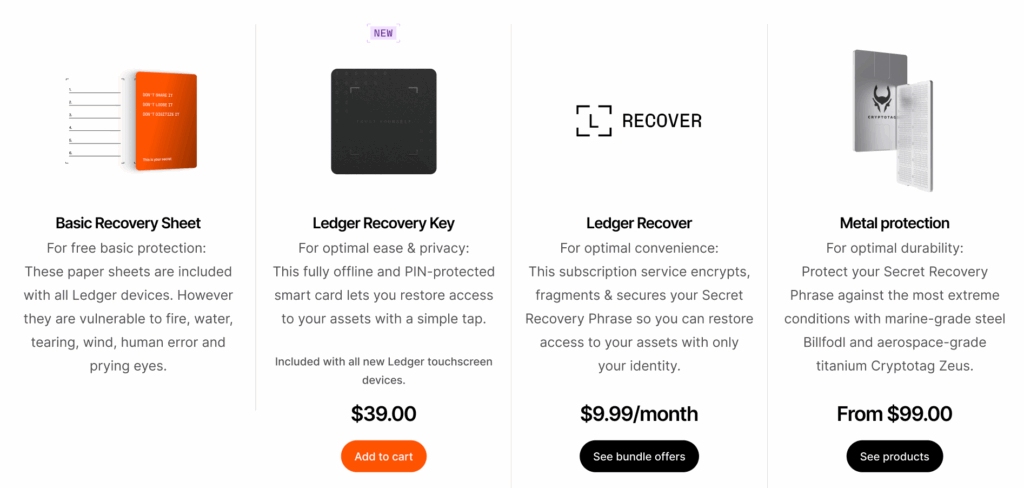
so the seed can leave. it always could. the only thing stopping it was ledger choosing not to build the path. recover built this path.
to be precise, because this is important: the chip has never been publicly broken. the seed only leaves if you subscribe and approve it on the device, and it leaves encrypted. ledger is right about all of that. but that's not the point. the point is that the guarantee you were sold was a policy, and a policy can change with 1 update.
you can't check the only important
ok, you might say, then i'll just read the code and confirm the bad path isn't there.
you can't. the firmware running on the secure element is closed. it's under a legal agreement with the chipmaker, stmicroelectronics, and ledger says so on its own website in a post literally titled "ledger is 95% open source, why not 100%?" the missing 5% is not random. it's the layer where your keys live. that's the exact part no outside researcher is allowed to read.

and your device trusts anything ledger signs. when an update comes, the device checks that it's signed by ledger and installs it. you don't get a vote. if you want the apps to keep working, you take the update.
in early 2026 ledger pushed an update that blocks non-standard derivation paths on the bitcoin app. a signed update you couldn't refuse changed what your own keys were allowed to do. that's the trust model, working exactly as designed. it just usually works in ledger's favor, so nobody notices.

the worst thing ledger leaked
in july 2020, ledger's customer database leaked. their first message downplayed it: about 9,500 customers had detailed info exposed. the real number that showed up on a hacker forum was 272,853 names, phone numbers, and home addresses. that's almost 29 times bigger than what they led with.

think about what that list is. a hardware wallet exists so nobody knows what you own. buying one put your full name, your home address, and the label "owns crypto" into one file. then that file went public.
what happened next was predictable. people got emails demanding bitcoin with lines like "see how my wrench works against your face." criminals mailed fake ledger devices to real home addresses, shrink-wrapped, with a flash drive soldered inside and a letter signed in the ceo's name, telling you to type in your 24 words. and it's not over. in 2026, ledger customers were still getting physical letters in the mail telling them to scan a qr code for a fake "post-quantum" upgrade.
most data breaches leak something you can change. reset the password, rotate the key. this one leaked where you sleep. you can't rotate your home address.
even a perfect device gets you drained
december 2023: ledger's own software library, connect kit, shipped a wallet drainer. one poisoned update hit sushiswap, balancer, zapper and others at the same time, and around $600,000 was gone.
Embedded post:
Author: Ledger (@Ledger) Post ID: 1735291427100455293 Source: https://x.com/Ledger/status/1735291427100455293 Reply to: none
Text:
> 🚨We have identified and removed a malicious version of the Ledger Connect Kit. 🚨 > > A genuine version is being pushed to replace the malicious file now. Do not interact with any dApps for the moment. We will keep you informed as the situation evolves. > > Your Ledger device and Ledger Live were not compromised.
the way in wasn't the chip. it was a former employee's npm account whose publishing rights were never turned off after they left. two-factor was on. an api key walked right around it.
your keys stayed on the device the whole time. you got drained anyway, because ledger's software told your screen to sign a transaction that wasn't what you thought it was.
recover brings back the two things self-custody was for
the reason self-custody exists is to remove two things: needing anyone's permission, and needing to prove who you are.
ledger recover puts both back. to use it you verify your identity with an id and a selfie through a third party. so now your government id is tied to encrypted copies of your seed. and the ceo, pascal gauthier, said on a podcast: "the only concern really is if we get subpoenaed by a government... we would like you to retrieve 3 three shards."
that's the company that sells you sovereignty telling you the state can pull your keys. opt-in, sure. but the option now exists, with your face attached to it.
so where does that leave you
give ledger its due. the secure element is genuinely good hardware. no one has publicly pulled a seed off an initialized ledger. every real ledger "hack" hit the screen chip, the software, or the supply chain, never the vault itself.
that's exactly why the vault was never the problem. the problem is everything around it: closed firmware you can't read, a customer database that keeps leaking, and a promise that was sold to you as a guarantee.
even zachxbt, who traces this stuff for a living, said in july 2026 that hardware wallets are "complete garbage" and called ledger the worst. his complaint wasn't the chip either. it was everything wrapped around it.
not your firmware, not your keys.
Related articles


EVERY DEVICE THAT KILLS YOUR $200/MONTH AI BILL. ALL IN ONE ARTICLE
Follow & Bookmark this - I'm @starmexxx, I track how AI tools are creating new income streams most people haven't heard of yet. This one is the entire map.
Ultimate Memecoin Trading Guide: How to make 100x in 2026 without being an insider
I turned $150k into $420k on memes in the last 30 days.