You already go to the gym. Add a camera + AI and it becomes a $6K/mo business. Full playbook.

You're already in the gym 3–5 times a week.
You sweat, you lift, you leave. The session is gone forever.
Here's the reframe that changes everything: every workout is inventory.
The average person sees an hour of exercise.
A few people see a $72,000-a-year asset walking out the door unrecorded.
Add a camera. Let AI do the boring 90%. Here's the playbook.
Kill the lie first
You cannot make money "just by working out." Anyone selling that is lying, and you'd be right to scroll.
The real mechanism is better. The gym is the thing that stops most people from making content — a reason to film, and a place to do it. You already show up. You already produce the hard, expensive ingredient: real footage of real effort.
That footage is inventory. Most people throw it in the trash every morning.
Two years ago, turning that inventory into income needed:

· an editor
· a copywriter
· a strategist
· a VA

Today it needs:
 · one person, on their phone, after leg day.
That's the whole shift. The barrier didn't shrink — it vanished.
Why small accounts WIN
Fitness is one of the highest-earning niches, because the audience actually buys — and the money quietly moved somewhere most people aren't looking:
→ Sponsorships used to be the prize. Now coaching, challenges, and digital products are the real income — the creators winning own the transaction instead of renting attention.
→ The surprise: you don't need to be huge. A "small" account most people would ignore — 10–30K engaged followers — can fill 20–30 coaching spots with zero ads. Thirty clients at $200 a month is $6,000 a month — $72,000 a year, recurring, at almost pure profit.
Sit with that. A mid-size gym account can out-earn an influencer with ten times the followers — because trust converts and follower count doesn't.
> However, this isn't the only way to earn money; more methods are listed below.

Why this works now
Content has two halves: the footage, and everything around it — the cutting, captioning, planning, posting, the client messages. The second half is the grind that makes everyone quit.
You already make the footage, free, every session.
And the grind — all of it — now runs on one cheap stack of tools while you rest between sets.
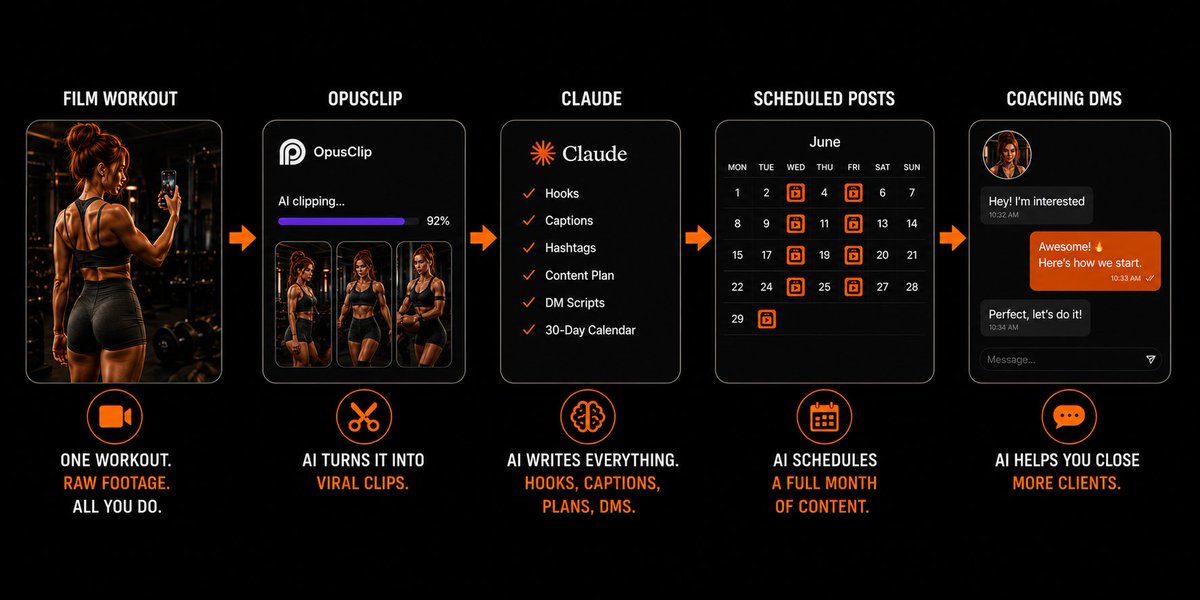
One 45-minute workout, filmed casually, becomes:

a week of posts   +   captions for all of them

Your part: ~30 minutes on your phone, after the gym.
You bring the one thing software can't: actually training. Everything after that costs about $20 a month.
The toolstack (real tools, real prices)
FILM
Your phone — $0. A $15 tripod is the only "gear."

CLIP IT
OpusClip — free tier -> $15/mo. One workout video -> several captioned vertical clips, virality-scored.

CapCut — $0 for manual cutting.

BRAIN
Claude — $20/mo. Captions, calendar, workout PDFs,
client check-ins, brand outreach — the non-gym work.

SELL
A free Stan / Beacons page + an email tool (free tier).
The whole machine: ~$20–35 a month and a phone.
Part 1 — The workflow (one workout → a week of content)
1  Film your session  +0 min   phone on a tripod, one angle is fine
2  Run it through AI   ~10 min  best sets -> captioned clips
3  Generate the words  ~15 min  hooks, captions, posting plan
4  Queue the week      ~15 min  5-7 posts scheduled, done
The one prompt that does the writing:
You are my fitness content coach. I filmed today's [leg day].
What I did: [1-line description].
Give me:
1. 5 scroll-stopping hooks for the first 3 seconds (on-screen text)
2. A caption for each, in a real, no-BS voice — I'm not a guru
3. Best posting time + 3 niche hashtags
4. One save-worthy tip post from this same session
End each caption with a soft CTA to my free plan.
Forty minutes after the gym = a week of content live.
Part 2 — Pick the lane that converts
You don't need abs or a million followers. You need one clear lane people trust:
CONVERTS HARD
  Transformation / weight loss   massive demand, high trust
  Beginner-friendly strength     huge audience, low competition
  "Busy person" fitness          relatable, sells programs
  Form fixes / injury-safe       save-worthy, builds authority

AVOID as your whole identity
  Generic gym memes              viral reach, terrible money
The filter: does your content make a stranger think "I could do that — show me how"?
That viewer becomes a client. "Wow, you're shredded" doesn't pay. "I'll help you start" does.
Part 3 — How the money actually works (4 streams)
Stack them. They compound as trust grows.
- Coaching — the engine. This is the real money. Thirty clients at $200/mo is that $6K/month — $72K/year, near-pure profit — no product, no shipping, just your time. Even part-time, 5 clients is $1,000/mo recurring. Trust sells this, not follower count.
- Challenges + digital products — infinite scale. Build once, sell forever. A 30-day challenge, a meal-plan PDF, a "$500 home gym" course. One mid-size account running two paid challenges a year can clear ~$29,000 from challenges alone, on top of everything else.
- Brand deals — the visible layer. Supplement, apparel, and equipment brands prefer micro creators (10–50K) because their audiences convert. You don't need to be big — you need a clear niche.
- Affiliate — the supplement layer. Fitness is the #1 supplement-affiliate niche. Recommend 2–4 products you actually use; it pays quietly in the background.

Part 4 — The asset everyone ignores
One fact worth the whole article: email subscribers buy at up to 40x the rate of social followers.
Social is rented — the algorithm decides who sees you. An email list is owned. Put a free starter plan in your bio, collect emails from day one, and you build the one thing that turns views into income on demand.
Most creators start this in year two and regret it. Start it in week one.
Part 5 — The 30-day start
Week 1  Film every session. Post 1 clip/day. Set up a free
        coaching page + an email freebie.
Week 2  Find your hook -> make 3 more like it. Pick ONE lane.
Week 3  Batch one workout -> a full week queued. Reply to
        every comment — that's where clients DM you.
Week 4  Open 3-5 coaching spots at $150-200/mo. Pin your best
        clip. Pitch one brand you already use.
First-month cost: a phone, a $15 tripod, ~$20. Your first client covers it 10x over.
Part 6 — Mistakes that kill it
Promising "get paid to work out." Bait attracts no-buyers and the algorithm punishes it. Sell the outcome, not the workout.
Chasing followers, not trust. A 40K account that converts beats an 800K one that can't sell a $29 plan.
Posting then quitting. One clip a day for 30 days beats one "perfect" video a month.
Renting attention only. No email list, no offer = you're at the algorithm's mercy.
Playing guru. Blunt and real beats fake authority every time.
The honest part
Most people won't hit five figures a month. Under 10K followers, many earn close to nothing for a while. The realistic curve for a micro account that builds trust and has an actual offer is a few hundred dollars climbing toward a few thousand a month. It's a real business disguised as a lifestyle.
But the asymmetry is real: you already pay the expensive cost — the training — and your tooling stays ~$20 whether you have 500 followers or 50K. You're not paid to lift. You're paid for the trust your consistency builds. AI just made producing that trust almost free.
The real insight
The gym was never the business. The footage was.
For years you let it disappear every morning — the early alarms, the heavy sets, the discipline — all of it evaporating the second you racked the weight.
Every workout already cost you something. Now every workout can finally pay you back.
That's the only thing that changed: the asset stopped walking out the door.
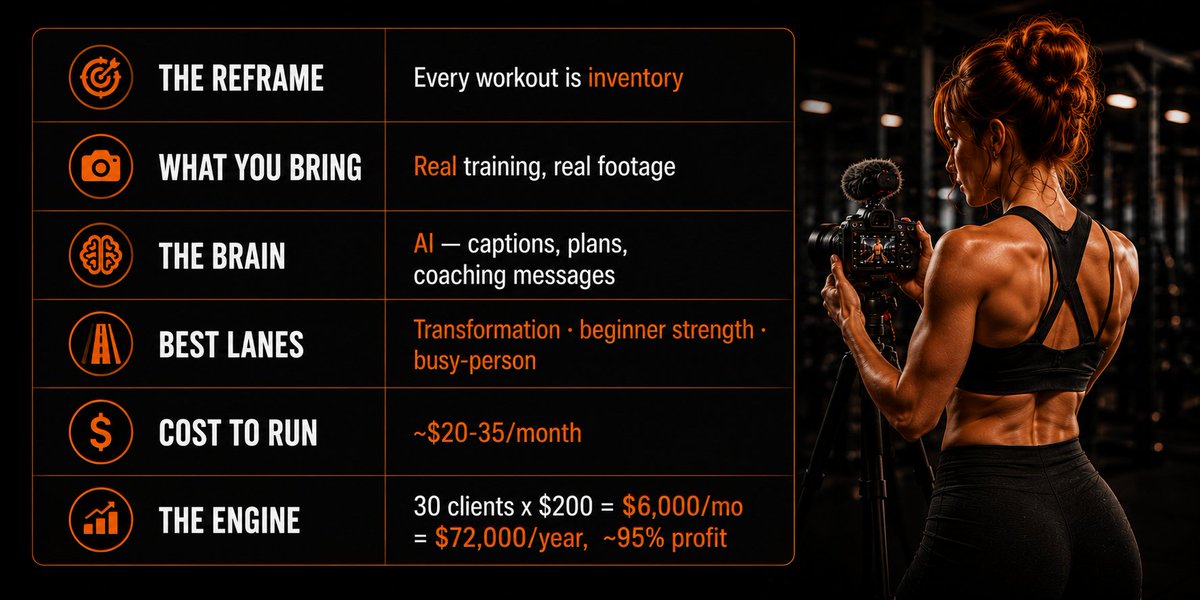
The reframe      Every workout is inventory
What you bring   Real training, real footage
The brain        AI — captions, plans, coaching messages
Best lanes       Transformation · beginner strength · busy-person
Cost to run      ~$20-35/month
The engine       30 clients x $200 = $6,000/mo = $72,000/year, ~95% profit
→ Repost if your gym sessions are secretly inventory
→ Follow — I break down the new way regular people make money online
→ Save this — the tools and the 30-day plan are worth bookmarking
Related articles


How to Build an AI-Native Company: Hiring, Standards, and Cadence
*We spent a year running hackathons, AI trainings, and office hours. But nothing changed until we made AI capability a requirement.*

38 Ways to Find $1M Startup Ideas:
1. Scrape 1 and 2-star G2/Capterra reviews of popular SaaS tools to find broken features or unmet needs.