10 Claude Prompts That Save Hours a Week
Most people don't have a Claude problem. They have a prompt problem — and it's rarely about length. A five-word prompt and a five-paragraph prompt can produce the same mediocre result if neither one removes the actual decision Claude has to guess at.
These ten aren't tricks. They're the specific phrasings that consistently change what comes back, pulled from how the model actually responds to structure, examples, and explicit permission to push back.

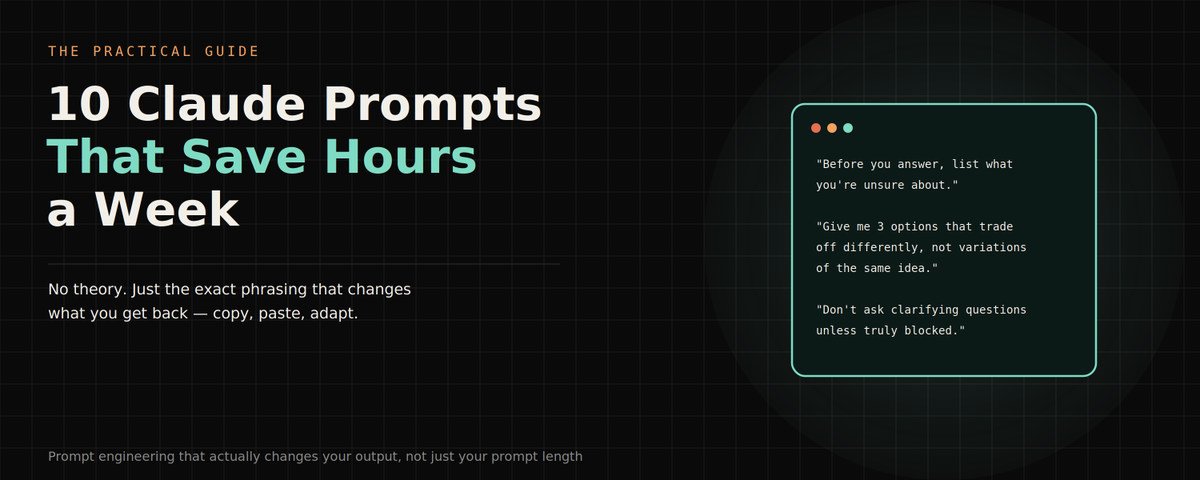
**1. "Don't ask clarifying questions unless truly blocked — state your assumption and go."**This one line kills more wasted turns than anything else on this list. Instead of a round of "did you mean X or Y," you get a complete answer with the assumption stated up front, which you can correct in one message instead of three.
**2. "Give me 3 options that trade off differently, not 3 versions of the same idea."**Without this, "give me options" often produces three flavors of the same answer. This forces Claude to actually vary what's being optimized for — speed vs. thoroughness, safe vs. bold, cheap vs. durable — so you're choosing between real trade-offs, not wording.
**3. "Before you answer, list what you're unsure about."**This surfaces hidden assumptions before they turn into a wrong answer you don't catch until later. It's especially useful on anything with numbers, dates, or specifics you can't personally verify in your head.
**4. "Write it, then cut 30% without losing meaning."**Asking for "shorter" after the fact usually gets you a slightly trimmed version of the same draft. Asking for the cut as part of the original instruction gets you something actually tightened, because Claude does the editing pass in the same context as the writing.
**5. "Explain like I already know [X], skip the basics."**Naming what you already know is more effective than saying "keep it technical" — it stops Claude from re-explaining fundamentals you told it you have, and it works because the model can skip building up to a level rather than guessing at your level from tone.

6. "Here's my draft. Where would an editor push back hardest?""Is this good?" invites polite agreement. This question targets the single weakest point specifically, which is almost always more useful than a general review — you get one real problem to fix instead of ten minor suggestions.
**7. "Use this exact structure: [paste a good past example]."**One real example does more work than a paragraph describing the format you want. This is the same principle behind few-shot prompting — showing beats describing, every time, especially for tone and structure that are hard to put into words.
**8. "What would you need to know to do this really well?"**Instead of hoping your brief was complete, this flips the question and lets Claude tell you what's actually missing before it starts guessing. It catches gaps you didn't think to fill in, because you're too close to the task to notice them.
**9. "Treat this as a first pass — I'll give feedback, then you revise."**Setting up iteration from the start changes the first response too — Claude aims for a solid draft to react to rather than a "final" answer trying to cover every possibility at once, which usually means it's faster to get somewhere good.
**10. "Save this context to a Project so I don't re-explain it every time."**The highest-leverage one on this list, because it's not really about a single prompt — it turns a one-off conversation into a reusable setup. Custom instructions plus a knowledge base means every new chat starts already knowing your voice, your standards, and your context, instead of you retyping the brief every morning.

None of these are about magic words. Every one of them does the same underlying thing: it removes a decision Claude would otherwise have to guess at — how long, how deep, which trade-off matters, what you already know, what "good" means for this specific task. A vague prompt forces the model to guess at all of that simultaneously, and it usually guesses at the average case, which is why average prompts get average answers.
The fix was never "write a longer prompt." It's writing the two or three sentences that remove the guessing entirely.
If this was useful, follow @BLAZT_AI I post something like this every day — no fluff, just things worth actually using.
Related articles

how to run an ai native agency with jev (FULL GUIDE)
jev is open to everyone now. it's a super fast decision model, so one person can now do work that businesses usually pay an agency a big cut for. here's how you can set up a whole ai native agency wi…


5 Step Video GEO Guide for SaaS (62k AI Mentions in 3 Months with Claude)
I pulled every "best ... software" keyword with real US search volume, 2,328 of them, and ran 140 through DataForSEO on Google US mobile on September 1, 2026: the 60 biggest category head terms plus…