$4,000 a Month From Books Nobody Had to Write

$4,000 a month. That's what a 50-title catalog of AI-narrated audiobooks can gross once it's built - and the operator didn't write a single new word to get there.
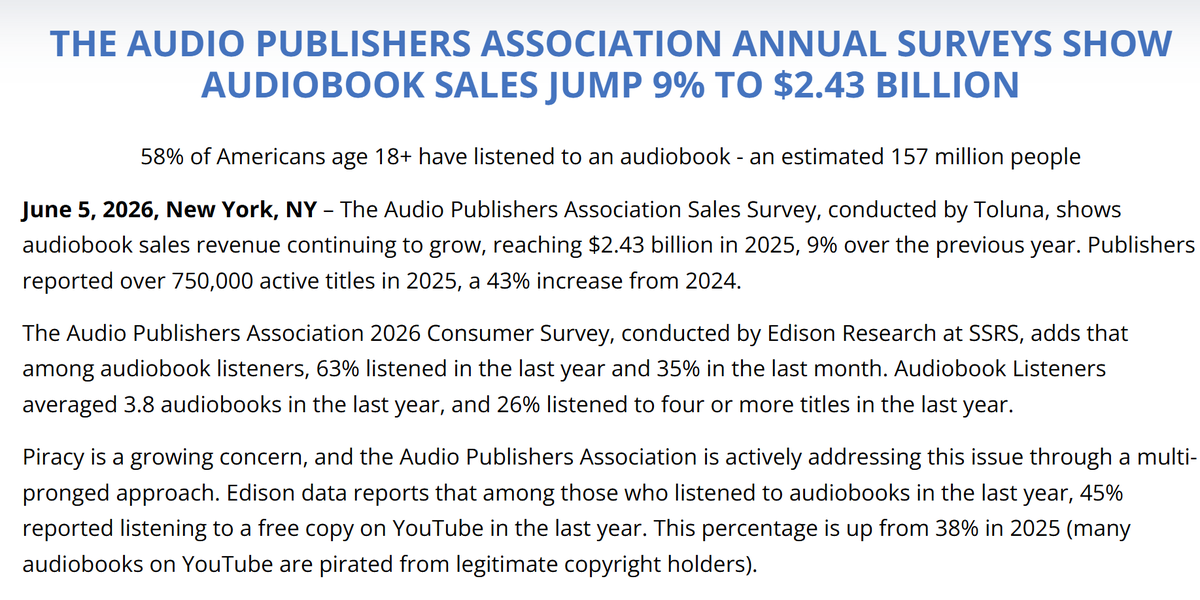
Here's the escalation. One converted ebook earns a modest $20–$200/month. Stack fifty of them and you're in $3,000–$5,000+/month territory, inside a US audiobook market that did $2.43 billion in 2025, up 9% year over year.
 — "data: https://www.audiopub.org/surveys"
The twist: human narration used to cost $2,000–$10,000 per title, which is exactly why millions of ebooks never got an audio edition. AI dropped that cost to near zero.
One person plus AI is now the leverage that used to require a production studio.
One honest flag before we start: AI-narrated titles were just 0.03% of 2025 audiobook sales, and listener willingness to try AI voices is slipping. The winners do this right, not fast-and-sloppy. Here's how.
Why This Works: Orphaned Books, Free Narration, and a Market That Keeps Growing
Let's be blunt about the income distribution first, because the hype accounts won't be.
A single AI-narrated title typically earns $20–$200/month. That's grocery money, not quit-your-job money. The payoff lives at catalog scale: 25 titles ≈ $1,000–$2,500/month, 50 titles ≈ $3,000–$5,000+/month, and top operators with genre fiction series go higher. The asset compounds because every title you add sells forever with zero marginal production cost.
 — "data: https://audiobookcalc.online/calculators/narration-cost-estimator/#calculator"
Now the credibility layer, with receipts. The Audio Publishers Association's annual sales survey put US audiobook revenue at $2.43 billion in 2025, up 9%, with 750,000+ active titles - a 43% jump in one year. Note the source discrepancy so you're not fooled later: the AAP's StatShot tracks "digital audio" at roughly $1 billion for 2025 - a narrower measure of the same market. Global estimates run higher still, around $8.7 billion for 2026. Different scopes, same direction: up.
The cost gap is the whole opportunity. Human narration runs $100–$400+ per finished hour, so a 10-hour book costs $2,000–$4,000+ before editing - and premium narrators push totals toward $10,000.
Meanwhile Amazon's Kindle store holds millions of ebooks, and only 750K audiobooks exist, period. That conversion gap - millions of orphaned ebooks - is the inventory you're mining.
So what does a $3K/month catalog actually take? Math, not magic:
40 titles × 12 sales/month × ~$6.25 average royalty per sale ≈ $3,000. Twelve sales a month per title is one sale every two or three days. Ambitious, but arithmetic - not virality.
The rest of this guide is the exact AI workflow to build that stack, title by title.
How You Actually Get Paid: The Three Royalty Routes (2026 Edition)
Route 1 - KDP Virtual Voice: ~40%, free, zero production cost.
Amazon's built-in AI narration converts eligible Kindle ebooks and sells them on Amazon/Audible. Priced $3.99–$14.99.
Worked example: a $9.99 Virtual Voice title × 40% = $4.00 per sale.
Route 2 - ACX Exclusive: 50%.
As of May 26, 2026, Audible's new royalty model pays 50% exclusive / 30% non-exclusive, replacing the legacy 40%/25%.
Worked example: $14.95 × 50% = $7.48 per sale. Big caveat below.
Route 3 - Wide / non-exclusive: 30% on Audible, more elsewhere.
Google Play Books pays 52% ($14.95 × 52% = $7.77), Kobo 45%, and Voices by INaudio (the former Findaway Voices) passes you 80% of net — typically 45–50% of list across 40+ platforms including Spotify and libraries.
Two things the hype accounts skip. First, ACX's 50% is a share of a pooled "Member Value" fund weighted by listening, not a fixed cut of retail - some authors report 30–40% royalty drops under it. Second, ACX's standard upload terms require human narration - AI audio's sanctioned paths are Virtual Voice and the wide aggregators.
The strategic wrinkle: a voice-cloned title distributed wide keeps earning on Spotify, Google, Kobo, Apple, and libraries for years. Lifetime, that stack can beat a 50% exclusive locked to one store.
How to Turn an Ebook Into an Audiobook with AI
Enough theory. This is the hands-on spine - the exact toolchain and the eight steps from orphaned ebook to live audiobook.
The AI Narration Tool Stack (What Each Tool Is Actually Good For)
- ElevenLabs (Projects) - the quality ceiling. Expressive voices, emotion tags, voice cloning, pronunciation control, book-grade export. A full novel realistically runs on the ~$99/month Pro tier, about one book per month. Commercial rights included on any paid plan.
- KDP Virtual Voice - free, built into your KDP dashboard, US English only, limited voices, fine for straightforward nonfiction. Zero control compared to ElevenLabs, but zero cost.
- OpenAI TTS API - the budget pick at ~$4–$7 per novel. Clean read, no cloning, no pronunciation dictionary.
- Kokoro-82M - free and local, Apache-licensed so you can sell the output. Weaker expressiveness; good for testing.
- Others worth knowing: NarrationBox, Murf ($19/mo), Play.ht, Speechify - all fine mid-tiers.
Clone a voice (with documented consent) when the author brand matters - a memoir, a known podcaster, your own backlist persona. Otherwise a stock voice wins on time.
The 8-Step Workflow (Copy This Exactly)
Step 1 — Source a convertible title. Three wells to draw from:
- Your own KDP backlist. Virtual Voice eligibility requires: ebook live 7+ days, English, a working table of contents, a cover, under ~240,000 words (~26 hours), no existing audiobook - and not public domain.
- License other indie authors' un-narrated books. Search Amazon for ebooks in your genre with no audio edition, then pitch a royalty-share deal. Copy-paste outreach: "Hi [name] - I produce AI-narrated audiobooks and noticed [title] has no audio edition. I'd cover 100% of production and distribution; we'd split net royalties 50/50, you keep all other rights. 10-minute call?" Get the split and term in writing.
- Public domain. Legal and free - but remember: Virtual Voice rejects public-domain titles, so it's custom AI narration + wide distribution only, and classics are brutally saturated.
Step 2 - Prep the manuscript. AI narrates exactly what's on the page, including your typos. Cleanup checklist:
- Strip headers, footers, page numbers, image captions, and URLs (an AI will read "h-t-t-p-s colon slash slash" out loud).
- Normalize chapter breaks - one clean heading per chapter, no ornaments.
- Spell out symbols and numbers how they should sound ("$19.99" → "nineteen ninety-nine").
- Build a pronunciation note list: character names, place names, jargon.
Step 3 - Choose your route and tool. Decision rule: nonfiction backlist title on KDP → Virtual Voice, free, done in an hour. Fiction or anything where reviews matter → ElevenLabs + wide distribution. Public domain → ElevenLabs or OpenAI TTS + wide (Virtual Voice is off-limits).
Step 4 - Generate the narration. In ElevenLabs Projects: upload the docx, pick a voice, set Eleven v3 model, stability ~50%, similarity ~75%. Then direct the read with inline tags. Copy-paste example:
[warm, conversational tone, steady pace] Chapter One.
[slight pause] Nobody expects a quiet Tuesday to change their life.
[curious, leaning in] Mine changed over a wrong-number phone call.
Generate one chapter first, listen end-to-end, then batch the rest. Sample voice-direction prompt for the AI assist:
"Narrate this chapter as a friendly, unhurried nonfiction read; emphasize the numbers; pause after every section heading."
Step 5 - QC to survive review and reviews. Tedious? Yes. Optional? No.
- Fix mispronunciations with ElevenLabs' pronunciation dictionary or phonetic respellings ("Siobhan" → "Shi-vawn").
- Listen at 1.25× for robotic stretches, missed pauses, and number blunders.
- Export to spec: MP3, 44.1 kHz, 192 kbps CBR, RMS between -18 and -23 dB, peaks under -3 dB, noise floor below -60 dB - the numbers platform QC checks first.
- Disclose the AI narration in metadata where the platform asks - it's required on most stores now, and hiding it invites takedowns.
Step 6 - Package it. Square cover at 2400×2400 px (your ebook cover re-cropped), metadata mirroring the ebook, narrator listed as the voice name or "Virtual Voice" per platform rules, and a retail sample from the strongest 3–5 minutes - usually chapter one, not the legal disclaimer.
Step 7 - Distribute. Virtual Voice path: click publish in KDP, live in ~72 hours. Wide path: upload to Voices by INaudio for 40+ platforms (Spotify, Apple, Kobo, libraries), and go direct to Google Play Books (52%) and Kobo (45%) to skip the aggregator's 20% cut where it's easy. ACX non-exclusive only if your audio qualifies under current terms - re-check, because ACX's AI stance tightened in 2025–2026.
Step 8 - List, price, and promote. Price $9.99–$14.95 for full-length titles; shorter nonfiction can sit at $6.99–$9.99. Link every format - ebook, audio, print - in your Amazon description and your email footer. New titles sell the old ones; that's the compounding engine.
That's one title. Now let's talk about what ten, twenty-five, and fifty of them do to your bank account.
The Money Math: Three Scenarios, No Fairy Tales
Every number below is a model, not a promise. Assumptions on the table: $14.95 list price, mixed routes averaging ~$6.25 royalty per sale, steady midlist performance.
Conservative - 5–10 titles: $200–$800/month. Say 8 titles × 8 sales/month × $6.25 ≈ $400. This is what "I did the workflow on my backlist" looks like with zero marketing. It pays a utility bill.
Realistic - 25 titles: $1,000–$2,500/month. 25 titles × ~11 sales/month × $6.25 ≈ $1,700. This typically means genre fiction series or licensed indie catalogs, plus light promotion. Real side income.
Aggressive - 50+ titles: $3,000–$5,000+/month. 50 titles × 12 sales × $6.25 ≈ $3,750. Flag this clearly: it's scaled, top-effort operation - licensing deals, series fiction, promotion - not the typical outcome.
Route delta on that same 50-title catalog at 400 total sales/month: 50% exclusive ≈ $2,990 vs 30% non-exclusive ≈ $1,794 on Audible alone - but wide adds Google Play, Kobo, Spotify, and library revenue on top of the $1,794, which is why many operators take the lower headline rate.
Risk & Reality Check (Read This Before You Spend a Dollar)
Here's the part the YouTube thumbnails leave out.
AI-narrated audiobooks were 0.03% of 2025 sales revenue, and listener willingness to try AI narration fell from 70% (2025) to 61% (2026) - only 16% of listeners have actually finished an AI-voiced title. The number of AI titles exploded from ~1,600 in 2023 to 40,000+ in 2025 - supply is flooding in faster than listener trust.
Platform risk is real too. ACX rewrote its royalty model in 2026 with a December 31, 2026 deadline forcing every legacy title into the new system. Rules can change again. And remember: public-domain books can't use Virtual Voice, and ACX/KDP terms must be re-verified before you act on anything in this article.
The honest-but-motivating close: single titles earn modestly and sloppy AI reads earn one-star reviews. The edge belongs to whoever builds a durable, quality-checked catalog now, while conversion costs sit near zero.
Related articles
How to Start a 6 Figure Faceless YouTube Channel (Full Breakdown)
I've helped over 400 people start profitable faceless youtube channels. i've ran over 50 channels myself. Generated over $4 MILLION by age 25. Worked with youtubers that have 10 million+ subscribers,…


This is how to NEVER get demonetized by YouTube again
This article will show you the craziest method no guru is telling you.