Brands pay $34,000 for one post from a 25-year-old who does not exist.
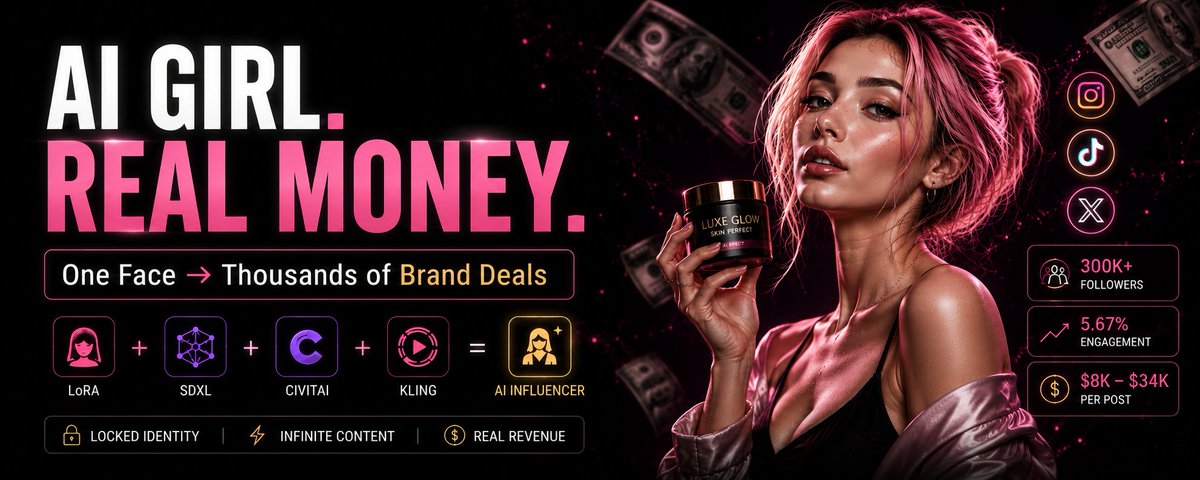
Her name is Aitana Lopez. Pink hair, 300,000 followers, the same face across three years of posts. A Barcelona agency called The Clueless Agency built her in 2023, tired of models who skipped shoots, asked for more money, or posted something drunk at 2 AM.
The trick behind her face has a name: a LoRA, a small adapter trained on a face until one word in a prompt locks it in place for good. Nobody needs a studio to build one anymore. Civitai runs the trainer and the generator on one site, the same pipeline RunPod says now processes 800,000 LoRA jobs a month.

The face itself often starts as two real faces, not one built from nothing. A blend tool merges them, keeps one face's pose and lighting, and pulls hair and eye color from the other. Four candidates come back in under a minute. Pick one, and it never changes again.

After that, one line drives most shoots: same woman, gym mirror selfie, natural window light, shot on iphone. Swap four words and she is on a rooftop bar instead, same face, same bone structure.
Video shrinks the prompt further: feed a reference clip in, ask it to copy that motion onto her photo, keep her face untouched.
Insiders call this whole discipline identity-locking, and it is the only thing standing between an AI face and a blown cover.
 — "Example:"
What it takes to build one:
| AI tool | Role | Cost |
|---|---|---|
| SDXL / Flux.1 | Base model the face gets trained on | Free, open weights |
| Kohya SS | Trains the LoRA that locks the face | Free, local or rented GPU |
| Civitai | Hosts the trainer, generator, and finished LoRAs | Free tier + paid credits |
| Nano Banana Pro (Higgsfield) | Blends two real faces into one identity | ~$29/mo |
| ComfyUI | Node workflow that generates the shots | Free, open source |
| Kling Motion Control | Transfers real movement onto the locked face | Credit-based, per clip |
| RunPod | Rents the GPU for heavier video workflows | ~$0.40/hr |
| CapCut | Strips AI metadata, adds a realism pass | Free |
The last generation of virtual influencers had no such shortcut. Lil Miquela launched in 2016 as a full 3D rig, animated frame by frame for Prada and Calvin Klein. Lu do Magalu, a Brazilian mascot turned influencer, pulls 8M followers and about $2.5M a year, built the same slow way. Imma, out of Tokyo, still gets modeled shot by shot for IKEA and Porsche.
A trained LoRA collapses that timeline to a weekend.
The money follows the shortcut. Campaigns running AI faces post 5.67% engagement against 1.89% for human influencers. Top AI models book $8,000 to $34,000 a post. The market sits at $11.7B today, projected at $154B by 2032, a 13x run in 6 years.
One operator with one laptop and a folder of checkpoints runs 5 to 10 of these faces across 5 to 10 niches at once.
One face. One prompt. Zero sick days.
Related articles

How I Built My AI Video Machine with Higgsfield MCP
*A finished 12-second spot for 30 credits. Two tools. I write the brief, the agent runs the other 4 steps.*

How to build an AI video studio in Claude Code:
I turned Claude Code into a working film studio and i'm going to hand you the complete system: the skills, the prompts, the loops, and the six-stage pipeline that ties them together

how i cook 30 winning AI ads in 30 mins w/ claude x higgsfield MCP
i timed the last production session.