Fanvue + four text files = $43,000 in 30 days. Here's how the machine works

In 2023, a convincing fake influencer took eighteen months, a studio, and a team. In 2026 it takes a weekend, about $400 in compute, and four text files. One of them reportedly cleared $43,000 before her own subscribers realized she was never a person. This is how that became possible, who is actually getting paid, and how to tell when the woman in your feed is a folder on somebody's laptop.
1 · The fake people who are already cashing checks
Before we get to the $43,000 screenshot doing laps around your timeline, look at the cases that are not in dispute. They have names, agencies, press coverage, and revenue. They just do not have bodies.
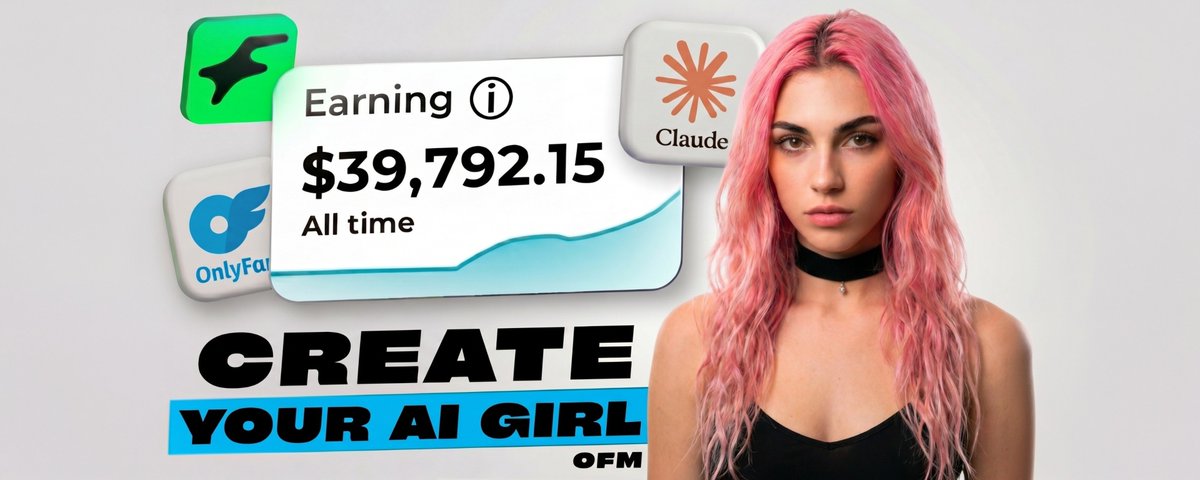
Aitana López launched out of Barcelona in 2023, built by a small agency called The Clueless. She is pink-haired, 25 on paper, and according to her creators she pulls in up to €10,000 in a strong month, with an average closer to €3,000. By 2026, reporting put her ceiling as high as $50,000 a month across brand deals, a skincare line, and a lingerie page on Fanvue. A Latin American actor with five million followers reportedly slid into her DMs to ask her out, not realizing he was flirting with a render.
Emily Pellegrini appeared the same year, spun up by an anonymous solo creator whose entire design brief was a ChatGPT prompt. He told the Daily Mail: "I asked what the average man's dream girl was, and it said brown hair and long legs, so I made her exactly like that." Footballers and at least one billionaire chased her. On Fanvue she went from roughly $6,000 in October to $23,000 that January. She has never existed for a single second.
Jessica Foster is the 2026 edition of the same trick, and the most cynical. She surfaced in December 2025 posing as a U.S. service member, photographed alongside Trump and his entourage, captioned like a patriot. Nearly a million people followed. They thanked her for her service. Her bio funneled them to an OnlyFans foot-fetish account where some fans paid more than $100 for a single post. She was unmasked by a detail the model got wrong: her uniform nametag read "Jessica," when the U.S. Army uses last names. A render does not know that. A real soldier would.
Then there is Grace, run by two British men in their early twenties, quietly clearing thousands a month selling explicit content of a woman who was never born. None of these are theoretical. Every one of them is sourced at the bottom of this page.


Which brings us to Maya.
In May 2025, an X thread claimed a 21-year-old in Austin had built an OnlyFans persona named Maya on a secondhand $400 MacBook and cleared $43,000 in her first 30 days. The thread did more than 7.5 million views. IBTimes picked it up under a headline about fraud concerns. Here is the honest part most reposts skip: nobody has verified it. No payout records, no platform confirmation, no face for the creator. Treat the $43,000 as a story, not a receipt. It is the round, frictionless number a recruiter reaches for when the actual product is your attention. We will come back to who really makes money off that number.
But the reason the story is plausible at all, the reason it spread instead of getting laughed off the timeline, is that the tools to build Maya genuinely shipped in the last two years. That part is real. Let's open the hood.
New here? This is the latest entry in an ongoing investigation.
Three deep-dives on the synthetic-creator economy, newest first.
2 · Why now: the three tools that collapsed the cost
Aitana took an agency the better part of a year. Emily's creator described fourteen to sixteen hour days for months on end. The thing that changed between them and "a weekend" is not ambition. It is that three separate technologies each crossed the line from uncanny to good enough at roughly the same time.
The first is image consistency. Open models like Flux, fine-tuned on a few dozen reference shots into a lightweight LoRA, will produce the same invented face across thousands of images, in different rooms and different lighting, holding the same jawline and the same freckles. The cost is rented-GPU change, not a photo studio.
The second is voice. A service like ElevenLabs will clone a usable voice from roughly ninety seconds of clean audio. One short Fiverr session and the persona has voice notes forever.


The third is persistence. A long-context language model can hold a character across a very long conversation without losing the thread, which is what turns a static picture into something that feels like a person who remembers you. Stack the three and the studio folds down into a laptop.
3 · The machine: how a synthetic persona is wired
Strip away the mystique and a synthetic creator is a small pipeline. A definition of who she is feeds a language model. An image model and a voice model give her a body and a sound. A memory file gives her continuity. A scheduler points the whole thing at a platform, and the platform points it at a paying stranger. I am sketching the architecture, not handing you a build script, because the interesting part is not the wiring. It is the one box that makes the rest work.
That box is memory. The system keeps a running file on each subscriber: their name, their job, the loneliness they let slip at 2am, the photo type that makes them tip. On the next message it reads that file first. The output is not a chatbot being clever. It is a stranger being remembered, which to the person paying feels exactly like being known. That is the engine. It is also the problem, because the same loop that personalizes affection is personalizing persuasion. Hold that thought until section six.
4 · The money, and the part nobody screenshots
Here are the figures that are actually sourced, side by side. Notice that the verified ones, Aitana and Emily, are real money but not lottery money, and that the headline $43,000 is the single bar wearing a question mark.
Now the part the recruiters edit out. The $43,000, if it were ever real, is gross. The viral thread itself subtracted a platform cut, a payment-processor cut, and compute, and landed near $32,000 net, before a single dollar of tax and before the refund requests that follow any account selling a person who cannot hop on a video call. Gross is the number that goes in the hook. Net is the number you live on. They are never the same figure, and the size of the gap is the first tell of a pitch.
Then there is the larger sleight of hand. Walk the actual market of "AI girlfriend" courses and roughly 80 percent of them turn out to be recycled Instagram-marketing advice with a few OnlyFans screenshots stapled on top. People have reported spending $3,200 across six months of these courses while stuck at $400 a month in revenue. The pattern is old and it is ruthless. In a gold rush the steady money is in selling shovels, and the person who actually cleared income off "Maya" is far likelier to be the one selling you the Maya playbook than the one running her.
I pulled apart where the real dollars actually hide in The Synthetic Creator Economy,


and it was rarely the subscription page. The full series sits here.
5 · The market is real even if the girlfriend isn't
It is tempting to file all of this under internet curiosity. The money says otherwise. Strip out the hype-men and there is a genuine, fast-growing industry underneath, and the capital chasing it is not pretend.
The virtual-influencer market was valued around $11.2 billion in 2025 and is forecast near $15.9 billion in 2026, on a path that several analysts put above $60 billion by 2030, compounding at roughly 40 percent a year. Alongside it sits a younger, hotter segment. AI companion apps pulled in about $82 million in just the first half of 2025 and were tracking toward $120 million for the year, with revenue per download more than doubling. People are not just looking. They are paying, monthly, and paying more each quarter.
6 · The catch: rules, law, and the people getting hurt
Here is what the "anyone can do this" thread leaves out. OnlyFans requires every account to be tied to a verified human being, and AI-generated content is supposed to be clearly disclosed. A persona that hides its nature to take money is not a clever loophole. It is a terms violation waiting on a payout clawback. Jessica Foster is the live example: exposed, and squarely against platform policy on two fronts at once.
The law is moving the same direction. The FTC treats virtual endorsers under the same rules as human ones, which means undisclosed synthetic endorsements are simply deceptive advertising. New York has passed a Synthetic Performer Disclosure requirement, and more jurisdictions are drafting versions of "say when it is AI." The regulatory window where this felt consequence-free is closing.
And then there is the human cost, which runs in both directions. On one side, the people being deceived: lonely subscribers paying real money into a relationship that has no one on the other end. On the other, the workers being erased. An entire layer of low-wage "chatters" in the Philippines, Kenya, Nigeria and elsewhere, paid around $3 an hour to impersonate models in DMs, are watching their own chat logs get used to train the AI that will replace them. Both sides of the transaction are getting automated, and only the person holding the folder comes out ahead.
7 · How to tell if you're talking to a folder


If the build cost has collapsed, the only defense left is your own eye. The classic pixel-level tells still work, for now, but they are fading fast as the models improve, so weight the behavioral tests highest. The single most powerful move costs thirty seconds: reverse image search. A real person leaves a real trail. A render usually leaves nothing but the accounts that posted it.
More from this investigation
This is the latest dispatch in an ongoing @ashercrw series decoding the synthetic-creator economy before it reaches the rest of the timeline. If this one connected, the three earlier deep-dives are the backstory, and the complete run lives at x.com/ashercrw/articles.
FAQ
Are AI influencers actually making money?
Yes, though less than the viral numbers suggest. Verified personas like Aitana López and Emily Pellegrini have reported figures in the low tens of thousands per month at their peak, across brand deals and subscription platforms. The broader virtual-influencer market is valued in the billions. The specific "$43,000 in 30 days" claim, however, is unverified.
Is it legal to run an AI OnlyFans model?
It is heavily constrained. OnlyFans requires accounts to be linked to a verified human and expects AI content to be disclosed. The FTC treats virtual endorsers like human ones, and states such as New York now require synthetic-performer disclosure. Running a persona that hides its AI nature to take money risks bans, payout clawbacks, and fraud exposure. This article is analysis, not legal advice.
Did the "Maya" $43,000 story actually happen?


Unclear. It comes from a May 2025 X thread that drew over 7.5 million views and was picked up by IBTimes under a fraud-concerns framing. No payout records or platform confirmation have surfaced. Treat the figure as an unverified claim, not a documented result.
How can I tell if an influencer is AI?
Start with a reverse image search, which takes about thirty seconds. Ask for an unscripted live video. Watch the hands, ears, and earrings, the skin texture, the lighting against the background, and any warped text. Behavioral tests beat pixel-level ones, because the image tells are fading as models improve.
What tools are used to build these personas?
Broadly: an image model such as Flux fine-tuned into a LoRA for a consistent face, a voice clone from a service like ElevenLabs, and a long-context language model to hold the character in conversation, plus a memory file for continuity. This article describes the architecture for media literacy, not as a setup guide.
Anyone can be a folder now. The useful question is no longer whether you have ever followed an AI. It is how many, and what they were quietly selling you while you scrolled.
Save this. I break down a system like this every week. Follow @ashercrw. Embedded post:
Author: Asher Crowe 🪺 (@ashercrw) Post ID: 2063961121803866288 Source: https://x.com/ashercrw/status/2063961121803866288 Reply to: none
Text:
> http://x.com/i/article/2063945770416398336
Embedded post:
Author: Asher Crowe 🪺 (@ashercrw) Post ID: 2066882168828153883 Source: https://x.com/ashercrw/status/2066882168828153883 Reply to: none
Text:
> http://x.com/i/article/2066852248563453952
Embedded post:
Author: Asher Crowe 🪺 (@ashercrw) Post ID: 2069092830048371042 Source: https://x.com/ashercrw/status/2069092830048371042 Reply to: none
Text:
> http://x.com/i/article/2069028694132129792
Article tables:
The pitch versus the receipts
| What the thread promises | What the reporting shows |
|---|---|
| "$43k in 30 days, totally passive" | One unverified screenshot; most operators never clear four figures |
| "No skills, no experience needed" | The bottleneck is taste and retention writing, not the tools |
| "It runs while you sleep" | Someone is still pressing send, eating refunds, and dodging bans |
| "Anyone can do this" | The people reliably getting rich are mostly selling the course |
Why "passive and consequence-free" is a lie
| The reality | What it means for an operator |
|---|---|
| OnlyFans requires a verified human + AI disclosure | Deceptive personas violate the terms: bans and payout clawbacks |
| FTC: virtual endorsers follow the same rules | Undisclosed synthetic endorsements are deceptive advertising |
| NY Synthetic Performer Disclosure law | Some jurisdictions now mandate a visible "this is AI" label |
| Chargebacks and impersonation exposure | Selling a fictional "real person" invites fraud claims |
| Displaced human chatters | $3/hr workers training the model that replaces them |
The field guide: spotting a synthetic persona
| Tell | What to check | Reliability |
|---|---|---|
| Reverse image search | 30 seconds; AI faces usually have no organic web history | High, fast |
| The live test | Ask for an unscripted real-time video or a specific gesture | High |
| Hands, ears, teeth | Extra fingers, mismatched earrings, fused detail | Falling |
| Skin and lighting | Too-smooth skin; face lit differently than the room | Falling |
| Background text | Warped signage, nonsense logos, melted edges | Medium |
| Consistency over time | Story details that drift; never an unflattering candid | Medium-high |
The four-layer stack that replaced a production team
| Layer | Tool class | What it does | What it replaced |
|---|---|---|---|
| Face | Flux + a custom LoRA | One consistent invented face across thousands of images | A model, a photographer, a studio |
| Voice | ElevenLabs voice clone | A clonable voice from ~90 seconds of audio | A voice actress on retainer |
| "Brain" | Long-context language model | Stays in character across a long relationship | A room full of human chatters |
| Memory | A plain text or JSON file | Remembers each subscriber's details | Human memory, or a CRM |
The synthetic-creator economy, by the numbers
| Segment | Recent value | Forecast | Source |
|---|---|---|---|
| Virtual-influencer market | ~$11.2B (2025) | $15.9B (2026); $62.7B (2030) | Research and Markets |
| AI companion apps (revenue) | $82M (H1 2025) | ~$120M projected (2025) | TechCrunch |
| AI "girlfriend" app market | ~$2.8B (2025) | $11.06B (2032) | SNS Insider |
| OnlyFans creator payouts | $6.6B (past year) | 305M registered fans | OnlyFans / reporting |
The confirmed roster: AI personas with real revenue
| Persona | Since | Run by | Where | Reported money | Status |
|---|---|---|---|---|---|
| Aitana López | 2023 | The Clueless agency | Instagram, Fanvue | Up to €10k/mo (avg ~€3k); up to $50k/mo per 2026 reports | Confirmed AI |
| Emily Pellegrini | 2023 | Anonymous solo creator | Instagram, Fanvue | ~$6k (Oct) rising to $23k (Jan) | Confirmed AI |
| Jessica Foster | Dec 2025 | Anonymous | Instagram, OnlyFans | ~1M followers; $100+ per post | Confirmed AI, exposed |
| Grace | 2024 | Two UK creators | OnlyFans | "Thousands per month" | Confirmed AI |
| "Maya" | May 2025 | 21-y/o student (claimed) | OnlyFans | $43,000 in 30 days | Unverified viral claim |
Links
Related articles

The smartest money-move of 2026: build her in 30 min, earn $1,500 per viral. System inside.
A face that doesn't exist can out-earn a real one.
I spent 3 months figuring out AI influencers. I walked out with $39k and the full playbook
Face #1 sets the vibe of the niche, sharp cheekbones, cold look, strong jaw

How to Run AI Slideshows Profitably on TikTok
the algorithm re-serves a slideshow to people who scrolled past it.