HE WAS PAYING $459/MONTH TO ANTHROPIC. NOW ANTHROPIC PAYS HIM.
His name is Wei. He's 29, lives in Shenzhen, writes code for a fintech nobody's heard of.
Last September he opened his card statement and saw the number that most heavy AI users never actually add up: $459/month. Claude Code Max at $200. ChatGPT Pro at $200. Gemini, Copilot, Cursor filling out the rest. He'd been paying it for eight months without noticing.
He cancelled everything except one $20 ChatGPT Plus. Bought a used RTX 3090 on Xianyu for 4,900 yuan (~$680). Set it up in a weekend.
Four months later that same card is earning him $520/month renting itself out to AI inference platforms while he sleeps. He now runs eight of them in a spare room and clears somewhere between $6K and $8K a month. Same hardware. Just pointed the other way.
This is the exact map he used. Devices, prices, the setup, and the flip that turns the whole thing from "save $200/mo" into "earn $6K/mo."
Follow @Flandermaxx . Here it is.

THE FIRST DISCOVERY: LOCAL MODELS CAUGHT UP
Wei's first assumption when he cancelled Claude was that quality would drop. It didn't.
He ran Qwen 3.6 27B locally on his 3090 the same week. Alibaba dropped that model quietly in early 2026 and the benchmarks embarrassed everyone:
Benchmark              Qwen 3.6 27B (local, free)   Claude 4.5 Opus ($200/mo)
RealWorldQA (vision)   84.1                          77.0
IFBench (instructions) 76.5                          58.0
AIME 2026 (math)       91.3                          93.3
MMLU (knowledge)       83.2%                         ~82%
A free model running on a $680 used card beats Anthropic's flagship on vision by 7 points and on instructions by 18. Wei kept the ChatGPT Plus for the 20% of hard reasoning where every point matters. Everything else moved local that week.
Setup was three commands. Same three whether you're on a $207 card or a $9,499 workstation:
Claude Code now talks to the local model. Zero API cost. Zero data leaving his network.
THE SECOND DISCOVERY: THE HARDWARE MARKET SPLIT INTO 4 BETS
When Wei went to buy a second machine three weeks later, he realized the "top 5 devices for local AI" lists were all cargo-culting each other. The real market had forked into four different bets that don't mix:
BET 1   NVIDIA CUDA (discrete GPUs)         The safe deep bench
BET 2   Apple unified memory                Bandwidth is the moat
BET 3   AMD Strix Halo (x86 APU)            Windows + big shared pool
BET 4   Tenstorrent (open silicon)          Betting CUDA cracks
He tested devices from all four. Here's what he found.
BET 1 — NVIDIA. WHAT WEI ACTUALLY BOUGHT
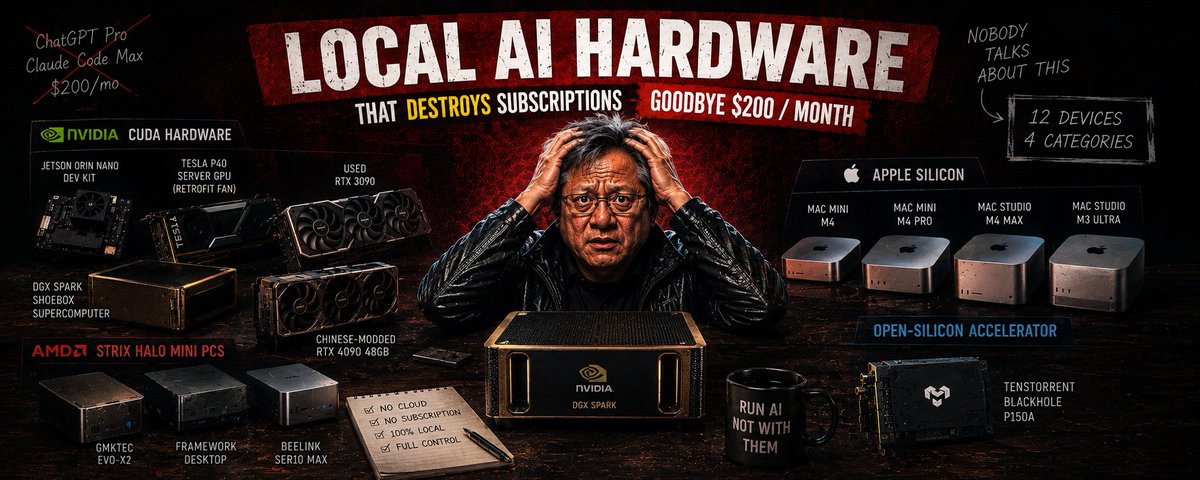
Jetson Orin Nano    $249      7B models           beginner shelf
Tesla P40 (2016)    $207      27B models          the hidden trick
Used RTX 3090       $700      27B fast, 70B ok    what Wei owns
DGX Spark (GB10)    $4,699    200B models         Wei's dream buy
The Jetson is Jensen's loss leader — kills a $20/mo ChatGPT Plus in 13 months.
The Tesla P40 is what nobody in the Western guides mentions. It's a 2016 server card that Chinese sellers on Xianyu list for 1,400 yuan (~$207). 24GB VRAM. Runs Qwen 3.6 27B at 16 tok/s. Wei bought two — bolted Noctua fans to them, wired 8-pin EPS adapters, ran them headless via SSH. Two P40s = 48GB VRAM for $414. There is literally no other way to hit that number.
His main daily driver stayed the used 3090 because plug-and-play matters when you're iterating fast.
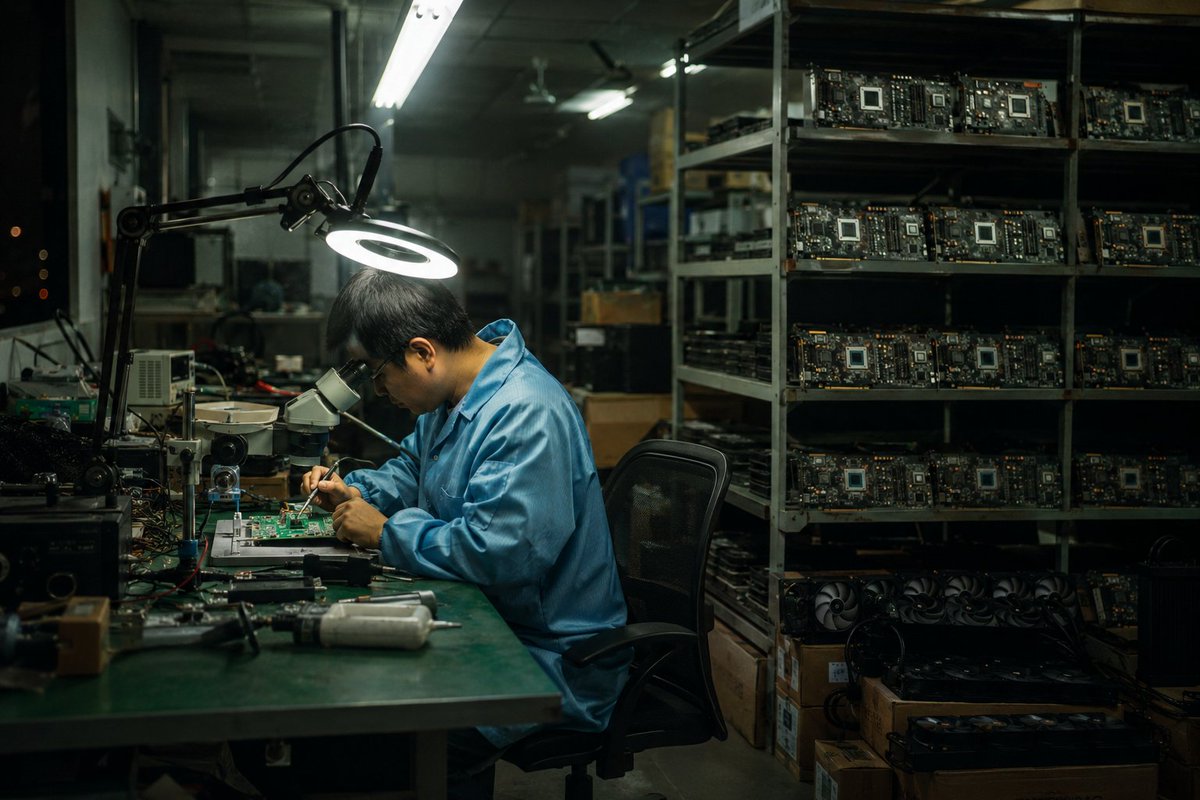
But the discovery that changed everything for his farm build was the modded RTX 4090 48GB. A workshop three metro stops from his apartment does this: buys failed 4090s from Amazon returns, desolders the AD102 die, transplants it onto a custom clamshell PCB with GDDR6X on both sides, flashes modified BIOS. Ships a functional 48GB card for 24,000 yuan (~$3,400). A legit RTX 6000 Ada with the same 48GB retails at $7,500. Failure rate is ~15%. At scale the math still works.
The DGX Spark at $4,699 is what Wei plans to buy next quarter. Shoebox with 128GB unified memory. Not faster than a $700 3090 on small models — bandwidth is the same ~273 GB/s. What it wins is capacity: fits 200B-parameter models no consumer GPU can touch. Two chained via ConnectX-7 gives you 405B locally.
BET 2 — APPLE. WHAT WEI RECOMMENDS TO FRIENDS WHO AREN'T ENGINEERS
Mac Mini M4 32GB          $799       14B daily driver
Mac Mini M4 Pro 48GB      $1,799     70B usable
Mac Studio M4 Max 128GB   $3,499     70B fast + 235B MoE
Mac Studio M3 Ultra       $9,499     frontier tier
Wei tells his non-technical friends to buy a Mac Mini M4 and not think about it.
The reason Apple wins this bet is boring and mechanical. On a normal PC, model weights copy from system RAM to GPU VRAM over PCIe every time. That copy is the bottleneck. On Apple Silicon everything reads from one physical memory pool. The M3 Ultra pushes 800 GB/s of memory bandwidth — three times any Strix Halo box.
The absurd play at the top of this bet: a dev in Tel Aviv posted a build in April — four M3 Ultras, 1TB aggregate unified memory, connected via Thunderbolt 5 with RDMA (macOS Tahoe 26.2 added that in a point release nobody noticed). Runs Kimi K2 Thinking — a 1 trillion parameter model — at 25 tok/s on his desk. Build cost: $40,000. Equivalent NVIDIA setup: 26 H100s at $780,000+ plus datacenter power. His whole cluster draws 450W. Wall outlet.

BET 3 AND 4 — THE SPECIALIST PLAYS
AMD Strix Halo is the x86 answer to Apple's unified memory bet. Three boxes worth naming:
GMKtec EVO-X2 128GB       $1,700
Framework Desktop 128GB   $1,999
Beelink SER10 MAX         $1,799
The Framework Desktop is the sleeper — modular, repairable, community Linux builds nobody else offers. Catch: 256 GB/s bandwidth. Half of an M4 Max. Bigger models fit, generation slower. If you want Windows and 128GB unified in one box, nothing else exists at this price.
Tenstorrent Blackhole p150a at $1,449 is the outsider bet. 32GB VRAM — same as an RTX 5090 that costs $3,800. Open ISA, open compiler, open kernels. Currently performs at DGX Spark level. Once Blackhole gets tuned kernels (roadmap: H2 2026), 2-3x. Buy if you're betting CUDA cracks. Skip if you need it working today.
THE TRAP WEI ALMOST FELL INTO
Every guide he read led with VRAM. VRAM decides what fits. Bandwidth decides how fast tokens come out. He almost bought a DGX Spark for daily use before he saw this table:
Device                 Bandwidth      70B tok/s
Mac Studio M3 Ultra    800 GB/s       25-32
Mac Studio M4 Max      546 GB/s       15-22
Modded 4090 48GB       ~1,000 GB/s    ~40
DGX Spark              273 GB/s       6-12
Mac Mini M4 Pro        273 GB/s       8-15
Strix Halo             256 GB/s       8-11
An M4 Max runs a 70B model 2x faster than a DGX Spark at half the price. Wei's rule: pick the device where the model you actually run fits and the bandwidth means you'll use it daily.
THE FLIP. HOW WEI STARTED EARNING INSTEAD OF SAVING
Three months in, Wei noticed his 3090 sat idle 16 hours a day. He was using it heavily during coding blocks and it did nothing overnight and while he was at work.
He listed it on Vast. ai — one of six platforms that rent consumer GPUs to companies running AI inference. First month it earned him $520. Second month $687. Third month $720. Consistent cash flow that his crypto mining side project had never delivered.
Here's the actual economics per card as of mid-2026:
GPU              Monthly earnings (net)
RTX 3090         $200-400
RTX 4090         $500-1,000
Modded 4090 48GB $700-1,300
RTX 5090         $700-1,400
A100 80GB        $1,200-2,500
H100             $2,500-5,000
The platforms: Vast. ai, Clore. ai, io. net, RunPod, Akash, Salad. They take 15-25% and pay the rest in dollars or stablecoins. OpenAI and Anthropic quietly buy that same compute cheap from these platforms and sell it back to end users for $200/month.
Wei's build at month 6:
Month 1   -$459     final subscription bill
Month 2   -$680     used RTX 3090 purchase
Month 3   +$41      down to one $20/mo subscription
Month 4   +$620     first Vast.ai payout
Month 5   +$687     stable rental income
Month 6   +$720     hands-off
By month 12 he'd added seven more cards — four modded 4090 48GBs from the local workshop, two more used 3090s, one RTX 5090 he flipped his Bitcoin miner rig for. Monthly farm output as of last month: $6,400 net, after platform fees and electricity.
Scaling math for anyone following:
1 card                       $400-800/mo
4 cards (spare room)         $1,600-3,200/mo
8 cards (Wei's current)      $3,200-6,400/mo
16 cards (medium farm)       $6,400-12,800/mo
50 cards (full operation)    $20,000-40,000/mo

THE DECISION TREE
If you want to copy Wei's move but don't know where to start:
Under $250, running a Linux server        → Tesla P40
Kill $20/mo ChatGPT Plus, easiest entry   → Jetson Orin Nano
Zero setup, silent, just works            → Mac Mini M4 32GB
Existing gaming PC + $700                 → Used RTX 3090 (Wei's pick)
Heavy Claude Code user                    → Mac Mini M4 Pro
128GB unified, Windows/Linux              → Framework Desktop
Best tok/s on 27-70B                      → Mac Studio M4 Max
CUDA + 128GB in a shoebox                 → DGX Spark
Willing to gamble on grey market          → Modded 4090 48GB
Frontier locally, cost irrelevant         → Mac Studio M3 Ultra
1T parameters at home                     → 4x Mac Studio cluster
Want to EARN instead of save              → Any 4090+ on Vast.ai
WHY THIS WORKS RIGHT NOW
$200/month wasn't chosen randomly. Claude Code Max launched at exactly the point where hardware math starts to work. Anthropic watches the curves. So does OpenAI.
LPDDR6 doubles memory bandwidth next year. RTX Spark laptop chips ship. Tenstorrent Blackhole gets tuned kernels. The subscription tier drops to $99 to keep retention.
Wei made his move at the widest point of the arbitrage. The window closes both ways — either subscriptions get repriced to compete, or open-weight models start getting restricted.
He stopped paying Anthropic in October. Anthropic started paying him in January.
Pick a device. Cancel the stack. Own the compute. Rent what you don't use.

// Saved you cash or hours? Follow @Flandermaxx . I find these setups before they hit YouTube. Next one's already cooking. //
Related articles

HOW I WENT FROM $600/MONTH TO $14. ELON'S GROK + KIMI'S BRAIN
Follow & Bookmark this - I'm [@starmexxx](https://x.com/starmexxx), I track how AI tools are creating new income streams most people haven't heard of yet. This one is the entire build.

OpenClaw: The Personal AI Agent That Went Viral in January and Nobody Explained How to Set It Up
OpenClaw: The Personal AI Agent That Went Viral in January and Nobody Explained How to Set It Up
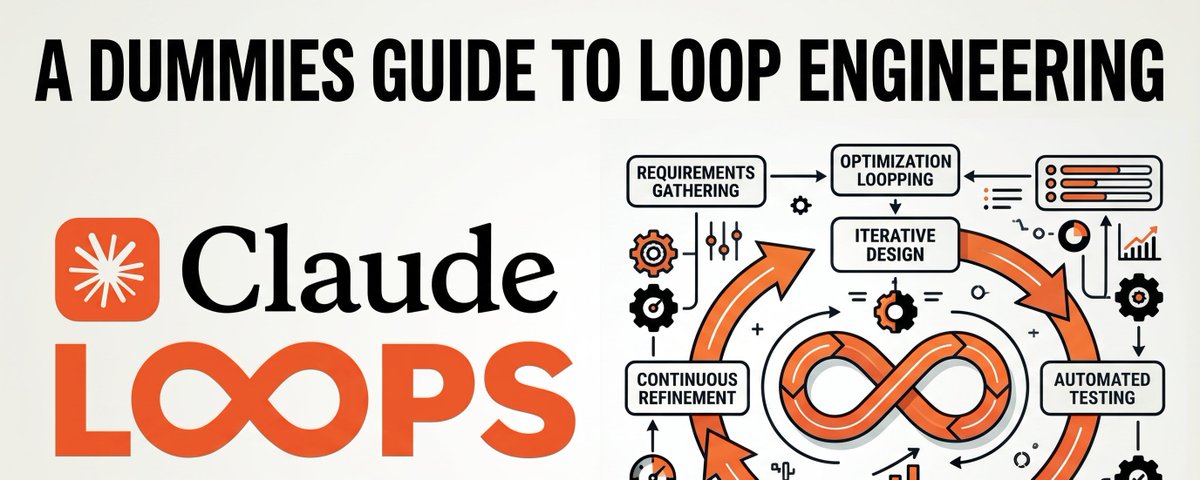
Loop Engineering: A Dummies' Guide to /loop
TL;DR: how anyone can 10x their Claude productivity with loops - even if you're not technical at all.