How to ACTUALLY make $300 a day with podcasts using seedance 2.5

here's the thing about making three hundred dollars a day with AI podcasts and seedance 2.5 that nobody selling courses about it will tell you.
the surface-level version of this play is everywhere right now. spin up an AI podcast, post clips to tiktok, monetize through the creator fund or a sponsorship. every guru with a ring light is teaching it. and almost all of them are lying about the numbers because they're monetizing course sales, not the actual podcast play they're teaching.
the real version of this play works. we've watched operators in the AFNW network run it cleanly. but the reason it works has almost nothing to do with what the surface guides tell you. the money isn't in the podcast. the money is in the specific technical decisions you make at four points in the pipeline, and most operators lose money because they get all four wrong.
let me argue for the version that actually pays before I explain the mechanics, because the argument is what most people won't accept.
the argument is this. AI podcasts as a monetization vehicle are not a content play. they are a distribution wrapper around a payload, and the payload is where the money is. if you're making AI podcasts to entertain people, you will make zero dollars. if you're making AI podcasts as a delivery vehicle for a monetizable action, you will make three hundred to a thousand dollars a day depending on how tight your funnel is. the difference is not the podcast. the difference is what you're using the podcast to do.
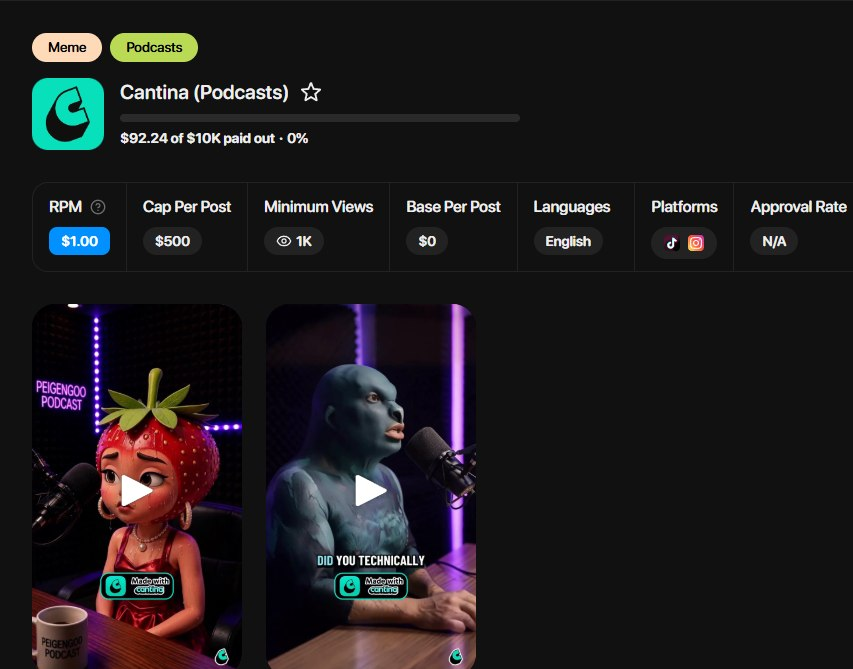
every operator I've watched try to monetize AI podcasts as pure content has failed. every operator who has treated the podcast as top-of-funnel for something else has printed. the entertainment guys chase creator fund payouts of three cents per thousand views and wonder why nothing works. the operators treating podcasts as a wrapper for an app CPA offer or an affiliate payout are the ones actually hitting three hundred a day consistently.
with that argument on the table, here's the technical breakdown of how the play actually works with seedance 2.5, at the depth almost nobody publishes.
the pipeline has four points where operators either win or lose the entire play. character generation, script math, seedance generation itself, and post-production distribution. every one of them has a specific technical requirement that seems minor and is actually load-bearing. skip any of them and the numbers don't work.
start with character generation because this is where most operators die before they even render a clip.
the podcast format that works is two AI characters in a conversation, roughly ninety seconds per clip, one character doing most of the talking and one reacting. the reason this format specifically works is that the reaction character carries the parasocial weight while the talking character carries the payload. viewers don't watch a podcast to hear information. they watch to feel like they're eavesdropping on two people they know, and if the reaction character reads as real, the viewer treats the entire conversation as real by association.
the technical requirement here is that both characters need locked reference sheets before you ever open seedance. this is the step ninety percent of operators skip and it's why their podcasts look uncanny by clip three. each character needs a headshot generated first with a photoreal portrait model, then a fullbody generated from that headshot as reference. the reference sheets ride every subsequent seedance generation as image references. never regenerate, never re-crop, never let the model reinvent the face between clips.
specifically for a podcast setup, the framing that works is a two-shot medium close-up with both characters slightly angled toward each other, headphones on both, microphone visible for the talking character, and neutral studio background with soft indoor lighting. seedance 2.5 handles this framing well because it reads as familiar to the model. try to get clever with unusual angles or lighting and the model will drift.
the identity anchors matter here more than in single-character UGC. both characters need at least one small fixed imperfection. freckles, a mole, a specific hair strand pattern, a slight asymmetry in the eyebrows. without anchors, the model will average them out across generations and by clip five they look like different people. we've watched entire podcast campaigns collapse because the operator didn't lock anchors and viewers noticed by episode three that the characters weren't consistent.
now to script math, which is the most technical part of the whole play and the one operators most consistently get wrong.
seedance 2.5 stretches spoken lines to fill whatever clip length you request. a ninety-second podcast clip at natural conversational pacing runs about three hundred fifteen words at three point five words per second baseline. but conversational pacing in a podcast is not the same as talking-head pacing. real podcast conversations have pauses, overlaps, laugh beats, verbal fillers. if you write your script as three hundred fifteen dense words, the model will speak them at a machine-gun pace that reads as artificial within four seconds.
the fix is scripting at a lower word density and letting seedance fill the space with breath and micro-behaviors. we've settled on about two hundred forty to two hundred sixty words for a ninety-second clip, with explicit stage directions for pauses and micro-behaviors written into the prompt. lines like "pauses for a beat, considers, then continues" or "small nod, then responds" tell the model to actually leave space between sentences, which is what makes the podcast read as real.
within those two hundred fifty words, the payload has to sit in a specific location. the hook lives in the first six seconds, which is about twenty words. the disturbance or claim that makes the viewer stop scrolling. the middle sixty seconds is where the content lives, and this is where operators try to be entertaining and lose the whole play. the middle should build toward the payload, not distract from it. the last twelve to fifteen seconds is where the payload lands, which is either the app mention, the affiliate call-to-action, or the specific action you want the viewer to take.
that structure is not negotiable. we've tested every variant. hook up front, payload at the back, middle building toward it. anything else drops conversion by fifty to seventy percent even if the view counts stay similar. views are not the metric. views converted to the payload action is the metric, and the operators making three hundred a day understand this at a level the entertainment-first operators never do.
now to seedance 2.5 generation itself, and this is where the technical breakdown gets specific because seedance is a very different model from seedance 2.0 and most of the guides on the internet are still written for 2.0.
the two changes in 2.5 that matter for podcast generation are the thirty-second single-shot capability and the expanded reference budget. seedance 2.0 capped clips at fifteen seconds, so a ninety-second podcast required six stitched clips with all the identity drift and audio splice problems that come with stitching. seedance 2.5 does a full ninety seconds in three shots. this is a massive quality upgrade for podcasts specifically, because you can hold a full conversation beat in one shot instead of trying to preserve identity across six.
the reference budget expansion is the second big change. 2.5 accepts up to thirty images, ten video clips, and ten audio clips as references. for podcasts, the useful budget is much smaller. we run with two character sheets (one per character), one environment reference (a photo of the studio setup), and one audio reference (the voice anchor for the primary talker). that's it. more references than that starts introducing drift because the model has to average across too many signals.
the specific prompt structure that works for a podcast clip is:
open with the format declaration. "realistic authentic AI podcast clip, medium two-shot, 16:9, both characters visible, studio lighting."
then the character consistency line. "keep both characters consistent with the reference images. their voices match the reference audio exactly."
then the scene setup. "seated across from each other at a podcast desk with microphones, both wearing headphones, subtle studio background with acoustic panels."
then the delivery direction with a single word. "delivery: casual, engaged, unrushed."
then the exact dialogue in quotes with speaker attribution. "character A says exactly: [line]. character B reacts with a small nod, then says exactly: [line]." with the "says exactly" prefix, seedance will lip-sync the line word for word.
then the hard rules. "characters stay seated the entire clip. no on-screen text or captions. reference audio only, no music."
that structure produces usable clips at roughly a sixty percent hit rate. meaning of ten generations, six are good enough to post, three need small re-rolls, and one has a fundamental artifact that requires a full re-generation. this is significantly better than the twenty to thirty percent hit rate on seedance 2.0.
the specific artifacts to watch for on 2.5 podcast generations are lip sync drift on the reaction character (the non-speaking character's mouth sometimes moves during the speaker's line, which reads as broken), microphone position inconsistency (the mic drifts between shots), and eye contact loop (both characters staring at each other unnaturally for the full duration instead of the natural look-away-and-back pattern). the fix for the eye contact loop specifically is to write the glance behavior into the prompt: "around second thirty, character A glances down at their notes for a moment, then looks back up."
now to distribution, which is where the actual money is made and where the argument for this play stands or falls.
the operators making three hundred a day are not making it from tiktok's creator fund. that math doesn't work at any realistic view volume for podcast content. one million views on a podcast clip pays roughly thirty to sixty dollars through the creator fund depending on your region and account status. even at ten million views a day, which is nearly impossible to hit consistently with podcast content, you'd be at three to six hundred a day in creator fund payouts and your account will get demonetized within a month for pushing volume that aggressive.
the actual money at three hundred a day comes from routing the payload to a monetizable action. three models work.
the first is direct app CPA. the podcast clip payload is a mention or on-screen callout for an app that pays per verified install. through a network like AFNW, verified install payouts on relevant app categories range from two to five dollars per install depending on the app's LTV and the geo. at those rates, three hundred a day requires sixty to a hundred fifty verified installs a day, which is achievable with two to three viral clips per week on a solid podcast account.
the second is affiliate CPM. instead of routing to an app install, the payload routes to an affiliate offer that pays per thousand qualified views. this is less common now but still works for specific verticals like finance apps, education apps, and dating apps. the math is roughly one to three dollars per thousand qualified views (qualified meaning US-based, not creator-fund-monetized views), so you need one hundred thousand to three hundred thousand qualified views a day to hit three hundred. this is doable if your podcast picks a category with high-value viewer demographics.
the third is sponsorship, which pays the best per-clip but requires a real audience. sponsorships on podcast clips run five hundred to two thousand per integration depending on the vertical and the average view count. one sponsorship per week is three hundred a day at the low end. this is the model most operators aim for and the hardest to actually secure because sponsors want to see track record and consistent audience metrics.
the most common actual model for operators hitting three hundred a day is a hybrid. some CPA revenue from app installs, some
seedance renders the clips & the script writes the payload. affiliatenetwork.com is what turns the views into revenue.
Join affiliatenetwork.com to make $300 a day as a clipper with RPM deals.
Related articles

How Li Jiaqi made $1.7B in 12 hours using TikTok farm. And how to set up one.
Behind half the viral content on your feed isn't a person.

How to Start a 6 Figure Faceless YouTube Channel (Full Breakdown)
I've helped over 400 people start profitable faceless youtube channels. i've ran over 50 channels myself. Generated over $4 MILLION by age 25. Worked with youtubers that have 10 million+ subscribers,…