How to build an AI system that outlasts every new model
Opus 5 just released. ChatGPT dropped 5.6 last week. And everybody's rushing off to try the newest models.
I get the excitement, but I'm not changing much about how I work, and I want to explain why.
The model is the easy part. You swap it whenever a better one comes along. But the part that takes effort, and pays you back, is the SYSTEM you build around it, and for me that whole system lives inside Hermes.
So if you're using Hermes like a fancier ChatGPT, you're probably getting maybe 10% out of it. I've spent hundreds of hours in this thing, so let me walk you through how I use it.
The way I think about all of it is pretty simple. Hermes runs on context.
That context becomes an artifact, like a PDF or an HTML doc or a diagram your team and your agents can both read quickly.
Once you're doing something over and over, it turns into a skill, and a stack of skills eventually becomes a loop that runs on its own.
There's a ladder that goes with it, eight levels, and most of us get stuck near the bottom.
8  company brain, compounding
7  permissioning + governance
6  connected company data
5  recurring checks as crons
4  repeatable work as skills
3  shareable artifacts
2  delegate one-off tasks
1  ask questions   (start here)
The model is just the part you swap
Let me start here, since it's what everyone's thinking about today with Opus 5 out.
A new model doesn't change my setup much, and that's on purpose. Hermes is open source, so it runs whatever model I point it at.
When Opus 5 drops, or 5.4, or whatever shows up next month, I just spin up a profile on it and leave everything else alone.
My context, my skills, my memory, my permissions, none of that moves. The model is basically the engine, and I can swap engines without rebuilding the car.
What I do is keep a few profiles for different jobs. Something heavier like Opus 5 or Fable when I'm planning or thinking through strategy, and something lighter for quick stuff. You match the model to how much thinking the task needs.
And because it's open source, you can run it on a local model, your subscription, or the API, whatever makes sense for the job.
So chasing every new model is kind of a treadmill. The thing worth building is the system underneath, because that sticks around no matter which model is winning that week.
Levels 1 and 2: don't treat it like a chatbot
Level one is asking it questions. Level two is handing it one-off tasks. Nothing wrong with either, and I do both. I use it to plan a trip to Italy like anybody else.
The mistake is stopping there.
My Hermes is connected to my documents, my memory files, my data, so I use it more like a thinking partner. The other day I asked it why my X views dropped from 3.1 million last month to a pace of 1.6 million this month.
It went and ran the whole analysis and came back with some banger candidates to get the profile moving again.
It pushes me on stuff too. It told me my website should be a revenue agent, not a brochure, which sounded a little contrarian at first, but it's right.
So now I've got a loop testing the site's conversion against a target, and it even wrote the resource offer that gets people to comment on a post to opt in.
I also lean on it to argue with me. I'll drop in someone's post, one of Matt Van Horn's skills for example, and ask how much it would move the needle for us on a scale of 1 to 100.
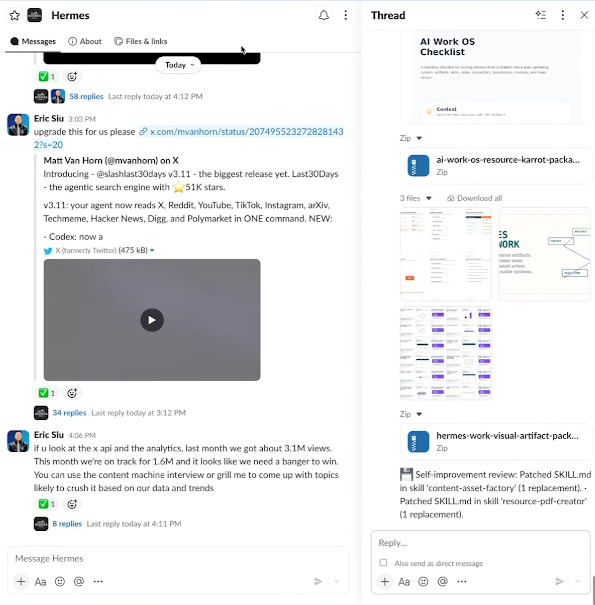
It rates it, tells me where it's weak, and upgrades it if it's worth keeping. One time it rebuilt a chunk of scaffolding and renamed all the stale copies over about 34 replies, and I barely touched it.
There's a /learn command too, which goes a long way. When something works, I have it save the lesson so the next run starts from a smarter place.
One habit that feeds all of this: when I go for a walk, I just talk into Whisper Flow for five minutes about whatever's on my mind. Product ideas, sales stuff, random thoughts.
Then Hermes sorts it into next steps or points me at a skill I already have.
Level 3: artifacts are how you scale yourself
The way I see it, a private answer is useful, sure. But the second it becomes an artifact your team can grab, it's a different thing entirely.
An artifact can be a checklist, a diagram, an HTML doc, a one-pager, a carousel, whatever. When I want the team to get a concept, I'll have Hermes turn it into a diagram and drop it in Slack.
People understand one clear picture a lot faster than a wall of text, and they usually come back asking if they can reuse it.
I also point it at our design file so whatever it makes comes out looking like us instead of generic.
And these artifacts pull double duty. When I make something downloadable, like an AI work OS checklist, people comment on the post to get it through ManyChat, so it helps the reader and pulls in a lead at the same time.

I even had it spin up the outline and a bunch of short-form video ideas off the same context. Same raw material, just more things the team can run with.
Level 4: skills are where it starts compounding
Prompts are kind of a pain. They're hard to remember and they're gone the second you close the tab. A skill is a saved process you can reuse, hand off, and run in any tool, and that's the part that compounds.
So anything I do more than once, I ask Hermes to skillify it.
I've got a Grill Me skill, from a guy named Matt PCO, that asks me one question at a time until it's satisfied and then builds a better plan. The one-at-a-time thing matters, because your answer to question one changes question two.
It'll ask stuff like which artifact Hermes has built that mattered most, and saying it out loud is usually where the answer shows up.
I've also got a Content Machine skill. Before it even interviews me, it reads my messy dump of thoughts and tells me which of my POVs are strongest, the ones buried in there. Then it grills me to sharpen them.
Honestly the best agent isn't the obedient one. Grill Me makes me think harder, Content Machine pulls the sharpest stuff out of me, and Hermes will straight up tell me when an idea is mid.
I use it to cut things too, because a lot of what I make needs deleting and it's good at spotting what to drop.
I keep skills for all the work I repeat. YouTube packaging for long and short form, recruiting, AEO and SEO. Each one is a process I never have to rebuild from scratch.
In the dojo I pack skills by role, so a new person on paid media or revenue picks up the right set on day one. Every skill has an eval that says what done looks like, so the quality doesn't drift as more people run it.
Skills get better socially too. Once one is public, people upvote it, fork it, improve it, and a better fork ends up being the one everybody runs. Ours is public over at skillsdojo.com if you want to grab one and make it yours.
Embedded post:
Author: ericosiu (@ericosiu) Post ID: 2080053294903562402 Source: https://x.com/ericosiu/status/2080053294903562402 Reply to: none
Text:
> We built an app store for AI agents. > > It's called Skills Dojo. > > Instead of every person teaching their agent how to do a task from scratch, we keep all our best workflows as ready-to-use "skills" in one shared library. > > You search for what you want to get done, grab the proven skill, and your agent just runs it. > > Less reinventing the wheel, more shipping. > > Early access is open, and it's free ↓
Media:
The one I use most is my X long-form writer. I built it a few months ago and it just keeps getting better as people build on top of it.
Level 5: crons that run without you
A cron is just a job that runs on a schedule. Mine keep an eye on the stuff that costs me money if I miss it. Deals that went quiet, follow-ups I'm late on, a pipeline summary sitting there when I wake up.
A good one does three things. It tells me what changed, it suggests what to do about it, and it offers to just do it for me. That last part is what makes it feel like an assistant instead of one more notification.
One thing to watch is that crons go stale. Something that mattered last month is noise this month, so every now and then I go through and kill the ones that stopped pulling their weight.
Level 6: multiplayer and connected data
It's easy to just run Hermes by yourself. The bigger move is making it multiplayer, putting it where your team already works, which for us is Slack.
The way I explain a company brain to people is pretty simple. Hermes is the driver. Your connectors feed it your tools. Memory holds what it's learned. And permissions decide who on the team can do what. Wire all that into Slack and now it's multiplayer.
Once it's multiplayer, everybody sees everybody's questions. Chris will ask for the open sales leads from the last four weeks with dates and follow-ups, and that answer is sitting right there for me too.
I'll ask who submitted applications in the last seven days and it pulls the list in seconds. His question sparks one of mine, mine turns into a quick meeting, and the whole team just trades ideas faster. And faster ideas turn into faster action.
The connectors themselves aren't the magic. The magic is the synthesis. When your analytics and your CRM and your revenue intelligence and your docs are all talking to each other, the answers get a lot sharper.

I asked Hermes to read our HubSpot and Gong and tell me the patterns from our client calls. It told me people are about an eight or nine out of ten excited to talk about Single Brain, and lower on Single Grain, more as a service than as hype.
That kind of read used to take me a week.
And when you run all that through a stronger model, the output gets even better. The flip side is if the data going in is a little off, it drifts on you. It's like a plane one degree off course ending up on the wrong continent.
Level 7: governance before something breaks
Before you scale any of this, you've got to decide who can do what.
The way I break it down is three tiers. Reading is usually fine as long as you scope it.
Drafting is where I let Hermes be aggressive, because a bad draft is cheap to throw away. But anything that writes externally, that publishes or sends, needs a human to sign off.
I'd start the team on read-only and open up drafting as you build trust. We run an API gateway across all our products so nobody can just wire up whatever they feel like.
Set the permissions and the security up front, because if a client's data leaks and it's because you never thought about this, that's on you. Think about it early and you skip a whole category of problems later.
Level 8: the company brain
Here's the one that matters most. If an agent can't remember its own decisions, it's never going to become a brain.
So I put a lot into memory. We log everything daily in Obsidian, keep a running decision history and active tasks, push the bigger stuff into Linear, and keep a lessons file that just grows over time.
We plug in outside memory systems too, like QMD from one of Shopify's co-founders, and Gary Tan's Gbrain and Gstack for deeper reviews. Hermes leans on recent context the most, so the fresh stuff stays close.
That's the difference between a chatbot and a brain. A brain holds onto what it decided, and that memory is what lets everything compound over time.
Embedded post:
Author: ericosiu (@ericosiu) Post ID: 2060415100603781497 Source: https://x.com/ericosiu/status/2060415100603781497 Reply to: none
Text:
> http://x.com/i/article/2056815177895747584
Run it in the desktop app
One practical thing before I wrap. Slack is where my team lives, but it's kind of fleeting, and I lose track of what I was doing in there.
The Hermes desktop app fixes that for me. I can see what I was working on, reprioritize the list, and keep my skills and artifacts and crons all in one spot. It even pulls context in from my other chats.
It feels a lot like working in Codex or Cloud Code, where I don't lose the thread of what I'm building. If you're serious about climbing this ladder, that's where I'd run it.
Embedded post:
Author: ericosiu (@ericosiu) Post ID: 2079502362364817433 Source: https://x.com/ericosiu/status/2079502362364817433 Reply to: none
Text:
> If you aren’t using your Hermes with this app, you’re leaving money on the table. > > Don’t get me wrong, I love using Hermes inside of Slack and Telegram, but this is a major unlock for work. > > Previously, I felt restricted on my mobile devices in terms of how far I could push things, but with Hermex you can: > > - Use its model selector to swap on command. This allows you to use Fable 5 and/or GPT Sol 5.6 for planning, then swap back to Opus 4.8 or GPT 5.5 for execution, then back to frontier models for review. > > - Easily access all your skills. I have so many skills that it’s hard to recall what I have. But on the left sidebar, you can see all your skills or use slash commands to invoke them. Slack Hermes is great for multiplayer, but it lacks this valuable context. > > - Active profiles. Easily switch between profiles and make adjustments to them. Like skills, I sometimes will forget about the different profiles I made. Make profiles for different business units, different reasoning profiles, and more. > > - Fork your chats. I use Hermes for a ton of research and it’s helpful for me to be able to continue one worktree while forking my curiosity into another. > > - Access all your recurring tasks/crons. Helpful to see what’s running and what’s not. > > - Projects are neat for keeping things organized. It was previously a messy blob for me. > > - Accessing the memory section and making adjustments ends up making your day to day usage compound better, faster. > > There’s a lot to like about Hermex and I think it’s only going to get better. Being able to install it on both my iPad and iPhone feels like an AI cheat code.
Media:
Where you are on the ladder
Look, new models are going to keep coming. Opus 5 today, something bigger next month, it doesn't stop.
The people who win won't be the ones who tried each one first. They'll be the ones who built something worth plugging those models into.
That's all the ladder is. Artifacts so your work travels, skills so it compounds, crons so it runs without you, connected data so it thinks with your whole company, permissions so it stays safe, and memory so it turns into a brain.
Pick whatever rung is one above where you are right now, and go build it this week. That's how you get off level one.
Watch the video breakdown here: https://www.youtube.com/watch?v=nunIJuHMRGU
If you're a business that wants AI systems built for you, check out https://www.singlebrain.com
For marketing help, go to https://www.singlegrain.com
For more like this, level up your marketing with 14,000+ marketers and founders in my Leveling Up newsletter, free: https://levelingup.beehiiv.com/subscribe
If you want to join our team, beat AI first ;) https://github.com/ericosiu/beat-claude
Related articles

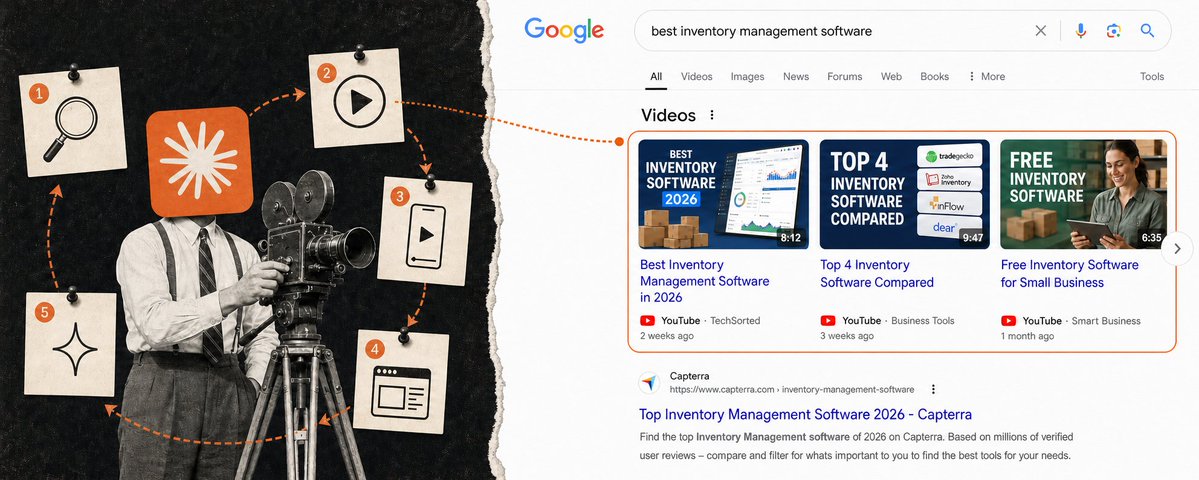
5 Step Video GEO Guide for SaaS (62k AI Mentions in 3 Months with Claude)
I pulled every "best ... software" keyword with real US search volume, 2,328 of them, and ran 140 through DataForSEO on Google US mobile on September 1, 2026: the 60 biggest category head terms plus…

Every Grok Bot Hack I Know (Aug 2026)
http://x.com/i/article/2091234629437227008