how to build revenue systems with grok bot (FULL GUIDE)

grok bot can run multiple business without you once it's set up, it just needs the right tools to do it, so the only thing left is deciding which businesses it runs.
by the end of this guide you'll have:
- five systems reading the internet for problems every day
- a bar that keeps out anything only one source confirmed
- a dashboard where you approve or kill ideas
- a new agent spun up for every business you approve
- products and checkout links created autonomously
- outreach going to the people who described the problem
the agents read job boards, freelance briefs, app reviews, podcasts, permit filings, forums and reddit every day, and it doesn't bring you anything until the same problem shows up in more than one of those places. one person complaining is not a business.
so what lands on your dashboard everyday is a few problems with the evidence attached.
you approve one and grok bot spins up a new agent for it. that agent builds the idea, deploys it live, puts it on whop so it can take money, and sells it to the people whose complaints started it.
then it goes back to reading, and you approve the next one while the last is still running.
who you're pointing this at
worth deciding before you build anything, because it changes what the systems read.
you want owner-led businesses. agencies, small software companies, ecommerce operators, professional services, contractors running real crews. people who own the thing, feel the cost of the problem personally, and can decide to buy without going through anyone.
that rules out consumers, and it rules out anyone big enough to have a procurement process.
the reason to be strict about this is price. an owner with a problem costing them a few thousand a month will pay a few hundred a month to stop it, and they'll decide that in a day. the same product sold to consumers is a $9 subscription and ten times the support.
on my own run the biggest verticals that came out were agencies, hvac, ecommerce and small saas. all owner-led, all with money moving.
why five separate systems
one scraper pointed at a forum gets you complaints, and complaints alone are not enough to build off.
what you want is the same problem showing up in a job posting, in a paid freelance brief, in a one star review of a tool people already pay for, and in someone complaining about it. when it appears in multiple places it's a real pain point.
so each system reads a different kind of evidence, and the scoring cares far more about how many systems confirmed something.
- system 1 is what they already pay to fix.
- system 2 is what smart operators are converging on.
- system 3 is getting the timing right.
- system 4 is what owners complain about.
- system 5 is what's blowing up.

step 1, the tools
the reason this works at all is that grok bot has its own computer with a terminal on it, and the whole whop api runs from a terminal now. so it signs into whop itself and holds that session, then creates the products, sets the prices, generates the checkout links and reads the numbers back without you. (even forms an llc btw!)
whop also marks the destructive commands in the manifest agents read, so deletes, payouts and transfers ask for confirmation before they run.
set it up once and every business the machine finds afterwards gets a product and a live checkout link.
paste this:
> set up everything you'll need to run any business i approve later.
> - install the whop cli and sign in. run whop skills add, then whop --llms, and tell me in your own words what you can and can't do with the login i've given you
> - list what's already on this account. if you find products i didn't create, leave them alone and just tell me what they are
> - here's the print api key: [key]. read their docs and tell me the exact size, bleed and file format they want, and generate everything to that spec from now on
> - here's the supplier api key: [key]. tell me which product types map to which of their skus, what artwork spec each needs, and whether they give a tracking number back
> - set the monthly cap at the provider's end for both, not in this chat
> - you deploy sites yourself and give me urls. never a zip file
> - before you use any of these for real, place one test order to my own address and show me what came back
set this up first and you don't need to do it again. for example, the 10th business the machine finds uses the same setup as the first, same whop account, different product.

step 2, the storage
the machine layer holds raw items, extracted problems, embeddings, clusters and scores. i started this on a hosted database and moved it to local sqlite, which does the same job. supabase works fine here too if you'd rather have it hosted, it's the same schema either way.
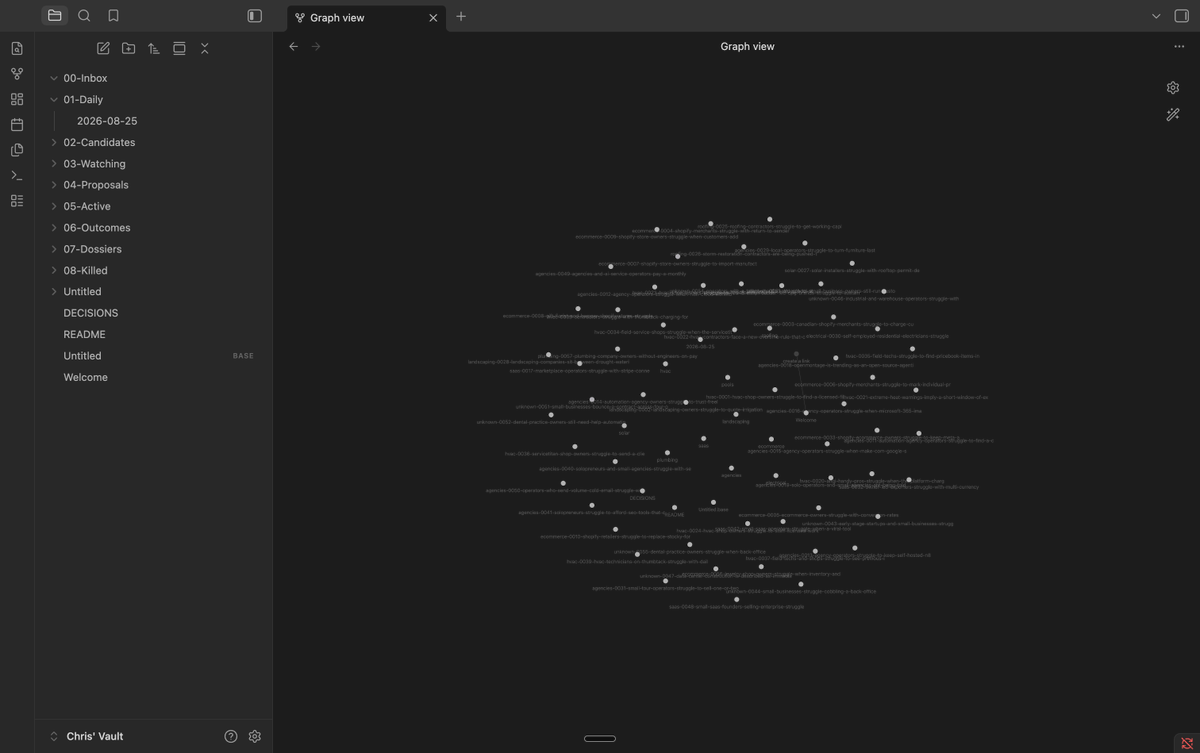
the layer you read is obsidian. it's just markdown files in a folder and grok bot writes into that folder directly.
mine is at /Users/chris/Documents/Chris' Vault and the numbered folders sit in the root:
00-Inbox, which the bot never writes to, that one's mine01-Dailyfor the digest02-Candidates,03-Watching,04-Proposals,05-Active,06-Outcomes,08-Killed07-Dossiers, one evergreen note per vertical that only ever gets dated lines appended
every cluster note is a page. yaml frontmatter at the top with the cluster id, the score, which systems confirmed it, the vertical, the status, and an empty verdict field. then the problem in one sentence, the quotes with their source urls, the diagnostic, and the enrichment with anything unverified labelled as unverified.
your frontmatter wins. the bot pulls it before writing anything.
paste this:
> set up the storage. sqlite with vectors for the machine layer, and my obsidian vault for the layer i read.
> - raw items, extracted problems with embeddings, clusters, enrichment, my verdicts, outcomes, and a run log all go in sqlite
> - the vault is at [path]. write markdown straight into it, no plugin
> - one folder each for daily briefs, candidates, watching, proposals, active, outcomes, killed, and one evergreen note per vertical
> - every note gets frontmatter with the cluster id, score, systems confirming, vertical, status, and an empty verdict field for me
> - read every note's frontmatter before you write anything so my edits always win
> - never put raw scraped items in the vault, and never copy code, tests or env files into it
> - if my machine is off, hold the notes and push them next time it's on
> - before you build it, tell me anything in this schema you think i'll regret in a month
the offline one because obsidian is a local folder, so the bot can only write when your machine is on. that sounds like a problem but it really isn't. the machine keeps running and collecting either way, it just queues the notes and drops them in next time you're on. i had 50+ notes staged once while my mac was off and they all landed when it came back.
the reason to bother with the vault at all rather than just reading the dashboard is that it compounds. you can hand that folder to any agent later in the future if needed and it knows everything the machine has ever learned.
step 3, what they already pay for
start here, because this is the one that finds the businesses worth building.
a job posting tells you someone is paying $45,000 a year to have a human handle it. a one star review of a tool they're subscribed to tells you they're already paying monthly and it still isn't fixed. neither of those is someone wishing for something, it's money already leaving the account.
paste this:
> every day, collect these and extract with one extra field for any dollar amount mentioned.
> - upwork and fiverr briefs in my verticals, filtered for recurring language like weekly, ongoing, every month
> - indeed postings for roles that only exist because of a process problem: dispatcher, estimator, permit runner, review manager, account manager
> - flippa and acquire listings in these categories and what they sold for
> - one to three star reviews only, from tools these owners already pay for: [list them]
> - use the free itunes rss feed for app store reviews rather than a scraper
> - only keep things where the person paying is the owner or someone reporting straight to them. skip anything that reads like a large company process
the reviews are where the best material came from on my run. thumbtack reviews had a contractor saying he paid $188 for eight leads and got no jobs, and another saying $520 for two. angi reviews had pros saying the platform charges the customer $100 and pays them $20.
nobody has to interpret that. it's a person stating what they pay and what they get for it, which is also the number you price against later when the product goes on whop.

step 4, the transcripts
these are the five i run: greg isenberg's startup ideas podcast, this week in startups, my first million, the ai daily brief, and lenny's podcast.
that's a decent starting list but it's mine, and yours should match whatever you're selling into. so before you set the monitoring up, have it build the list for you:
> find me the 10 best podcasts and youtube channels where people talk about real businesses, what owners are struggling with, and what's being built with ai.
> - i want shows where operators and founders talk about actual businesses, not news commentary or motivation
> - for each one tell me who the audience is, how often they publish, and whether the episodes are long enough to have real detail in them
> - skip anything that's mostly interviews with big company executives, i want owner-led
> - give me the youtube channel id for each so i can pull the rss feed
> - tell me which of these you think are a waste of time and why, rather than giving me ten to be polite
then the monitoring itself. youtube gives you an rss feed per channel with no api key. take youtube.com/feeds/videos.xml?channel_id= and the id, poll it every few hours, and pull the transcript when something new appears.
paste this:
> watch these channels by rss and pull the transcript whenever a new video appears: [list].
> - for audio only shows, take the podcast rss, grab the mp3 and transcribe it
> - extract every distinct idea and every named tool, with who said it, the vertical, and a conviction score out of 5 where 5 means they'd build or fund it themselves
> - skip sponsor reads, personal stories with no idea in them, and macro commentary
> - mark all of these as confirmation only. they can raise the score of something another system already found. on their own they stay at watching
> - if three different shows mention the same category within 30 days, flag that separately as a wave
podcast ideas are the most public signal in the machine.
i ran a full month of transcripts through this, 184 videos across those five shows, and nine owner-led problems came out. that's the rule doing its job.
a few of the ones it pulled, so you can see the shape of what comes out. 1. a dental practice where someone spends most of her day phoning insurers and reworking rejected claims. 2. a jewelry shop owner asking why all these sales don't show up as money in the bank. 3. a plumbing company with no engineers on payroll trying to automate dispatch. 4. a small business bouncing one contract across four or five platforms to get it signed and invoiced.
they're are real problems that came up while someone was telling a story, which is exactly what you want out of this system.

step 5, the timing
this is the only system worth running more than once a day, because it's the one that creates urgency.
it also happens to be where the high ticket stuff comes from. a regulation change or an insurance carrier pulling out of a state creates a problem an owner has to solve this quarter etc.,
paste this:
> every two hours during the day, check google news rss per query for my verticals, county permit portals, new business registrations, contractor license boards, and noaa severe weather.
> - for each one tell me who it creates urgency for, the geography, how long the window lasts, and what it implies someone should do
> - if a new catalyst matches an existing cluster that already has two systems confirming it, message me immediately with five lines. do not wait for the morning brief
on my run this pulled solar permit delays, roofing contractors trying to get working capital before storm season, and landscapers caught between drought restrictions and hoa rules that still want a green lawn.

step 6, the complaints and the launches
the last two are the cheapest to build and the least reliable on their own, which is why they come after everything else.
for the complaints, paste this:
> every morning, read the last 24 hours from these subreddits and forums: [list].
> - pull new posts and their top comments
> - any discourse forum gives you public json if you add .json to the url, use that rather than scraping
> - keep the source url, the author, and the engagement numbers
> - put the source list in a config file so i can add and remove places without you rewriting code
then the extraction part:
> for each item, decide if it contains a real problem from a business owner or operator.
> - ignore employee complaints, consumer complaints, politics, motivation posts, and success stories with no problem in them
> - if nothing qualifies, return nothing. do not stretch
> - for what does qualify, give me one plain sentence saying who struggles with what, who has it, the vertical, and how severe out of 5 where 5 means it's costing money or hours every week
> - pull the shortest exact quote proving the pain or the willingness to pay, 25 words maximum, and do not clean up their phrasing
> - phrases worth catching: "i wish there was", "is there a tool that", "we currently pay", "i spend hours every week", "alternative to", "why is there no"
the trade forums are worth more than reddit here. someone posting in a plumbing forum is running a plumbing company, and reddit gives you a mix of owners, employees.
then the launches, which is quick to build:
> daily, pull product hunt's top 20, github trending, and show hn and ask hn above 50 points.
> - record the traction evidence with the age attached, not just the count
> - separately tag any ai or automation tool crossing a threshold as a sponsor target, and put those in their own section of the brief
step 7, the nightly pass
this is where five piles of items become a short list.
paste this:
> every night after the systems have run, do this in order.
> - embed every new problem and either attach it to an existing cluster or start a new one
> - update how many distinct systems confirm each cluster, and how fast it's growing compared to last week
> - compare anything new against everything i've already killed. same idea with no new evidence, archive it and log that. same idea but something material changed, bring it back and tell me exactly what changed
> - score every cluster, weighting how many separate systems confirmed it above everything else
> - weight anything with a real dollar amount attached above anything without one
> - include my last 30 verdicts and the reasons i gave, and penalise the patterns i've killed while favouring the ones i've pursued
> - promote to candidate at 70 or above with two systems confirming. only propose building at 85 with three systems and verified numbers
> - never cite a number without a source url. if you can't verify it, write unverified next to it
after twenty or thirty verdicts the scoring starts to understand what you actually build.

step 8, what actually comes out
worth setting expectations here:
my run collected 576 items and pulled 72 problems out of them. those grouped into 57 clusters, and of those 57 exactly one became a candidate. the other 56 sat on watching.
that's it working correctly. one thing worth looking at, and 56 it's watching without wasting your time.
the candidate was hvac shop owners struggling to find a licensed fill-in technician for last minute call-outs, confirmed by two systems, scored 84.9. the held items included stripe connect payout fees costing a marketplace operator around $9,000 a month, dental practices where staff spend most of the day on insurance claims, and dumpster swaps running about a thousand dollars each.
none of those are candidates because each has one system behind it. that's correct and you leave them alone.
step 9, the dashboard
you need one place to make decisions and it should be a list and a page.
i went through several versions. sketches, cards, a systems map. all of it looked interesting and none of it helped me decide anything. what works is a list sorted by score:
paste this:
> build me the dashboard and host it. give me a live url that works on my phone.
> - home is a list of everything needing a verdict, sorted by score. each row shows the one-line problem, the vertical, the score, how many systems confirmed it, and the status
> - clicking a row opens a full page: the problem as one sentence, why it's here, every quote with its source and url, and whatever enrichment exists
> - the verdict buttons are pursue, watch and kill, and a reason is required before it saves
> - keyboard shortcuts to move down the list and set a verdict
> - a second view for watching only, with one line saying what would promote something out of it
> - a third view for anything live, pulling revenue straight from whop stats time_series for that product, and showing how close it is to its kill metric
> - keep every page light enough to load on a phone
> - tell me now if the host you're planning to use can't keep this url alive permanently
the live view pulling from whop directly is worth doing rather than tracking sales separately. the numbers on your dashboard are the numbers whop has, so there's nothing to reconcile.

step 10, what happens when you approve
when you hit pursue, grok bot creates a new agent for that business. it gets the evidence, the tools you set up in step 1, and its own set of books.
paste this:
> when i approve something, spin up a new agent for it. do not run it from this one.
> - give it everything the cluster has: the problem, every quote, the sources, and the enrichment
> - it inherits the whop login, the print api, the supplier api and deploy access from the setup we already did
> - it keeps its own books. never mix spend or revenue between businesses
> - it reports into the same dashboard and the same morning brief as everything else
> - it does not touch any other business, ever
> - before it starts, tell me what it thinks the first sale looks like and how long it'll take. if it thinks this can't work as described, say so now
separate agents matter for the same reason separate books do.
step 11, the test before the build
paste this into the new agent:
> do not build the product yet. build the test.
> - write the landing page in the words from the evidence, not in my words. the headline is the problem quoted from the person who had it
> - say specifically what it does, who it's for and who it isn't, and put a price on it
> - price it against what they're already spending on the problem, not against what it cost us to build
> - no testimonials, no invented numbers, no "join 2,000 readers" when there are none
> - deploy it and give me the url
> - create the product on whop with whop plans create and generate the checkout link with whop checkout-configurations create --plan_id plan_xxx, so it can take money the moment someone wants it
> - then set the kill metric before any traffic goes near it, and tell me what number means this is dead
the landing page goes up before the product exists. if people click through and try to pay, you build it out.
having a waitlist tells you someone is curious. a checkout page tells you whether they'll pay. that's the whole reason the whop product gets created before itself.
 — "example mockup"
step 12, the shape of the build
what gets built depends on what the evidence says, and there are only really four shapes.
paste this:
> work out which of these four this is and tell me before you build.
> - a tool, when the evidence is people paying monthly for something that doesn't work. build the narrow version doing the one thing they complained about, not a competitor to the whole product
> - a service, when the evidence is a job posting or a repeated freelance brief. someone is paying a person to do it, and you're selling the same outcome without the person
> - a physical product, when the problem happens in a place rather than on a screen. you already have the print and supplier apis for this
> - an info product, when people ask the same question repeatedly and the answer is knowledge rather than software. cheapest to build, and only worth doing when the question repeats across weeks
> - whichever it is, the product and the pricing go on whop and you generate the checkout link yourself
> - if it doesn't fit any of these cleanly, say so rather than forcing it into the nearest one
a job posting is the clearest possible evidence, because a business decided the problem was worth $45,000 a year and a headcount. selling the same outcome for a few hundred a month is an easy close.
the tool shape is the one to be careful with. evidence that people pay $130 a month for an online tool and find it overwhelming is not evidence they want your seo tool. it's evidence they want the one report they actually use, for less.
put the tiers on whop as separate plans rather than one product with options, because then whop stats time_series tells you which tier people actually buy without you working it out.
step 13, reaching the people who told you the problem
the machine found the problem by reading actual people. review authors, the company that posted the job, whoever wrote the freelance brief. those people are the first customers and they're already in the database.
paste this:
> build the outreach list from the evidence itself.
> - start with everyone whose quote is attached to this cluster. they described this problem in their own words and they're the warmest people who exist for it
> - anyone who posted a job for this, or paid a freelancer for it, goes to the top of the list. they've already put a budget against it
> - for anything postal, pull businesses in the same category with a physical address, between 20 and 200 reviews scored above 4.0, owner run rather than a chain
> - write each message using their own phrasing from the evidence. do not write marketing copy
> - every message and every card carries the whop checkout link, so there's no step between wanting it and buying it
> - for the physical route, generate the postcard, leave the qr corner blank and tell me, i'm compositing a real one in
> - prepare every batch fully and stop. i approve the actual batch before anything goes out
> - never post or reply from any of my social accounts. i do that part myself
the batch approval is separate from the idea approval, because approving a concept and approving 500 postcards going out are two different decisions.
and the social accounts stay manual. platforms detect automated posting and i've tested that with vpns and rotating proxies.

step 14, running it after the sale
the business doesn't end at the checkout link:
paste this:
> handle what happens after someone pays.
> - watch for payments on the whop account and match each one to the person in the list, then mark that book as paid
> - for a physical order, send it straight to the supplier with their details and the artwork we already generated, then log the order id and the tracking number
> - for a site or a tool, provision it, remove any waiting bar, and send them one address they can reply to
> - send a confirmation with what they bought, when it ships or goes live, and one place to reply
> - if the shipping address on the payment differs from the one we mailed, use the one on the payment and flag it to me
> - if the supplier rejects an order or an artwork file, hold it and tell me rather than retrying with something changed
> - if anything about an order is unclear, hold it and ask me one question rather than guessing
for anything digital, whop handles the delivery once the file is on it, so that side needs nothing from you at all.
then the reporting:
> every morning, for each live business, pull the numbers from whop and tell me what came in, what went out, how many are in the pipeline, and how far it is from its kill metric.
> - if something has passed its kill metric, say so plainly and recommend shutting it down
> - if something is working, tell me the single thing you'd change to make it work harder
> - do not fill this with activity numbers if nothing sold. say nothing sold
what it's allowed to do without asking
get this right first before you turn on the schedule.
paste this:
> these are your permissions and they don't change without me saying so.
> - you can do these after one approval: research, a landing page with a checkout link on a throwaway domain, draft content, building a prospect list. cheap, reversible, contacts nobody
> - you prepare and stop for anything that contacts a real person or spends real money. outreach, postcards, ads
> - never refund, change a price or move money on whop. those are the destructive commands and they stay mine
> - never send anything external, publish anything, or spend beyond the run budget without the matching approval. there are no small exceptions
> - run a maximum of two live things at once and queue the rest
> - every live thing has a kill metric from the start, and when it resolves either way you log the outcome and feed it back into scoring
the outcomes feeding back into scoring is what compounds.
the schedule
paste this last:
> from now on run this on a schedule.
> - morning: systems 1, 4 and 5 collect
> - every two hours: system 3 checks for catalysts, and message me immediately on anything matching an existing cluster
> - when a new episode appears: system 2 pulls and extracts it
> - night: cluster, score, apply my verdicts, update the vault and the dashboard
> - morning: one brief. what moved, new catalysts, any convergence, the viral list, what each live business did on whop, and what it all cost
> - weekly: tell me which verticals are producing nothing and whether to drop them
> - if nothing moved, say that in one line rather than filling the brief to look busy
what breaks
the free data sources fail constantly. google news threw 503s on three separate runs, the bls api came back with a request not processed error, and census was unreachable. build it to log the failure and carry on.
transcripts fail on some videos with no explanation. so same here, skip and move on. (you can use apify here instead if it breaks a lot)
and the big one, the machine drifts toward consumers if you let it optimise purely on volume, because consumers complain more loudly and more often than owners do. keep it pointed at owner-led businesses where the problem is money or time.
where to start
set up the whop cli and the apis first, before you build a single one of the five systems.
it feels backwards and it isn't. the moment you approve something you want a live checkout link the same day.
hope you have fun setting this up.
join here for more value: https://t.me/+pbCBBtUEtu1lZDA1
Related articles

7 Step AI Visibility Guide Behind 58k Mentions in 3 Months (4,231 citations Analyzed)
I analyzed 100 buy-intent questions across five AI answer engines: ChatGPT, Gemini, Perplexity, Google AI Overview and Google AI Mode. The questions are 25 business software categories crossed with 4…

Grok Bot: How I Built a 24/7 Agent That Turns Reddit and X Into Product Ideas
Turn Reddit and X into an always-on product opportunity feed

Every Grok Bot Hack I Know (Aug 2026)
http://x.com/i/article/2091234629437227008