Grok Bot: How I Built a 24/7 Agent That Turns Reddit and X Into Product Ideas

Grok Bot launched in beta on August 11. Just ten days later, on August 21, xAI expanded access to SuperGrok Plus, Cursor Pro+, and all Cursor Teams plans.
I’ve spent the last few days figuring out what I’d actually use it for beyond the obvious chatbot stuff.
The part that clicked for me was persistence: a Grok Bot can have its own job, keep context, run on a cloud computer, stay signed into real tools, and keep working while your laptop is closed.

That opens up a much more interesting use case than asking it questions all day:
> Turn Reddit and X into an always-on product opportunity feed
Because while founders are asking AI to brainstorm “20 SaaS ideas,” people on Reddit and X are already publicly complaining about broken workflows, expensive software, missing features, ugly spreadsheets, and tools they wish existed.
So we're going to build a Grok Bot that watches those conversations, finds repeated pain, filters out the noise, and turns the strongest signals into product ideas actually worth investigating.
AI made generating ideas cheap. The edge is finding demand before everyone else does.
1. How I Set Up the Product Scout
For this build, I started with one agent.
Not a research agent that also writes content, checks competitors, summarizes news, and somehow ends up doing everything.
Just one role: Product Scout
Its job is to watch Reddit and X, collect problems people keep talking about, and bring back the ones that look worth investigating.
That fits Grok Bot much better than a giant “do everything” prompt. The product is built around persistent specialists: one agent owns one type of work, keeps the context around that work, and can later run the same process as a Skill or Routine.
The role matters because once an agent is responsible for one narrow domain, you can start teaching it what good work actually looks like.

A generic assistant might see:
> “This invoicing app is annoying.”
and immediately invent an AI invoicing startup.
A Product Scout should ask:
- Is this problem showing up more than once?
- Are unrelated people describing the same pain?
- Is anyone already paying to solve it?
- Are people using spreadsheets, scripts, VAs, or multiple tools as a workaround?
- Is the pain tied to a specific kind of user?
- Is there actually something here beyond one angry post?
That becomes the agent’s first filter:
> Don’t generate ideas - collect evidence
So I gave it a simple role definition:
You are my Product Scout. Continuously research Reddit and X for recurring user problems that could turn into software products

Prioritize:
- repeated complaints from unrelated users
- expensive or manual workflows
- requests for alternatives
- spreadsheets, scripts, or multiple tools used as workarounds
- clear signs that people already spend time or money on the problem Ignore one-off complaints and generic feature requests

For every signal, save:
- the problem
- who has it
- source links
- current workaround
- number of independent examples Do not propose a product yet
For now, the Product Scout stops at evidence. It can save a messy thread, connect it to similar complaints, and note how people are working around the problem - but it doesn’t get to turn every frustration into a startup.
> That’s where most idea-generation workflows go wrong: they jump from “someone complained” straight to “there’s a market.”
Next, we’ll give the agent a simple way to tell the difference.
2. What Counts as a Real Signal
The useful signal usually isn’t the complaint itself. It’s what the person had to build around it.
Someone saying:
> “This tool sucks”
doesn’t tell us much.
But someone saying:
> “I export this into Sheets every Monday, clean it manually, then upload it into another tool because the reporting is useless.”
is already describing a workflow a product could replace.
The same goes for people running custom scripts, paying VAs, connecting three SaaS tools together, or staying with software they hate because there’s no decent alternative.
Those are the posts I want the Product Scout to notice first.
I’d have it treat every discussion as a combination of signals:
> Recurring pain + workaround + time/money spent + weak alternatives = worth digging into
The more of those that appear around the same problem, the stronger the opportunity becomes.
For example:
Weak signal
> “Notion’s calendar is annoying.”
Better signal
> “Does anyone know a better way to manage client approvals in Notion?”
Strong signal
> “We run client approvals through Notion, Slack, and Google Sheets because none of them handles the full workflow. It takes our account manager 4-5 hours every week.”
Now there’s something to investigate.

I don’t need the agent to decide yet whether this becomes a $10M company.
I just need it to recognize when a random complaint starts looking like a workflow people would actually pay to remove.
3. Reddit and X Play Different Roles
I wouldn’t search both platforms the same way.
Reddit is better when I want context. People explain what they’re trying to do, what they already tried, which tools failed, and usually add more detail in the comments.
> X is better for catching things early
A pricing change happens, a product removes a feature, an API breaks, a new workflow starts spreading - and people react almost immediately.
So I gave each source a different job:
> Reddit → understand the problem > > X → detect when the problem is starting to move
Say the agent notices developers on X complaining about a new pricing change in a popular API.
That’s interesting, but I wouldn’t call it an opportunity yet.
The agent can then go deeper on Reddit and look for people explaining what the change actually broke:
> “Our bill went from $80 to $600”
> “We’re migrating because this no longer makes sense for our use case.”
> “I ended up building an internal wrapper because none of the alternatives does what we need.”
Now the signal has context.
And it works the other way around too. A problem might have been discussed on Reddit for months, then suddenly start showing up much more often on X. That can be a sign that something changed and the market is getting more frustrated.

I want the Product Scout to care much more when the same problem appears independently on both platforms.
At that point, we’re no longer looking at a random post.
We’re starting to see a pattern worth measuring.
4. I Built an Opportunity Score
At this point, the agent will have a growing pile of problems. I don’t want to read all of them.
So I’d make it score every recurring problem out of 100:
- Pain - 20
- Frequency - 20
- Existing workaround - 15
- Money already being spent - 15
- Clear user group - 10
- Bad existing alternatives - 10
- Reasonable to build - 10
Then I’d keep the rules simple:
> Below 60 → ignore > > 60–74 → save > > 75–84 → investigate > > 85+ → send it to me
Imagine the agent keeps finding freelance agencies complaining about collecting client assets before a project starts.
People are chasing files through email, Slack, Drive links, Notion pages, and forms.
It might score something like:
Pain: 16/20
Frequency: 17/20
Workaround: 14/15
Existing spend: 8/15
Clear user group: 10/10
Weak alternatives: 8/10
Buildability: 9/10

Total: 82/100
Now I have something much more useful than “here’s a cool SaaS idea.”
I know why the agent thinks it deserves attention.

This also stops loud posts from taking over the research. A complaint can get thousands of likes and still score badly if nobody is paying for a solution, nobody has a workaround, and the problem disappears a week later.
5. The Full Research Workflow
By now the Product Scout knows what to look for, where to look, and how to rank what it finds.
So this is where I’d turn the whole process into one set of instructions and let the agent actually run with it.
You are my Product Scout.

Your job is to find recurring problems discussed on Reddit and X that could become software products.

Start with evidence. Never brainstorm ideas from scratch.

For every research run:

1. Search Reddit and X for complaints, broken workflows, requests for alternatives, expensive tools, manual work, spreadsheets, scripts, and multi-tool workarounds.

2. Group discussions that describe the same underlying problem.

3. Open the original threads and comments to understand:
- who has the problem
- what they are trying to accomplish
- what they use today
- why the current solution fails
- how much time or money the problem costs them

4. Look for independent evidence.
Do not treat one viral post or one highly engaged thread as market demand.

5. When possible, confirm the same problem on both Reddit and X.

6. Score each problem out of 100:

Pain: 20
Frequency: 20
Existing workaround: 15
Existing spend: 15
Clear user group: 10
Weak alternatives: 10
Buildability: 10

7. Ignore anything below 60.

For every problem scoring 60+, return:

Problem:
Who has it:
What they are trying to do:
Evidence:
Current workaround:
Current products used:
Why existing solutions fail:
Estimated time/money lost:
Reddit sources:
X sources:
Opportunity score:
Reason for score:

Only after the evidence is complete, suggest the simplest product that could remove the painful part of the workflow.

Do not invent demand to make an idea sound better.
If the evidence is weak, say so.
The important part is that the agent doesn’t search for a post and immediately come back with an idea
It has to move through the whole chain:
> find → cluster → investigate → cross-check → score → only then suggest

The result I want isn’t a list of 30 ideas. It’s a small number of briefs where I can see the problem, the people experiencing it, what they’re doing today, and the actual discussions behind it.
That makes it much harder for a mediocre idea to sneak through just because the agent wrote a convincing paragraph about it.
6. Evidence Before Assumptions
There’s one failure mode I’d watch closely here: the agent starts “helping”
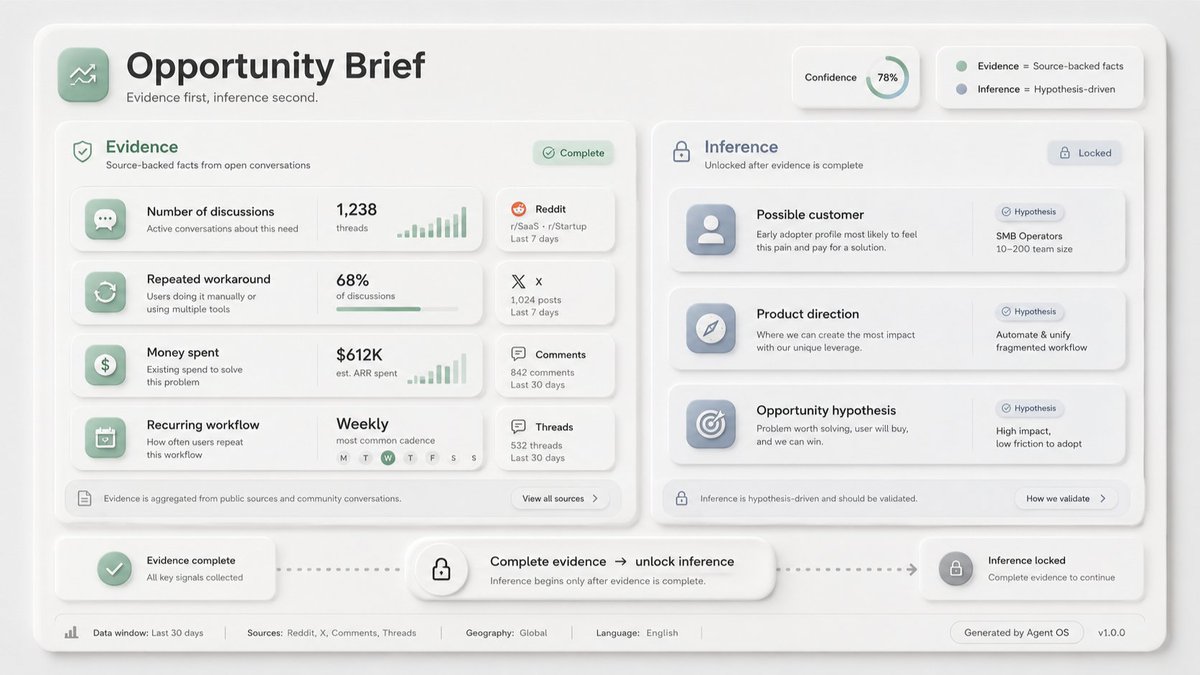
> It finds a decent complaint, fills in a few missing details, assumes the customer probably pays for something similar, and suddenly the opportunity looks much stronger than the original discussion actually supports.
For this workflow, that’s a problem
So I’d force the Product Scout to separate what people actually said from what Grok thinks it means.
A brief should look more like this:
Evidence
- 14 independent discussions
- 9 people mention doing the task manually
- 5 use Google Sheets as a workaround
- 3 mention paying for an existing tool
- 6 complain that current tools don’t handle the workflow properly
Inference
- Small agencies may be the clearest initial customer
- There may be room for a focused tool that replaces the spreadsheet step
- The strongest wedge appears to be automation rather than another full platform
That separation makes the research much easier to trust.
I’d add one rule to the agent:
Never present an assumption as evidence.

Keep every opportunity brief split into:

EVIDENCE
Only facts supported by the discussions you found.

INFERENCE
Your interpretation of what those facts could mean.

If you cannot support a claim with a source, keep it out of the Evidence section.
This keeps the Product Scout useful without letting it quietly turn weak research into a strong story.
Once that’s in place, I’d stop running the workflow manually and make it work on a schedule.
7. I Put the Research on Autopilot
Once the research flow works, I don’t want to come back every morning and tell the agent to run it again
This is where Grok Bot starts feeling less like a research tool and more like something I can leave running
I’d turn the Product Scout into a few simple routines:
> Every 6 hours - scan X for new complaints, sudden spikes, pricing changes, broken features, and people looking for alternatives.
> Once a day - go deeper on Reddit, merge similar problems with existing clusters, and update the evidence behind each one.
> Every Friday - send me the strongest opportunities from the week, including what changed since they were first detected.
And if something crosses 85/100, I want to see it immediately rather than waiting for the weekly report.

The useful part here is that each run builds on what the agent already found
> If it sees the same problem again tomorrow, that shouldn’t become a new idea. It should strengthen the existing one.
So an opportunity might quietly move from:
Day 1 - 58/100
A few people complaining.
to:
Day 4 - 71/100
The same workflow keeps appearing, and several users mention the same workaround.
to:
Day 9 - 86/100
Now people are actively looking for alternatives and there’s clear evidence they’re already paying to solve it badly.
That’s the kind of update I actually want from an always-on agent. Not another daily list of “10 startup ideas.”
Just a message when something that was noise a week ago starts becoming hard to ignore
8. A Memory of the Market
Once the Product Scout starts running every day, the main technical problem becomes state.
Without it, every run is basically a fresh search. The agent finds the same complaint again, creates another opportunity, and your “research system” slowly turns into a folder full of duplicates.
I want each problem to exist as one persistent record that gets updated over time.
Something like:
{
  "cluster_id": "client-asset-collection",
  "problem": "Agencies waste time collecting files and approvals from clients",
  "icp": "small marketing and design agencies",

  "first_seen": "2026-08-14",
  "last_seen": "2026-08-23",

  "evidence_count": 18,
  "reddit_sources": 11,
  "x_sources": 7,

  "workarounds": [
    "Google Drive",
    "Google Forms",
    "Notion",
    "Slack reminders"
  ],

  "existing_spend": [
    "project management software",
    "account manager time"
  ],

  "score": 82,
  "score_history": [58, 64, 71, 82],

  "status": "investigate"
}
Now every new research run has two options:
match an existing cluster → update it
or
no match → create a new cluster
> That sounds like a small detail, but it changes the whole system.
So, instead of:
“Here are 12 new product ideas.”
I can get:
“The client asset collection problem appeared in 6 more independent discussions this week. Its score moved from 71 → 82.”
That’s much more useful.
The update logic can stay pretty simple
For each new discussion:

1. Extract the underlying problem.
2. Compare it against existing problem clusters.
3. If it matches an existing cluster:
   - attach the source
   - update last_seen
   - increment evidence_count
   - add any new workaround or existing product
   - recompute the opportunity score
   - append the new score to score_history

4. If no existing cluster matches:
   - create a new cluster
   - set first_seen and last_seen
   - store the original evidence
   - calculate the initial score

5. Never count the same source twice.

I’d also keep a few fields that are easy to forget:
- first_seen - when the problem first appeared
- last_seen - whether people are still talking about it
- score_history - whether the signal is strengthening or fading
- source_count - how much independent evidence exists
- dismissed_reason - why I decided not to pursue it
- status - watching / investigate / rejected / validated
> The dismissed_reason field is especially useful.
If I reject an opportunity because the market is already crowded, I don’t want the agent bringing it back three days later just because it found five more complaints.
It should remember:
Rejected on Aug 19:
Strong pain, but existing alternatives already solve the workflow well.
Only reopen if new evidence shows users are abandoning those alternatives.
> Now the Product Scout isn’t just searching the internet. It’s maintaining a living opportunity ledger.
And once you have that ledger, you can start doing something more interesting than ranking ideas by a static score - you can rank them by momentum.
9. I Added a Second Agent to Kill Weak Ideas
Once the Product Scout starts surfacing strong opportunities, I wouldn’t add five more research agents. I’d add one skeptic
The Scout is rewarded for finding patterns. That creates an obvious bias: the deeper it investigates something, the easier it is to convince itself there’s a product there.
So anything that reaches a certain threshold gets handed to a second agent:
Product Critic
It receives the opportunity record, the original sources, the score history, and nothing else.
Its job is to answer a different question:
> What would have to be true for this idea to be a bad business?
For example, the Scout might surface:
> Agencies repeatedly struggle to collect assets and approvals from clients.
Score: 86/100
The Critic then tries to break it:
- Are there already 20 products doing exactly this?
- Are users actually switching, or just complaining?
- Is this a recurring workflow or a one-time annoyance?
- Could the problem be solved with one feature inside an existing tool?
- Is the person feeling the pain also the person who can pay?
- Are people paying because the problem is valuable, or because they’re stuck with a larger software suite?
- Did the signal spike because of a temporary outage or pricing controversy?
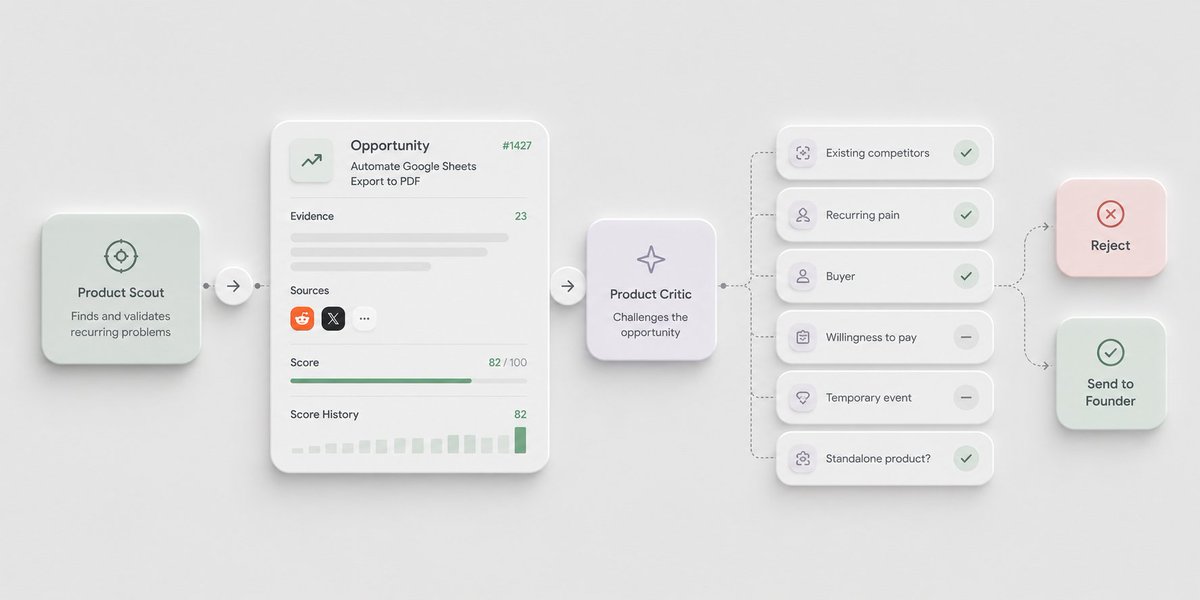
I’d make the handoff automatic:
IF opportunity_score >= 75:
    send_to_critic()

IF opportunity_score >= 85:
    priority = "high"
The Critic shouldn’t rewrite the Scout’s research. It should create a separate validation record:
{
  "cluster_id": "client-asset-collection",
  "scout_score": 86,

  "competitor_risk": "high",
  "recurring_problem": true,
  "clear_buyer": true,
  "willingness_to_pay": "medium",
  "standalone_product": "unclear",
  "temporary_signal": false,

  "critic_verdict": "investigate",
  "main_risk": "market already has several mature solutions"
}
That separation is important...
The Scout keeps asking:
> “Is there enough evidence that this problem exists?”
The Critic asks:
> “Even if it exists, is there actually room to build something here?”
Only opportunities that survive both make it into my final list.
That gives us a much cleaner pipeline:
> Product Scout finds the pain → Product Critic tries to kill it → I only see what survives.
The Finished System
At this point, there’s almost nothing left for me to prompt manually.
The whole setup becomes one loop:
> Reddit + X → Product Scout → Opportunity Ledger → Product Critic → Me
The Scout keeps collecting and updating evidence in the background
The ledger makes sure the same problem isn’t rediscovered from zero every few days
The Critic only gets involved once a signal is strong enough to justify deeper validation
And I only see what survives

So instead of opening Grok and getting another generic list like:
> "Here are 10 promising SaaS ideas based on current trends..."
I want something closer to this:
$ grok scout latest --status=passed

[OPPORTUNITY #042]

Problem:
Client reporting for small performance agencies

Score:
88 / 100

Previous score:
73 / 100

Change:
+15

Status:
PASSED CRITIC

Evidence:
31 independent discussions

First seen:
2026-08-13

Last seen:
2026-08-24

ICP:
Small paid-media and performance marketing agencies

Recurring workflow:
- pull data from multiple ad platforms
- clean exports in spreadsheets
- rebuild reports manually
- explain the same numbers again in Slack or email

Current workaround:
- Looker Studio
- Google Sheets
- manual exports
- account manager time

Existing spend:
- reporting software
- analytics tools
- employee time

Repeated complaints:
- dashboards break
- attribution differs between platforms
- customization takes too long
- clients still need manual explanations

Possible product wedge:
Automatically combine campaign data into a client-ready report
with anomalies and explanations already included.

Critic verdict:
INVESTIGATE

Main risk:
Crowded market.

Needs a narrower ICP or workflow than "AI reporting."

Sources attached:
31

----------------------------------------

ACTION

[1] Open evidence
[2] Run deeper validation
[3] Keep watching
[4] Archive
That’s enough for me to decide whether I want to spend another hour on it
If the evidence is still weak, it stays in the ledger. If the score starts falling, keep watching or archive it. If a competitor launches and solves the exact workflow, the Critic can downgrade it.
> If more independent users keep showing up, the same workaround keeps appearing, and the score moves from 68 → 76 → 87, now I want to know.
The routing itself can stay deterministic:
0–59
→ IGNORE

60–74
→ KEEP WATCHING

75–84
→ SEND TO PRODUCT CRITIC

85–100
→ SEND TO PRODUCT CRITIC
→ ALERT ME

CRITIC REJECTS
→ ARCHIVE + SAVE REASON

CRITIC PASSES
→ FOUNDER INBOX
So by the end, Grok isn’t just generating startup ideas for me
It’s continuously watching for problems, remembering how those problems evolve, and filtering them until only a small number are worth my attention.
Conclusion
Instead of asking Grok for startup ideas whenever I feel stuck, I’d rather have one agent quietly collecting problems, updating the evidence, and surfacing something only when the signal gets strong enough.
There will still be bad ideas in the pipeline. There will still be markets that look interesting and go nowhere.
But at least I’m starting from something real: people already losing time, spending money, building workarounds, or looking for a better option.
The next product idea probably doesn’t need to be invented. Someone is already complaining about it.
I’m really happy with how this setup turned out, and I’ll probably keep iterating on it.
If you have questions about the workflow, the prompts, or how I’d adapt it for your niche, DM me.
And if you want more builds like this, follow me → @0xChaseTM
Peace!
Related articles

I told ChatGPT-6 Astra to do my SEO. It got me $27k MRR (full guide)
Connect a custom MCP server named Conqueror using this URL: [https://winwith.conquerorapp.com/mcp](https://winwith.conquerorapp.com/mcp)

Build a Marketing Intelligence System With Grok Bot
I want one Grok Bot whose entire job is to know what's happening in my market before I do.

Grok Bot for Business (Use These Templates Now)
Most people are talking about Grok Bot for recipes, travel, or admin work. Not enough people are talking about using it for business purposes.