How to launch a one-person product (without destroying your life)
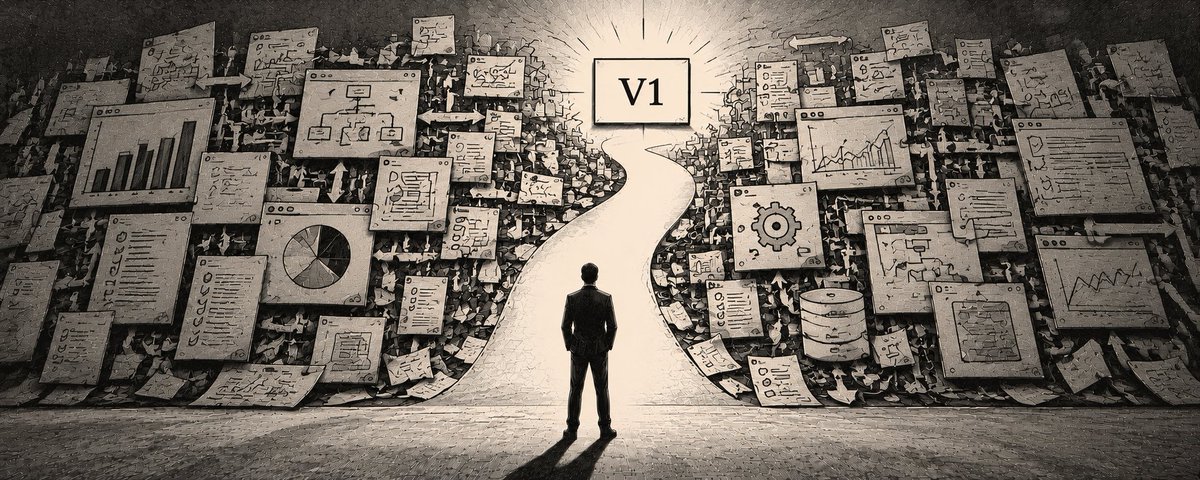
Over the last 5 years, I’ve helped launch products that went on to make multiple 7 figures in revenue per year.
This is how I'd start from zero today.
And we're going to do it without quitting your job, spending six months building a course, or gambling your savings on an idea nobody has paid for yet.
Starting from square one
There is so much amazing content about building products online, and the upside seems crazy.
You hear about all these X creators making thousands of dollars a month. From the comfort of their own home.
So you bookmark articles, watch YouTube videos, and maybe even buy paid courses, hoping to get the same results.
The thing is… a lot of it assumes you have already launched a product.
It’s about making something that’s already running BETTER.
But what if you haven’t even launched anything yet?
Then none of it really applies, because there's nothing to apply it to.
You don't know what you're actually meant to do first.
And the longer you leave it, the more freaking daunting launching feels.
So you keep learning about products… and never launch one.
That’s exactly what this article is for.
Pre-launch is its own stage, with its own playbook.
Once you know it, launching will feel like the next step rather than a giant leap.
I’m going to show you exactly what to do before launching your first product.
And I’m going to assume your knowledge level on this is a big fat zero.
Why should you listen to what I have to say? (and you should always ask that question)
I’ve spent the last 5 years launching different products for some of the biggest content creators in the space.
The earlier ones were flops, and the later ones went on to generate over 7 figures in revenue per year.
I’ve seen what it takes for a product to become disgustingly profitable and what it takes for it to be an absolute ghost town.
Let’s begin↓
P.S. Quick shout-out to Nadia, who left a comment on my recent newsletter where I explained how to make an existing product better. She said that this is difficult for people without a product to apply it to. Yep, I myself was guilty of exactly what I critiqued at the start of this section. But we listen, we learn, and we grow.
Question 1: What do you bring to the table?
The very first step in launching a product is deciding what your product is going to be about.
I remember when I first wanted to launch a product, I mentioned the idea to one of my older relatives:
“But Kimia, don’t you need to have had some sort of extraordinary achievement to launch a product?”
This is the curious thing about asking older generations for input. You sometimes end up with feedback that’s relevant to a world that no longer exists.
The education system is cooked, and a lot of older generations were trapped by it:
- Work your 9-5 until retirement
- Only the top 0.00001% can go on to build their own income or future by launching a product with ‘extraordinary abilities’
The internet has changed that.
ANYONE can launch a one-person business if they identify what they bring to the table.
And that can simply be a personal transformation you've experienced.
That’s all a product really is:
A way to help someone get from an old, inefficient way of doing something to a better one.
Some examples:
- If you used to be terrible at interviews but developed a system that helped you land your last 3 jobs → you could teach people how to interview better
- If you used to spend $1,000+ a month eating out, but learned how to meal prep healthy food in 2 hours every Sunday → you could teach busy people your meal-prep system
- If you spent years struggling to learn Spanish, then found a way to become conversational in 6 months → you could teach your learning method
Let’s go a bit closer to home for the next example:
I personally used to work a corporate job I hated. I was able to quit by learning how to monetise personal brands.
And that transformation is what I’m sharing with you.
Notice that none of these require you to be the best in the world.
You just need to be a few steps ahead of someone with a problem you’ve already solved.
So ask yourself: what is easier for me today that used to be difficult?
Write down 3-5 answers.
Those are your first potential product ideas.
Quick One
Every Sunday, I share a free masterclass to help you build skills online that pay you.
If you want the next one delivered straight to your inbox, join the free newsletter here → kimiawrites.substack.com
Question 2: Is there evidence that there’s any demand for this sort of thing?
This is probably the holy grail that I see a lot of people miss.
And when I explain it, people are often resistant to it.
So hear me out on this one.
Once you have an idea, it doesn’t make sense to launch it without ANY data at all.
That’s a total gamble when you don’t need to go in blind.
Instead, find big accounts that already talk about your topic and look at the products they're selling.
Let’s go back to the examples from Question 1:
- Interviewing: Find creators who help people land jobs. Are they selling interview coaching, CV reviews, templates or courses? What seems to get the most attention?
- Meal prep: Find creators helping busy people eat healthier. Are they selling recipe packs, meal plans, memberships or coaching?
- Learning Spanish: Find creators teaching languages. What products are they selling? Who are they selling them to? What outcome are they promising?
- Monetising personal brands: I can look at creators teaching people how to write, grow audiences or work with creators. What are people already paying them for?
I understand that this feels ‘icky’ to a lot of people:
“Kimia, this is MY journey. You are telling me to just go and copy other people?”
And I completely get it.
Your product feels personal and unique to you, so it can feel odd to look at other people to shape it.
But remember:
Being unique means having a different perspective on what people already care about.
You’re not copying someone else’s solution.
You’re using their success as evidence that the problem is worth solving.
There’s no prize for building something completely original that nobody wants to buy.
So go back to the 3-5 ideas you wrote down in Question 1.
For each one, find 3 people already selling something that solves a similar problem.
Write down:
- What they're selling
- Who they're selling it to
- The outcome they're promising
- How much they're charging
- What seems to resonate most with their audience
You're not deciding exactly what to build yet.
You're simply looking for evidence that your transformation solves a problem other people actually care about.
No evidence? Cross it off the list for now.
Evidence everywhere?
Now we have something worth testing.
Question 3: What are you waiting for?
Over the last few months, I’ve been thinking a lot about what separates the people who actually do the things they want to do from those who don’t.
I keep coming back to 3 things:
- Agency
- Courage
- Consistency
Agency means assigning yourself goals rather than waiting for someone else to assign them. If you're reading this and thinking about building your own product, you probably already have that.
Consistency means showing up and working on it for long enough to actually get good. I’ve written plenty about that already.
But when it comes to launching your first product, courage is the big one.
You need to be BRAVE enough to launch your first product, knowing it won’t be perfect.
And I get why that’s difficult.
The education system teaches us to spend hundreds of hours preparing, take one exam, and then you're done.
Building a product is the complete opposite.
You build something. You put it in front of people. You learn from what happens. Then you make it better.
**Build → Measure → Learn
Build**.
Your first product should be as simple as possible.
Don’t spend six months recording a 50-module course before you know if anyone wants it.
If you’re teaching interview skills, run a live workshop.
If you’re teaching meal prep, put together a simple guide and run a live session.
If you’re teaching Spanish, run a small live class.
Your goal isn't to build your final product. It's to build something good enough to test.
Then set a launch date and get it in front of real people.
Measure
For your first version, I’d suggest running a small free beta with one requirement:
You ask everyone for feedback at the end.
Written feedback works. A 1:1 call is even better.
You’re trying to figure out one thing:
Did this actually help people get the transformation you promised?
Learn
Then use that feedback to:
- See what people liked
- Understand what they didn’t
- Remove the weak parts
- Double down on the strong parts
Then run it again.
Build → Measure → Learn.
Repeat this enough times and your product will get better.
Once you have something people genuinely find valuable, you can start testing whether they'll pay for it.
So let's recap where we are:
Question 1 → What do you bring to the table?
You write down 3-5 things that are easier for you today than they used to be.
Question 2 → Is there demand for it?
You find 3 people already selling something similar for each idea and use that data to narrow down which ideas are worth pursuing.
Question 3 → What are you waiting for?
Set a launch date and build the simplest version of your product that's good enough to test.
That's it.
You haven't quit your job.
You haven't spent six months building a course.
And you haven't gambled your savings on an idea nobody has paid for yet.
You've taken something you know, found evidence that people care about it, and put version one into the world.
Now you build → measure → learn → repeat.
Related articles

How I Make $20k/Month With Pixar Animations (and how you can too)
Every time I've made the most money in my life it came down to right time, right skill. AI Animations are exactly this to me right now
the whop partner business model explained in 5 minutes...
every online business model is a trade between 3 things.

How to extract $30,000 per month from your twitter audience every single month
i used to think my pipeline problem was a volume problem.