the whop partner business model explained in 5 minutes...
every online business model is a trade between 3 things.
-
how much it costs to start
-
how long until it pays
-
and whether the income keeps coming
most models score badly on at least 2 of those.
whop referral partnering scores well on ALL 3,
and this article explains exactly what it is...
the structure, in plain terms:

whop is a platform businesses use to sell subscriptions, memberships, digital products, and services, and to take payments for all of it.
they charge the business roughly 2.9% of everything it processes.
partners introduce businesses to whop, and whop pays them 30% of its own fee on that business.
the base term is 6 months, and it extends as your volume grows.
3 things follow from that structure, and each one shapes how the business feels to run.
1. whop funds your commission.
a business on whop pays 2.9% whichever way it arrived on the platform.
so your pitch is a cheaper setup, and the platform compensates you for making the introduction.
in practice that removes the hardest moment in any sales conversation, which is justifying new spend.
2. the payment repeats.
you earn a percentage of what that business processes, every month, for as long as it keeps processing.
a business you introduced in january is still paying you in december.
3. the business grows without you.
a shop that grows from $50k to $200k a month in processing quadruples what it pays you.
you are attached to their growth and they carry all the work behind it.
the unit economics:

here is the calculation on a single business.
monthly processing × 2.9% = whop's fee.
whop's fee × 30% = your monthly commission.
- a business at $25k a month pays you roughly $218
- at $50k a month, roughly $435
- at $100k a month, roughly $870
- at $250k a month, roughly $2,175
- at $500k a month, roughly $4,350
what that means for your time.
introducing a $25k business and a $250k business takes the same effort.
you write a similar message, build a similar demo, and have a similar conversation, and the outcome differs by 10x.
that is why i hold a floor of $50k a month in processing while building volume.
stacking it.
10 businesses averaging $80k a month in processing comes to roughly $6,960 a month.
30 businesses at that average comes to roughly $20,880 a month.
each business you add stacks on top of the ones already live,
and the earlier ones keep running untouched.
the durability.
payment processing has some of the lowest churn of anything recurring.
a business that has migrated its checkout, customer records, and payout details stays put.
that durability is how i spent 8 months in mexico while those accounts kept paying me somewhere between 6 and 8 thousand a month without my involvement.
(so far i've made over $180k with this lol)
where the income actually comes from:
the pitch has 3 doors, and fees are only one of them.
door 1: they are overpaying.
substack takes around 9%.
hotmart takes around 10% and dominates spain, brazil, and mexico. legacy card terminals run 2.6% to 3.5% plus fixed fees plus hardware rental.
against roughly 2.9% with the hardware gone, the gap on a business doing $100k a month runs into thousands every month.
with hotmart specifically, that is roughly $10,000 a month in fees against roughly $2,900, a $7,000 monthly saving you can state as a plain number.
door 2: they are stitching tools together.
plenty of these businesses run a checkout, a separate subscription manager, a discord access bot, and a manual payout process.
whop consolidates all of it into one account,
and the hours they get back often matter more to them than the fee.
door 3: they want more customers.
whop has discovery and affiliate tooling built in, so a business on the platform gets found by people already browsing it.
for a business whose only acquisition channel is its own audience, this is the angle that lands.
pick the door before you write anything.
a barber cares about tap to pay. a course seller on hotmart cares about the fee gap.
you need to match the door to the business.
what you actually do all day:
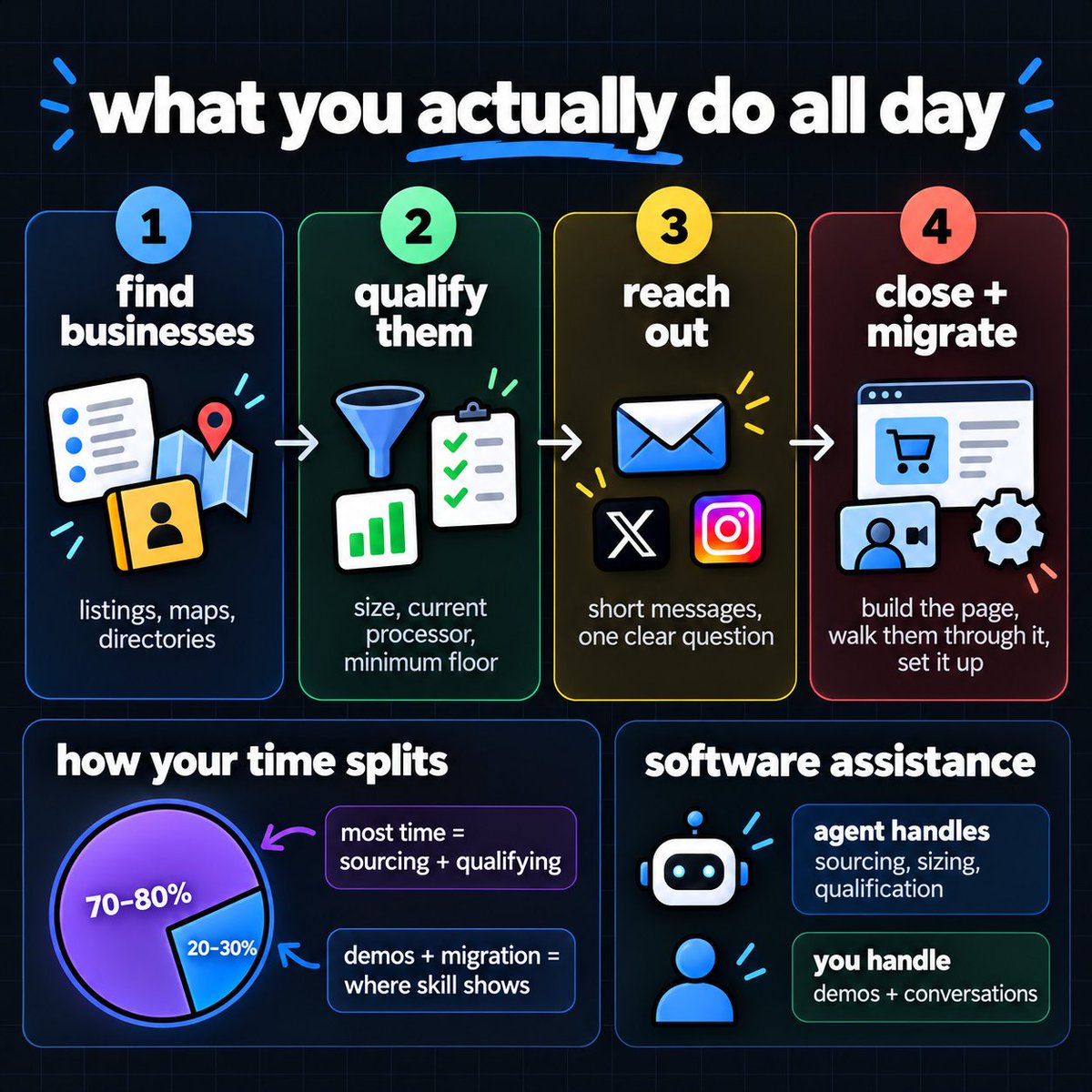
the job breaks into 4 activities.
finding businesses.
pulling listings, community directories, marketplaces, and maps results, then filtering for size.
qualifying them.
estimating what they process, identifying what they currently use, and checking they clear your floor.
reaching out.
short messages across email, x, and instagram depending on the niche, each ending in one clear question.
closing and migrating.
building them a working store page, walking them through it on video, answering their questions honestly, and then setting the whole thing up for them.
how your time splits.
sourcing and qualifying take the majority of it.
outreach moves fast once the list exists.
demos and migration are where your skill shows, and they stay human.
that split is why i built the software side.
the agent runs the sourcing, the size estimation, and the qualification pass, and the crm holds every conversation and surfaces who to chase today.
my day becomes demos and conversations, which is where the commissions come from.
the markets worth working:

online communities.
trading groups, education communities, and paid discords. member counts and prices are usually public, so volume estimates take seconds.
ecommerce brands.
review velocity and consistent ad spend signal real processing volume.
latam information businesses.
hotmart's grip on spain, brazil, and mexico creates the largest fee gap anywhere in this model.
local service businesses.
detailers, barbers, mobile mechanics, cleaners, and personal trainers. tap to pay on a phone replaces a rented terminal completely.
that last market is the least crowded by a wide margin, because partners overwhelmingly chase online communities first.
my student nick's $6,000+ deal came from a single car detailing shop in that category.
the market to skip.
restaurants.
their setups are tied into pos systems, table management, and tipping flows, and thin margins make them slow to move.
the limits of this model:
every model has real downsides, and these are the ones here.
it pays slowly at the start.
a business takes weeks to move, and your first commission is small and arrives after the work.
my own first referral took 2 to 3 months to close and paid around $800 in its opening month.
if you need money inside 14 days, pick something faster.
it involves conversations.
the demo and the migration are human work, every time.
churn is low and still real.
businesses close, get acquired, and change direction, so plan for some attrition.
you depend on one platform.
whop sets the rates and the terms, which is a concentration risk to go in aware of.
it needs volume.
one business at $50k a month pays $435.
so the income comes from stacking businesses, and stacking takes months of steady sourcing.
why this beats the alternatives:
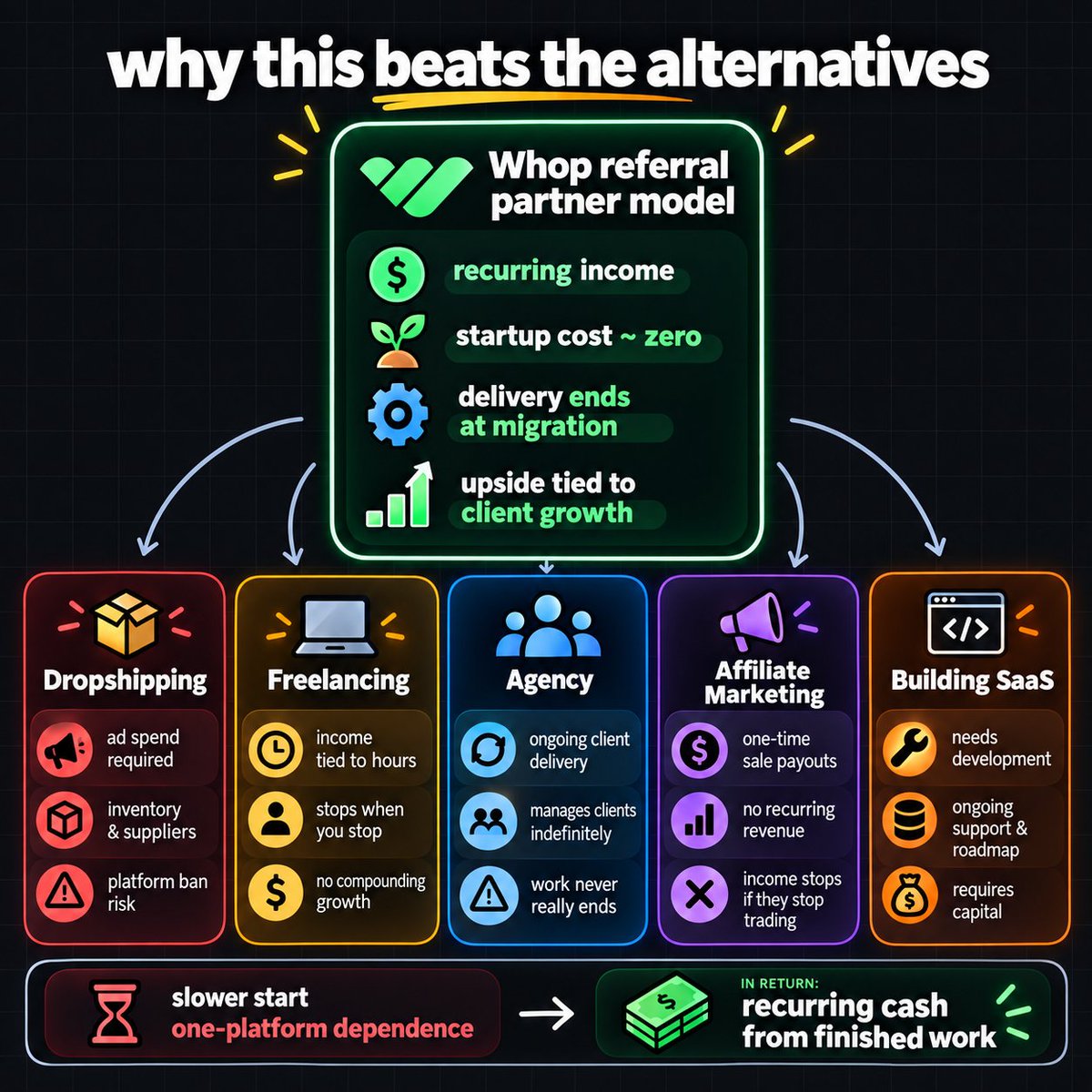
against dropshipping.
dropshipping needs ad spend, inventory, customer service, refunds, and suppliers,
and a platform ban can end the store overnight. here your entire cost is time.
against freelancing.
freelance income follows your hours.
this keeps arriving from businesses you introduced months ago.
against running an agency.
an agency delivers a service every month and manages clients indefinitely. here the delivery finishes when the migration does.
against affiliate marketing.
most affiliate programs pay once per sale. this pays a percentage of a business's ongoing revenue for as long as it trades.
against building saas.
saas needs development, support, a roadmap, and capital before revenue. this needs a laptop.
the shape of the trade.
you accept a slower start and a dependence on one platform.
in return you get recurring income from finished work, a startup cost of zero, a delivery obligation that ends at migration, and upside tied to somebody else's growth.
i have run several of the alternative business models above, and this is the one where the money kept arriving while i was away from it.
- dylan
**also, if you want:
-
the custom AI agent and software i use
-
weekly coaching calls
-
a full 16 module course
-
campaign assets
-
and more**
all helping you close deals and make money with the business model i just explained, (whop referral partnering)
**DM me "REFERRAL" or book a call @ go.revkeep.ai/read**
(the program is not free btw)
Related articles

How I Make $20k/Month With Pixar Animations (and how you can too)
Every time I've made the most money in my life it came down to right time, right skill. AI Animations are exactly this to me right now

How to launch a one-person product (without destroying your life)
Over the last 5 years, I’ve helped launch products that went on to make multiple 7 figures in revenue per year.

How to extract $30,000 per month from your twitter audience every single month
i used to think my pipeline problem was a volume problem.