How to Make an AI Film and Get It Into Theaters

A filmmaker from Tunisia generated a 9-minute short with AI tools and walked away with a seven-figure prize.
Another team's AI short just landed a two-week run across 2,300 theaters. This is not a hypothetical future, the money is already moving.
Here's the exact pipeline, the exact prompts, and the real earning potential behind the fastest-growing category in independent film.

Here's the number that should stop you mid-scroll:
- one AI-generated short film, 9 minutes long, made by a filmmaker with no studio backing, just won $1,000,000 at the Astana AI Film Festival.
Not a Hollywood budget.
Not a 200-person animation team.
> A story, a laptop, and the right AI pipeline.
Before we go further, full honesty. This guide is about making original AI-animated films with your own characters and story, not repurposing Disney or Pixar cartoons, which is copyright infringement no matter how much AI is involved.
The films winning these prizes are original work.
That's also exactly why the opportunity is wide open, nobody owns this space yet.
What This Can Actually Pay / Realistic Numbers
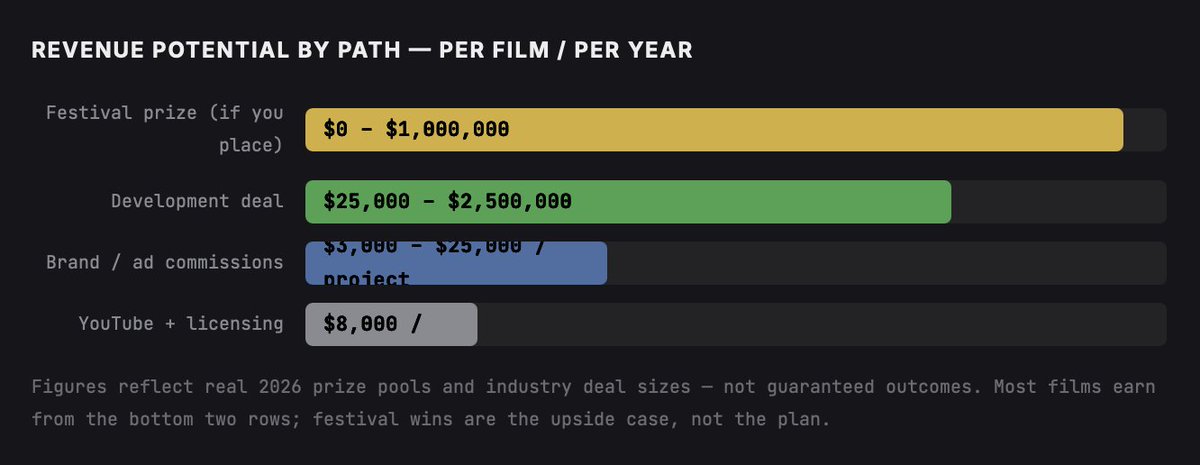
→ THE REALISTIC PATH
Treat festival prizes as a lottery ticket, not a business plan.
The reliable income is the studio-for-hire model: once you've built a real pipeline and a portfolio piece, brands are already paying $3,000–$25,000 per AI commercial
and two dedicated festival categories (WAIFF, LifeArt) exist specifically because agencies are scouting for this skill set right now.
Six Tools That Replace an Animation Studio
1. Claude Story & Script
[ Screenplay · Shot List · Scene Breakdown ]
Every film starts here.
Claude writes the screenplay, breaks it into scenes, generates a shot list with camera directions, and writes the detailed visual prompts for every frame.
> Your writers' room and assistant director in one.
2. Runway Gen-4 or Kling 2.5 Video Generation
[ Character Animation · Scene Generation · Camera Movement ]
Both support consistent character generation across shots, critical for anything longer than a 10-second clip.
> Runway's own festival specifically favors films built in their tools.
3. Midjourney + Character Reference Visual Development
[ Character Design · Environment Concepts · Style Bible ]
Generate the same character from multiple angles before animating anything.
> This becomes the reference every video tool locks onto for consistency.
4. ElevenLabs Voice
[ Character Voices · Dialogue Performance ]
Full character performances with emotional direction.
> Original voice design keeps you eligible, never clone a real person's voice without licensed permission.
5. Suno or Udio Score
[ Original Score · Sound Design Foundation ]
A fully original score matched scene by scene.
> Copyrighted music disqualifies you instantly from nearly every AI film festival.
6. DaVinci Resolve
[ Editing · Color Grade · Final Assembly ]
This turns a folder of generated clips into a film.
> Pacing and sound design are still entirely human craft, this step matters more than any single AI tool.
The Screenplay That's Built to Be Generated

> BUILDING THE STYLE BIBLE

Scene-by-Scene Production Workflow
1 / SHOT PROMPT GENERATION
For every shot, Claude generates a detailed video prompt referencing your style bible
> character
> environment
> camera
> emotional beat
all locked to consistency

2 / VOICE PERFORMANCE DIRECTION
Direct ElevenLabs like a real actor
> emotional notes
> pacing
> breath
Text-to-speech alone reads flat; direction makes it a performance.

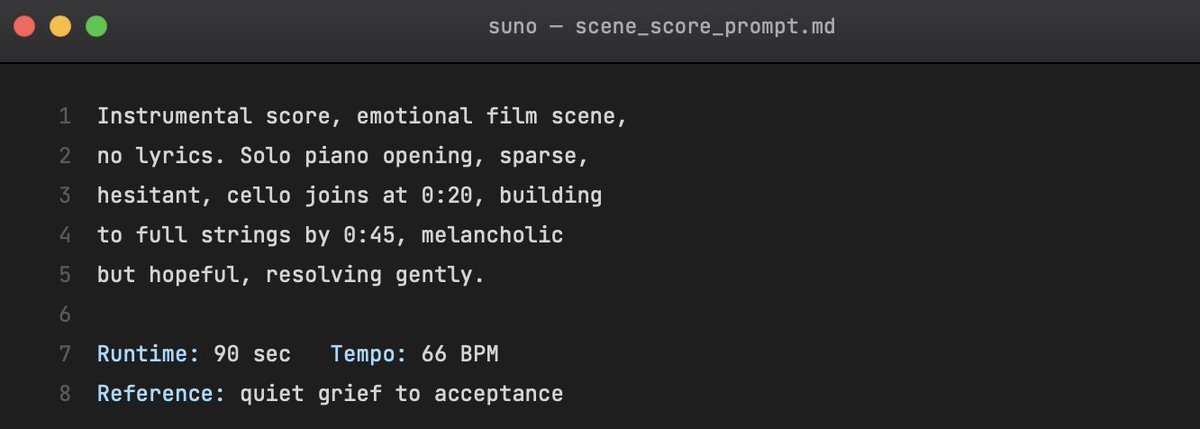
3 / SCORE GENERATION
Generate score scene by scene matching the emotional arc, not one continuous track.
This gives you far more control in the edit.
Where the Real Money Is Sitting Right Now
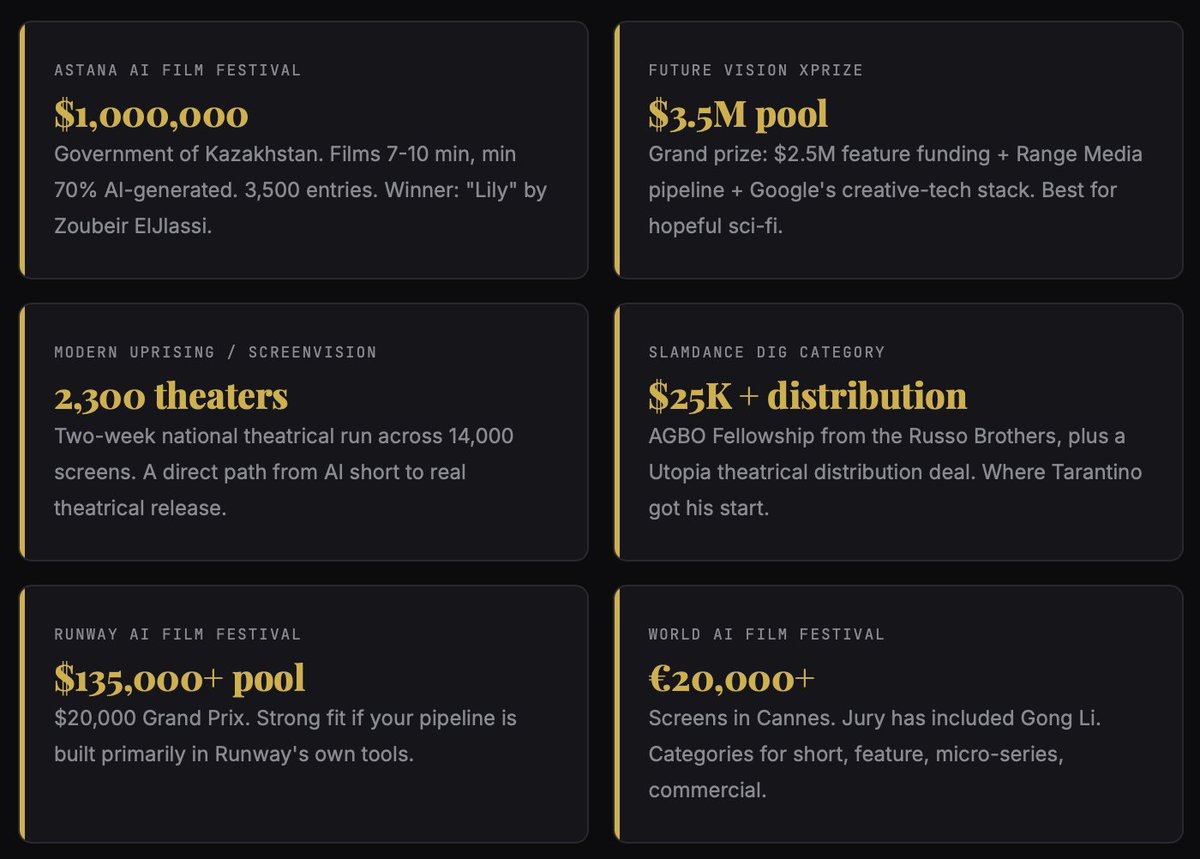
→ THE STRATEGIC ENTRY POINT
Start with mid-tier festivals (Reply AIFF in Venice, LifeArt, World AI Film Festival) before chasing the million-dollar prizes.
Higher acceptance rates, real exposure, and many feed scouting pipelines into the bigger festivals the following cycle.
What Disqualifies Otherwise Great Work
Minimum AI-Generation Threshold
Usually 50–70% of visual content
Keep a production log documenting which tools generated which shots. Several festivals now request this as part of submission.
Original Music and Voice Only
No copyrighted tracks, no unlicensed cloned voices
The single most common disqualification. Suno/Udio scores and original ElevenLabs voice designs keep you clean.
Runtime and Format Compliance
Read each festival's category rules
A 9-minute cut won't qualify for a 25+ minute "feature" category elsewhere. Build runtime around your primary target festival first.
→ THE HONEST TIMELINE
A festival-quality 9-minute short realistically takes 6–10 weeks for a small team, not a weekend.
Story development, style bible consistency, and editing still require real craft. Treat your first film as a learning project, not a guaranteed million-dollar ticket.
> A decade ago, an animated short needed a studio > > a budget in the millions, and years of production > > In 2026, it needs a story worth telling > > and the discipline to finish it
Every prompt above is ready to use today.
> Thanks for reading!
I share useful content every day, so follow me so you don't miss out
@rich_odinn
Related articles

how to run an ai native agency with jev (FULL GUIDE)
jev is open to everyone now. it's a super fast decision model, so one person can now do work that businesses usually pay an agency a big cut for. here's how you can set up a whole ai native agency wi…

5 Step Video GEO Guide for SaaS (62k AI Mentions in 3 Months with Claude)
I pulled every "best ... software" keyword with real US search volume, 2,328 of them, and ran 140 through DataForSEO on Google US mobile on September 1, 2026: the 60 biggest category head terms plus…