How to Make Money on YouTube Without Showing Your Face (And Let AI Do 90% of the Work)

There are YouTube channels making between $1,000 and $10,000 per month.
Their owners never appear on camera.
They have no production teams.
They record nothing.
And most of them started knowing nothing about video.
This is not a secret. It is a system. And AI makes it accessible to anyone who understands how it works.
Why YouTube Shorts and Not TikTok or Instagram Reels
The logical question for anyone starting out is: if I am going to make short videos, why YouTube and not TikTok or Instagram? The answer has three parts.
Direct monetization. Since February 2023, YouTube includes Shorts in its Partner Program (YPP). YouTube shares ad revenue directly with short-form creators, something TikTok and Instagram do not do in any comparable way. TikTok's Creator Fund pays significantly less per million views, and Instagram has no direct view-based payout for Reels in most markets. To access YPP with Shorts you need 500 subscribers and 3 million public Shorts views in the last 90 days. Once inside, YouTube pays between $0.03 and $0.07 per 1,000 views depending on your niche and audience location.
Content permanence. A Short published on YouTube can keep accumulating views for months or even years, because YouTube search, the second largest search engine in the world, indexes and ranks that content long term. On TikTok, a video has a lifecycle of 24 to 72 hours before the algorithm buries it. On YouTube, a well-optimized video generates organic traffic indefinitely.
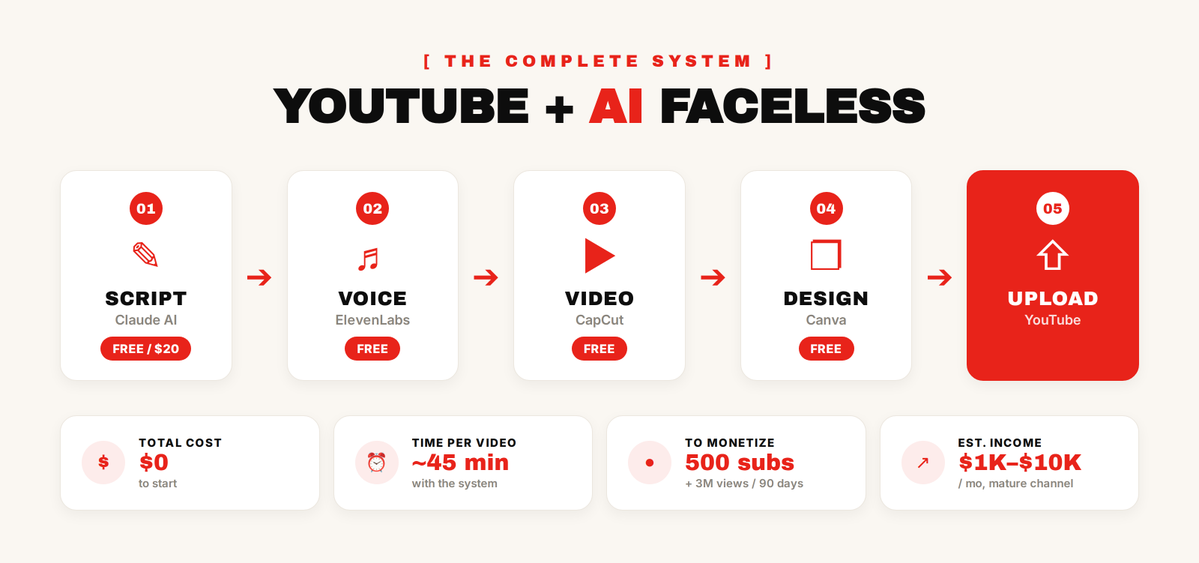
The funnel to long form. Shorts work as an audience acquisition funnel toward the main channel. A viewer who watches your Short can become a subscriber and, eventually, a consumer of long-form content, where CPMs run between $2 and $15 per 1,000 views depending on the niche. It is a business model with two revenue streams that feed each other.
How to Find a Niche That Already Works
The most common mistake new creators make is trying to invent something new. The correct logic is the opposite: find what already works, understand why it works, and replicate the pattern with your own angle. This is not copying. It is market research.
Method 1: Manual search on YouTube. Search broad terms related to the content you are interested in: "historical facts", "science facts", "true crime stories", "stoic philosophy quotes". Filter results by "This month" and sort by view count. Look for channels with fewer than 50,000 subscribers but videos with hundreds of thousands or millions of views. That disproportion is the signal: someone found a pattern the algorithm is actively distributing. For each channel, note the average video length, whether they use voiceover or on-screen text, the editing pace, the publishing frequency, and the specific subtopic inside the broad niche.
Method 2: Analytics tools. VidIQ and TubeBuddy are browser extensions that show performance data for any public channel or video: click-through rate, average retention, ranked keywords, and growth velocity. Both have free plans that cover the research phase. Use their keyword features to find terms with high search volume and low competition.
Method 3: Validate with Claude. Once you have two or three candidate niches, run them through these prompts before committing time and resources.
PROMPT 1: Niche validation
PROMPT 2: Sub-niche identification
PROMPT 3: Competitor analysis
The Five-Step Production System
Once the niche is validated, the production system has five sequential steps. Each one is supported by a specific tool and, where possible, by a Claude prompt that automates the creative part. The goal is to produce a complete Short, from idea to publication, in under one hour.
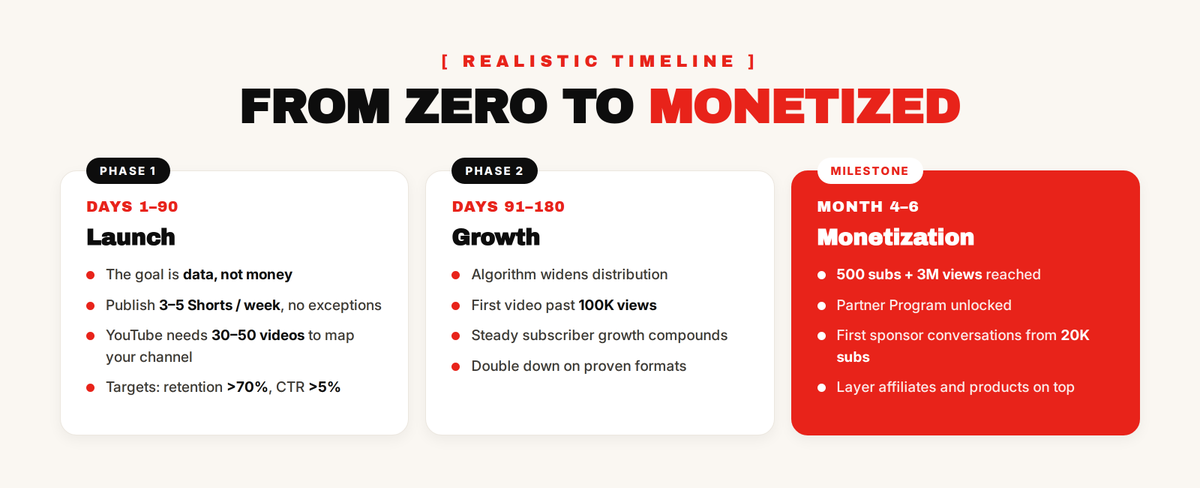
Step 1: Editorial planning
Do not publish video by video without a content map. Use Claude to generate a full editorial calendar for the next four weeks:
PROMPT 4: One-month editorial calendar
Step 2: Script writing
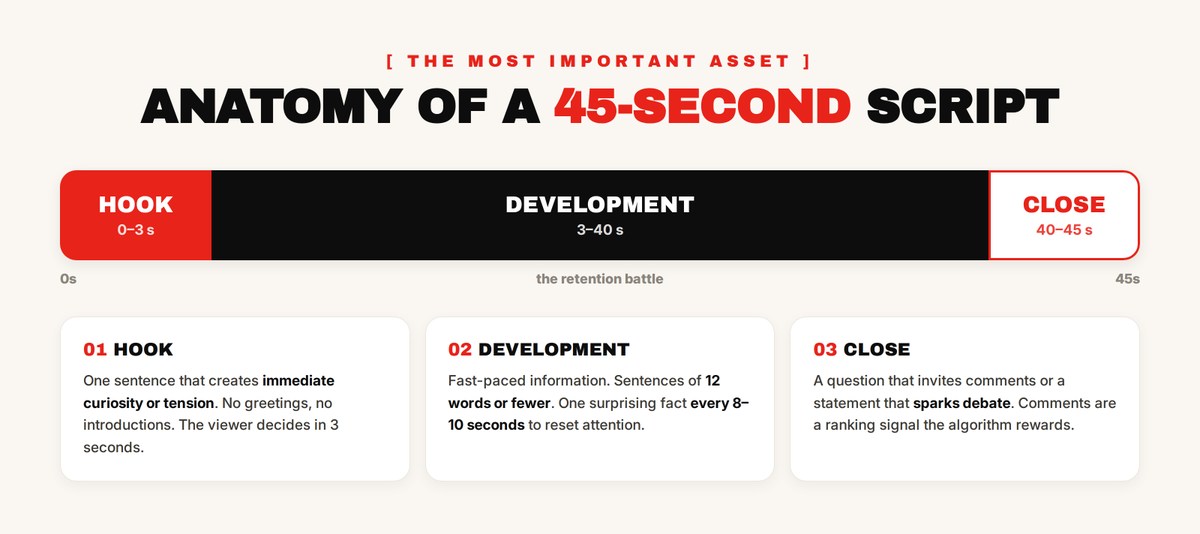
The script is the most important asset in the system. Everything else, the voice, the video, the editing, serves the script. A Short with a mediocre script will not work regardless of production quality. A Short with an excellent script can work even with basic editing.
PROMPT 5: Individual Short script
PROMPT 6: 10-script pack, for volume production
Step 3: Voice generation with ElevenLabs
ElevenLabs is the industry standard for professional-quality synthetic voice. The process is direct: paste the script, select a voice that fits your channel's tone, and download the audio in under 30 seconds.
Criteria for choosing the right voice: for true crime or dramatic history, a deep male voice with clear diction works best. For personal finance or productivity, a neutral, approachable voice builds more trust. For philosophy or motivational content, a slightly slower and more deliberate voice improves retention.
A technical tip that makes a real difference: set voice stability to 65% and clarity to 75%. That combination sounds natural without losing diction. For dramatic content, lower stability to 45% to get more emotional variation.
The free plan includes 10,000 characters per month, enough for 8 to 12 scripts. The Starter plan at $5 per month raises that to 30,000 characters, covering 25 to 35 videos monthly.
Step 4: Video editing with CapCut
CapCut is the most complete free editing tool for this type of production: vertical templates, automatic subtitles with precise sync, a royalty-free music library, and built-in stock clips.
The workflow: import the ElevenLabs audio as the main track, enable automatic subtitles and style them for mobile readability, add clips that illustrate the script, add background music at 10 to 15% of total volume, and export at 1080x1920 pixels, 30 frames per second.
For volume production, Pictory automates this entire step: paste the script and the tool selects stock clips and assembles the video with the audio track. It costs $19 per month on the basic plan.
Step 5: Optimization and publishing
Three critical elements before hitting publish: the title, the description, and the hashtags.
PROMPT 7: Optimized titles
PROMPT 8: Description and hashtags
PROMPT 9: First-frame text
Niche Strategy: The Mistake That Kills New Channels
The variable that most separates growing channels from stagnant ones is not production quality or publishing frequency. It is niche specificity.
Intuitive logic says: the broader the niche, the bigger the potential audience. The algorithm's logic says the opposite: the more specific the niche, the clearer the signal you send to YouTube's recommendation system about who should see your content, and the easier it is for the algorithm to find that audience and distribute your content organically.
The practical difference is this: "Motivation" is a niche that is far too broad, where you compete with thousands of channels. "Practical stoicism for men aged 30 to 45" is a specific niche where the algorithm knows exactly who to show you to. The more specific the niche, the more loyal the audience, the higher the average retention rate (the metric YouTube's algorithm weighs most heavily), and the more attractive the channel becomes to specialized sponsors who pay higher rates.
PROMPT 10: Positioning strategy
How Much You Can Earn and in What Realistic Timeframes
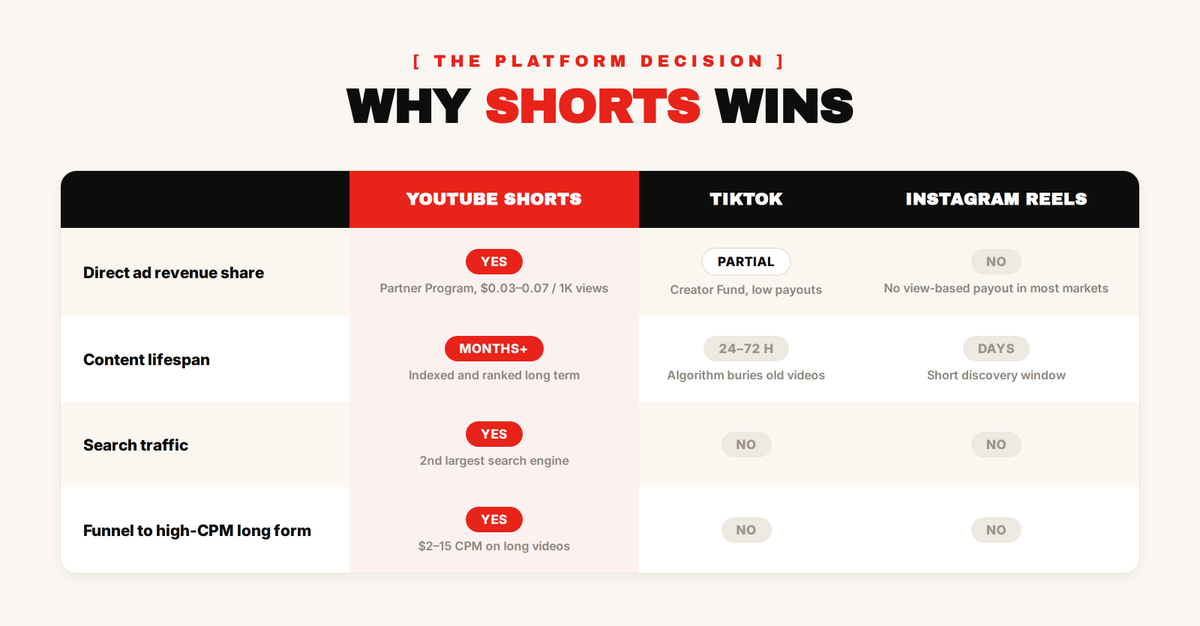
Phase 1: Launch (days 1 to 90). The goal of the first 90 days is not to make money. It is to accumulate data. YouTube needs at least 30 to 50 published videos to understand what the channel is about and who to distribute the content to. During this phase, publish 3 to 5 Shorts per week with absolute consistency. Every two weeks, analyze which videos have the best average retention (target: above 70%) and which titles generate the highest click-through rate (target: above 5%). Adjust based on that data, not on your intuition.
Phase 2: Growth (days 91 to 180). If the first 90 days have produced positive data, high retention, sustained subscriber growth, at least one video crossing 100,000 views, the channel enters an acceleration phase. At this point, the algorithm starts distributing the content more broadly. Channels that reach this phase with consistency generally hit the 500 subscribers and 3 million views required to monetize between month 4 and month 6.
The mature channel. A channel with 50,000 subscribers and 3 to 5 million monthly views can generate income through five streams:
Channels that depend only on AdSense have limited income. Those that build a multi-stream monetization ecosystem can exceed $3,300 per month with fewer than 100,000 subscribers, as long as the niche is specific enough to attract quality sponsors.
The Complete Tool Stack
Ideas and scripts: Claude AI, free plan available, Pro at $20 per month. Voiceover: ElevenLabs, free plan with 10,000 characters per month, Starter at $5. Video editing: CapCut, full free plan, Pro at $7.99. Stock clips: Pexels and Pixabay, completely free. Thumbnails and first frame: Canva, free plan available. Niche research: VidIQ or TubeBuddy, free plans available. Video automation at scale: Pictory, from $19 per month.

Total cost to start with the fully free stack: $0. Cost to scale with the two paid tools that have the biggest impact, Claude Pro and ElevenLabs Starter: approximately $25 per month.
Conclusion
The system described in this article is not a magic formula or a promise of guaranteed income. It is a replicable framework that removes the two main barriers stopping most people from building a YouTube channel: production cost and content creation time. With the right AI tools, both barriers disappear.
What AI cannot automate is consistency. Channels that fail do not fail because of a lack of technical quality. They fail because the creator quits before the algorithm has enough data to distribute the content. The first 90 days are the hardest because the results are minimal. The channels that push through them with consistency have every probability in their favor.
The tools are the same for everyone. The prompts are the same. The platforms are the same.
The only thing that separates those who succeed from those who do not is who starts and who does not.
If this article was useful:
Follow @LeoCreaIA for more practical AI systems like this one: real workflows, real tools, and prompts you can copy and use the same day.
Bookmark this article so you can come back to the 10 prompts when you start your channel.
Repost it to help other creators who are still paying for courses that teach less than this.
New deep dives like this one every week.
Prompts
Write 10 different scripts for 45-second YouTube Shorts for a channel about [NICHE].
Each script must have a 3-second hook, a 35-second development with a concrete fact or story, and a close with a question or statement that sparks debate.
All scripts must be independent from each other. Overall tone: [conversational / educational / dramatic].
Number them 1 to 10 with the suggested title above each one. 120 words maximum per script.
Give me 6 text options for the first frame of a YouTube Short about [TOPIC].
Each option must: be between 3 and 6 words, create immediate tension or curiosity, and work visually as a full-screen headline.
Do not include unnecessary punctuation.
List the 6 options numbered, with no additional explanations.
Write a script for a 45-second YouTube Short about [SPECIFIC TOPIC] for a channel in the [NICHE] niche.
The script must follow this exact structure:
HOOK (first 3 seconds): one sentence that creates immediate curiosity or tension, no introductions.
DEVELOPMENT (35-40 seconds): fast-paced information, short sentences of no more than 12 words, one surprising fact every 8-10 seconds.
CLOSE (5 seconds): a question that invites comments or a statement that sparks debate.
Tone: [conversational / educational / narrative / dramatic].
120 words maximum in total. Write only the script, no scene directions or notes.
Act as the content director of a YouTube Shorts channel in English about [NICHE].
Create a 28-day editorial calendar with publishing from Monday to Friday (20 videos in total).
For each video indicate: a YouTube-optimized title (60 characters max), the narrative angle (story, fact, list, question, debate), and the hook for the first 3 seconds.
Organize the videos so each week has variety of formats.
This prompt gives you the structure of a full month of content in under two minutes. From that calendar, you produce the scripts one by one or in batches.
I need 5 title options for a YouTube Short about [TOPIC].
The titles must: be between 40 and 60 characters, include the main keyword at the beginning when possible, create curiosity without being clickbait, and be written in clear, natural English.
For each title, indicate in parentheses the main emotion it triggers (curiosity, surprise, fear, pride, etc).
Act as a YouTube content strategy expert.
I am going to create a faceless Shorts channel in English about [NICHE].
Analyze the following: current competition level on YouTube in English, estimated monetization potential, the type of audience that consumes this content, recommended publishing frequency, and three specific angles within this niche with high demand and low competition.
Be technical and direct. Do not include introductions.
I have a YouTube Shorts channel about [BROAD NICHE].
Give me 10 specific sub-niches within that topic that meet these three criteria: a passionate and loyal audience, low or medium competition on YouTube in English, and monetization potential through affiliates or sponsors.
For each sub-niche indicate: competition level (low/medium/high), the natural sponsor type, and one example of a video title that would work well in that sub-niche.
Act as a YouTube growth strategist.
I have a Shorts channel in English about [NICHE].
Give me a positioning strategy that includes: the channel's value statement in one sentence (what problem it solves, for whom, in what unique way), the three content pillars the channel should rotate to maintain variety without losing coherence, the exact profile of the ideal subscriber (age, interests, motivations), the optimal publishing frequency for the launch phase (first 90 days) and for the growth phase (from month 4 onward), and a channel name proposal that reflects the positioning.
Be specific and practical.
Write the YouTube description for a Short about [TOPIC] in the [NICHE] niche.
The description must be between 100 and 150 words, include the main keyword in the first sentence, naturally mention the value the video provides, and end with a call to action to subscribe.
Then include 8 relevant hashtags: 3 broad-niche, 3 specific-niche, and 2 trending. Write the description first and then the hashtags separately.
Act as a YouTube content analyst.
I have found these three channels that are direct competitors in my niche: [CHANNEL 1], [CHANNEL 2], [CHANNEL 3].
Based on what you know about YouTube content strategies, identify: what their most successful videos have in common, what title pattern they use, what content gap exists that none of them is covering, and how a new channel could differentiate itself in this same space.
Related articles
How to Start a 6 Figure Faceless YouTube Channel (Full Breakdown)
I've helped over 400 people start profitable faceless youtube channels. i've ran over 50 channels myself. Generated over $4 MILLION by age 25. Worked with youtubers that have 10 million+ subscribers,…

How to Run AI Slideshows Profitably on TikTok
the algorithm re-serves a slideshow to people who scrolled past it.
