How to run a quant desk with four AI agents and zero people

You keep trading by hand, getting chopped up, and telling yourself you'll build a bot one day. Then you remember you can't code.
This is how I built one anyway: the research, the rules in plain English, and turning it into a bot that trades itself.
No code, no all-nighters staring at charts. You describe it once and it runs.
Here's the whole build you need 👇
Before we dive in, I share daily notes on AI & vibe coding in my Telegram channel: https://t.me/zodchixquant 🧠
The desk, and the one thing we are building
A trading desk is four jobs: an analyst who reads the market, a quant who writes strategies, an execution trader who places orders, and a risk manager who stops the bleeding.
Minara runs all four as agents on one account.
Instead of touring all four, I made them build one real thing: a SOL trend-following bot on the 1-hour that goes long and short, from the first hunch to a live position.


Every screenshot is a step I actually did👇
- The hunch
SOL trends for weeks, then chops sideways for weeks. Trading every move by hand kept getting me chopped up.
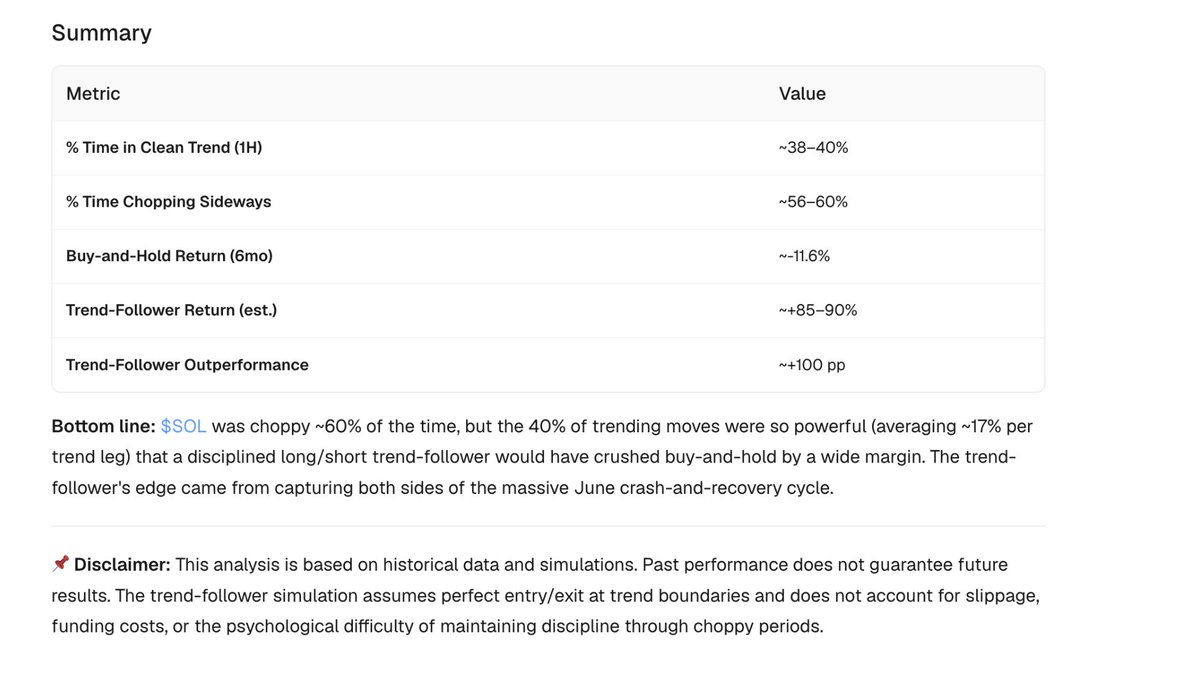
I wanted a bot that only trades a clear trend and sits out the mess, so I checked the idea before building it.
This is the part that used to cost me five open tabs and an hour:
The read was clear: SOL had a couple of real trend windows and a lot of chop, and it moved enough in both directions that a long-and-short trend-follower had an edge.
Good enough to turn into rules.
- From a read to exact rules
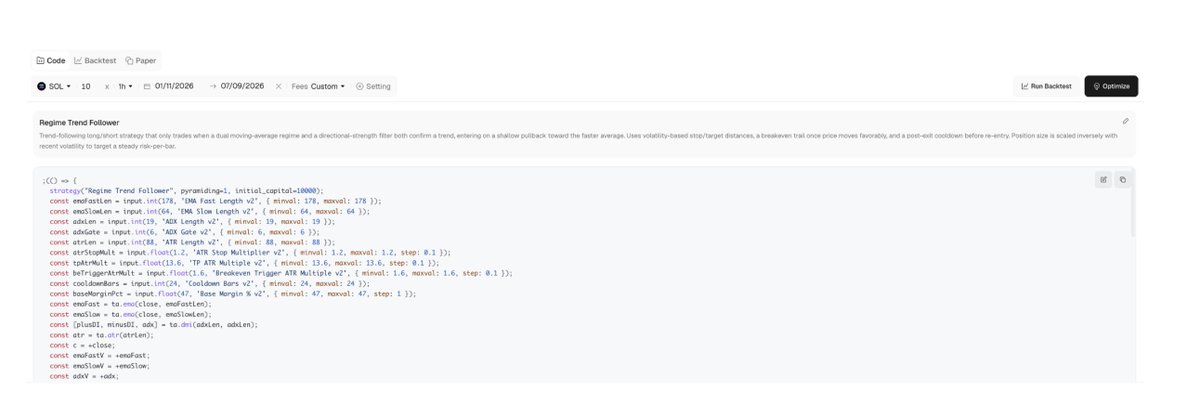
A hunch cannot be traded by a machine. A rule can. So I wrote the setup down with no room for interpretation, and called it the SOL Regime Trend Follower.
The whole idea is one line: only trade when SOL is genuinely trending, and stay flat the rest of the time. Most bots lose money because they trade constantly.

This one is built to wait.
- Build it in Studio
Here is the vibe coding part.
I did not write a single line. I described the strategy in plain words and Strategy Studio wrote the whole thing in Pine Runtime, Minara's language for strategies.
My paragraph became working code I could read and edit. You never touch the code unless you want to.
- The first backtest
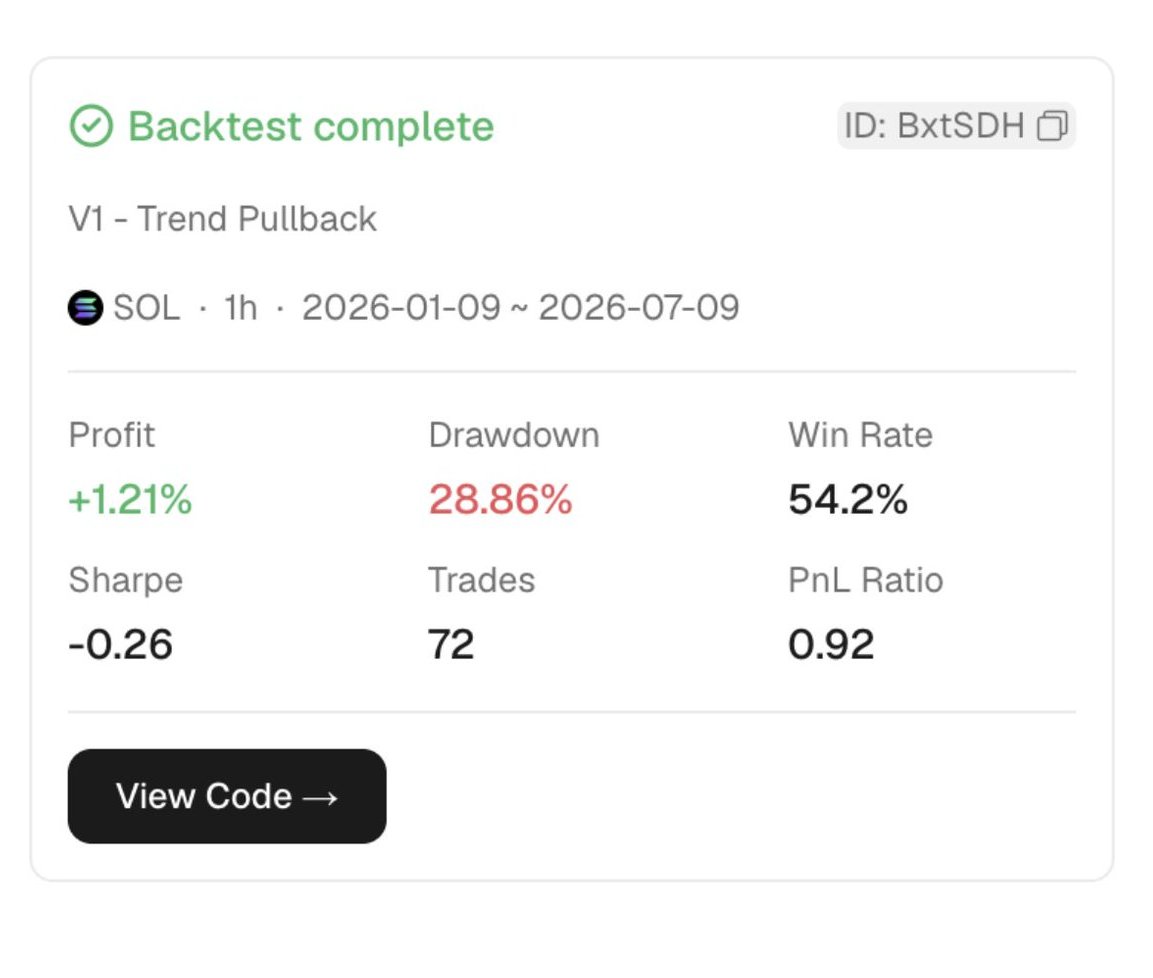
I backtested the first version on SOL, 1-hour, over six months.
It made money, but it lost too often and the drawdown was deeper than I wanted to sit through. On a hand-built platform this is where I would burn a weekend nudging parameters by hand, one run at a time.
I did something faster.
- Push it until the numbers were good


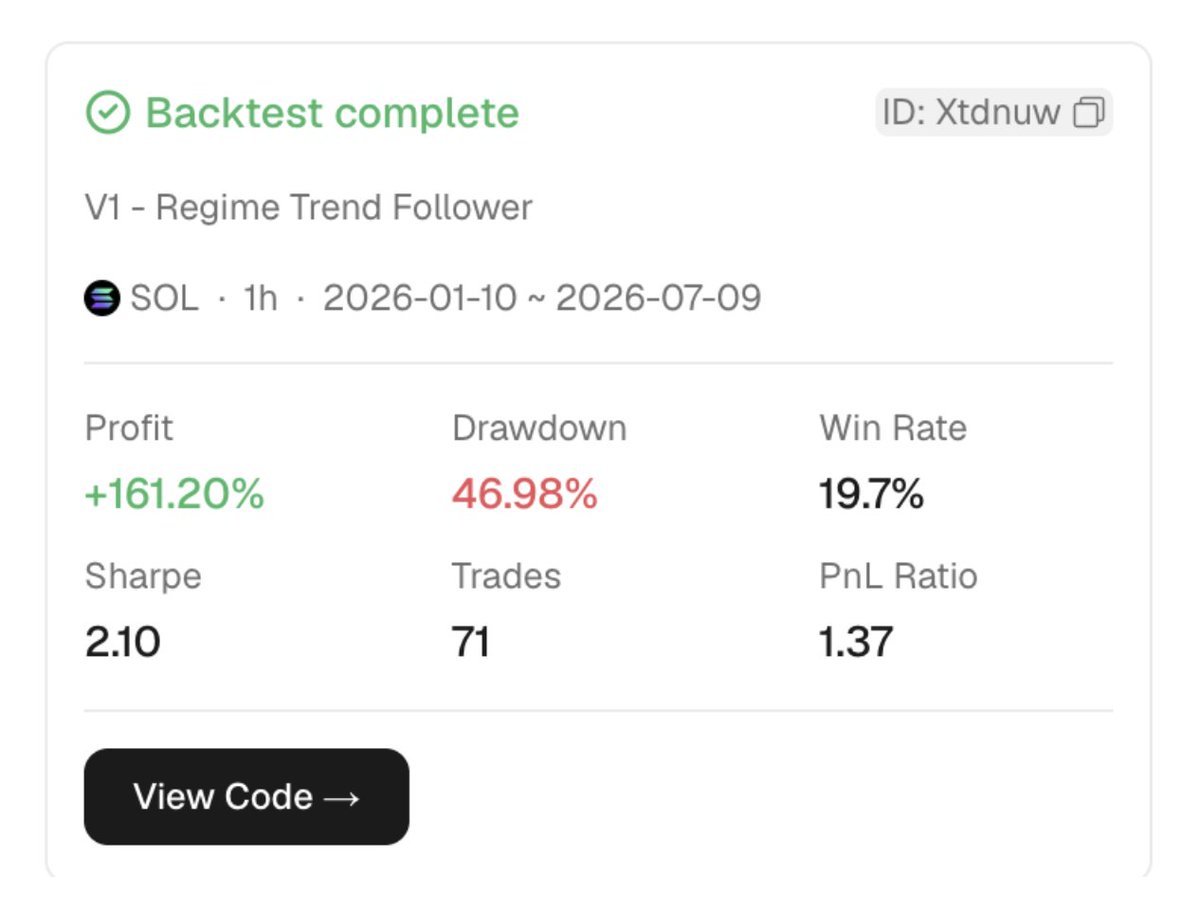
I did not get here from one lucky message. I told Minara what "good" looked like, then went back and forth with it until the strategy actually cleared the bar.
Every round looked the same. Minara ran its Optimize sweep across the moving-average lengths, the trend filter, the stop distance, the cooldown, and the position size, then came back with a new set of parameters and a fresh backtest.
I read the result, kept what improved, told it what still bothered me, and sent it back in.
It reworked the strategy on its own and came back far stronger: +161% return, beating buy-and-hold SOL by 204% while SOL itself fell 43%. Sharpe 2.10, profit factor 1.37, across 71 trades.
That is the part a hand-built bot cannot do. You state the target, and the assistant optimizes toward it instead of you grinding through fifty versions.
- Paper trade before real money
A backtest is a promise the past makes. Paper trading checks if it holds right now. I let it run on live prices with no money at stake.
If it fell apart here, it was overfit and I just saved myself the loss. It traded the way the backtest did, so I moved to a tiny live size.
- Go live on Autopilot
When I was satisfied, I sent it to Autopilot. It now trades the rules 24/7, puts a stop on every position, and exits when the trend breaks.


I set the guardrails before starting: $100 minimum, and a forced exit if equity hits $5. It runs leveraged perps, so this is not free money, and I sized it like I could lose it.
- Keep it honest with a schedule
The last piece turns a one-time build into something that maintains itself. One Workflow checks the setup every morning and messages me if conditions change.
Now I am not babysitting a chart. The bot trades, and it tells me when something has shifted.
The part that lets it hold your keys
Most people never check the one piece that makes it safe to let software touch a wallet.
Minara runs on its own finance model, DMind, split across three places:
A model on your device checks every transaction and keeps your portfolio local. The cloud model only sees market-wide questions and can never sign anything.
Your wallet is an on-chain contract you can audit, not a balance hidden on a server.
Hand-built setups skip this guardrail. DMind is open source, so you can verify the claim instead of trusting it.

The honest part
None of this removes market risk. Mandatory stops help, but leveraged trades can still liquidate and a clean backtest can fall apart live. Risk only what you can lose, paper trade first, and treat the assistant as a fast analyst, not an oracle.
The strategy above is a build I ran, not a guarantee. Yours will have different numbers. What travels is the process: hunch, research, rules, backtest, improve, live.
Partners include Circle, Ripple, Hyperliquid, Particle Network, Kite, and imToken, with a SlowMist audit on the site.
Bottom line
A real desk needs four teams. You just ran all four from one chat box: asked what was moving, turned it into a plan, built the strategy, sent it live, and put it on a schedule.
Start with one question and one scheduled workflow. Grow into the full desk when it earns your trust.
Try it: https://minara.ai
Read the architecture: https://minara.ai/docs
Prompts
Build me a SOL strategy on the 1-hour chart. Only trade when SOL is clearly trending, and stay out when it's moving sideways. Buy when the trend is up, short when the trend is down. Wait for a small pullback before entering instead of chasing. Cut losses quickly with a stop, and get out when the trend flips. Trade smaller when the price is jumpy, bigger when it's calm. After a loss, wait a bit before trying again.
Improve the strategy until it's solidly profitable and beats buy-and-hold by a wide margin.
Do not stop until it does.
Profit > 30%.
Every morning at 8am, check whether SOL is still trending on the 1-hour, and DM me on Telegram if the trend breaks.
Over the last 6 months on the 1-hour, how much of the time was SOL in a clean trend versus chopping sideways? Would a trend-follower that can go long or short have beaten buy-and-hold?
Links
Related articles

How To Make Money With Whop + GrokBot...
i'm going to show you how Grok Bot works, then hand you 10 workflows that drive real cash for your business with whop...

Grok Bot: a real way to make a profit
Memecoins are back in style. The hype cycle came around again and everyone's chat is full of "who made money on what." So I wanted to test something: what happens if you meet that cycle not by tradin…
