I Cloned a $3 Billion App With Codex. Now it's Free Forever.

I Cloned a $3 Billion App With Codex
Calendly has an estimated valuation of $3 billion. Cal.com is valued around $150 million and has raised tens of millions.
I cloned the core scheduling experience with Codex, named it SnagTime, and can run it locally for free.
The product works. The build also consumed 334 aggregate agent hours, 76 unique subagents, 32.1 billion input tokens, and roughly $15,000 in equivalent inference.
TL;DR
→ SnagTime handles live availability, booking links, paid calls, team roles, and branded workspaces
→ One large prompt sent Codex through research, planning, building, and repeated testing
→ Agent swarms found technical bugs, but I still had to fix the human experience
→ Five days of active work turned into 334 aggregate hours because agents ran in parallel
→ I avoided the equivalent API bill through my Codex subscription, but owning the software means maintaining it
What SnagTime Actually Does
The home screen shows upcoming bookings, the number of meetings booked this month, total booked hours, and every published scheduling link.

I can open a booking to see the details, reschedule it, or cancel it.
The workspace settings cover the practical stuff too: password, profile photo, workspace image, colors, description, and team invitations. Invited teammates can be members or admins.
Event types are fully customizable.
I can change the name, description, URL slug, color, location, and duration. Availability rules can include date ranges and buffers.
I can also add custom questions for someone to answer before booking. An event can be free or paid.

The public booking page carries the workspace branding instead of looking like a generic scheduler.
It is running on localhost in the video, which is why it costs me nothing to host during development. To send real links to clients, I would deploy it to a public domain through something like Vercel and connect Google, a backend database, and Stripe.
Get it here: https://github.com/nateherkai/snagtime
The Booking Flow
The availability is tied to my real Google Calendar.
When Friday had meetings in the morning and from 3:00 to 4:00, SnagTime removed those slots. When I added a new block from 1:00 to 6:00 on Monday and refreshed the booking page, those times disappeared too.
The rest of the flow works like you would expect:
1️⃣ Pick an available date and time

2️⃣ Enter contact information and answer any custom questions
3️⃣ Review the details and confirm
4️⃣ Receive the confirmation and calendar invitation
5️⃣ Reschedule or cancel when needed
Paid event types route the customer through Stripe Checkout before the meeting is confirmed. I demonstrated it with Stripe's sandbox card, but switching to production API keys turns it into a real payment flow.
The availability settings cover working days, weekends, hours, time zone, date overrides, and time off.
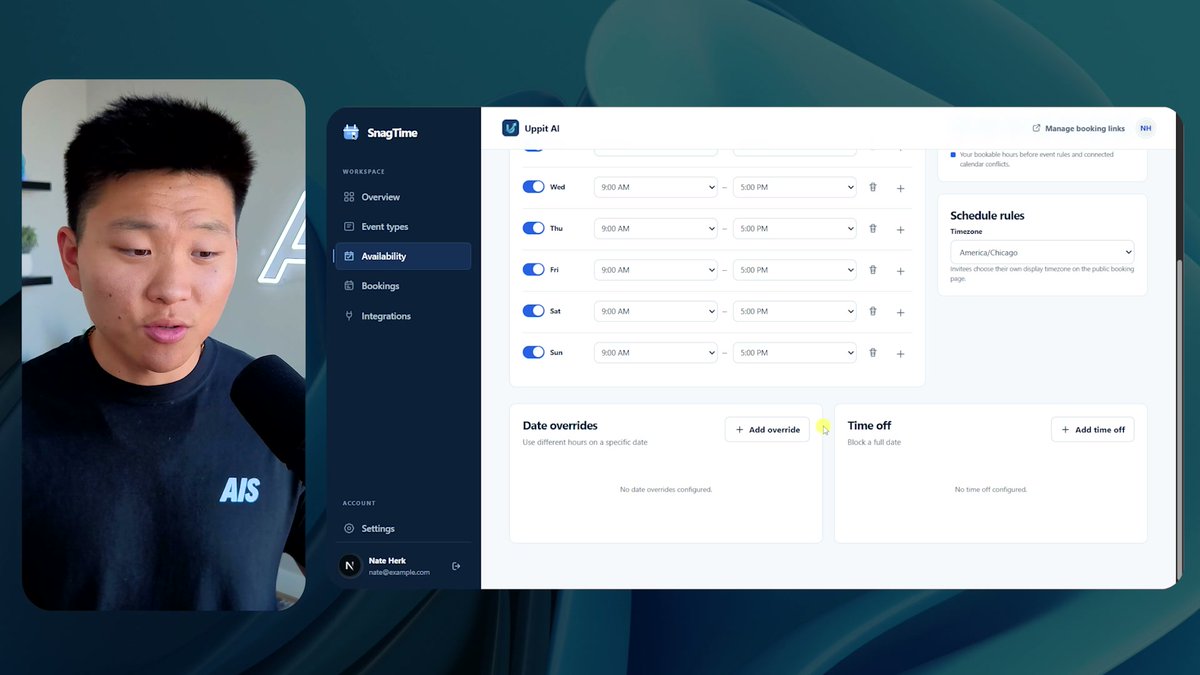
SnagTime is still missing some of Calendly's automation features. The difference is that I own the software layer, so I can ask Codex or Claude Code to add an automation or change a workflow when the pain shows up.
The Five-Prompt Build
The first instruction was a large /goal prompt that broke the project into four phases.

1️⃣ Research Calendly, Cal.com, and what customers like or dislike
2️⃣ Plan the features, architecture, database, integrations, and agent responsibilities
3️⃣ Build the application
4️⃣ Test it, fix the failures, then test it again
I did not ask for a proof of concept and stop there. I had Codex send agent swarms through the admin experience, signup, booking flow, and event creation process.
Some testing loops involved at least 50 agents trying to break the app. They would find bugs, report back, fix them, and repeat the cycle. That loop ran for days.
The first result was called TempoCove and looked extremely vibe coded, so the next rounds were rebranding and redesigning it as SnagTime.
Performance needed its own pass. Mouse movement and typing lagged badly, with some interactions feeling close to one second. I gave Codex a target closer to 10 milliseconds and sent it back through the app.
Then I moved buttons, cleaned up the interface, and reworked parts of the user experience.
What The Agents Missed
The testing agents were good at finding technical failures, but they did not always use the product like a person.
The clearest example was the booking progress bar. On the review step, I immediately tried to click the earlier stages to go back. The interface looked clickable, but the original build only let me navigate with a small arrow that barely pulled my attention.
The agents clicked through the flow over and over without flagging it.
I had even prompted them to think about the experience, but the better interaction only became obvious when I used the product myself.
That gap matters when people say a few prompts can build an entire SaaS business.
There is a big difference between software that works for one person or a small internal team and a product expected to make tens of thousands of dollars per month.
A scaled product brings inference costs, database work, bugs, support, security, and a constant stream of feature requests. Someone still has to own those decisions after the first build finishes.
The Real Cost
The project ran across roughly two calendar weeks because I would send a prompt, work on other videos, and sometimes leave it idle.
The actual active agent time was five days and five hours.
Because the agents worked in parallel, that became 334 aggregate hours of Codex running on the project.

The system created 76 unique subagents, but it appears to have reused many of them across tasks. I estimate it delegated work more than 300 times once the testing and verification swarms are included.
The token numbers were even bigger:
→ 32,103,178,736 input tokens
→ 47,364,103 output tokens
→ $14,982.96 in equivalent inference
I did not pay a $15,000 API bill.
Most of the work ran through my $200 per month Codex plan, which I completely maxed out. Based on the usage numbers shown in the app, that plan delivered roughly $14,000 of inference. Maxing the comparable $200 Claude Code plan was closer to $8,000, or about $6,000 less.
I also used roughly $150 in extra usage credits.
Is It Actually Free?
SnagTime is free for me to run locally, and it could replace a monthly scheduling subscription for a small internal team.
But the subscription cost gets replaced by ownership.
If I adopt it fully, I expect to send a few prompts every month to fix bugs, improve performance, maintain integrations, and add features. That can still be a good trade when you want control over the product and are willing to dedicate the headspace.
The useful lesson is not that Codex can turn five prompts into permanent software. It is that an agent system can get a capable builder much further into a real product than it could a year ago, while the human still owns the judgment, maintenance, and consequences.
I walk through the app, build process, and full cost breakdown in the video. Link in the first reply.
Related articles

The New $10,000 AI Product Is Not an App. It’s a Workflow Claude Can Run
Most people building with AI are still trying to make another app. They take a model everyone can already access, place it behind a cleaner interface, add billing, authentication and a dashboard, the…

10 SEO backlink Claude automations for 61k AI mentions in 3 months
Link building is trial and error.

The Guide to Dominate Local SEO (Automated with Claude)
"Here's my site: [url]. Audit my Google Business Profile setup. Find the top 3 competitors ranking locally for my main keyword, tell me which primary and secondary categories they use, and give me a…