Polymarket from A to Z: The Complete Beginner's Guide (2026)

I'm not going to teach you how to trade. I'm not a great trader, and anyone selling you a "strategy" for prediction markets probably isn't either. what I can do is make sure you understand exactly what you're clicking before you put a single dollar on the platform.
most of the money beginners lose on @Polymarket isn't lost to bad predictions. it's lost to not understanding the mechanics. so that's what this guide covers: what Polymarket is, how to set up an account, how to deposit, how shares and prices work, what the fees cost you, how markets resolve, and how to get your money back out. by the end you'll understand the platform better than 90% of the people already trading on it.
What is Polymarket?
Polymarket is the world's largest prediction market. you buy and sell shares in the outcomes of real-world events: elections, sports, crypto prices, fed decisions, whatever is happening in the world.
three things make it fundamentally different from a sportsbook, and they're worth internalizing before anything else:
1. you're trading against other people, not the house.
Polymarket is a peer-to-peer exchange. there is no bookmaker setting odds and taking the other side of your bet. every share you buy, someone else is selling. Polymarket doesn't profit when you lose. it earns small transaction fees, like a stock exchange.
2. prices are probabilities.
every market is a question with outcomes priced between $0.01 and $0.99. if "Yes" costs 30¢, the market collectively believes there's roughly a 30% chance it happens. if you buy that share and the event happens, it pays out exactly $1.00. if it doesn't, it pays $0.
3. you can exit anytime.
unlike a sportsbook bet, you don't have to wait for the event. if you bought Yes at 30¢ and news pushes it to 60¢, you can sell right there and take the profit, or cut a loss before resolution. positions are liquid as long as there's someone on the other side of the order book.
that's the entire product. everything else is detail, but the details are where beginners get hurt, so let me walk through them.
one platform, two products
before you sign up, know which Polymarket you're signing up for.
the global platform (polymarket.com): crypto-native, available in most of the world. deposits and withdrawals run on crypto rails. this is the original product and what this guide focuses on.
the US app (Polymarket US): a separate, CFTC-regulated product relaunched for the American market. while it's federally legal, state-by-state availability varies. it's currently live in 38 states (including CA, TX and FL) and explicitly restricted in 8 (including NV, OH and MA) due to local regulatory friction. worth flagging: during the initial rollout, US users are limited primarily to sports markets, with political markets restricted. funding runs on fiat rails: debit cards, ACH, Apple Pay.
if you're in the US, you'll be routed to the regulated app. everywhere else, you're on the global platform. the trading mechanics are the same idea on both: shares, prices, order books. the funding rails are different.

setting up your account
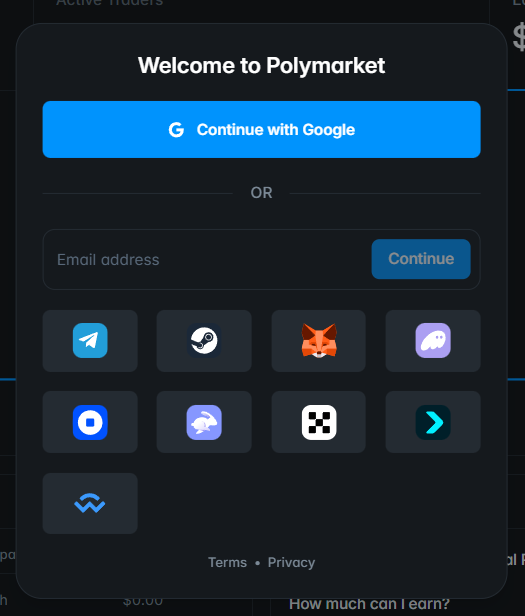
three ways in, and only one of them requires any prior crypto experience:
- Google account. one click, done. Polymarket creates a wallet for you in the background. you never touch a seed phrase.
- email. enter your email, receive a 6-digit code, you're in. same deal, wallet handled for you.
- crypto wallet. if you already use MetaMask, Rabby or Phantom, connect it and sign two messages (one to connect, one to enable trading).
 — "Polymarket Login"
if you're new to all of this, just use Google or email. the embedded wallet removes every crypto footgun in one move.
one security rule that matters more than anything else in this guide: never share your 6-digit email login code with anyone, including people claiming to be Polymarket support. real support will never ask for it. anyone who does is trying to drain your account, and lost funds from a shared code are not recoverable.
depositing: the cheap way and the fast way
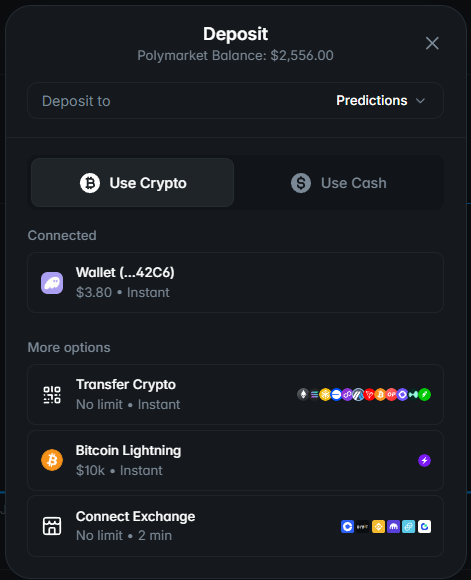
your Polymarket balance is denominated in pUSD, Polymarket's own dollar-pegged stablecoin. you don't need to think about this. whatever you deposit (USDC, USDT, ETH, BTC, SOL and a long list of other tokens) gets automatically converted to pUSD on arrival. your balance is always 1:1 with the US dollar, every market still prices in cents, and you can withdraw back to USDC or other tokens anytime.
 — "Polymarket Deposit"
two routes in:
the cheap way: deposit crypto directly.
if you have an exchange account (Kraken, Coinbase, etc.), buy USDC and send it to your Polymarket deposit address. Polymarket charges zero deposit fees. you only pay the network fee, which on Polygon is fractions of a cent. funds typically arrive within minutes.
two rules to not lose money here:
- always copy the deposit address from your own Polymarket profile and verify it before sending. never use an address from a DM, a screenshot, or anyone "helping" you.
- check the network. sending on the network shown in your deposit screen is what makes the transfer near-free and fast. sending on the wrong network is the classic way beginners get funds stuck.
the fast way: card and payment apps.
if you have no crypto and want to start in the next five minutes, the deposit screen has a cash option: credit/debit card, Apple Pay, Google Pay. it works, but the third-party payment processors charge significantly higher fees than a direct crypto transfer, typically a few percent (2-4%, depending on the payment provider) of your deposit. that's not Polymarket's fee, it's the on-ramp's.
the honest math: on a $100 card deposit you might land with roughly $96-97 tradeable. fine for trying the platform once. if you plan to deposit regularly, set up an exchange account and transfer crypto. it pays for itself immediately.
you don't need much to start. there's no meaningful minimum, and there is zero reason to fund more than you'd be comfortable losing while you learn the mechanics.
how shares work
this is the core of the platform, so let's make it concrete.
every market is a yes/no question. say the market is "Will the Fed cut rates at the September meeting?" and Yes is trading at 40¢.
- you buy 100 Yes shares. costs you $40.
- the Fed cuts: each share redeems for $1.00, so you receive $100. profit: $60.
- the Fed doesn't cut: shares redeem for $0. you lose your $40.
the same market has No shares, and here's the elegant part: Yes and No prices always sum to $1.00. if Yes is 40¢, No is 60¢. buying No at 60¢ is mathematically identical to betting against Yes. there's no "house line" on both sides like a sportsbook. it's one market, two sides.
and because it's a live market, you're never locked in. if Yes moves from 40¢ to 55¢ after a soft inflation print, you can sell at 55¢ and book the gain without waiting for the Fed at all. many active traders on Polymarket rarely hold to resolution. they trade the movement.
multi-outcome events (like "Who wins the election?" with several candidates) are just bundles of these yes/no markets, one per candidate. same mechanics.
order types: the one setting that saves you money
when you buy or sell, you have two options:
market order: executes immediately at the best available price. simple, instant, and it's what the default "Buy" button does.
limit order: you set the exact price you're willing to pay, and your order sits in the book until someone matches it. it might fill in seconds, might take hours, might never fill.
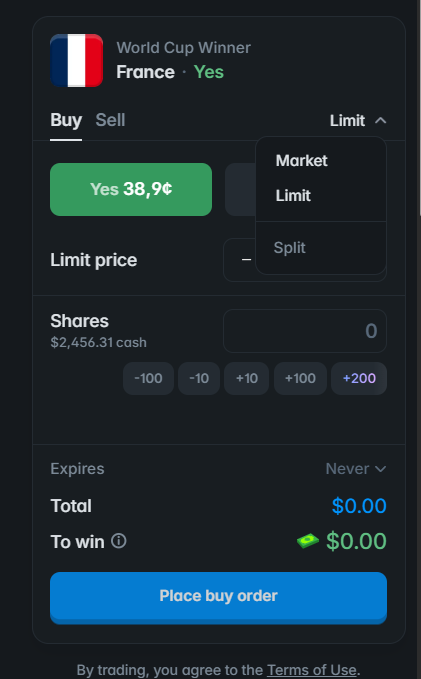
why should a beginner care? two reasons:
- fees. Polymarket charges fees on taker orders (market orders that execute instantly) but not on maker orders (limit orders that sit in the book). simply switching to limit orders removes the fee entirely on most of your trades.
- price control. in thin markets, a market order can fill at a worse price than the number you saw on screen (slippage). a limit order fills at your price or not at all.
the habit to build from day one: unless something is moving right now and you need in immediately, use a limit order at or near the current price. you'll usually get filled within moments anyway, and you'll pay nothing for it.
fees explained
Polymarket charges taker fees on most market categories, and the structure is unusual, so here it is.
the fee is dynamic. it depends on the probability of the outcome you're buying. it peaks when a market is at 50¢ (maximum uncertainty) and shrinks toward zero as prices approach 1¢ or 99¢. it's also symmetric: a trade at 30¢ costs the same fee as a trade at 70¢.
the easiest way to think about it is the fee on 100 shares, at the worst case (a market sitting exactly at 50¢):
- crypto: $1.75
- economics, culture, weather, other: $1.25
- finance, politics, tech, mentions: $1.00
- sports: $0.75
- geopolitics and world events: $0 (completely fee-free)
buy anywhere other than 50¢ and the fee drops from there. at 90¢ or 10¢, you're paying roughly a third of those numbers. tiny trades near the extremes can even round down to zero.
and to repeat the most important sentence in this section: maker orders pay no fee. limit orders are the beginner's fee-avoidance cheat code, hiding in plain sight.
the fees Polymarket does collect don't just disappear either: they fund daily rebates to market makers (which is why spreads stay tight), and there's a tiered taker rebate program where active traders earn a portion of fees back. there's still no house edge. the exchange makes money from activity, not from your losses.
beyond trading: Polymarket itself charges no deposit fees, no withdrawal fees, no account fees. the only other costs you'll ever see are blockchain network fees (negligible) and third-party on-ramp fees if you deposit by card (not negligible, see above).
read more about fees here: https://docs.polymarket.com/trading/fees
resolution: read the rules before you buy
here's the single most expensive mistake beginners make, and it has nothing to do with prediction skill: buying a market without reading its resolution criteria.
every market has a description defining exactly what counts as Yes: which source is used, what deadline applies, what edge cases mean. markets don't resolve based on vibes or what "everyone knows happened." they resolve based on the written rules, applied literally.
the pattern repeats constantly: an event sort of happens, or happens after the deadline, or happens per one source but not the official one named in the rules. traders who never read the description are shocked when the market resolves against them. they weren't wrong about the world. they were wrong about the market they actually bought.
on the global platform, disputed outcomes go through a decentralized oracle (UMA), where token holders vote on the correct resolution per the market rules. the overwhelming majority of markets resolve without drama. but the lesson stands: the description is the contract. read it before you trade, every time. thirty seconds of reading has saved more money on Polymarket than any strategy ever will.
withdrawing
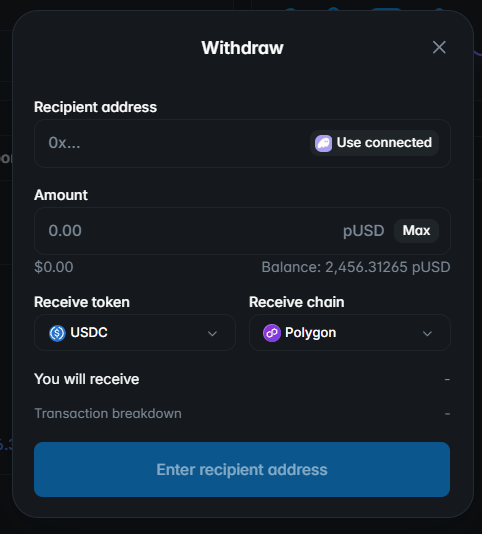
getting money out is as simple as getting it in. hit Withdraw in the Portfolio tab, choose your token (USDC is standard), paste your exchange or wallet address, confirm. Polymarket charges nothing; you pay only the small network fee. from there, an exchange like Kraken converts to your local currency and sends it to your bank.
same discipline as deposits: verify the address, verify the network. every time.
the mistakes that cost beginners money
none of these are about predicting badly. all of them are avoidable with mechanics knowledge:
- not reading resolution criteria. covered above. the #1 killer, by a wide margin.
- paying taker fees for no reason. market-ordering everything when a limit order would have filled anyway.
- wrong-network deposits. always match the network shown in your deposit screen.
- sharing the 6-digit login code. no legitimate person will ever ask for it. ever.
- trusting PnL screenshots. the screenshots that pull people into prediction markets are trivially easy to fake, and profiles showing only wins are showing you a story, not a track record. come for the markets, not because someone on the timeline turned $100 into a billion.
- market-ordering into thin books. check the order book depth before sizing into a small market, or your fill price will surprise you.
- confusing "the event happened" with "the market resolves Yes." see #1. it's on the list twice because it deserves to be.
perps: Polymarket's newest product
in April 2026, Polymarket launched something entirely separate from prediction markets: perpetual futures, or "perps." it's a different game with different rules, so before you open the tab, here's what you're actually looking at.
what perps are: leveraged contracts that track the live price of an asset (Bitcoin, Nvidia stock, gold) with no expiry date. you go long (price up) or short (price down), and you can hold the position as long as you want, 24/7. this is the same instrument that dominates crypto exchanges like Hyperliquid or Binance, Polymarket just brought it under one roof with its prediction markets. one genuinely new thing: assets like Nvidia and gold normally only trade during market hours. here, they trade around the clock.
how they differ from everything else in this guide: a prediction market share is a defined bet. you pay 30¢, you get $1 or $0, your maximum loss is what you paid, and time works for you as resolution approaches. a perp is the opposite animal on every axis:
- leverage. you can multiply your exposure. the product launched with up to 10x. with $100 of margin at 10x, you're controlling $1,000 of position. gains are multiplied, and so are losses.
- liquidation. this is the concept that doesn't exist anywhere else on Polymarket. if the price moves against you far enough, your position is automatically closed and your margin is gone. at 10x leverage, a roughly 10% adverse move wipes the position entirely. Bitcoin can move that much in a bad week. there's no "holding to resolution" and hoping, the position simply ceases to exist.
- funding. perps stay anchored to the real asset price through periodic funding payments between longs and shorts. in practice: holding a position isn't free. depending on which side is crowded, you pay or receive a small fee on a rolling basis. time can literally cost you money.
the honest truth: prediction market shares have defined risk by design. you can never lose more than you paid, and nobody can force you out of a position. perps trade that safety for flexibility and firepower. neither is "better"; they're different tools. what matters is that you understand leverage, liquidation, and funding before your first position, not after. the 10x wins you see on the timeline never come with the liquidated accounts that posted nothing.
perps are currently in early access, so you can't just open the tab and trade. you need an activation code. mine gets you in: polymarket.com/perps?c=005ju5i1
if you're brand new, my suggestion is simple: learn the event markets first, then come to perps with position sizes that don't matter while you get a feel for how leverage behaves. the section above is the minimum entry knowledge, not the full picture.
read more about perps here: https://docs.polymarket.com/perps/overview

getting started
that's the platform, A to Z. no strategy, no signals, no promises. Polymarket is one of the most interesting products in crypto and, mechanically, one of the simplest: prices are probabilities, shares pay $1 or $0, and everything in between is a live market you can enter and exit freely.
if this guide was useful and you want to try it, you can sign up through my link: poly.market/j0xnah. and if perps caught your eye, my early-access code is here: polymarket.com/perps?c=005ju5i1. both support my work at no cost to you. 💙
start small. read the rules. use limit orders. everything else, you'll learn by watching the markets move.
disclosure: I'm an official Polymarket affiliate. the links above are referral links. nothing here is financial advice. it's a manual for the machine, not a map to profits.
Related articles

Grok Bot: a real way to make a profit
Memecoins are back in style. The hype cycle came around again and everyone's chat is full of "who made money on what." So I wanted to test something: what happens if you meet that cycle not by tradin…

how memecoin insiders really make money (and how you can spot them)
a token appears, the chart starts moving almost immediately, big accounts begin posting about it, people in telegram say the community is taking over, the market cap pumps from almost nothing to mill…

Secret Prompts + Grok = Prediction Markets Edges + $16,000
I started with $1,000 I was fine losing. Over about ten weeks I ran every market through four fixed Grok prompts before placing anything, never risked more than ~15% of my bankroll on one question, a…