The Fable 5 effort dial: stop paying max rates for medium work
> Everyone is asking what to build with Fable 5 before it leaves the Claude app on July 7. Almost nobody is asking the question that decides your bill: how much thinking to buy per task.
Fable 5 runs about twice the price of Opus 4.8 per token, and it is smart enough to overthink. Left on defaults, it reasons in loops, re-checks its own work, and burns tokens on tasks a cheaper model closes in one pass. And since Claude Code now opens with Fable as the default model, most people are paying double rates for casual chats without noticing.
I know because I audited my own last 10 weeks of Claude Code. The numbers were ugly: 61% of my burn was the model re-reading context, and only 13% was actual output. My routing was broken too. One expensive model carried 72% of the cost while Haiku, the cheapest tier, got about a dollar of work in ten weeks. This guide is the fix I wrote for myself.
I covered what to build in the 7 builds guide. This is the missing half: how to run those builds without torching your weekly limit, and how to survive on the API after the 7th.
PART 1. The dial
One block to save. Effort is set per task, not per day:
LOW        chats, drafts, summaries, routine edits.
           surprisingly capable, and this already
           competes with Opus at its top settings.
MEDIUM     the workhorse. real builds, synthesis,
           analysis. default here for actual work.
HIGH       earned escalation only: debugging that
           survived two attempts, architecture calls.
XHIGH/MAX  burns the most tokens and often returns a
           WORSE answer: the model overthinks past the
           right one. reserve for one-way doors,
           plans you cannot redo.
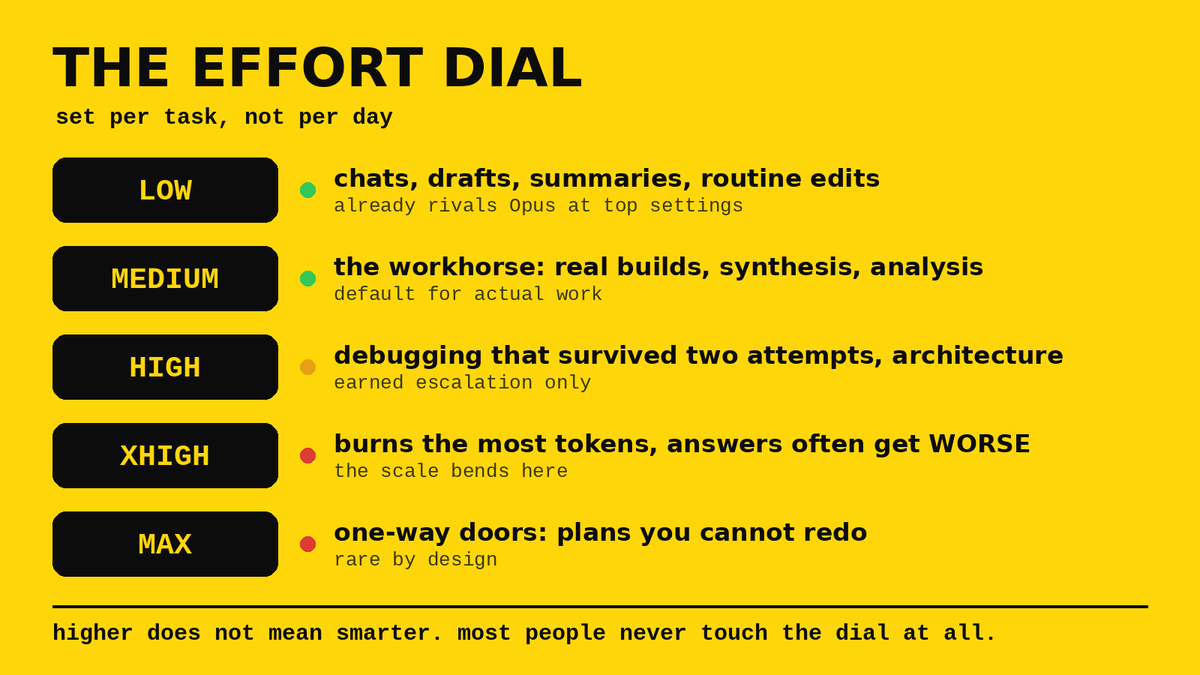 — "The whole guide in one picture. If you save one thing, save this."
Higher does not mean smarter here. The scale bends at the top. And the real leak is simpler than picking a wrong level: most people never touch the dial at all.
Bonus setting: Extended Thinking stays off by default. Turn it on for one hard problem, turn it off after. Left on permanently, you pay deep-thought rates on every typo fix.
PART 2. The routing rules
Rule 1. Medium is the default, escalation is earned
Start real work at medium, chats at low. Escalate only when the output tells you to: wrong answer twice, missed structure, shallow reasoning. Escalating on evidence costs a few retries. Running everything at max on instinct costs your whole cap, and past a point it buys worse answers.
Rule 2. Fable plans, cheap models execute, Fable reviews
The full shape of an efficient project. Builders have started calling the split 10-80-10:
- First slice: Fable at high designs the work. Architecture, success criteria, constraints, what could go wrong.
- The bulk: execution goes down the ladder. Opus 4.8 for reasoning-heavy pieces, Sonnet for standard build work, Haiku for formatting and boilerplate.
- Last slice: Fable comes back to review the finished output against its own plan. Reviewing is cheap, it reads a result instead of generating one, and this is where it catches what the cheap tier missed.
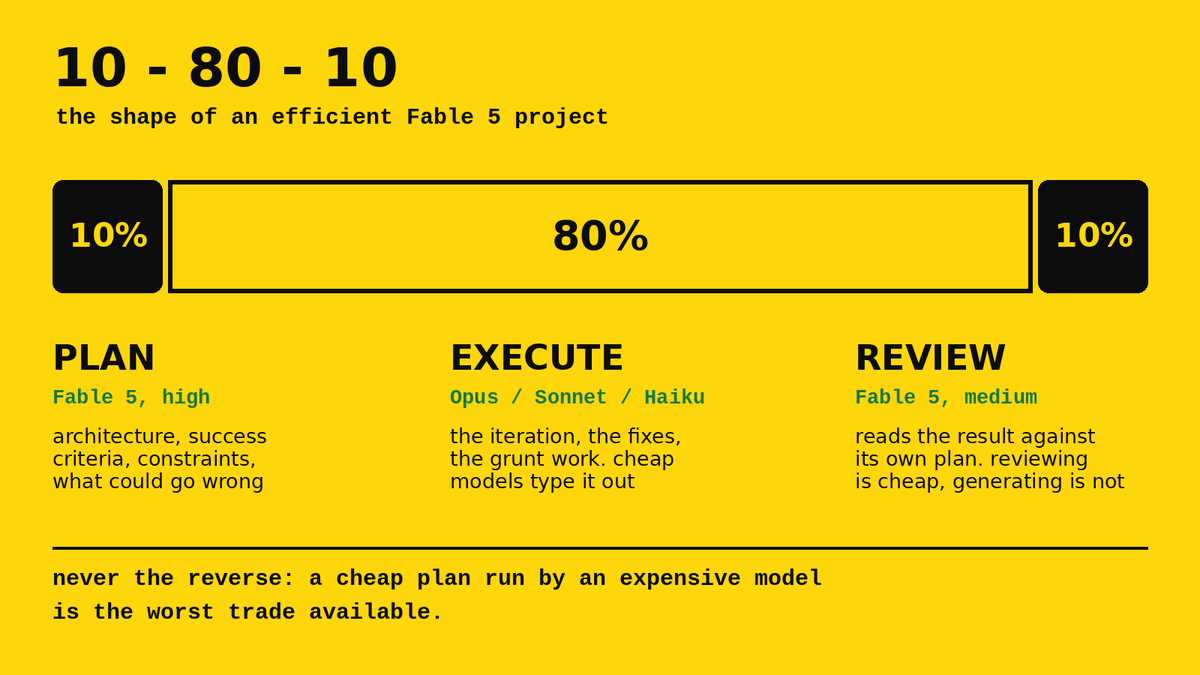 — "he expensive brain works the edges. The middle belongs to cheap models."
Never the reverse. A cheap plan executed by an expensive model is the worst trade available.
Paste-able version for your CLAUDE.md:
## Model routing
Fable 5:  plan, architect, review final output.
          never mechanical work. effort: medium,
          high for architecture only.
Opus 4.8: reasoning-heavy execution, complex debugging.
Sonnet:   standard build work, refactors, features.
Haiku:    formatting, boilerplate, grader subagents.
Rule: the expensive brain decides, the cheap hands type.
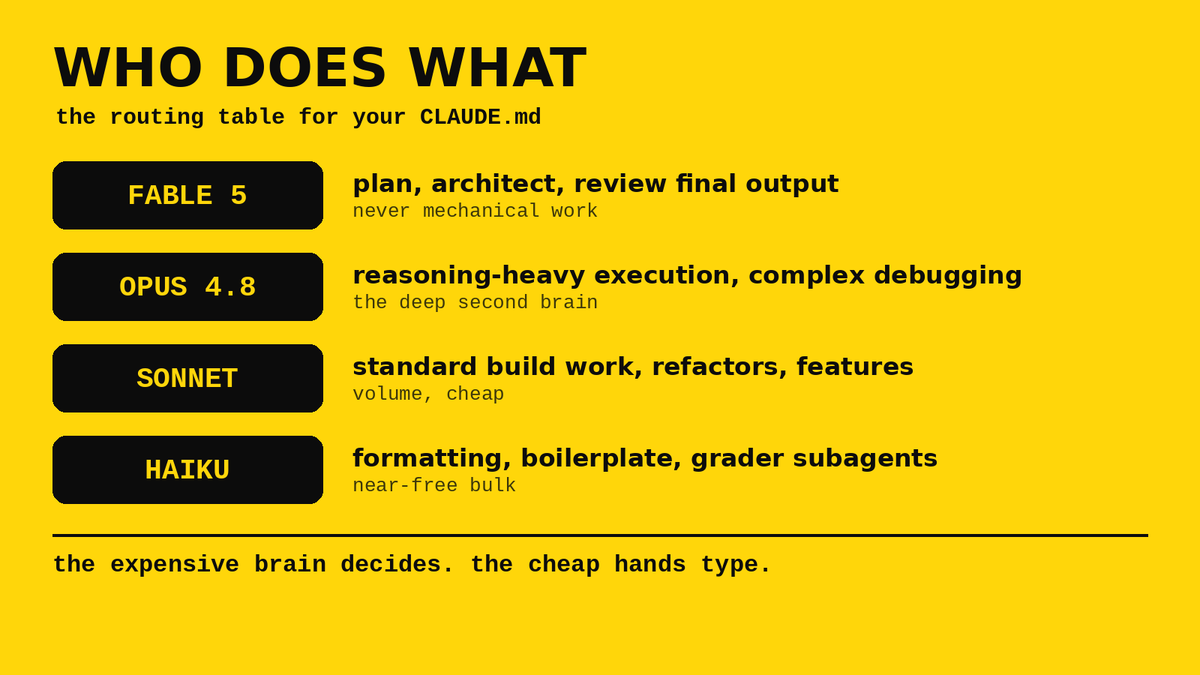 — "Same table as above, for the people who scroll. Steal either version."
Rule 3. Sub-agents inherit the dial
Spawn a sub-agent and it copies your current model and effort. Fan out ten workers while sitting at high, and you pay high ten times. Set the dial down before you spawn, not after.
Rule 4. Different models catch different bugs
For reviews that matter, one judge is not enough. Have Fable do the review, then hand the same material to a rival model as an adversarial check. Practical version: paste the finished diff or report into Codex or GPT with the same checklist and one instruction, attack it, do not summarize it. Cross-model judging catches what any single family misses.
Rule 5. Context is money
Every message re-sends the conversation tail, so a long session quietly multiplies the price of each next reply. From my own audit: five marathon sessions were holding 330 to 528K tokens of context on every single call, and those five sessions alone were two thirds of my entire cache bill. I had used /clear zero times in ten weeks. /compact, four times.
Two fixes:
- Finished a task: /compact, or open a fresh window.
- Need to continue elsewhere: ask for a handoff first. "Write a prompt under 500 tokens that restarts this session in a new chat: decisions made, current state, next steps, constraints." Paste it into the fresh window and continue at a fraction of the cost.
And feed it whole problems in one message: full context plus the why behind the task. Fewer correction rounds is where the real savings hide, because every correction re-bills the whole conversation.
PART 3. The API survival kit (July 7 and after)
Four habits before the switch:
- Check the model selector at the start of every session. Fable is the default now, and "accidentally ran Fable on a casual chat" is the most common leak.
- Set a hard spending cap the day you add a card: Settings, Usage, Adjust Limit. Autonomous runs bill while you sleep, and stories of three-digit invoices from a single overnight run are already circulating.
- Run /usage regularly until you know your burn rate by feel.
- Keep the routing table in CLAUDE.md so the discipline survives the pricing change.
What one build actually costs
Fresh measurement, so you can plan the week. I ran the session-audit build from the 7 builds guide on Fable at medium effort. It spawned 4 parallel subagents, pushed one session from 47% to 90%, and took 9 points off my weekly Fable cap. So: a real build on medium is roughly a tenth of the weekly Fable budget, and one session slot. Plan two heavy builds a day at most, and the math holds.
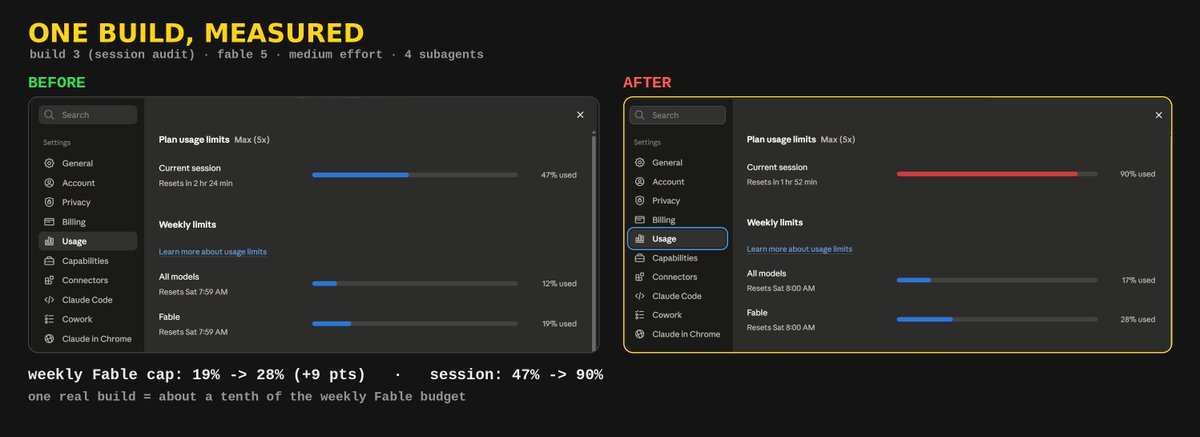 — "Not a benchmark, my actual Usage screen. One audit build on medium: 9 points of the weekly Fable cap."
Honest limits
The dial defaults above are working settings you should tune, and content type matters: code review punishes low effort harder than drafting does. The cost comparisons in circulation, including "Fable low beats Opus high", come from creator-run benchmarks rather than Anthropic. Directionally consistent across sources, but treat exact percentages as marketing until you see your own bill.
The one-line version
> Buy expensive thinking for decisions, cheap thinking for repetition, bring the expensive brain back to check the result, and look at the dial before every run.
What to point it all at is in the 7 builds guide. Save this one next to it, they are halves of the same system.
> Follow for the daily breakdowns. And reply with where you keep the dial by default, I am curious what people actually run.
Related articles


How to Build an AI-Native Company: Hiring, Standards, and Cadence
*We spent a year running hackathons, AI trainings, and office hours. But nothing changed until we made AI capability a requirement.*