The 8-Step TikTok Research System Behind Winning Slideshows

People keep saying, "do research before you post."
Almost nobody gives you an actual playbook for doing it.
So people save 40 posts.
They call it research.
Then make another random slideshow.
The goal is not more ideas.
It is finding formats that already WON.
Give yourself one free hour to find proof before you make anything.
> Don't copy a post. > > Copy the reason it worked.
Good research gives you a repeatable content machine.
It tells you what niche to enter.
It tells you which formats deserve another ten attempts.
It also tells you what to ignore.
I learned this by rebuilding formats that had already proven themselves.
The first one came from another country.
I rebuilt the mechanics for a local audience and a product that fit it.
That research turned into a product people actually paid for.
Not because the post was copied.
Because the reason people cared was understood first.
 — "The search result is not the idea. It is the entrance to the account behind it."
1. Start with a market, not your product
Don't search your exact product name first.
That usually gives you nothing useful.
Your exact category is usually too narrow.
Search the world your customer already cares about.
If you sell a sleep app, search sleep routines.
If you sell a color analysis product, search outfits, hair, makeup, and style.
If you sell a fitness product, search transformations, meal ideas, and gym mistakes.
Your product is the payoff. The niche is the distribution.
This matters because people don't open TikTok looking for your app.
They open it looking for a better version of themselves.
> Find the problem people already scroll for. > > Put your product behind the answer.
Write down one broad niche first.
Then split it into smaller corners.
For style, that could be hair color, body type, outfit mistakes, seasonal color analysis, celebrity looks, or makeup shades.
Each corner gives you different winners.
Each winner teaches you a different format.
The best niches have volume and emotion.
People need to care enough to save it.
They need to care enough to send it.
They need to care enough to comment, "which one am I?"
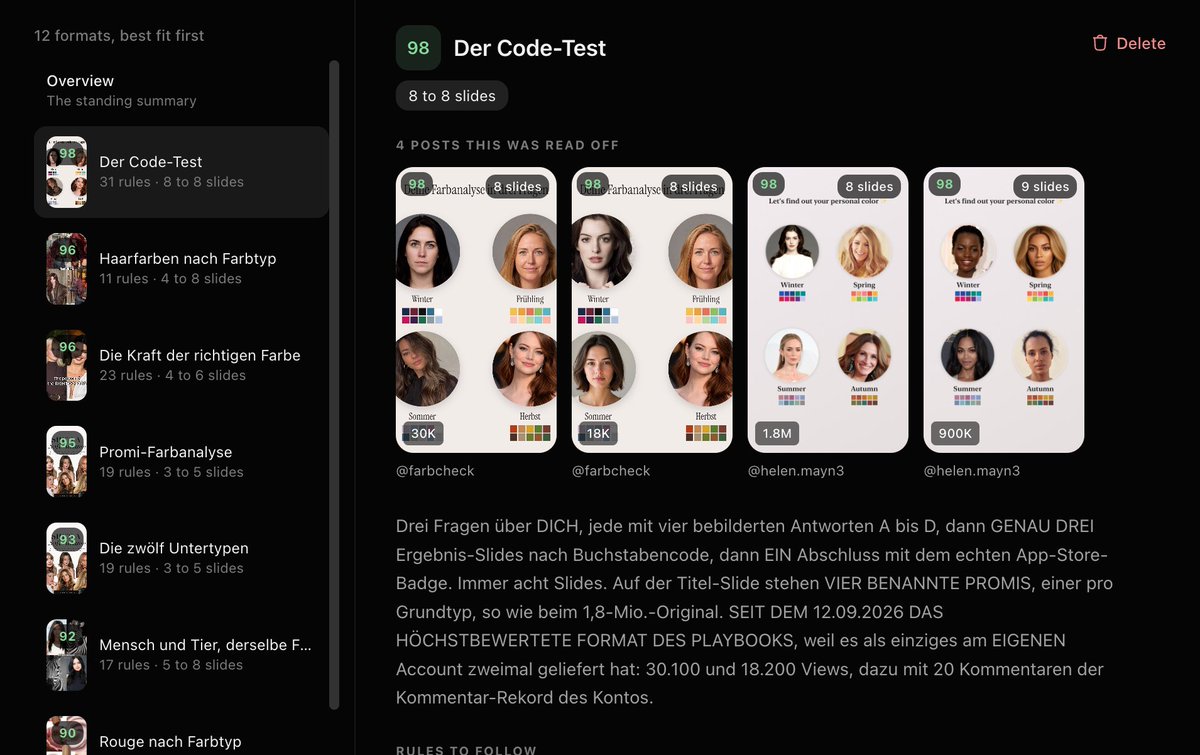 — "Broad niches find volume. Specific sub-niches uncover formats you can actually own."
2. Search like a person, not a marketer
Most keyword lists are way too polished.
TikTok isn't Google Ads.
People type short, obvious phrases.
They search the problem.
They search the desired outcome.
They search the thing they want to buy.
Search every intent, not ten versions of the same phrase.
For one niche, I like four angles.
Problem: "why does this look bad on me"
Outcome: "best colors for brunette"
Comparison: "before and after color analysis"
Identity: "soft summer outfits"
> One niche can hide ten content worlds. > > Your searches are how you find them.
Start broad enough to find active accounts.
Then get painfully specific.
"Makeup" is broad.
"Blush for soft summer" is where the useful stuff starts.
Don't worry if the best examples are in another country.
That can be an advantage.
You are not stealing their audience.
You are finding a proven angle before your own market is saturated.
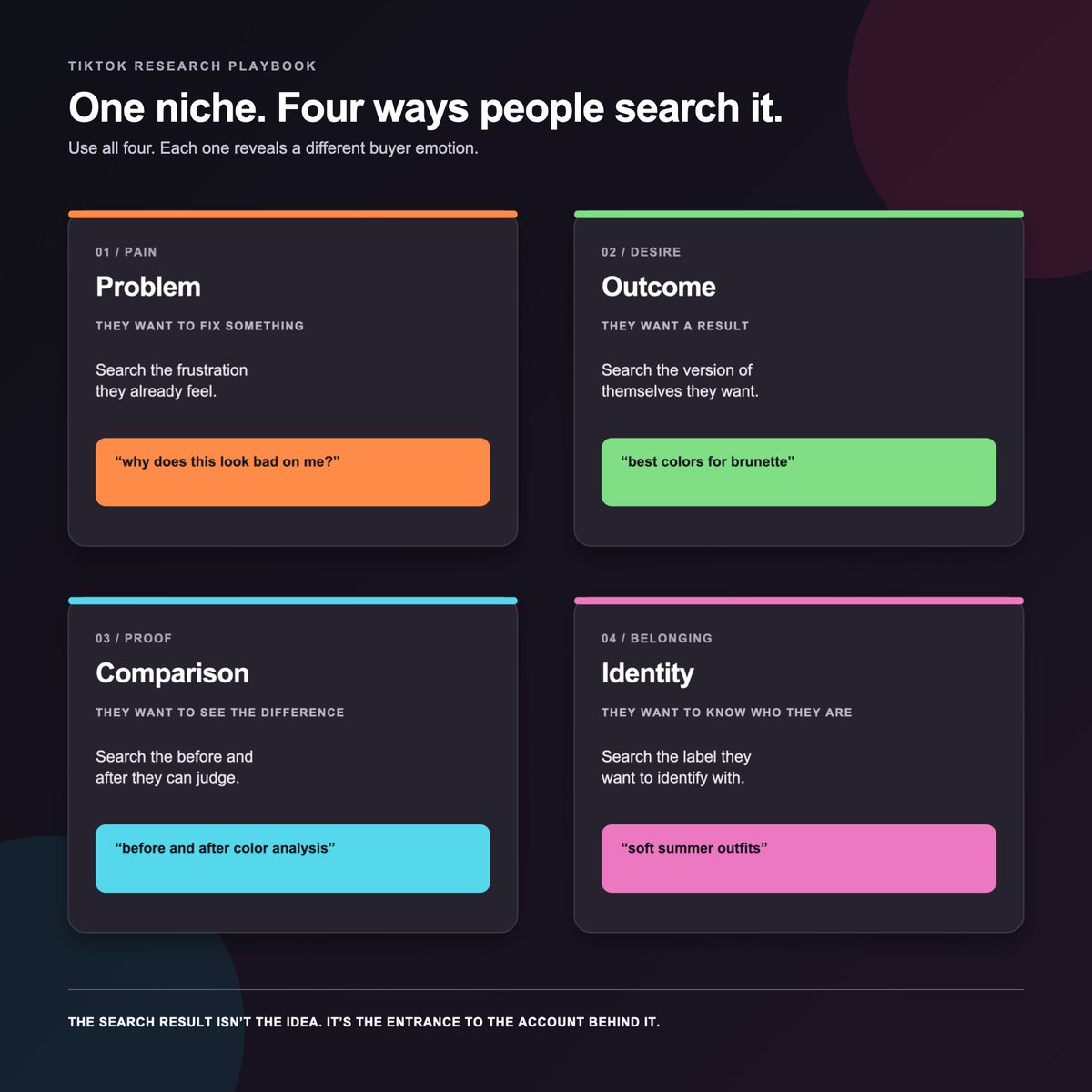 — "Different searches reveal different buyer emotions, even inside the same niche."
3. Find accounts, not one viral post
A viral post is interesting.
An account with five similar winners is a blueprint.
That is the difference.
When you find a good slideshow, click the profile.
Then ask four questions.
Does this account post slideshows consistently?
Do several posts beat their follower count?
Do the same ideas work more than once?
Are they still posting now?
A small account with repeat winners is usually more useful than a famous account.
Big accounts can win because they are big.
Small accounts need the post to do the work.
> Views above follower count are the first thing I look for. > > It means the format travelled past their own audience.
Also look at the spread.
One post at one million views can be luck.
Five posts between 100k and 300k are a system.
Save the account when it has proof.
Don't save it because the cover looked nice.
Your research library should be full of operators, not inspiration.
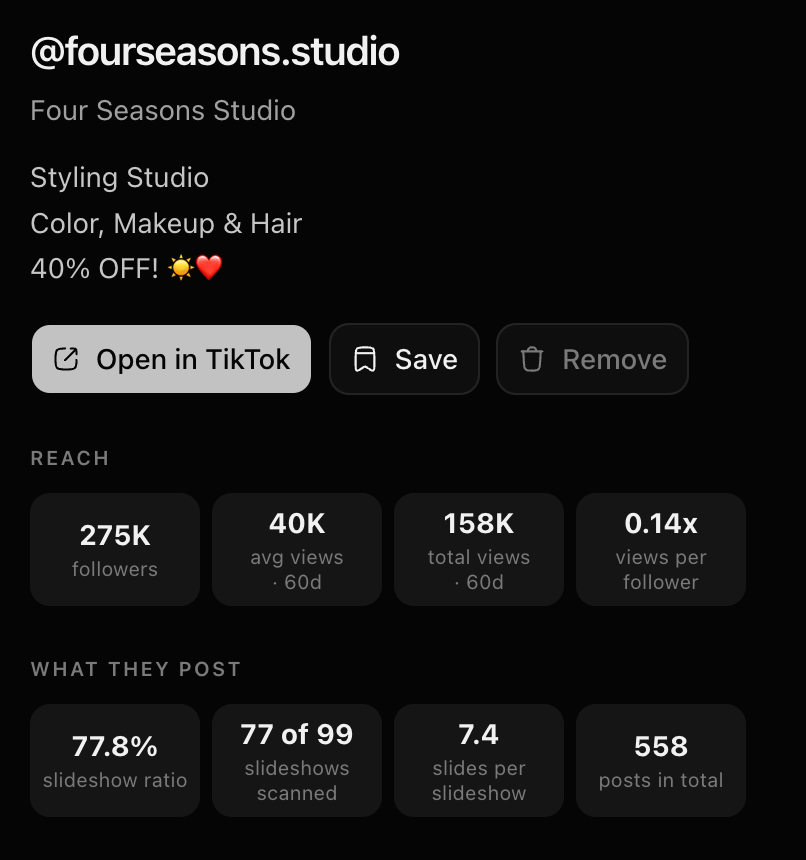 — "One huge post can be luck. Repeated reach is a format worth rebuilding. This account for example has 275k followers but generally isnt an account I would copy from"
4. Turn winners into formats
This is where most people stop too early.
They save the post.
They try to make something similar once.
Then they move on.
Instead, break every winner into parts.
What is the first-slide promise?
What does each slide prove?
Where does the visual change?
What makes someone save it?
What question makes them comment?
The topic is often replaceable. The structure is the asset.
> The format scorecard > > Hook: what makes slide one impossible to skip? > > Proof: what makes the promise believable? > > Visual switch: what changes as people swipe? > > Save trigger: what will they want later? > > Comment trigger: what can anyone answer instantly?
"The power of the right colors" is a topic.
Wrong color versus right color on the same person is a format.
"Which one suits you?" is a topic.
Two clear options, then a reveal, is a format.
> A format is a promise you can make again. > > A post is only one delivery of that promise.
Write the format down in one sentence.
Then list five ways it could change without breaking.
Different person.
Different item.
Different sub-niche.
Different gender.
Different buyer question.
That gives you a real series.
Not a lucky remake.
 — "The useful unit is the pattern behind the post, not the post itself."
5. Look for the pattern inside the format
Formats can still fail.
The details decide whether they land.
Look across the best three to ten posts.
Don't only study the biggest one.
Study what repeats.
The repeated details are usually doing more work than the idea.
Maybe every winner uses seven slides.
Maybe the first slide has almost no text.
Maybe every post shows the same person twice.
Maybe the comment prompt asks about a shirt, not a technical label.
Maybe the product appears late.
> If it repeats across winners, treat it like a rule. > > If it appears once, treat it like a guess.
I look for four pattern types.
Hook patterns: what makes the first slide impossible to skip.
Visual patterns: what changes from slide to slide.
Proof patterns: what makes the claim believable.
Interaction patterns: what people can answer without needing context.
That last one is underrated.
Questions only experts can answer get ignored.
Questions about something everyone owns get replies.
"Which shirt do you wear most?" beats "which subtype are you?"
 — "The details that repeat across winners are the rules. Everything else is decoration."
6. Rebuild the mechanism for your market
You do not need to invent the wheel.
You need to rebuild a wheel that already rolls.
Take a winning format from another market.
Keep the emotional promise.
Keep the visual logic.
Then swap the subject, language, references, and payoff for your own audience.
Don't translate every word blindly.
Translate the desire.
The viewer should feel like the post was made for them.
A proven comparison format can become outfits.
It can become skincare.
It can become gym form.
It can become finance, food, language learning, or travel.
The underlying move is still the same.
Show a choice.
Make the difference visible.
Give the reader a reason to save the answer.
> Rebuild the mechanics. > > Never copy someone else's identity.
This is also how you avoid becoming a clone account.
Your inputs can be borrowed.
Your execution needs to become local.
Your people.
Your references.
Your product.
Your comments.
That is how a format starts feeling native.
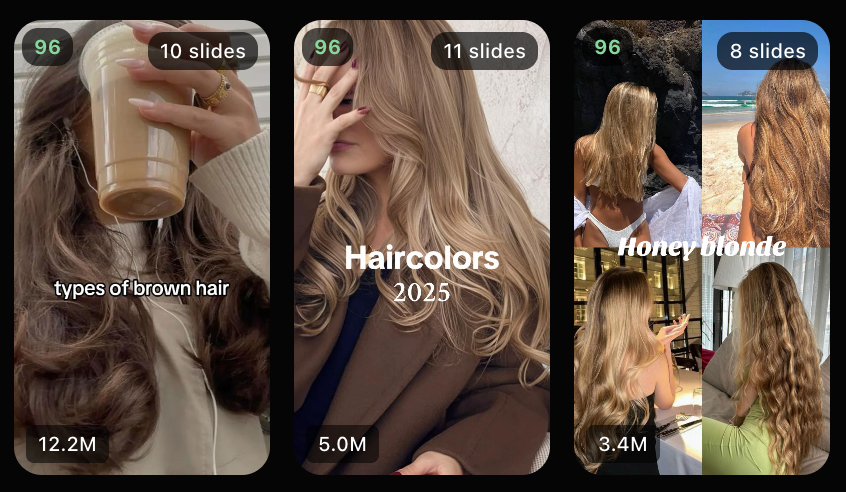 — "The structure can travel. The references need to feel local."
7. Let Claude run the first pass
The hard part is not watching TikTok.
It is staying objective while you watch it.
You start seeing a beautiful cover and convincing yourself it is strategy.
Claude is useful because it can do the boring part.
Give it a real browser and make it research like a person would.
With Playwright, it can search TikTok while you do something else.
It can open profiles.
It can collect the posts.
It can compare views, cadence, hooks, captions, and slide counts.
Then it can tell you which accounts have repeatable proof.
> Don't ask Claude for "content ideas." > > Ask it to find evidence first.
The prompt is simple.
> Find 10 slideshow accounts in this niche.
> Show me which ones consistently outperform their follower count.
> Group their winning posts by format.
> Tell me what repeats across each format.
> Give me 5 localized versions I could build.
That is enough.
No complicated setup.
No technical rabbit hole.
Just turn research into a decision you can use.
 — "The goal is not more saved posts. It is one clear decision about what to build next."
8. The part most people miss
Once a format works twice, don't get bored.
Most founders get one good post.
Then they chase the next clever thing.
That is backwards.
When a format clears twice, it earned more attempts.
Make ten better versions.
Change one variable at a time.
Try a different hook.
Try a different person.
Try a different item.
Try a different angle.
Keep the structure until the data tells you it is dead.
> You don't need more formats. > > You need more shots on the formats that already work.
I have made the most progress by doing less random posting.
The research came first.
Then the rebuild.
Then the repetition.
That is the whole game.
This article gives you the playbook.
But if you want the full system I built around my own personal strategy, keep reading.
That is exactly why I built Scrollmine**.**
It is my ENTIRE CUSTOM system turned into one tool.
Find the right accounts.
Break down the winning formats.
See what repeats.
Turn the research into posts.
Automate the hard part of getting them out.
This is EXACTLY what I used to get my newest projects from zero audience to a lot of traction in a matter of days.
Not because I found some magical hook.
Because I stopped guessing and built a system around what was already proving itself.
The goal is not more content. It is less guessing.
I originally made it for myself, so I could run this whole workflow without manually living inside TikTok all day.
I was not planning to release it yet.
But I am opening this to a small group.
I'm keeping this early group small, and the early-access closes soon.
I want to focus on making it great for the people inside.
Want to use the exact system before I close access again?
You can sign up here: https://scrollmine.com/go/slideshows
(btw this is also the tool you saw in the screenshots of this article)
TL;DR
- Start with the broad world your customer already scrolls, not your product name.
- Search problem, outcome, comparison, and identity phrases inside every niche.
- Study accounts with repeat winners, especially smaller ones beating their follower count.
- Save formats, not isolated posts. Write down the hook, proof, visual change, and comment trigger.
- Treat repeated details as rules. One-off details are guesses.
- Localize the mechanism for your market without copying someone's identity.
- Use Claude with Playwright to collect evidence, then make it turn patterns into ideas.
- When a format wins twice, make ten better versions before hunting for another one.
Related articles

How I Semi-Automated 650k+ Views on Instagram In 30 Days With Fable 5
I made an entirely new Instagram and TikTok account last month and ran them both up to 650,000+ impressions in less than 30 days. I did this with a really unique combination of clipping, Fable 5, Pos…

The Language Arbitrage: Dubbing Viral Videos Into Markets Nobody Else Has Touched
Translate and dub this video into Brazilian Portuguese.

$31,211/month selling testosterone to Clavicular's fans. 6 Claude prompts replaced a $5K/month team
4%, generate 3 variants of that hook and add to queue.