There Are Only 4 Numbers That Run Your Financial Life.

You looked at your balance this morning. That is not one of them.
Let me ruin a few things you believe about money.
The emergency fund you keep meaning to build is one of the four, filed under a name that hides what it actually buys you. The budgeting app you downloaded in January and gave up on in March was sorting your spending into categories, which is roughly like counting your steps and calling it a training plan. And the salary you fought so hard for last year does not decide how long you work. Something else decides that. You have never worked it out.
Your whole financial position comes down to four divisions.
Not a spreadsheet. Not twelve metrics on a dashboard. Four numbers, each one a single division you could do on your phone while the coffee is being made.
Nobody handed them to you, and the reason is not a conspiracy. A number you can compute is a number you can argue with. A number you cannot compute turns into a feeling, and it is much easier to sell things to a feeling.

Here they are. Pay attention to the ones you have never run even once.
NUMBER 1: SAVINGS RATE
The share of your income you keep. It decides how long you work, and almost nobody has ever calculated it.
> savings rate = (income - spending) / income
Take last month. $6,000 came in, $5,400 went out. The gap is $600, divide it by the $6,000 that came in, and your savings rate is 10%.
Now leave that percentage running for a working life and watch what it does.
Two people both earn $6,000 a month. One spends $5,400. The other spends $4,200. Same income, same city, same job title if you like. Their clocks differ by twenty three years.
The reason the gap gets that wide is that a savings rate pulls on both ends at once. More goes into the pile every month, and the pile you are aiming at gets smaller, because what you need is a multiple of what you spend. Nearly every other move in personal finance pulls one end only.
At a 5% real return, targeting 25 times annual spending, starting from zero:
Save 10%, work 51 years. Save 20%, work 37. Save 30%, work 28. Save 40%, work 22. Save 50%, work 17.
Do not scan for your own row. Read them against each other. Going from 10% to 20% hands you back fourteen years. Going from 40% to 50% hands back five. The cheapest years to buy are the first ones, and the first ones are the ones everybody skips.
For scale, the number nobody quotes. The US personal saving rate was 2.7% of disposable income in June 2026, down from 4.4% in January of the same year (Bureau of Economic Analysis, released 30 July 2026). That is the national average, not a statistic about people in trouble. Run 2.7% through the same math and the answer is 78 years, which is why there is no row for it on the table above.
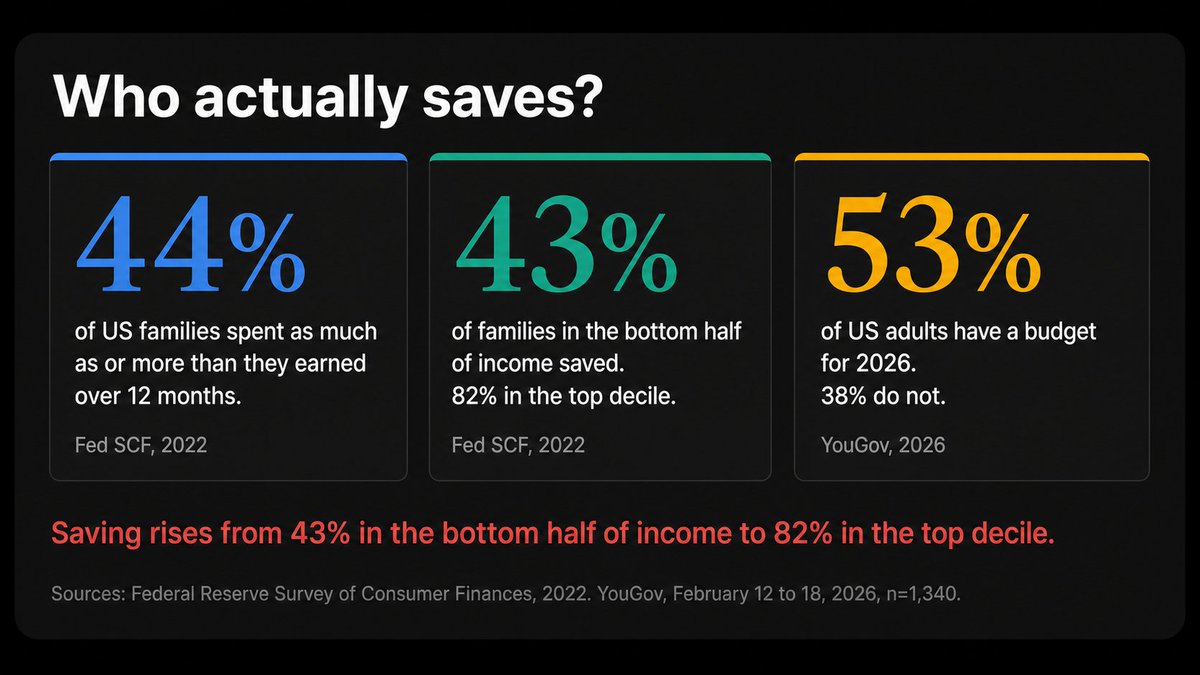
Now the honest part, because that table gets used as a weapon.
If your income barely covers rent and food, your savings rate is not a character flaw, and no amount of discipline will fix it. At that level the only lever that moves is income. Anyone telling you otherwise is selling a course. The arithmetic is identical for everyone. What it costs you personally to move the number is not.
One more caveat. The 5% is an assumption, not a promise. Change it and every line above shifts. The shape of the curve stays exactly where it is.
Tonight: open last month's statement, total both columns, divide the gap by the money that came in. Write the percentage on paper. Change nothing, cancel nothing, build no budget. Just stop guessing at the one figure that sets the length of your working life.
NUMBER 2: REAL HOURLY RATE
What an hour of your time actually sells for. It runs about a third below the number in your head, and every decision you make about buying time back is priced off the wrong one.
> real hourly rate = (take-home pay - what the job costs you) / every hour the job takes
Most people get their number by dividing salary by 2,000. That division is wrong at the top and wrong at the bottom. Tax and job costs come out of the top. And 2,000 hours is a number from a contract, not from your life. The average American worker actually logs 1,796 paid hours a year (OECD, 2024). The hours the job takes from you run in the other direction entirely.
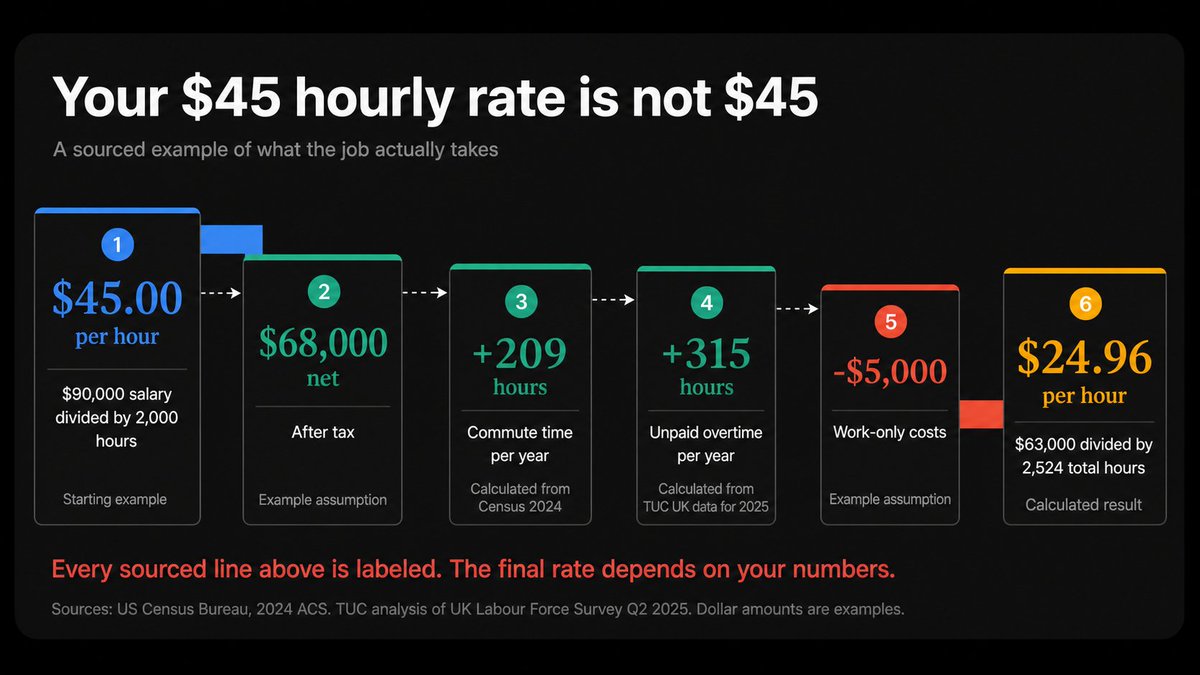
Run it properly.
$90,000 gross, call it $68,000 after tax. The hours: 2,000 on the clock, 250 in traffic at an hour a day, 150 of unpaid overtime, another 100 of evening email and Sunday preparation. Total 2,500. Then the costs that exist only because this job exists: $3,000 getting there, $1,500 on lunches you would never buy at home, $500 on clothes you would not otherwise own.
Those hours are not invented for the example. The average one way commute in the US ran 27.2 minutes in 2024, which works out at 209 to 236 hours a year depending on how much leave you take (Census Bureau, American Community Survey). Among workers who do unpaid overtime, the average is 6.8 hours a week, roughly 315 hours a year (TUC analysis of ONS Labour Force Survey, published February 2026, UK data). And Microsoft's own telemetry counts more than 50 messages per employee per day sent or received outside core hours.
$63,000 divided by 2,500 hours is $25.20.
The number in your head was $45.
That gap has been making decisions for you for years. A task will take you three hours, and someone will do it for $60. At $45 an hour, paying feels smart. At $25.20 you are spending $60 to save $75 of your own time, which is close enough that the real question is whether you hate the task. Turn it around and the rule is clean: if the price is under your real rate times the hours it saves, that is arithmetic, not indulgence.
It reprices job offers too, and this is where it stings. An offer paying 15% more that adds an hour of commuting in each direction adds 500 hours to your year. Run both jobs through the same division before you decide which one pays better. Sometimes the raise survives it. Sometimes you bought a worse deal with a better headline.
The honest part: this number is not a verdict on your worth. It is a price for one kind of trade, and it moves. Kill the commute and it rises. Cut the unpaid hours and it rises. Get scarcer at what you do and it rises a lot. Almost nobody watches it move, because almost nobody ever computed the starting point.
Tonight: write down every hour this job took you this week, including the unpaid ones. Subtract the costs that exist only because of the job. Divide. Then think of the last thing you refused to pay someone else to do, and check whether you were right.
NUMBER 3: RUNWAY
How many months you last with no income arriving. Not a safety cushion. A list of the moves currently available to you.
> runway = liquid savings / monthly spending
Answer in months, and count only money you could spend this week without selling anything, breaking anything, or asking anyone.
Most people file this under emergency fund and stop thinking about it. That name is exactly why the number stays small. It sounds like insurance against a disaster that probably will not arrive, so it competes with things you want now, and it loses.
Read it as your list of options instead.
Under one month of runway, your decisions get made for you. You take the bad client. You stay in the job. You accept the terms as written, because you cannot afford the week it would take to argue.
At three months, you can leave before the next job exists.
At six months, you can take a pay cut for a path that pays more later.
At twelve months, you can start something and give it long enough to actually work.

Two numbers to hold against that list. The median unemployment spell in the US ran 10.5 weeks in July 2026, and the average ran 24.9 weeks (Bureau of Labor Statistics). Meanwhile 45% of US adults do not have three months of expenses set aside, and 30% could not cover three months by any means at all, including borrowing and selling things (Federal Reserve, Economic Well-Being of U.S. Households, published May 2026).
So three months is not an ambitious target. It is roughly what the median job search actually costs.
Same career move, one month of runway or twelve. Reckless in the first case, reasonable in the second. The move never changed. The number behind you did.
The honest part connects straight to the next section. Runway sits in cash, and cash loses to inflation every year you hold it. That loss is real and you should know its size. It is also what the option costs, and the option is usually worth more than the loss. Just do not file a large cash pile under investments. You made a purchase, and what you bought is the ability to say no.
Tonight: add up what you could actually reach this week, divide by last month's spending. Then name the single move you would make if that answer were twelve.
NUMBER 4: REAL RETURN
What your money did after inflation took its cut. The only version of return that describes anything real.
> real return = (1 + return) / (1 + inflation) - 1
At normal rates you can just subtract and be close enough. US inflation ran 3.4% in the year to July 2026 (Bureau of Labor Statistics), so an account paying 4% is earning you about 0.6%.
Now run the account most people actually have. The FDIC national average savings rate is 0.38%. Against 3.4% inflation that is negative 2.92% a year. At Chase, standard savings pays 0.01%, which comes out at negative 3.29%. Leave $10,000 there for a decade and the statement will still say $10,000. It will buy what $7,157 buys today.

The best nationally available online savings accounts pay around 4.10% right now, which after inflation is plus 0.68%. Same money, same deposit insurance, same access. The gap between those two accounts is the entire decision, and 43% of savings account holders do not know which side of it they are sitting on (Talker Research for LendingClub, surveyed October 2025).
No statement will ever print that line. The balance is accurate. The number of grocery runs it converts into is not.
This is why "safe" is the most expensive word in personal finance. Money left uninvested carries a rate. The rate is negative. It gets charged every year whether you look or not, and it never shows up as a transaction you could point at.
Zoom out and the picture holds. Over 126 years, cash has returned 0.5% a year above inflation, government bonds 1.6%, and equities 6.6% (UBS Global Investment Returns Yearbook 2026, covering 1900 to 2025). Cash is not a slow investment. Over any long horizon it is a holding pen, and it is priced like one.
The honest part: this is the one number of the four you do not set. You do not choose returns, and you certainly do not choose inflation. You choose where the money sits and how long it sits there before you need it back. That is a smaller decision than the industry implies, which is roughly why the industry talks about this number and stays quiet about the other three.
Tonight: list every place your money currently sits, write the rate beside each one, subtract inflation from each. Then find the largest balance on that list and check the sign in front of it.
THE DECOMPOSITION: TAKE ANY MONEY DECISION APART
Once you have the four, most money questions stop being questions.
Take the offer that pays 15% more and adds two hours of commuting a day? Number two. Run both jobs through the same division, and one of them turns out not to be a raise.
Pay $60 for something that would cost you three hours? Number two again, this time against a threshold you actually know.
Quit before the next thing exists? Number three. Not courage, not readiness, not how you feel on Sunday night. Months.
Leave the money in an account paying nothing because it feels safe? Number four, and the answer has a minus sign in it.
Afford this apartment? Number one. Rent is not a monthly cost, it is a permanent haircut to your savings rate, and the table above converts that haircut directly into years of your life.
Five decisions people agonise over for weeks. Four divisions. None of them take a minute once you have the inputs.
THE AUDIT
Three questions. Answer them honestly and you will know more about your position than any budgeting app has ever told you.
How many of the four have you ever computed?
For most people the answer is zero. Not one of them. That is not laziness, nobody ever showed them the divisions. It does mean that every decision listed above got made on instinct, over and over, for years.
Which one is running your life right now while you are not looking?
If you have never left a job you wanted to leave, it is runway. If you keep promising yourself you will start investing later, it is real return. If your income has doubled since your first job and you are not noticeably closer to anything, it is savings rate. One of them is deciding. It is just doing it without you.
Which one can you actually change this month?
Exactly one. You cannot raise market returns. You cannot lower inflation. You cannot rebuild a runway in four weeks, and your hourly rate moves on the scale of a career, not a month. Savings rate moves this month, by you, without permission from anyone.
That is the whole case for starting at number one instead of number four, which is where everyone starts, because picking investments feels like the serious part.
THE CLOSE
Four numbers. Four divisions. Twenty minutes of arithmetic you have been putting off for a decade while making the decisions anyway.
Do not do all four tonight. Do the first one. Open last month's statement, total both columns, divide the gap by the money that came in, write the percentage down. Four minutes, and it produces the one figure that turns into years.
You have been making these calls the entire time. Not knowing the numbers never paused a single decision. It only meant you made them by feel and found out afterwards. So the question is not whether you can handle the arithmetic. It is what a decade of guessing has already cost you, and how much longer you plan to keep paying it.
I am writing the next one now. Where the money should actually sit, sorted by when you need it back instead of by how safe it feels.
Most people run two accounts, both priced for the same three months, which is exactly why the ten year money is the money that quietly loses.
> Follow @limalemonnn
Related articles

How to Build a One-Person Company That Runs from Slack
content finds ideas for X and YouTube.


The Hidden Mechanics Behind Building Wealth
A dollar left untouched cannot reproduce. Put that same dollar inside a productive system, however, and it can finance inventory, purchase part of a company, earn interest on a loan, absorb a risk so…