this 'addictive' youtube strategy changed my life
Last year, I recorded ten videos, and only posted two. I hated it. I hated making content.
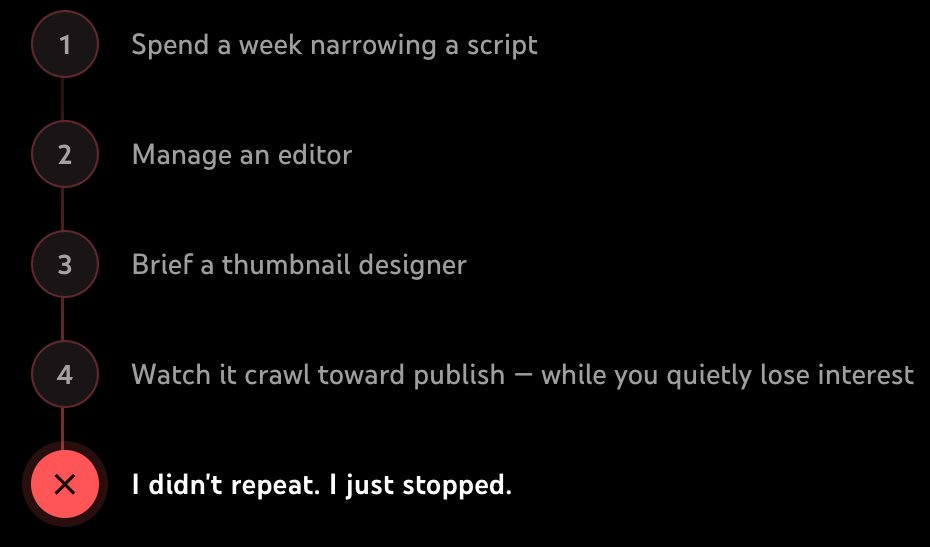
I'd spent the whole year doing the wrong thing.
I've led some of the largest channels on YouTube, and still, I felt this.
Until a few months ago, when I discovered a strategy. One that feels stupidly simple, but it made me addicted to making YouTube content.
Engineering Novelty
Right now, too many YouTubers are over-indexed on familiarity. Titles and thumbnails that look objectively similar to everything else in the knowledge-space.
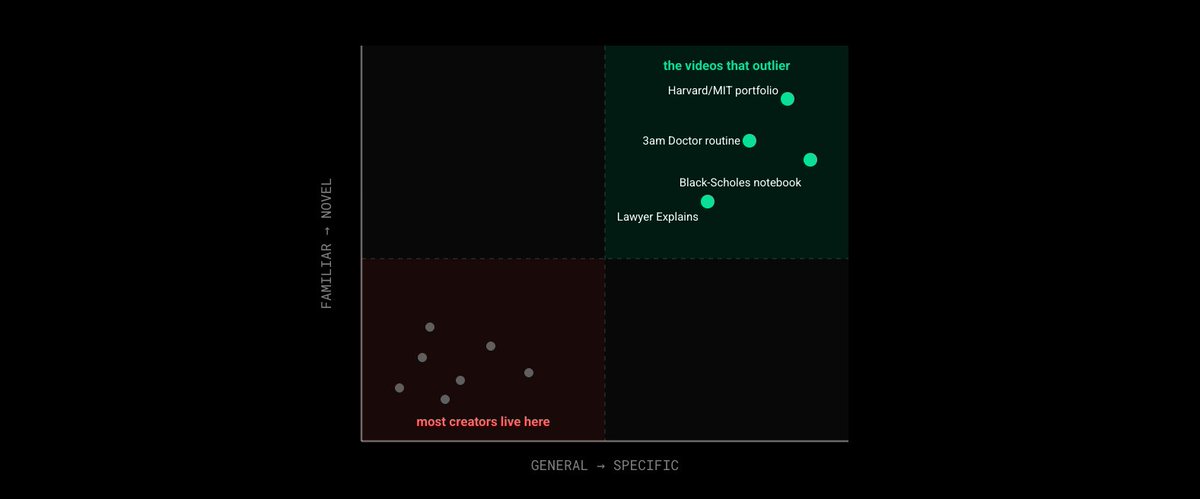
One axis runs from familiar to novel: whether you're explaining something in a new way, or explaining completely new information. The other axis runs from general to specific: whether you're giving principles and theory, or showing real documents, concrete proof, actual artefacts.
Most creators sit in the bottom-left corner: familiar promise, general delivery. The videos that outlier tend strongly toward the top-right: novel enough to stop a scroll, specific enough to prove it's real.
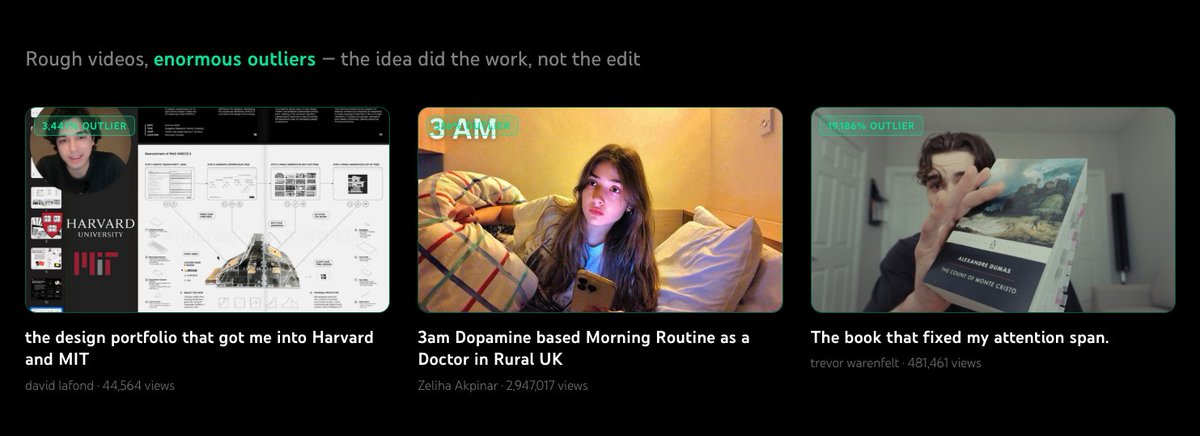
A working architect posted "the design portfolio that got me into Harvard and MIT" - a 60-minute narrated walkthrough of the actual 60-page PDF that got him into both graduate programmes simultaneously.
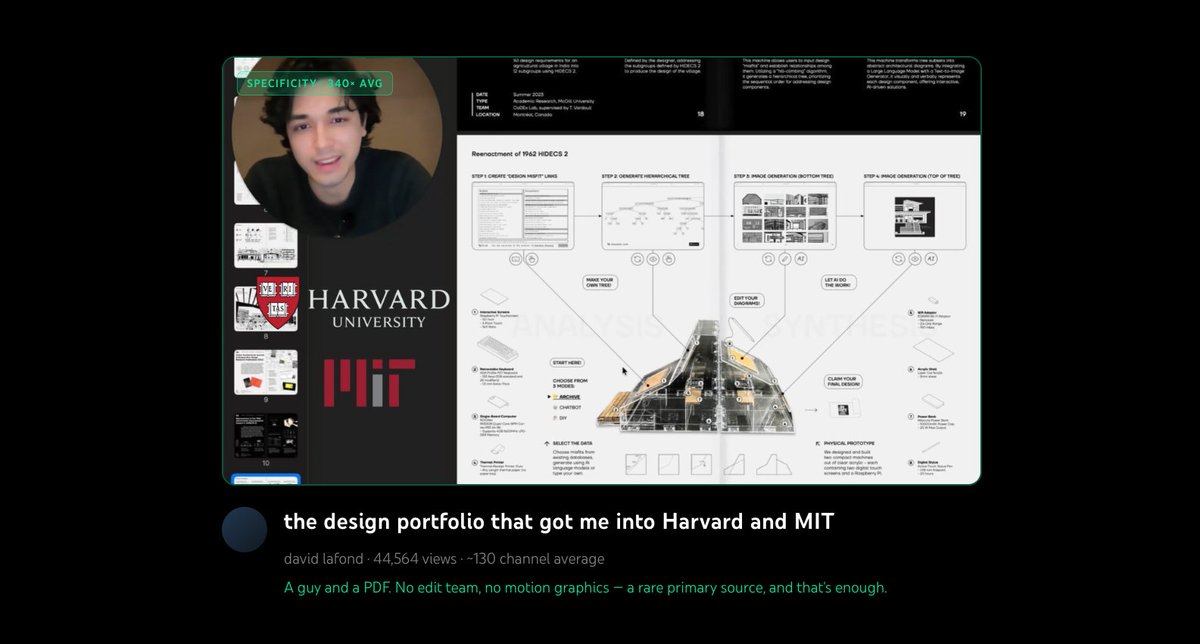
That video has 44,564, roughly 340x the average.
The thumbnail is practically nothing: a guy, a PDF. It's a rare primary source in an opaque admissions process, shown to an audience of architecture students who've never seen one.
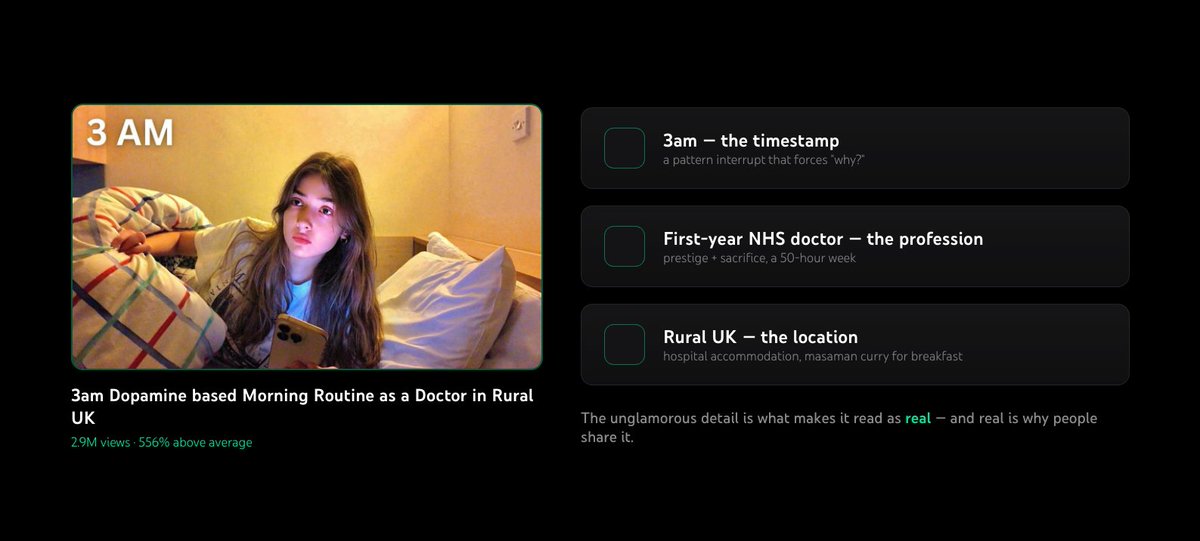
"3am Dopamine Morning Routine as a Doctor in Rural UK" - 2,947,017 views, 556% above channel average.
That video earns its numbers because it stacks three specifics no one else in that feed can claim: the timestamp, the profession, the location. A 50-hour work week. Hospital accommodation. Masaman curry for breakfast. The unglamorous detail is what makes it read as real, and real is why people share it.
And this is important.
Don't give fake stories, don't straw-man, don't invent composite characters to make a point. Those are the obvious tells of generated content faking authority.
A real artefact (the actual PDF, the actual notebook, the actual morning) is something no competitor can reproduce.
The YouTube Hamster Wheel
Find a video that outperformed in your space, copy its structure, translate the topic into your niche. Someone already proved the demand exists.
The obvious problem is that an outlier is more often a local accident than a repeatable formula. It worked for that creator, with that recurring audience, in a particular competitive window.

Ali Abdaal's "you only need a phone" video pulled 487,000 views, 2.8x his channel average at the time. Import that as a template onto your channel and it won't work. It worked because of the returning audience, the existing trust, and a topic built on years of accumulated credibility. The title and thumbnail are terrible. The surface signals are the easiest thing to copy but the least important thing about the result.
What works is extracting causal principles: understanding why a video succeeded relative to its environment, then building something your own channel can produce from that understanding.
So instead of outlier-copying: First: read your audience. What do they believe? What have they watched that left the question unanswered? Second: yourself. What do you know that no one else in this space can show? Where those two things overlap, that's the video.
Once you drop outlier-copying, a different problem shows up almost immediately. Your videos become generic in a different way: familiar and broad in a space that's seen it all.
Steal From The Right People
The names that come up when I ask creators who they copy are overwhelmingly the same short list.
Alex Hormozi. Ali Abdaal. Daniel Dalen. A handful of others sitting at millions of subscribers.
Never steal from these creators.

They are embedded: they've been at significant subscriber counts long enough that their audience clicks on almost anything they publish.

An embedded creator wins on recurring audience trust.
Someone who's been subscribed for two years clicks because they trust the creator, not because the packaging is irresistible to a cold viewer.
An emerging creator wins in suggested feeds - cold traffic, no prior relationship. The video has to earn the click on novelty and specificity alone, because there's no accumulated trust to draw on.
Copying the embedded creator's format onto a channel without their audience produces a polished, carefully templated video that gets 340 views.
Whoever is currently going from 3,000 to 300,000 subscribers is solving the same problem you have. The million-subscriber creator solved a different one, years ago.
The YouTube Strategy
What carries the video, then, is not the format and not the edit.
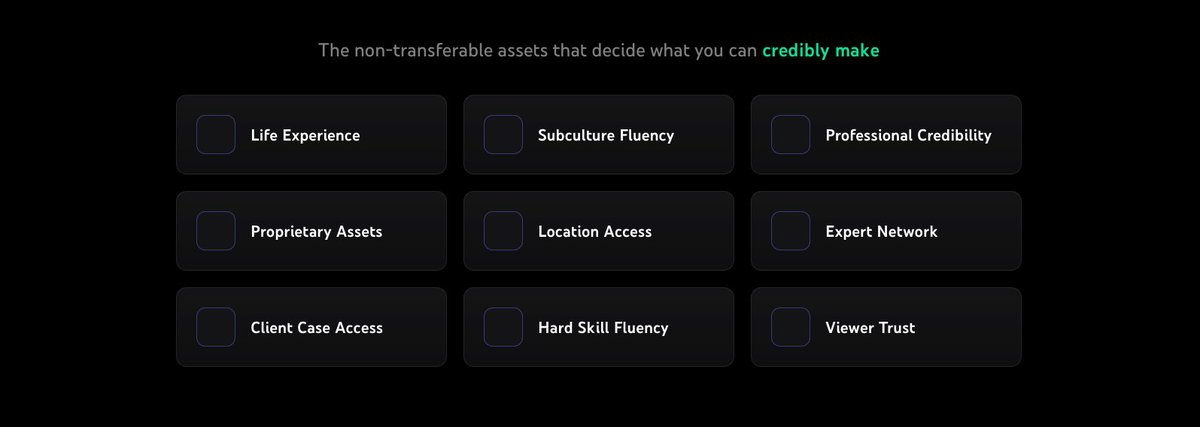
Every creator holds a set of specific, non-transferable assets that determine what content they can credibly make. Five real outlier videos, each with those assets visible.
The 3am doctor morning routine: life experience and subculture fluency. A 3am wake time only lands because she's a first-year NHS doctor on a 50-hour week. Someone without that life doesn't have the video.

"I'm a Doctor with ADHD: How I Really Focus": insider trust plus life experience. The insider-sufferer frame works because she holds both sides of that identity - the credential and the condition. Without both, it's just another focus video.
"Lawyer Explains: How Corporate Lawyers Make Millions" - 1,240,000 views, 8.1x channel average at time of posting: professional credibility plus subculture fluency.
A practitioner walking through the exact math behind £4.7M partner paydays in a Magic Circle firm. A non-lawyer making this video has to cite it secondhand. The lawyer is describing their own industry.
The Harvard and MIT portfolio: professional credibility plus life experience. The portfolio only lands because he got in. The same walkthrough with a made-up PDF is fraud. The real PDF is a primary source.
The Black-Scholes Monte Carlo video - 328,793 views, a quant practitioner running 100,000 simulations live in a Jupyter notebook. Professional credibility, subculture fluency, hard skill fluency. The notebook link in the description turns passive learning into something viewers bookmark. Without the quant background, the same proof reads as a tutorial. With it, it reads as insider access.
In each case, strip the specific asset and the video collapses. What's left is a format without a foundation.
Conclusion
I spent a year recording ten videos and posting two because I was busy making videos I'd be proud of.
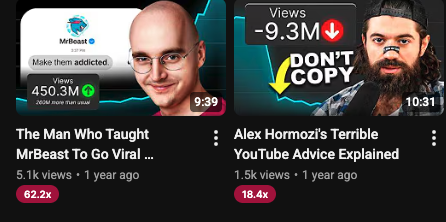
The two that got posted were polished. They were also built around nothing I uniquely owned. What finally moved the channel was finding the overlap between what my audience hadn't seen answered and what I could show from the inside. That's not a production decision. That's a prior decision, made before the camera turns on.
Related articles

We are in the middle of the digital renaissance, please take advantage of it
We’re in the middle of the second renaissance where proof of work replaces the resume, an audience replaces the employer, and taste replaces credentials.

My Grok Bot Just Paid Its Own Salary
(9 Automated Income Streams Running 24/7 While I Sleep)

What It Actually Takes to Build a $45K/Month YouTube Channel
*The honest version of this guide exists because the dishonest version is easy to write and expensive to believe.*