18 Months of Notes Taught My Obsidian Vault Something About Me I Never Noticed.
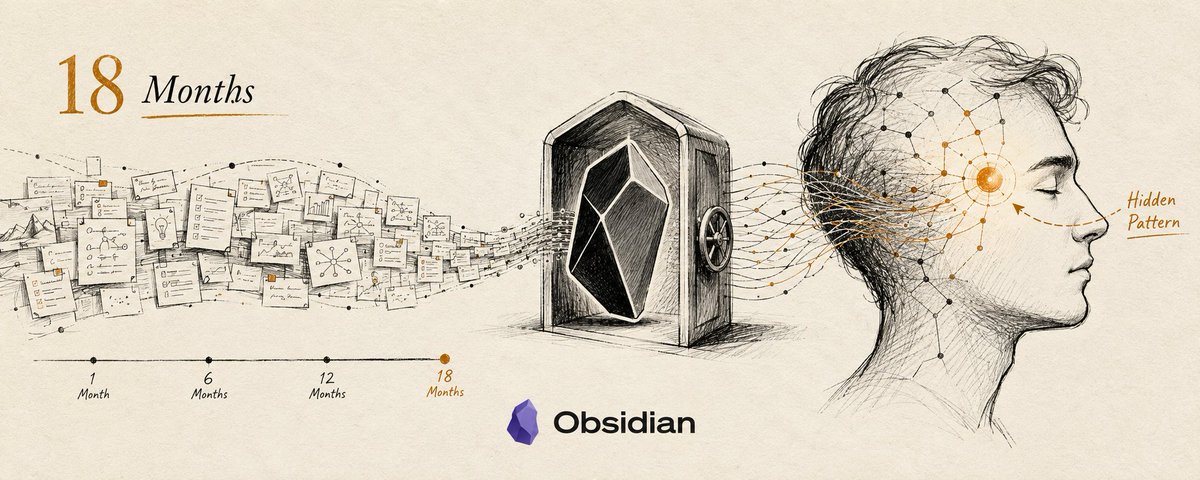
My Obsidian Vault Has Been Watching Me Work for 18 Months. Here Is What It Knows About My Blind Spots.
Every series I've ever abandoned died within twelve days of its best-performing post. I didn't know that until I asked Claude to read eighteen months of my vault end to end instead of searching it for a single answer.
The vault had the pattern the entire time. I just never looked at it as one continuous record.
This is the follow-up to the piece where I called my vault a co-founder. That article was about what the vault could do for me. This one is about what it already knew about me, and never had a way to say.
I Was Using It as a Filing Cabinet
For a year and a half, I opened my vault the way most people do. Search a term, pull a note, close it again. Daily logs, project notes, content drafts, all sitting there as separate files I never read as a sequence.
That's the blind spot in how most people use Obsidian. Every note gets written in isolation, in the moment, solving the problem in front of you. Nobody sits down and reads eighteen months of their own behavior back to back, because a human brain doesn't hold that much continuity in working memory.
Claude does. That's the entire difference.
How the Vault Actually Gets Read
This only works if Claude can see the whole vault, not search fragments of it. I run this through an Obsidian MCP server connected directly to Claude, which lets it read the raw markdown files instead of relying on Obsidian's built-in search index.
Scale matters here. My vault sits well under a thousand notes, which fits comfortably in a single pass. A vault in the tens of thousands of notes would need to be chunked by date range first, or the read has to happen in batches, otherwise you're back to search-style retrieval instead of true end-to-end reading. If your vault is significantly bigger than mine, expect to run this in date-range chunks rather than one shot.
What I Actually Asked It to Do
I didn't ask a question. I asked for a pattern.
The prompt I used:
> Read every daily note and project note in this vault chronologically, from the earliest to the most recent. Identify any recurring behavioral pattern that repeats at least three times across separate projects or time periods. Do not summarize the content of the notes. Report only the pattern, the dates it occurred, and what changed each time right before it happened.
That last line matters. I wasn't asking for a summary of what I worked on. I was asking for what I do right before something stops working.
The Pattern I Didn't Want to See
Every series that started gaining real traction in the vault got abandoned within roughly twelve days of its best-performing entry.
Not because the idea ran out. Every single time, a new series started pulling my attention in that same window, right when the old one needed follow-through instead of a new idea.
I could see it once it was laid out with dates next to it. I could not see it living day to day, because each decision to start something new felt like momentum in the moment. It never felt like abandonment while I was doing it.
The vault didn't judge it. It just had the dates.
Why I Didn't Just Take Claude's Word for It
An LLM reading eighteen months of unstructured notes can absolutely produce a pattern that sounds insightful and isn't real. That's a fair thing to be skeptical of, and I was skeptical of it too.
Before I trusted this, I went back and manually checked the specific dates Claude flagged against my own posting history and analytics. Three separate instances, three separate series, and in each one the abandonment date landed inside the window Claude identified, not somewhere close to it. That cross-check is what turned this from an interesting-sounding output into something I'd actually publish as true.
If you run this yourself, do the same thing. Don't publish the pattern until you've verified at least the specific dates against something outside the model's own output.
Why I Never Caught This Myself
This isn't a discipline problem. It's a visibility problem.
When you're inside week two of a winning series, the win doesn't feel like a reason to keep going. It feels like proof you're ready for the next thing. That's the exact moment the vault shows the pattern breaking, and it's also the exact moment it's psychologically hardest to notice, because you're riding a high, not a low.
A human going back through eighteen months of notes to check this manually would need to hold dozens of separate timelines in their head simultaneously. Nobody does that. I certainly never did. The vault held all of it. I just never asked it to show me the shape instead of the content.
This Is Not the Same as Search
Search answers a question you already know to ask. This required asking the vault a question I didn't know I needed to ask, because I didn't know the pattern existed yet.
That's the actual shift. A note-taking app that only responds to search can only ever confirm what you already suspect. A vault that gets read end to end by something with no working memory limit can surface what you never suspected at all.
Eighteen months of daily notes is not a filing cabinet once you stop treating it as one. It's a behavioral record with your fingerprints on every entry, and it was sitting there the entire time waiting to be read as a whole instead of in pieces.
Worth being honest about the tradeoff here. This means sending eighteen months of personal notes to a cloud model. I'm comfortable with that given what Claude does and doesn't retain, but if you keep anything genuinely sensitive in your vault, that's a real decision to make deliberately, not something to skip past.
This is also a different category from tools like Rewind or Reflect, which passively capture everything you do and surface it back on demand. Those tools remember. This approach doesn't just remember, it was asked to find a pattern I didn't know to look for, across notes I wrote for entirely different reasons than self-tracking. The vault wasn't built to watch me. It just could be read that way once I asked.
What I'm Doing With It Now
I'm not fixing this by trying harder to notice it in the moment. I already know that doesn't work, because eighteen months of evidence says it doesn't.
Instead, I set a standing check. Every time a series crosses its best-performing entry, I have Claude flag it and ask me directly whether I'm about to start something new in the next two weeks. The vault can't stop me from making the same decision again. It can make sure I'm making it with my eyes open instead of riding the high blind.
That's the actual value here. Not therapy. Not motivation. A pattern that was always visible in the data and never visible in the moment, finally read back to me by something that doesn't forget any of it.
Follow @damidefi on X for daily Claude AI tools, crypto analysis, and the full journey to 100K. Bookmark this. Share it with one person who needs it.
Related articles

How Obsidian + Claude Made Me 10x More Productive
I used to keep my brain in 6-7 different places: 40 Claude tabs, a dying Notion workspace, Telegram saved messages, Apple Notes, random folders, and my own fading memory. Every new project or post st…

How to Build a Second Brain with Karpathy's Method (Claude + Obsidian)
http://x.com/i/article/2062853610820534272
