$1B Retro Arbitrage: Liquidating Low-Poly CAC
If you are running a low-poly indie game or retro mobile app right now, your unit economics are likely getting crushed on paid social.
You already know the baseline metrics. It costs thousands of dollars and months of development cycles to ship a clean, functional 3D build. The product execution isn't the problem. The bottleneck is user acquisition. To get users to pass the download page and make their first in-app purchase, you are forced to brute-force Meta and TikTok ads with raw cash.
The industry standard is terrifying. Gaming studios are dropping six figures a week on single ad campaigns, burning through thousands of fresh ad creatives a month just to outrun instant creative fatigue.
You are trapped paying $20 to $30 per US install on ad networks that punish your margins the second an asset loses its initial algorithmic steam.
Worse, you are likely trying to compete with massive hyper-casual publishers by making generic gameplay trailers that users have developed absolute, clinical banner blindness toward. If your creative looks like a standard mobile game ad, it is dead before the user even registers what they are looking at.
You are paying to force traditional ad assets down the throat of an exhausted audience instead of leveraging your app's built-in aesthetic advantage (skill assets are in the article).
As an internal growth team, you need to exit the traditional mobile game UA math and deploy a decentralized distribution pipeline. Your visual aesthetic is already an organic pattern interrupt. You don't need more high-budget marketing trailers, you need to turn your game engine assets into an automated traffic machine.
Here is the exact growth engineering playbook to transition your low-poly application from burning paid ad spend to scaling an organic swarm.

Phase 1: Structuring the Frictionless Asset Bank
The biggest advantage a low-poly game has over any generic software app is that your core visual identity is highly nostalgic and trend-native. You are sitting on an asset library that is perfectly positioned to capture the weirdcore and dreamcore subcultures currently dominating the algorithm.
To stop creative fatigue, you have to weaponize your raw engine files.
Take high-stakes gameplay captures, bizarre physics glitches, developer build logs, and raw character model animations from your unity or unreal project. Ensure these clips are exported in clean 9:16 vertical format, high-definition, with raw sound effects isolated from any background music.
Instead of routing these clips into a slow internal editing queue to make standard variants for ad accounts, you drop them into a centralized, public cloud repository for external creators.
You establish absolute guardrails for the assets:
- The Hook Target: The first 1.5 seconds must feature an immediate visual anomaly, such as a glitching low-poly model, a harsh physics collision, or a highly nostalgic retro sound bite.
- The Conversion CTA: Every clip must end exactly on a cliffhanger, a game-over screen, or a high-stakes decision prompt, with a hard call-to-action directing users to download your exact game title in the App Store to try it themselves.
- The Tracking Layer: Issue unique Mobile Measurement Partner (MMP) tracking links or unique referral promo codes for every distribution node to monitor downstream active users and in-app purchases, not just empty app installs.
Phase 2: The Hyper-Retro AI Shift
To scale your paid ad accounts alongside your organic efforts without hitting immediate creative fatigue, you need to run pattern interrupts that completely bypass traditional ad-skipping reflexes. You achieve this by taking your existing low-poly assets and mutating them into hyper-stylized PS1-era low-poly art.
Take a raw screenshot of your game's main character or central map and drop it into a node canvas. Process it through a GPT Image 2 node set to high quality to generate your stylized visual anchor, using a prompt that forces a complete 90s PlayStation aesthetic shift:
> Create this image in this style: Rendered in low-poly PS1-era 3D graphics, mid-1990s PlayStation aesthetic. Chunky low-polygon geometry, stretched and warped low-resolution textures with affine texture mapping distortion, visible vertex jitter, flat photographic textures pasted onto rough 3D models in surreal collage style. Liminal, weirdcore atmosphere with an eerie nostalgic mood. Flat ambient lighting, muted vaporwave-adjacent color palette, no antialiasing, low resolution, crunchy dithered textures. Retro pixelated blocky font for any text. VHS-tinged, lo-fi, uncanny.
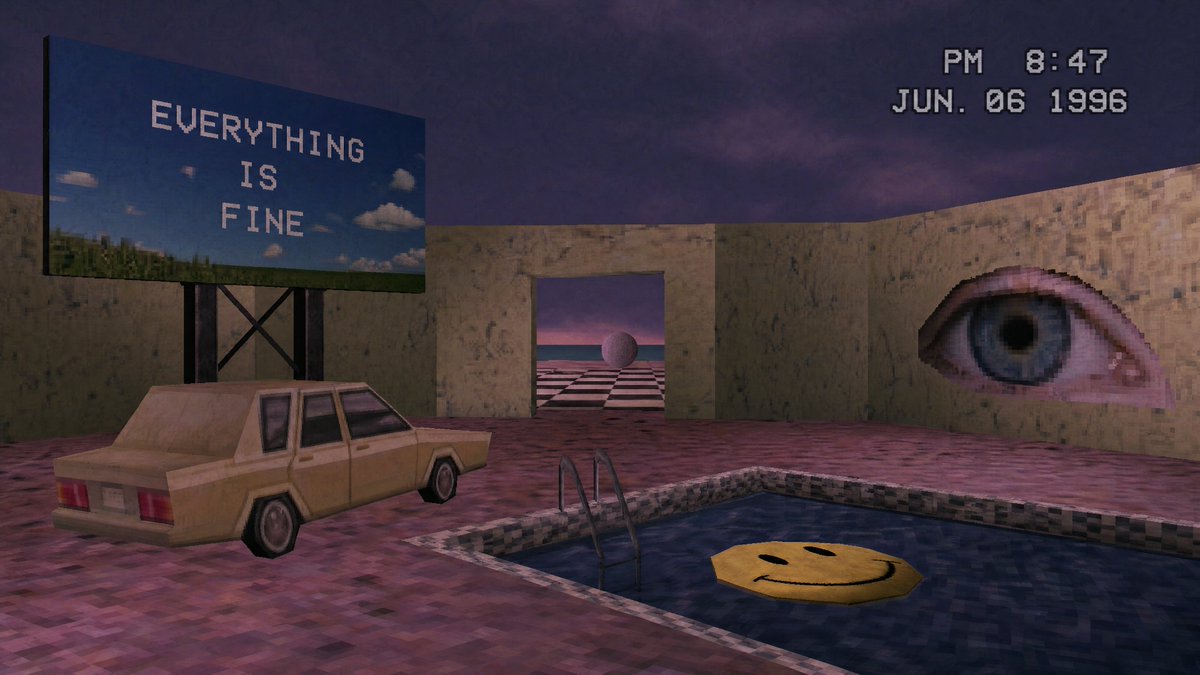 — "image produced by gpt image 2 (really fit to use for (pre)launch ads)"
Route that visual anchor into a Seedance 2.0 video generator node to animate the gameplay sequence with stiff, robotic, low-poly PS1-era movement. Intentionally export the video at 480p or 720p at a jagged 15 frames per second.
Take the raw audio from your game engine and layer it directly over the blocky, retro 3D visuals.
When a user scrolls past this on the feed, their brain treats it like an unedited, corrupted retro game file found on an old hard drive, completely breaking their standard ad defense. They stop to figure out what vintage game they are looking at, only to get instantly sucked into your modern gameplay loop. It is a pure cultural bypass that breathes months of extra life into your creative assets.
Phase 3: Launching the Creator Swarm
You cannot hit critical mass by running this pipeline through five internal brand accounts. You need a network that can drop thousands of unique clips onto the feed simultaneously, creating artificial omnipresence for your game.

You take your structured asset library, your text hooks, your low-poly AI variations, and your MMP tracking links, and you deploy them directly onto AffiliateNetwork.
Instead of paying Meta a fixed $25 CPM upfront whether a user downloads your app or not, you configure your campaign on a pure performance basis. You set clear validation terms for the creator network:
- You pay a fixed, capped rate per 1,000 verified views.
- You offer a high-tier CPA bounty for every trackable App Store install or first-time in-app purchase driven through their unique referral link.
- You retain full rights to pull the highest-converting organic clips directly from the network and plug them back into your scaling paid ad accounts as whitelisted dark posts.
The platform's internal bot detection automatically filters out simulated traffic, meaning your acquisition budget is insulated from click farms and spoofed engagement metrics.
You have 200,000 performance-focused clippers downloading your vertical engine clips, cutting them into unique micro-variations, adding localized text overlays, and flooding the TikTok, Reels, and Shorts algorithms on demand.
Phase 4: The Conversational Conversion Loop
To maximize the ROI of this massive top-of-funnel reach, you must eliminate traffic friction. If a user has to pause a viral gameplay clip, click a bio link, navigate an external landing page, and then open the App Store, your drop-off rate will destroy your unit economics.
Instruct your creator network to use an automated conversational call-to-action in every post: "Comment 'PLAY' to get the direct beta link and skip the App Store waitlist."
You plug OpenClaw into your campaign webhooks to intercept every inbound comment in real-time. The automation immediately takes over the user's DMs, delivering a native, localized conversational message:
> "Hey! Saw your comment on that low-poly run. Here is the direct link to download the game app right now. I just attached a unique referral code to your link that unlocks 500 free gold coins and an exclusive retro skin the second you clear the tutorial. Let me know what level you hit! 🕹️"
The user clicks the deep link right inside their inbox, which instantly routes them to the App Store, registers the install via your MMP, and opens your app directly, tracking their user journey flawlessly from view to active player.
The New Distribution Paradigm

The old media buying playbook for mobile games is structurally broken. You cannot achieve sustainable growth while constantly burning millions on ad networks that demand thousands of manual creative refreshes every single week just to combat creative fatigue.
Your low-poly game is sitting on a goldmine of pre-validated, highly nostalgic visual assets. By shifting your growth strategy from centralized paid campaigns to a decentralized distribution network, you flip the unit economics completely in your favor.
You stop paying for vanity impressions, you hard-cap your creative expenditure, and you only pay for actual, real human attention that converts into long-term player retention.
Stop fighting the ad platform algorithms. Launch your game's marketing campaign, upload your raw assets, and scale your organic network on AffiliateNetwork. Use this skill file to make similar scenes and prompts.
Related articles

How to turn attention into consumer-app customers who don’t churn
That playbook worked when building the product was hard and distribution was cheap, but the opposite is true in 2026.

i analyzed 27 apps that went from zero to millions of views without spending a dollar on ads. they a
$0 to $80K MRR in 70 days. $0 to $200K MRR in 9 months

How to create AI ads for apps that make $10,000/mo (EASY MODE)
The AI revolution is here, and it has completely changed the way I grow apps.