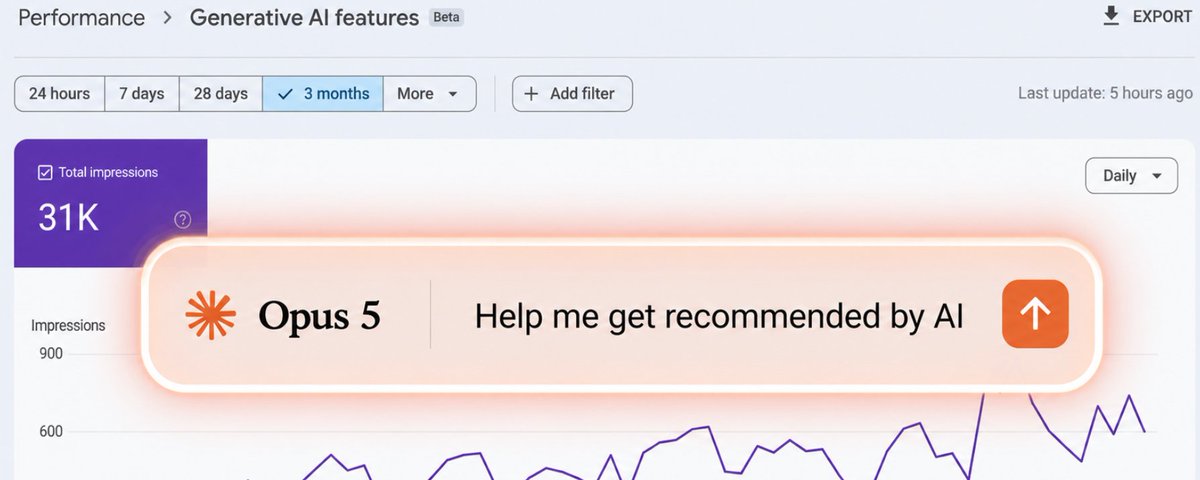
31K Mentions by AI in 2 Months: How Claude (Now Opus 5) Became Our SEO Agent
If you want ChatGPT to recommend your SaaS but
↳ Your competitors appear in every buying answer.
↳ Your site is never one of the visible sources.
↳ You publish more pages and the answer does not change.
Then here is the Citation Gap Method I use to find the pages shaping the answer and turn each gap into an exact content, outreach or distribution job.
👉 Automate it with Claude (now Opus 5), Codex or Cursor using one SEO Skill. 👈
Embedded post:
Author: borja (@borjafat) Post ID: 2080985724371742900 Source: https://x.com/borjafat/status/2080985724371742900 Reply to: none
Text:
> Google AI Overviews has recommended Distribb 31k times in the last 2 months > > Traffic from AI citations converts the BEST > > We use Distribb to grow Distribb: > > - good ol' SEO > > - backlinks > > - FAQs > > - target buy-intent queries > > - Above all: unique insights / content > > Read those last 2 points, it's what sets us apart
Media:
I analyzed 100 software buying decisions.
Google returned 790 visible organic results.
ChatGPT recommended 500 products.
But only 90 of those 500 product domains appeared in the paired Google results.
> Only 20 of ChatGPT's 100 number-one choices had their official domain in Google's captured results.
> And only 50 of 200 visible ChatGPT source domains also appeared in Google for the same decision.
This was one observed sample, not a universal law.
But it exposed something most SaaS teams still miss:
Google rank, AI recommendation and AI citation are three different leaderboards.
- Google ranks pages.
- ChatGPT recommends products.
The citations show which pages helped it build the answer.
Your competitor can win the product recommendation while a third-party listicle wins the citation.
> You can rank above a competitor on Google and still lose the recommendation inside ChatGPT.
You are probably stuck in this workflow:
↳ Export competitor keywords.
↳ Pick one with decent volume.
↳ Ask Claude for 2,000 words.
↳ Publish another blog post.
↳ Ask ChatGPT about the category once.
↳ Wonder why the same products still appear.
The problem is not your prompt.
The problem is that you created content before finding the missing source.
AI visibility is a source graph, not a keyword rank.
Here are the 7 Citation Gap workflows I would automate 👇
1️⃣ Turn buying decisions into frozen prompts
Traffic is an input.
Decisions create revenue.
Start with the questions buyers ask immediately before a trial, demo, quote or purchase.
Pull them from:
↳ Search Console queries.
↳ Sales-call objections.
↳ Support questions.
↳ Competitor comparisons.
↳ Lost-deal notes.
↳ Pricing and integration questions.
Then express every decision twice.
First as a Google query:
best AI SEO software for agencies
Then as the natural question somebody asks an AI:
What is the best AI SEO platform for a small agency that needs keyword data, CMS publishing and help earning backlinks? Recommend up to five and explain the fit of each.
The short query shows which pages Google rewards.
The natural prompt shows which products the AI recommends and which visible sources support the answer.
Freeze the wording, date, engine and location.
Do not rewrite the prompt after seeing the answer.
Otherwise you are comparing moving targets.
You need 10 to 25 prompts close to money, not a sheet with 2,000 vague keywords.

2️⃣ Build the recommendation and citation map
A recommended product and a cited page are not the same thing.
Record them separately.
For every prompt and engine, capture:
↳ The products recommended.
↳ Their order in the answer.
↳ The verified official domain for each product.
↳ Every visible citation URL.
↳ The source domain and page type.
↳ Whether your brand was cited, mentioned or absent.
Run the same prompt across:
↳ ChatGPT.
↳ Perplexity.
↳ Gemini.
↳ Google AI Overviews.
↳ Google AI Mode.
Do not write "competitor wins."
Write what happened:
Competitor A was recommendation #2. Its homepage was not cited. A third-party agency listicle was cited.
That distinction tells Claude what job to run.
If the product is recommended but its domain is absent, third-party evidence may be doing the work.
If the vendor's comparison page is cited, it owns an asset you can study.
If your brand is mentioned but not cited, the engine may understand the company but lack a page worth using as evidence.
No visible citation does not mean nothing was retrieved.
Record it as no visible source.
Never fill a blank with a guess.

3️⃣ Name the exact Citation Gap
A vague audit creates vague content.
Classify every lost prompt into one of four gaps.
Decision gap
You do not have a page that directly answers the buying decision.
The buyer asks for the best tool for a ten-person agency. Your site only has a generic feature page.
Entity gap
Your product facts are inconsistent or unclear across the web.
The engine cannot confidently tell who the product is for, what it does, what it connects to or where its limits are.
Evidence gap
A competitor claim appears across credible sources while your alternative has little independent support.
Distribution gap
You published a useful page, but the listicles, directories, communities and professional sites shaping the answer have never seen it.
Then write one gap statement:
For [buyer prompt], the engines repeatedly use [source type] to support [competitor/use case], but no source clearly compares [our differentiator] using verifiable criteria.
That sentence becomes the brief.
Do not pretend the map proves the model's private reasoning.
It shows the recommendation and the visible evidence.
That is enough to choose a useful next job.

4️⃣ Let Claude map the source pattern
For every cited page, extract:
↳ The exact question it answers.
↳ The products it names.
↳ The criteria it uses.
↳ The use cases it makes explicit.
↳ The claims with primary support.
↳ The limitations it admits.
↳ The page format.
↳ The buying question it leaves unanswered.
Keep every fact beside its source URL.
Then give the evidence table to Claude.
Claude chooses the smallest useful intervention:
↳ Improve an existing page.
↳ Create a comparison or alternatives page.
↳ Publish pricing reality.
↳ Build a statistics page or original study.
↳ Pitch a third-party listicle.
↳ Distribute useful proof outside your own domain.
Copy the evidence pattern, not the article.
You are identifying the job the source performs.

5️⃣ Build a source worth citing
You are not writing another blog post.
You are building an answer component.
For a SaaS buying decision, I would include:
↳ A direct answer near the top.
↳ A named shortlist instead of generic advice.
↳ Clear "best for" language.
↳ One comparison table with the same criteria for every product.
↳ Current prices where they can be verified.
↳ Supported integrations.
↳ Honest limitations.
↳ Screenshots or operational examples.
↳ Primary sources.
↳ A named author and visible update date.
↳ Sentences that still make sense when quoted alone.
If the query is "best X," publish a real list.
If it is "X vs Y," compare those two products using the same criteria.
If it is pricing, answer what a real buyer could pay and what changes the amount.
Do not hide the useful answer under 700 words explaining why the category matters.
And do not make your product win every row.
An honest limitation can make the rest of the page believable.

6️⃣ Get into the third-party pages already shaping the answer
A source nobody encounters cannot become the default source.
Find the third-party pages already appearing across your buyer prompts.
Prioritize:
↳ Listicles that mention several competitors.
↳ "Best tools" roundups.
↳ Competitor-alternative pages.
↳ Independent comparisons.
↳ Review directories.
↳ Professional communities.
↳ Useful Q&A answers.
Do not send:
Please add our tool.
Send:
Your article compares A, B and C, but it does not include an option for teams that need [missing use case]. We built a sourced comparison with [specific evidence]. I can send the facts and screenshots if they are useful for your next update.
One missing category is a better pitch than one more feature list.
Some publishers will ask for money.
Some will ignore you.
The author decides what gets added.
Distribb's backlink exchange can support this layer by connecting real businesses that cite relevant partner resources.
Giving a useful network link earns a credit toward backlinks from other businesses.
Never invent reviews or manufacture consensus.
Do not measure this step by raw link count.
Measure whether your brand starts appearing in the pages already influencing buyer prompts.

7️⃣ Rescan and turn the answer into the next job
One scan is a screenshot.
A loop is a strategy.
Rerun the frozen prompts after publishing and distribution.
Track four states:
↳ Cited.
↳ Mentioned but not cited.
↳ Not cited.
↳ No data.
Then ask:
↳ Did the brand enter the shortlist?
↳ Did its recommendation position change?
↳ Did the new page become a visible source?
↳ Did a third-party page add the brand?
↳ Which domains still shape the answer?
↳ Which use case remains unsupported?
If the page ranks but is not cited, improve the answer structure and corroboration.
If the brand is cited but not recommended, strengthen product-fit evidence.
If the brand is recommended through third-party sources, keep those product facts current.
If nothing changes, do not publish five versions of the same article.
Return to the citation map.
The missing job may be distribution, not content.

Copy this Citation Gap prompt
You are my AI Citation Gap analyst.
Business: [what we sell]
Audience: [who buys]
Revenue event: [trial, demo, quote or purchase]
Competitors: [list]
Existing pages: [URLs]
Frozen buyer prompt: [exact prompt]
Engine results: [recommendations and visible citation URLs]
- Keep product recommendations, official domains and citation URLs
in separate columns.
-
Verify every product-domain mapping.
-
Read every available cited source.
-
Extract the source type, named products, comparison criteria,
supported claims, primary references, limitations and update date.
-
Mark anything unavailable or unverifiable as unverified.
-
Identify the missing informational job our brand could perform.
-
Classify it as a decision, entity, evidence or distribution gap.
-
Recommend the smallest useful intervention: improve a page,
comparison, pricing page, statistics page, original research,
outreach or third-party distribution.
-
Produce a content brief and a pitch brief.
-
Never invent rankings, citations, traffic, reviews or product facts.
-
Do not draft or publish until I approve the evidence table.
Before publishing, check:
↳ Does the page answer one frozen buying decision?
↳ Are recommendation and citation evidence separate?
↳ Is every material claim verifiable?
↳ Does the format match the decision?
↳ Are products compared on the same criteria?
↳ Is there at least one honest limitation?
↳ Can a useful sentence stand alone when quoted?
↳ Is the author and update date visible?
↳ Is there a distribution target?
↳ Is the rescan prompt saved?
That is the process:
Buyer decision
→ Frozen prompt
→ Recommendation map
→ Citation map
→ Citation Gap
→ Better source
→ Third-party support
→ Rescan
Distribb can track your buyer prompts per project across ChatGPT, Perplexity, Gemini, Google AI Overviews and Google AI Mode.
It shows cited pages, competitor share of voice and whether the brand was cited, mentioned or absent.
Then the same SEO infrastructure connects the gaps to Search Console, keyword data, internal links, a publishing calendar, CMS publishing and a backlink exchange.
Try Distribb free:
Thanks for reading! 🙏
Borja
Related articles

38 Ways to Find $1M Startup Ideas:
1. Scrape 1 and 2-star G2/Capterra reviews of popular SaaS tools to find broken features or unmet needs.

6-Step Claude SEO Hack to Rank Without Backlinks in 24 Hours
I scored every site on page one for 80 searches. On <niche> statistics 2026, 24% of page one is held by small sites few backlinks
