6-Step Claude SEO Hack to Rank Without Backlinks in 24 Hours

If you want to rank without backlinks, but:
↳ Every keyword you want is too hard
↳ The sites above you have 16,000 links and you have 50
Then build a statistics page. Small sites win those searches.
Run this 6-step playbook and let Distribb research and publish the page 👈
TL;DR
> I scored every site on page one for 80 searches. On <niche> statistics 2026, 24% of page one is held by small sites few backlinks
↳ On <niche> trends 2026 it is 21%
↳ On <niche> news it is 12%. On <niche> report 2026 it is 10%, and no small site made the top 3
↳ A dental site with 57 links sits at position 2 for dental practice statistics 2026
↳ Page one for these searches is 174 days old. For normal keywords it is 345
↳ Step 1: pick the two shapes small sites actually win
↳ Step 2: build /statistics as its own dated section
↳ Step 3: get a number only you have
↳ Step 4: write it so one line can be quoted
↳ Step 5: put the year in the title, never in the URL
↳ Step 6: link it to the page that sells, and redo it every year
The 6-step playbook
Step 1: Pick the type of keyword
Not every search is equally hard. I checked, and the gap is big.
↳ Go after <your niche> statistics 2026 and <your niche> trends 2026
↳ Skip <your niche> news and <your niche> report 2026
On statistics searches, 24% of page one goes to sites with under 1,000 links. On trends, 21%. On news it drops to 12%. On report searches, 10%, and no small site made the top three at all. News is where the big publishers live. Statistics is where you can win.
Stick to what your site is already about. A dentist doing crypto statistics is the one that fails.

Time: 10 minutes.
Step 2: Build /statistics as its own dated section
Make sure "statistics" is in the Slug of the URL
↳ Put it at /statistics/, with an index page
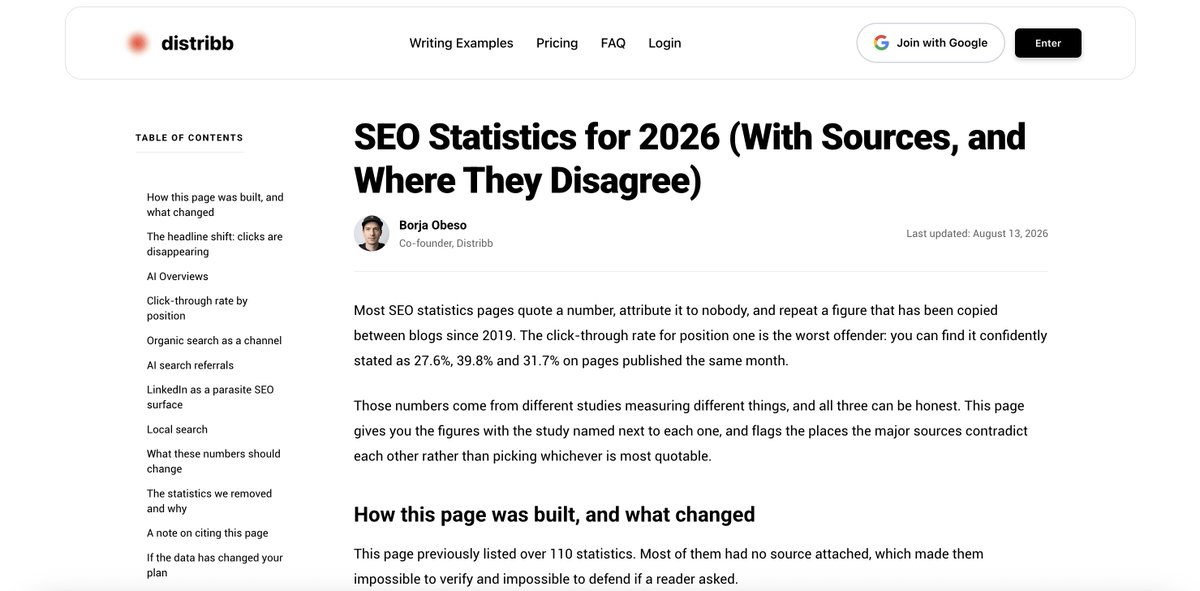
↳ Show the date you last updated it, on the page, not just in the code
↳ Use Article schema with datePublished and dateModified
Page one for these searches is 174 days old, against 345 for normal keywords. Old pages do not sit there. A visible update date is how you stay in the rotation.
Time: 1 hour once.
Step 3: Get a number only you have
This is the whole thing. Google punishes pages that add nothing to what they copied, and it does not matter if a human or an AI wrote it. A page of other people's stats is a copy.
So publish something only you can count:
↳ Your own booking, pricing or volume data: "we quoted 4,000 roofs last year, here is what they cost"
↳ A survey of your own customers, even 60 replies
↳ What you see that the trade press cannot, from your own systems
One original number carries the page. The rest can be sourced from others, as long as you credit them.

Pro tip: Ask Claude Code to run Deep Research and find unique insights no other website has. Analyze the sentiment in reviews of your competitors or other companies in your Industry, for example.
Time: 1 hour for the first one.
Step 4: Write it so one line can be quoted
Nobody links to a page. They link to a number they used on their content.
↳ One stat per line, short, with the source named right there
↳ Make every line stand on its own: "42% of X did Y in 2026, according to Z"
↳ Put your own number at the top, above the borrowed ones
↳ Add the sample size next to it, so a journalist can trust it
A stat that only makes sense after three paragraphs never gets picked up.

Time: 1 hour.
Step 5: Put the year in the title, never in the URL
You want the page to look current every January without starting over.
↳ Title says 2026. URL stays /statistics/ with no year in it
↳ Every January, swap the numbers, change the title year, update dateModified
↳ Keep the old figures further down as history, so the page grows instead of resetting
Put 2026 in the URL and you throw away the page's age every year, which is the one thing you cannot buy.

Time: 30 minutes a year.
Step 6: Link it to your money pages
The stats page will get you the clicks but from there you need to drive visitors (and SEO link juice) to your money pages
↳ First search site:yourdomain.com <your phrase> so you do not compete with your own service page
↳ Link the stats page to that service page
↳ Link the service page back to the stats page
↳ Check every quarter which numbers people actually quoted, and add more of those

Time: 15 minutes.
Two things to know first
Do not build this unless you will update it every year. A stats page with 2026 in the title, still showing 2026 numbers in 2028, is worse than no page. The date you were using as an advantage becomes the reason people leave.
The link part is a bet, not a measurement. I proved small sites rank for these searches. I did not measure how many links they earned. The reasoning is simple. People cite numbers, and your own number is the only one nobody else can publish. Treat that as a reason to try, not a promise.
Run the 6 steps in order
↳ Step 1: target statistics and trends, skip news and report
↳ Step 2: build /statistics as its own dated section
↳ Step 3: get one number only you have
↳ Step 4: one stat per line, sourced, quotable
↳ Step 5: year in the title, never in the URL
↳ Step 6: link it to the page that sells, and redo it every January
Try Distribb free and let the agent build the page for you
Thanks for reading.
Borja
*credit to my co-founder @florian.darroman for showing me this hack
The study behind this
> I analyzed 80 live US Google searches across ten niches, from home solar to commercial real estate. Then I scored all 423 sites that held a page-one spot, using their referring domain counts. On <niche> statistics 2026, 24.4% of page one went to sites with under 1,000 referring domains. On <niche> trends 2026 it was 21.4%. On <niche> news it was 12.0%, and on <niche> report 2026 just 10.0%, where no small site reached the top three. The middle site on these searches has 16,100 referring domains, so page one is not weak. It just has room in it, and that room sits on the statistics and trends searches. This is one snapshot of one day, and it shows who ranks now, not how quickly anyone got there.
Real examples from page one: patientfy.ai at position 2 for dental practice statistics 2026 with 57 referring domains. premierimagedentistry.com at position 5 on the same search with 59. docsels.com at position 7 for dental practice trends 2026 with 50. californiadgstats.ca.gov at position 2 for home solar statistics 2026 with 72.
I also checked whether news searches are easier than normal keywords. They are not. Sites on news page one have a median of 16,100 referring domains against 9,476 on evergreen searches, so news is the harder route, not the easier one. That is why this playbook targets statistics instead.
Sources
https://developers.google.com/search/docs/essentials/spam-policies
https://developers.google.com/search/docs/appearance/structured-data/article
Related articles

38 Ways to Find $1M Startup Ideas:
1. Scrape 1 and 2-star G2/Capterra reviews of popular SaaS tools to find broken features or unmet needs.
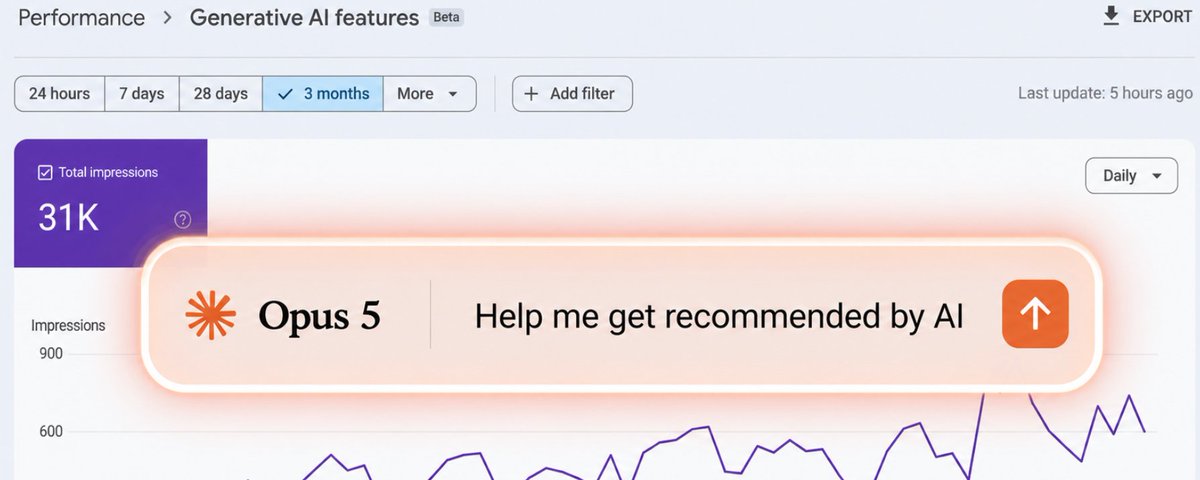
31K Mentions by AI in 2 Months: How Claude (Now Opus 5) Became Our SEO Agent
Google AI Overviews has recommended Distribb 31k times in the last 2 months
