A beginner's guide to metacognition

If you work with AI every day, you are part of a human–AI system, yet most of the advice available to you is about prompting the machine. Metacognition is how you can debug the other half.
Here, metacognition means translating your thoughts into a computational frame so you can inspect what they are doing, notice when they are failing, and change the conditions around them. The practice is closer to debugging than meditation or a set of journaling prompts.
Many of the readings that diagnose a stuck agent also diagnose a stuck afternoon. The comparison has limits, of course, but it is useful to treat both yourself and the model as bounded search processes with limited working context, biased sampling, finite resources, and poor visibility into your own execution.

Debugging prompts taught me this. With a vague instruction, I could watch a model wander; after tightening the constraints, I could watch it converge. For the first time, the traces of something shaped enough like thinking were visible to me.
After enough of those traces, I started recognizing similar patterns on my side of the screen. In late 2025, I described my willpower as finite RAM: a small daily pool, spent on decisions and context switches, restored by sleep. Four months later, I wrote almost the same note about agents. The context window was RAM, memory was the hard disk, and the design problem was deciding what to load. I had drawn the diagram for myself first.
The basic frame comes from a journal line I wrote in August 2024: the mind is not an abstract construct; it is much closer to a physical computer.

Working memory is bounded, energy is metered, and beliefs behave like caches that do not reliably invalidate when new information arrives. Reconciling everything you know whenever something changes would be too expensive, so old conclusions remain available long after the evidence beneath them has shifted.
Once you take those limits seriously, mental states begin to look less like verdicts about your character and more like readings from a running system. The following readings are the ones I use most often.
What level am I operating at?
I borrowed two terms from statistical mechanics for describing the "level" or "hierarchy" of a problem. A microstate is one exact configuration: this sentence, this file, this particular decision. A macrostate gathers all the configurations that share the properties you care about, such as whether the tests pass, the argument lands, or the day produces something shipped.
Problems appear at both ends of the scale. At the microstate level, you may find yourself editing an agent's output word by word, keeping every branch of a project in your head, or rewriting the same sentence nine times. Zoom out too far and nothing is constrained: “make it good” as a prompt, “be productive” as a plan.
Somewhere between those extremes is a useful level, where the conditions bound the search without forcing you to track every particle.

This check works on both halves of the system. When AI output becomes frustrating, ask whether you are editing microstates that would be cheaper to handle by restating the desired result and rerunning. When your own work feels overwhelming, look for details being held in working memory that could live on a board or in a file. Overwhelm is often how holding too many microstates feels from the inside.
What temperature is the search running at?
Creative and knowledge work tends to alternate between divergence and convergence. Phenomenologically this often comes up as oscillations between "chaos" and "order". Divergence expands the space through more drafts, branches, and ideas; convergence reduces that space by selecting, merging, finishing, and shipping.
Each phase asks for a different kind of attention. Judging too early can end the search before it finds anything, as when a writer deletes every opening sentence for an hour. Continuing to generate after the work is ready to converge produces forty browser tabs and nine nearly finished projects.

I learned to notice the transition while making videos on deadline. I enjoy the high-temperature part, moving quickly across possibilities and seeing what appears, but the moment I had to choose one version, repair the seams, and finish, I would suddenly want to do anything else. For years I treated that resistance as a character defect before recognizing the switching cost involved.
Once the transition had a name, I could leave time for it and change the instruction when it arrived rather than expecting exploration and completion to feel the same.
This matters even more with AI because the model amplifies the phase you give it. It can generate indefinitely, but it can also merge candidates, reconcile drafts, and clean up seams. If you already have thirty unjudged branches, asking for more ideas turns a convergence problem into a larger divergence problem.
Is the model updating from reality, or just elaborating?
A model can update from new evidence or continue elaborating on what it already contains, and the resulting prose may look almost identical in either case: coherent, detailed, and confident.
When I simulate customers or explore a product idea with AI, I keep going until the responses stop surprising me. Once every answer is something I already half-expected, the loop has closed around my framing and the model's priors. Further conversation may add language without adding much information, which is my cue to send the message, talk to a user, run the code, or put something in front of the market.
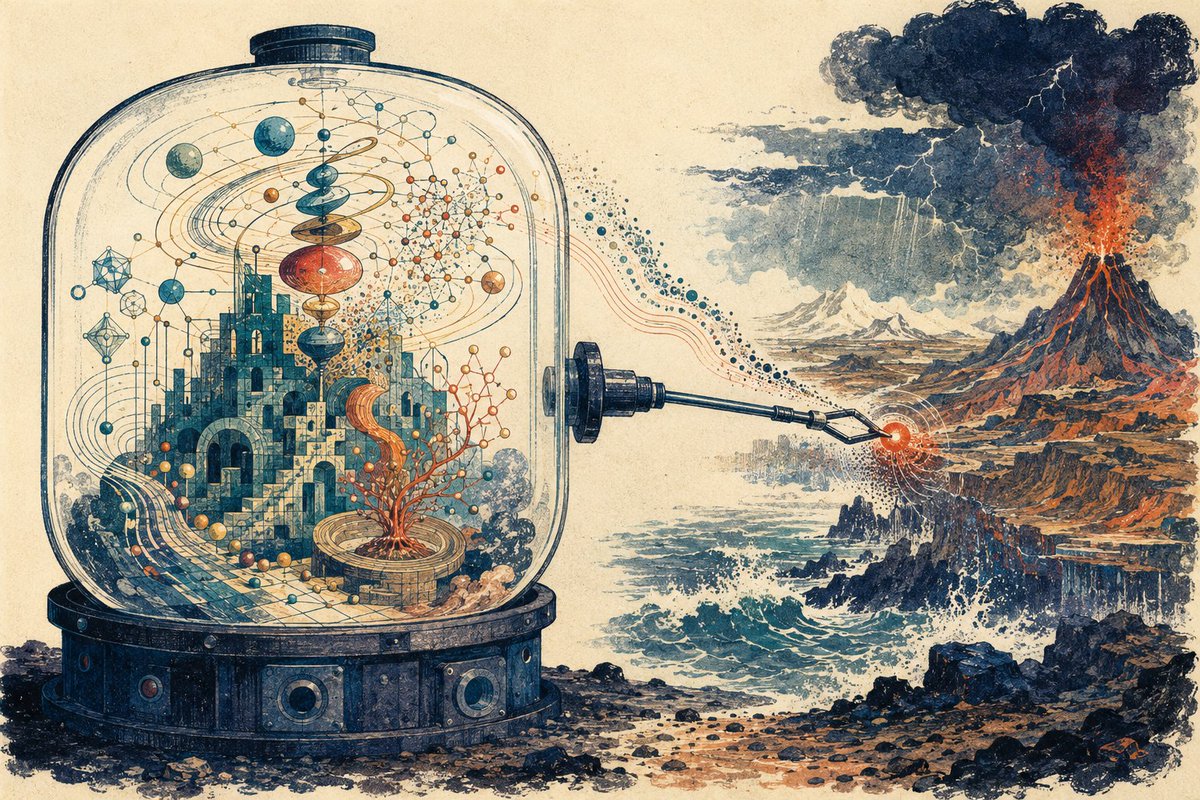
Agent reports need the same discipline because a claim that something works remains a prediction until a test turns it into an observation. When I ask AI to evaluate work, I trust deterministic checks first, a separate call with fresh context second, and the model grading its own answer in the same context last. A model conditioned on its own output is unusually good at explaining why that output was reasonable.
Your own certainty deserves the same audit. Anxiety, for me, often means simulation has replaced sampling. The mind keeps branching through possible outcomes, but nothing arrives from the world to prune them. Worry has no natural stopping condition, so it can continue indefinitely.
Feeling like a genius at 2 a.m. can be the same failure with the opposite emotional sign. Your ideas have elaborated on their own outputs for long enough that everything fits. Reality is the physics engine; your internal model is a rendering. When they have not synced recently, the rendering can become more beautiful while becoming less true.
Being smarter may only make the closed loop more convincing, since the same intelligence that could recognize an error can also produce a better elaboration of it.
What's the budget?
Thought has a cost, although most of it is paid in currencies we do not track. Working memory holds only a few active items before it begins to thrash; starting unwanted work can consume a surprising amount of energy, while small context switches become expensive through repetition.
Visible temptations create the same kind of recurring charge. Changing the environment usually costs less than winning the argument with yourself every time you look at it. When I eventually give in after resisting for hours, crossing a resource threshold is a more useful explanation than treating the lapse as a revelation of character.

AI makes this reading more important because it creates state-space explosion. The tools can generate options far faster than you can verify them, so ten new branches may be cheap to create while still imposing a large cost on whoever has to understand and judge them.
The low-grade unease that appears while several tools are running, when you feel movement everywhere but cannot tell whether anything is landing, is often a budget signal. Your search space has expanded much faster than your capacity to verify it.
I respond by writing things down so they do not have to be re-derived, capping the number of open branches, and removing recurring temptations from view. All three measures protect attention, which remains fixed even as the system gains more ways to generate.
Writing something down is a form of memoization: the thought becomes cheap to retrieve later, while reconstructing it might cost as much as it did the first time.
Where the bias catalog goes
This computational lens compresses the familiar catalog of cognitive biases into one mechanism: a cheap heuristic stands in for an expensive search and fails on an edge case.
Confirmation bias, for example, ends the search after finding a supporting match instead of paying for a broader evidence scan. Availability relies on the examples that come to mind most easily, even when an actual count would tell a different story. An anchor saves us from generating an estimate from scratch, while sunk-cost thinking leaves spent resources in the value function after they should have disappeared.

You do not need to memorize every name. Ask where your mind is replacing an expensive operation with a cheap approximation, then check whether the current situation is one of the cases where that shortcut breaks.
The same question helps with LLM output, since cached approximations are part of what makes models useful and part of why they fail. An answer can be fluent, plausible, and wrong precisely where a fuller search would have been expensive.
The practice
When you cannot explain a problem cleanly, the nebulous language is itself a reading. The model underneath the explanation may be missing a useful distinction, and the fog in the sentence gives you somewhere to investigate.
When you hit friction—yours or an agent's—run four checks:
- What level am I operating at?
- Is this work diverging or converging?
- Has anything here touched reality recently?
- What is this costing, and what budget remains?

Turn the answer into a mechanism you can change. Labels such as lazy, undisciplined, or bad at focus often stand in for “mechanism unknown,” ending the investigation at the point where it should begin.
Write down what you find. Memory tends to keep conclusions while dropping the reasoning that produced them. Without the reasoning, the next version of you may inherit a rule but have no idea when it applies.
You are now the operator of a system that is partly you and partly machine. The machine half improves every few months on someone else's schedule; the half that belongs to you improves as it becomes easier to read.
Debug it. Do not grade it.
Related articles
How to Start a 6 Figure Faceless YouTube Channel (Full Breakdown)
I've helped over 400 people start profitable faceless youtube channels. i've ran over 50 channels myself. Generated over $4 MILLION by age 25. Worked with youtubers that have 10 million+ subscribers,…
jev for seo is insane (here's why)
Jev launched on September 15 behind a waitlist. It doesn't chat. It doesn't generate text. You send it state and a typed question, it returns a probability in about 250 milliseconds, for a fraction o…

How We Generated Millions Of Organic Clicks With Programmatic SEO
most SEO looks like this: