Can You Actually Make Money With AI Music? Here's What's Real in 2026

Somewhere between "this is a scam" and "quit your job tomorrow" sits the honest version of the AI music story. It's worth telling, because real people are making real - if usually modest - money from it, and the story that put the whole thing on the map is genuinely remarkable.
The story that started the conversation
Telisha Jones was 31, lived in Mississippi, and had never released a song. What she did have was poetry, years of it, written for herself. In 2024 she started feeding those poems into Suno, a $10-a-month AI music generator that turns a text prompt into a finished track, vocals and instrumentation included, in under a minute. She picked R&B and gospel, uploaded the results to Spotify under the artist name Xania Monet, and one track - "How Was I Supposed to Know" - started climbing the streams.
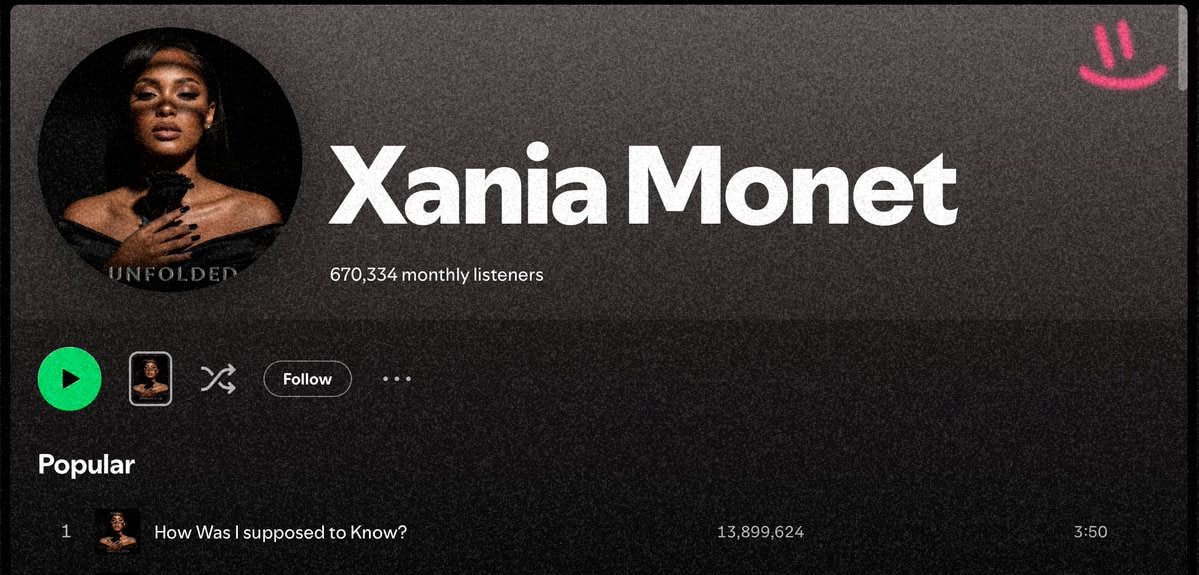
It didn't stop at a few thousand plays. The song passed 13 million streams on Spotify. Xania Monet hit #3 on Billboard's gospel chart, becoming the first fully AI-generated artist to chart on a Billboard radio ranking. Five of her songs reportedly earned around $52,000 in royalties in two months. Hallwood Media signed her to a deal reportedly worth $3 million, and by most accounts she never even turned her camera on during the audition.
It's an outlier. Nobody should read this expecting the same outcome. But it's real, it happened inside about eighteen months, and it's the reason a much bigger and much quieter trend is worth paying attention to.
The numbers behind the story
Suno itself is no longer a curiosity. As of February 2026 it was reportedly generating around $300 million in annual recurring revenue, with roughly 2 million paying subscribers and a valuation near $2.45 billion. The major labels spent close to two years fighting AI-generated music in court, then Warner Music Group settled with Suno and signed a partnership instead, and Universal Music Group reached a similar settlement with the AI platform Udio. Whatever position the industry holds on the ethics of it, it has functionally stopped pretending AI music doesn't exist.
Ordinary people, smaller (but real) numbers
Below the outlier story, a much less dramatic pattern shows up repeatedly: people with no musical training building small, steady royalty streams.
One anonymous Reddit poster described building an 80-track catalog of AI-generated lo-fi and meditation music that brings in roughly $5,000 a month in Spotify royalties. A writer going by "James 99" documented earning about $30,000 over four months from Spotify and Apple Music royalties on sleep-music and focus-playlist tracks, a deliberately unglamorous niche. Another creator, uploading under several different artist names, reported averaging around $200 a day by releasing ten to twenty tracks a week and doubling down on whichever ones the algorithm favored.

None of them had industry contacts or studio time. What they had in common was a cheap AI subscription, a distribution account, and a habit of publishing consistently in a genre nobody else wanted to compete in.
How it actually works
The mechanics are almost boringly simple, which is part of why so many people can replicate them.
- The tool: Suno's Pro plan costs $10 a month and comes with commercial rights, the part that actually makes monetizing the output legal. You describe what you want ("upbeat lo-fi for studying, gentle piano, soft drums") and get a finished track back in under a minute.
- The distributor: platforms like Spotify don't accept uploads directly from individuals. A distributor such as DistroKid, at roughly $22 a year for unlimited uploads, pushes your catalog out to Spotify, Apple Music, Amazon Music, YouTube Music, and more than a hundred other platforms at once, while letting you keep essentially all of the royalties.
- The niche: nobody wins by releasing AI pop songs and competing with chart artists directly. The money sits in categories musicians rarely bother with - sleep music, study playlists, meditation, ambient, lo-fi, white noise, gospel - where listeners stream passively for long stretches and volume of plays matters more than star power.
- The volume: one great track rarely moves the needle. The pattern among people who actually earn from this is releasing several tracks a week, watching which ones the algorithm and listeners respond to, and producing more in that direction.
Where the money actually comes from
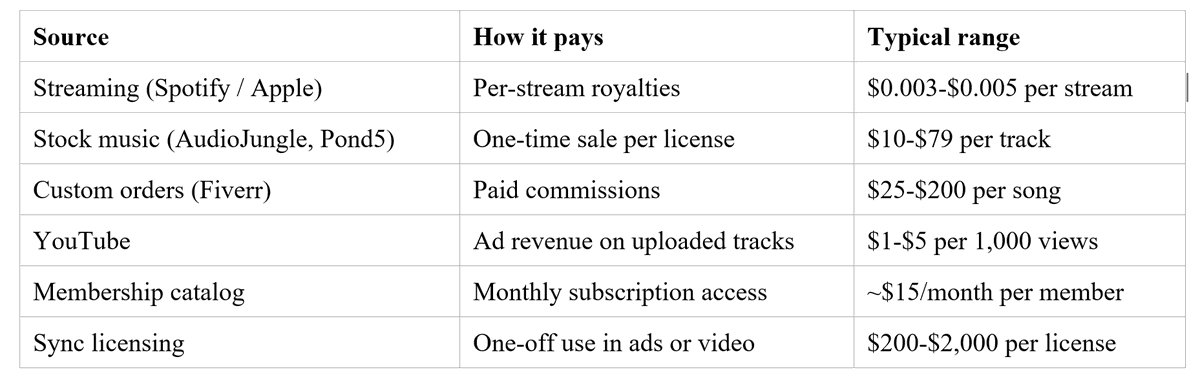
Streaming royalties are the most talked-about revenue source, but they're rarely the biggest one for an individual creator, since the per-stream rate is a fraction of a cent and it takes real scale to add up. Most people who earn a meaningful amount stack several sources at once:
Writing prompts that actually produce something good
Output quality depends heavily on input quality. A vague prompt like "calm music for videos" tends to produce something generic. Something closer to this tends to do better:
Soft acoustic guitar with gentle piano melody, morning coffee
atmosphere, no drums or percussion, warm analog tape sound,
90 seconds, ends with a gentle fade, no lyrics, tempo 72 BPM,
key of G major, production quality similar to lo-fi but cleaner,
emotional warmth.
And if you're planning to release more than a handful of tracks, it's worth generating a batch of prompt variations at once rather than starting from scratch every time:
I want to create a catalog of [genre] tracks for [use case].
For each track idea, write a detailed AI-music prompt that includes:
specific instruments and their role, exact tempo in BPM, key and
scale, 3-5 mood descriptors, a production style reference, duration
and structure, and anything to exclude (no drums / no lyrics / etc).
Generate 10 variations that feel related but distinct.
The honest reality check
This is the part most "make money with AI" content skips. A rough, honestly-stated version of a typical timeline:
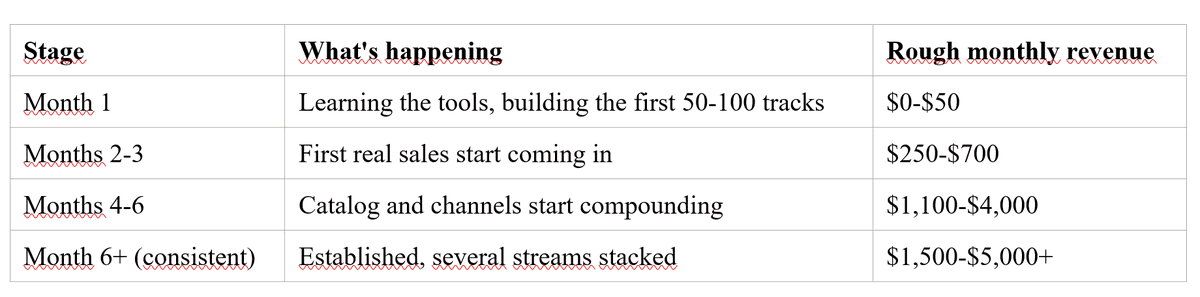
Even the standout examples in this piece, the $8,500-in-six-months and $30,000-in-four-months stories, took daily, sustained effort. Nobody in the reporting made this money from one track and a long wait.
What could go wrong
It's worth being upfront about the friction too. Spotify has reportedly removed more than 75 million AI-generated tracks from its platform as it tightens spam and quality filters. AudioJungle receives an estimated 15,000+ AI submissions a month, so the "low competition" niches are getting more crowded by the week. And the legal ground is still shifting - Suno faces active lawsuits from major labels that could change what's allowed going forward. None of this has stopped the trend so far, but it means the easiest window, the one Telisha Jones and the early Reddit and Medium creators walked through, is narrower today than it was a year ago.
If you want to start
The entry cost is genuinely low: a Suno Pro subscription, a DistroKid account, and a niche you're willing to release into consistently. What separates the people making real money from the much larger group making nothing usually isn't luck or talent, it's whether they kept releasing tracks after the first ten didn't sell
@insomnia_vip
Related articles

5M ChatGPT prompts analyzed. Here's what matters for GEO:
Jacky from Link Garden came on the MVP podcast with Paul (my co-founder) and Antoine.

Grok Bot: How I Built a 24/7 Agent That Turns Reddit and X Into Product Ideas
Turn Reddit and X into an always-on product opportunity feed

how memecoin insiders really make money (and how you can spot them)
a token appears, the chart starts moving almost immediately, big accounts begin posting about it, people in telegram say the community is taking over, the market cap pumps from almost nothing to mill…